


Equity Cash Out Private Lender: Unlock Your Property Value Fast in 2026
September 21, 2026Private Money Cash Out Refinance: Tap Property Equity Fast in 2026

Waiting 60 days for a conventional bank to approve an equity withdrawal doesn’t just stall momentum; it kills profitable deals. If you’re a real estate investor or self-employed entrepreneur, you already know the frustration of rigid tax-return audits and slow institutional underwriters. When a time-sensitive investment surfaces, you need capital immediately. That is where a private money cash out refinance steps in, trading endless bureaucratic delays for asset-driven velocity.
We understand the pressure. Watching prime acquisitions or urgent business expansions slip away because traditional debt-to-income calculations disqualified you is infuriating. Your real estate holds immense value, and you should be able to tap it without jumping through endless institutional hoops. In this guide, you’ll discover how a private money cash out refinance unlocks rapid property equity when traditional banks move too slowly, freeing up liquid cash in days rather than months. We’ll explore the underwriting mechanics, key lending structures, and strategic steps to convert your dormant equity into high-yield growth right now.
Key Takeaways
- Understand how a private money cash out refinance leverages property equity directly to fund time-sensitive deals without conventional underwriting roadblocks.
- Compare the funding speed and document requirements of asset-based financing against rigid 60-day institutional bank schedules.
- Discover when to replace existing debt entirely versus using a subordinate hard money second mortgage to preserve low-rate legacy financing.
- Identify high-impact deployment strategies for liquid equity, including fast-close property acquisitions, construction funding, and business growth.
- Learn the streamlined qualification roadmap from initial equity evaluation through title verification and final capital disbursement.
What Is a Private Money Cash Out Refinance?
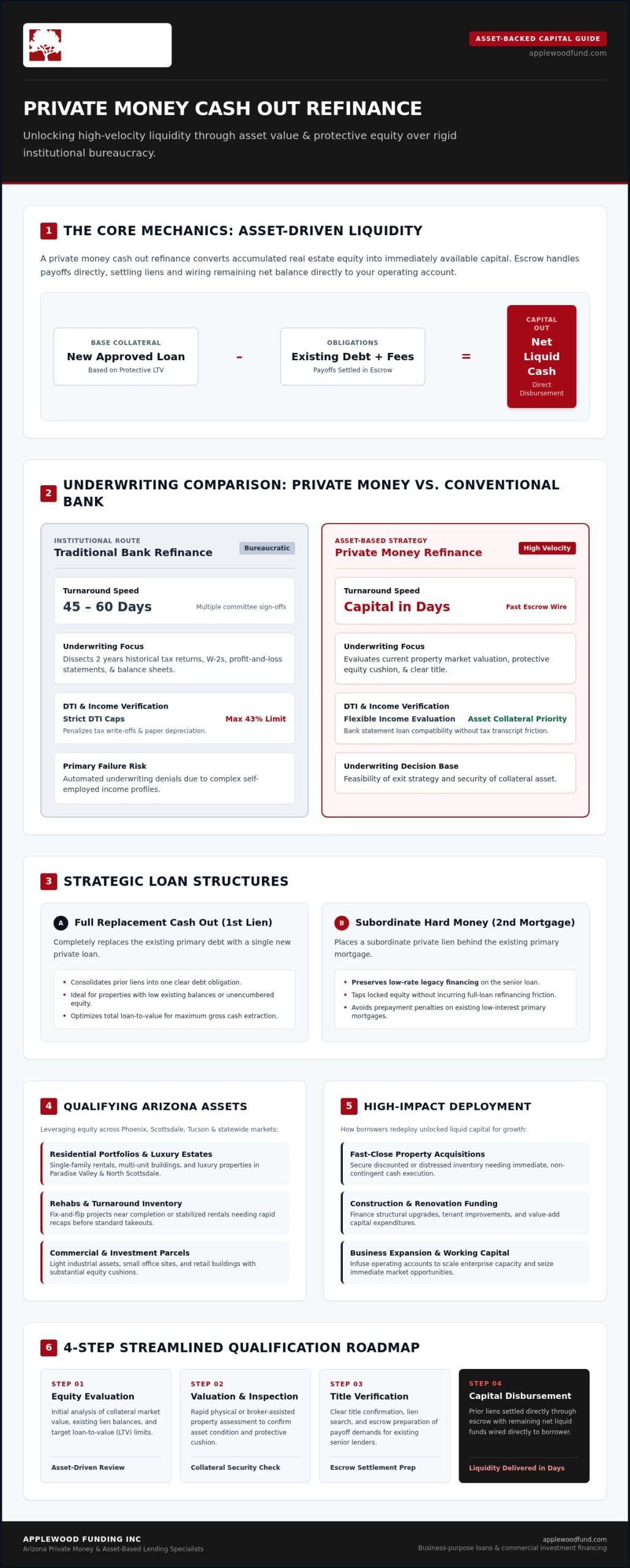
A private money cash out refinance is an asset-backed financing strategy that converts accumulated property equity into immediate liquid capital by replacing existing debt with a new primary or subordinate private loan. Rather than scrutinizing personal tax returns, debt-to-income ratios, or complex employment paperwork, private lenders prioritize the actual market value of your real estate and your protective equity cushion. Escrow manages the mechanics: they wire payoff funds directly to any existing senior lienholders, settle closing fees, and disburse the remaining net balance straight into your operating account. For borrowers managing fast-moving acquisitions or self-employed professionals across Phoenix, Scottsdale, and Tucson, this approach eliminates the traditional friction that stalls institutional approvals.
The Core Mechanics: Asset Value Over Bureaucracy
Unlike institutional mortgage underwriting that dissects two years of historical tax returns, private capital structures center on protective equity. Loan-to-value limits dictate your net capital: your available cash equals the newly approved loan amount minus your current debt balance and transaction fees. Because private equity firms rely on hard money loans focused on collateral security, underwriting moves fast. Once clear title is confirmed and the asset is inspected, escrow coordinates the existing payoff and releases your funds without delays.
Qualifying Property Types Across Arizona Markets
Collateral flexibility gives asset-based financing its real power. Investors and owners leverage diverse Arizona property profiles, including:
- Residential Portfolios and Luxury Estates: Single-family rentals, multi-unit residential buildings, and luxury estates in Paradise Valley or North Scottsdale holding substantial unencumbered equity.
- Rehabs and Turnaround Inventory: Fix-and-flip properties near completion or recently stabilized rental inventory requiring fast capital recaps before standard takeout financing.
- Commercial and Investment Parcels: Light industrial assets, small office sites, and retail buildings statewide.
Navigating local requirements matters. Arizona law establishes specific distinctions between business-purpose loans on investment real estate and consumer-purpose, owner-occupied properties. Working with an agile Arizona specialist like Applewood Funding ensures your deal complies with state lending standards while deploying capital fast.
Private Money Cash Out vs. Traditional Bank Refinance
Conventional banks move at a crawl. They demand tax returns, W-2s, profit-and-loss statements, and multiple committee sign-offs. That bureaucracy often drags a closing out for 45 to 60 days. A private money cash out refinance cuts through that friction. By prioritizing property equity over personal tax documentation, private financing puts speed and control back in your hands.
Underwriting Speed and Documentation Demands
Institutional underwriters obsess over historical paper trails. If you are a self-employed business owner or an active investor, aggressive tax write-offs and paper depreciation often lower your net income on paper, triggering automated bank denials. Private lenders focus on actual asset value instead. For entrepreneurs whose tax returns don’t reflect their true cash flow, solutions like bank statement loans offer a practical route to verify revenue without tax transcripts. While a bank spends weeks auditing balance sheets, private underwriting verifies title clarity, orders property valuation, and clears files in a fraction of the time.
Credit Score and Debt-to-Income Flexibility
Institutional lenders enforce rigid debt-to-income (DTI) caps, often disqualifying borrowers who exceed 43% DTI or hold less-than-perfect credit profiles. Private financing changes the rules. Underwriters examine the collateral and the feasibility of your exit strategy. As highlighted in the Consumer Financial Protection Bureau guidance on home equity borrowing, traditional equity loans lean heavily on personal creditworthiness and ability-to-repay metrics. In contrast, private lenders evaluate the protective equity cushion within the property. If the collateral is strong and the deal makes business sense, past credit events or non-traditional income streams won’t automatically stop the transaction.
Execution Timelines: Capital in Days Instead of Months
Timing dictates profitability. In dynamic real estate environments, waiting two months to access your equity causes you to miss off-market acquisitions, auction deposits, and high-margin turnaround opportunities. Utilizing a private money cash out refinance lets you bypass institutional committees and close before opportunities disappear. If you need to mobilize cash quickly for an upcoming venture, you can connect with an Arizona private lending specialist to evaluate your equity position and structure a fast closing.
Strategic Comparison: Cash Out Refinance vs. Hard Money 2nd Mortgage
Tapping real estate equity doesn’t always mean wiping the slate clean. Many Arizona property owners today hold historically favorable senior mortgages secured years ago. Replacing that entire balance through a standard primary lien restructure can needlessly inflate ongoing debt costs. Choosing between a full private money cash out refinance and a subordinate hard money second mortgage comes down to capital efficiency, loan structure, and your timeline.
Preserving Your Low First-Mortgage Interest Rate
Refinancing a sub-4% primary loan into a complete first-position private note can significantly increase monthly debt service. Why reset cheap long-term leverage across the entire asset if you only need short-term liquidity? A subordinate second lien taps accumulated equity while keeping your primary mortgage undisturbed. Self-employed borrowers and real estate investors frequently evaluate how to leverage home equity hard money to extract fast working capital without triggering unnecessary payoffs on low-rate underlying debt.
Evaluating Combined Loan-to-Value (CLTV) Limits
Underwriters calculate Combined Loan-to-Value (CLTV) by adding the proposed second lien to the existing first mortgage balance, then dividing by the appraised value. Junior lienholders accept greater default exposure because senior lenders receive payoff priority during a trustee sale. Because of this risk distribution, lenders operate under strict compliance with the Arizona Department of Insurance and Financial Institutions mortgage licensing requirements. In competitive territories like Maricopa County, private lenders typically require stronger equity cushions on secondary liens than on first-position notes to safeguard against sudden market shifts.
Selecting the Right Vehicle for Your Financial Objective
Picking the ideal structure depends entirely on your existing balance and planned exit strategy:
- Execute a full private money cash out refinance: Best when your existing debt already carries high financing costs, nears balloon maturity, or when you own the real estate free and clear. It consolidates obligations into a single, clean senior lien.
- Deploy a junior second mortgage: Best for securing short-term bridge capital or funding rapid turnaround renovations while safeguarding low fixed-rate legacy financing.
Analyze your exit path before committing. Whether paying off the debt through property disposition or refinancing into permanent long-term debt, your financing vehicle must align with your true cost of capital.
Proven Ways Borrowers Deploy Private Cash Out Capital
Tactical capital deployment transforms dormant equity into actionable, high-velocity purchasing power. A private money cash out refinance serves as an immediate liquidity engine for operators who cannot afford to let prime market opportunities sit idle while waiting on conventional approvals. Whether reinvesting into real estate or resolving business bottlenecks, fast liquidity creates strategic leverage.
Funding Fix-and-Flip Acquisitions and Renovations
Real estate investors regularly tap equity from stabilized rentals to fund earnest money deposits or heavy rehab budgets. Having liquid funds lets you submit non-contingent cash offers on distressed properties across Phoenix and Scottsdale, beating competitors tied to bank approvals. Pairing this extracted equity with dedicated fix and flip loans accelerates turnaround times, covers contractor draws, and maximizes your ultimate after-repair value.
Consolidating Business Debt and Tax Obligations
Carrying expensive short-term liabilities, equipment debt, or pending tax liens drains operational cash flow. Extracting equity from commercial or investment property lets business owners clear high-cost, fragmented debts into a single manageable structure. This rapid balance-sheet cleanup restores working capital immediately, providing a reliable bridge while you wait for long-term SBA approvals or seasonal revenue cycles.
Accessing Equity on Owner-Occupied Arizona Residences
Primary residences require a distinct regulatory framework under Arizona and federal consumer lending statutes. While investment property financing focuses purely on business utility, consumer transactions demand strict adherence to ability-to-repay and consumer protection rules. When urgent timing or non-traditional income prevents bank financing, qualifying homeowners can utilize owner occupied hard money loans to tap residential equity. These transactions are structured carefully to comply with state lending standards under the direct supervision of licensed mortgage expert Joel McDaniel (NMLS 175371).
Ready to deploy your dormant property equity into your next growth phase? Apply for an Arizona cash out loan today to secure quick, asset-focused financing tailored to your goals.
How to Qualify and Secure an Arizona Private Refinance
Securing private financing comes down to clean execution and verifiable collateral value. While conventional underwriters spend weeks verifying historical employment records, private underwriters focus on the physical asset, equity cushion, and your exit strategy. Moving through the process quickly requires organized paperwork and an accurate appraisal of your property’s real market standing.
Calculating Equity and Determining Realistic LTV
Determining your borrowing potential starts with an objective valuation. Local private lenders use on-site inspections, broker price opinions (BPOs), or independent appraisals to verify “as-is” market value across Arizona submarkets. The formula is straightforward: multiply the current appraised value by the lender’s loan-to-value ceiling, then subtract existing lien balances and closing expenses to calculate your net cash proceeds. To review specific LTV thresholds and structuring nuances, study our guide on cash out hard money loans before submitting your file.
Document Checklist for Streamlined Underwriting
Speed depends on clear title and immediate documentation. While an asset-based lender won’t demand mountains of personal tax transcripts, they require precise verification to issue loan documents without delays. Keep these core items ready:
- Payoff and Title Records: Current mortgage payoff statements, property tax statuses, and existing title insurance policies to confirm there are no surprise mechanic’s liens or municipal encumbrances.
- Property Documentation: Proof of active hazard insurance, lease agreements for tenant-occupied investment units, and government-issued borrower identification.
- Concrete Exit Strategy: A clear, documented repayment plan, whether through an upcoming property sale, operational business cash flow, or a future takeout loan.
Partnering with Applewood Funding for Rapid Execution
Working with a local capital provider eliminates the geographic disconnect common with out-of-state institutions. Applewood Funding deploys direct capital across Mesa, Glendale, Peoria, and Flagstaff, bringing regional market insight to every deal. Led by licensed mortgage expert Joel McDaniel (NMLS 175371), our team evaluates equity directly and structures solutions that bypass rigid institutional red tape. When execution velocity matters, you can move directly to action: Apply for Arizona Private Financing today to put your property equity to work.
Turn Dormant Equity Into Immediate Opportunity
Institutional banking delays don’t have to dictate your investment momentum. A private money cash out refinance bypasses tax-transcript audits and rigid debt ratios, allowing you to access substantial capital based directly on property value. Whether you need to replace existing debt entirely or leverage a junior lien to protect favorable legacy rates, asset-focused financing delivers speed when execution counts most.
Applewood Funding eliminates bureaucratic barriers across Arizona. Led by licensed mortgage expert Joel McDaniel (NMLS 175371), we specialize in rapid, asset-based solutions for both real estate investors and qualifying owner-occupied properties statewide. You’ve built solid equity; now make it work for you. Unlock your Arizona property equity with Applewood Funding today and secure the liquidity you need to scale your next venture.
Frequently Asked Questions
What is a private money cash out refinance and how does it work?
A private money cash out refinance is an asset-based mortgage transaction where a non-institutional lender finances a new loan against your property’s equity, replacing existing debt and paying you the remaining cash. Underwriting focuses primarily on your collateral’s market value and protective equity cushion rather than personal tax returns. Escrow coordinates paying off any prior liens and disburses net funds directly to your bank account upon closing.
How quickly can a private cash out refinance close in Arizona?
Private funding deals can close in as little as 5 to 14 business days across Phoenix, Scottsdale, and Tucson. Traditional bank transactions typically take 45 to 60 days due to loan committee reviews and manual income audits. Private lenders bypass institutional red tape by conducting fast internal asset assessments, ordering expedited title work, and deploying direct balance-sheet capital immediately.
Can I get a private money cash out refinance on my primary home?
Yes, but it requires strict adherence to state and federal consumer protection lending statutes. While most hard money lenders strictly fund commercial or investment properties to avoid regulatory hurdles, Applewood Funding provides compliant Owner Occupied Hard Money Loans in Arizona. Managed by licensed mortgage expert Joel McDaniel (NMLS 175371), our team handles primary residence equity transactions under complete regulatory compliance.
How does a cash out refinance differ from a hard money 2nd mortgage?
A full cash-out refinance replaces your existing primary mortgage with a completely new first-position loan, providing one unified balance and payment. A hard money second mortgage leaves your current first lien intact and places a subordinate lien behind it. Second mortgages are ideal for borrowers who want to pull equity without giving up a favorable, low-rate primary mortgage.
What documents are required to qualify for an equity-based cash out loan?
Asset-based qualification focuses on collateral verification rather than extensive financial histories. You generally need a government-issued photo ID, a current mortgage payoff statement, a clear property title report, and proof of property insurance. If the property is tenant-occupied, lenders also review active lease agreements to calculate existing rental revenue and confirm your repayment strategy.
Can self-employed borrowers qualify without submitting W-2s or tax returns?
Yes. Self-employed borrowers frequently write off substantial business expenses, which lowers their taxable income and triggers automated rejections at conventional banks. Private lenders evaluate real property equity rather than tax filings. Borrowers can also utilize specialized Bank Statement Loans for Self-Employed professionals, which verify operational cash flow through business or personal bank statements instead of standard W-2s or 1040s.
What property types qualify for private equity cash out in Arizona?
Private equity capital applies to a broad selection of Arizona real estate holdings. Eligible collateral includes single-family investment homes, multi-family apartment buildings, fix-and-flip properties, commercial sites, and vacant land development parcels. Financing is deployed across major metropolitan markets like Phoenix, Mesa, Glendale, and Peoria, as well as high-equity secondary markets such as Sedona and Flagstaff.