

Hard Money Loans for Business Capital: Arizona Guide
September 5, 2026
Fix and Flip Loan Requirements: The 2026 Investor’s Pre-Funding Checklist
September 7, 2026Fix and Flip Loans: The Investor’s Guide to Arizona Real Estate Funding in 2026

In the 2026 Arizona market, speed isn’t just a luxury. It’s your only defense against cash buyers who are ready to snatch your next deal while you’re still waiting for a bank’s loan officer to return your call. You’ve likely felt the sting of losing a prime Scottsdale property because traditional financing moves at a snail’s pace. It’s frustrating to deal with complex rehab requirements or lenders who don’t understand the urgency of a 66-day market cycle. You deserve a partner who moves as fast as you do.
This guide will help you master the mechanics of fix and flip loans to secure capital and scale your Arizona investment portfolio with confidence. We’ll show you how to maximize leverage using After-Repair Value (ARV) and navigate the latest 2026 regulatory shifts, including the new middle housing laws and tax exemptions. By the end of this article, you’ll know exactly how to secure funding in days, not months. You’ll stop chasing deals and start closing them. Let’s dive into the strategies that will turn you into a high-volume Arizona flipper today.
Key Takeaways
- Scale your portfolio by mastering asset-based financing that skips the rigid debt-to-income requirements of traditional mortgages.
- Use After-Repair Value (ARV) as your financial “North Star” to unlock higher leverage and cover your renovation costs without draining your cash.
- Secure fix and flip loans in as little as 7-10 days to outpace cash buyers in competitive Arizona sub-markets like Scottsdale and Phoenix.
- Follow a proven checklist to qualify quickly by targeting high-potential properties in Glendale, Peoria, or Tempe with a bulletproof rehab budget.
- Leverage local Arizona expertise to navigate 2026 zoning changes and secure funding for distressed properties that traditional banks refuse to touch.
Scaling Your Portfolio with Arizona Fix and Flip Loans
Success in the 2026 Arizona market requires a shift in mindset. You aren’t just buying houses; you’re managing capital velocity. Fix and flip loans serve as the essential bridge between a distressed property and a profitable exit. These are short-term, asset-based loans that focus on the property’s future potential rather than its current state. Traditional mortgages are designed for move-in ready homes. They fail the moment an inspector sees a missing kitchen or a damaged roof. Private bridge financing provides the liquidity needed to transform a neighborhood eyesore into a premium listing without the typical bank delays.
By treating capital as a tactical tool, you can scale your investment portfolio without the friction of personal debt-to-income limits. Flipping real estate in high-demand zones like Phoenix or Scottsdale is a race against time. If you rely on institutional lenders, you’re bringing a knife to a gunfight. Private capital allows you to move with the same decisiveness as a cash buyer. It is the engine for rapid scaling that lets you manage three projects at once instead of waiting months to finish just one. Speed is your greatest asset in this environment.
The Core Advantage: Asset-Based vs. Credit-Based
Traditional banks are obsessed with your past. They want years of tax returns, W2s, and months of bank statements. For the self-employed investor, this is often a recipe for a rejection letter. At Applewood Funding Inc, we focus on the future. We look at the deal’s After-Repair Value (ARV) and the strength of your renovation plan. The property’s potential matters more than your personal debt ratios. This shift in perspective is why we can fund projects that big-box lenders won’t touch. We evaluate the asset, verify the math, and get out of your way so you can start the demo. Our goal is to find a way to say yes when the bank says no.
Why Arizona Investors Choose Private Capital
The 2026 Arizona real estate market is fierce. In sub-markets like Mesa, Scottsdale, and Phoenix, inventory remains tight and competition from institutional buyers is relentless. You need to close in days, not weeks. Private capital provides that agility. It levels the playing field, giving you the leverage to strike while others are still waiting for a loan officer to return a call. Some flippers even apply this strategy to their own homes. If you’re looking to renovate your next primary residence, explore our guide on Owner Occupied Hard Money Loans for a specialized approach. At Applewood Funding Inc, we provide the speed you need to dominate the local market and build a sustainable flipping business.
Understanding the Math: ARV, LTV, and Rehab Budgets
Numbers don’t lie. In the fast-moving Arizona market, they are the difference between a massive payday and a financial trap. When structuring your fix and flip loans, everything starts with the “North Star” of investing: After Repair Value (ARV). ARV is the estimated market value of a property after all renovations are complete. If your ARV is off by even 5%, your entire profit margin could evaporate. While the CFPB outlines different kinds of loans for traditional buyers, investors need a more aggressive math set that accounts for rapid appreciation and renovation costs.
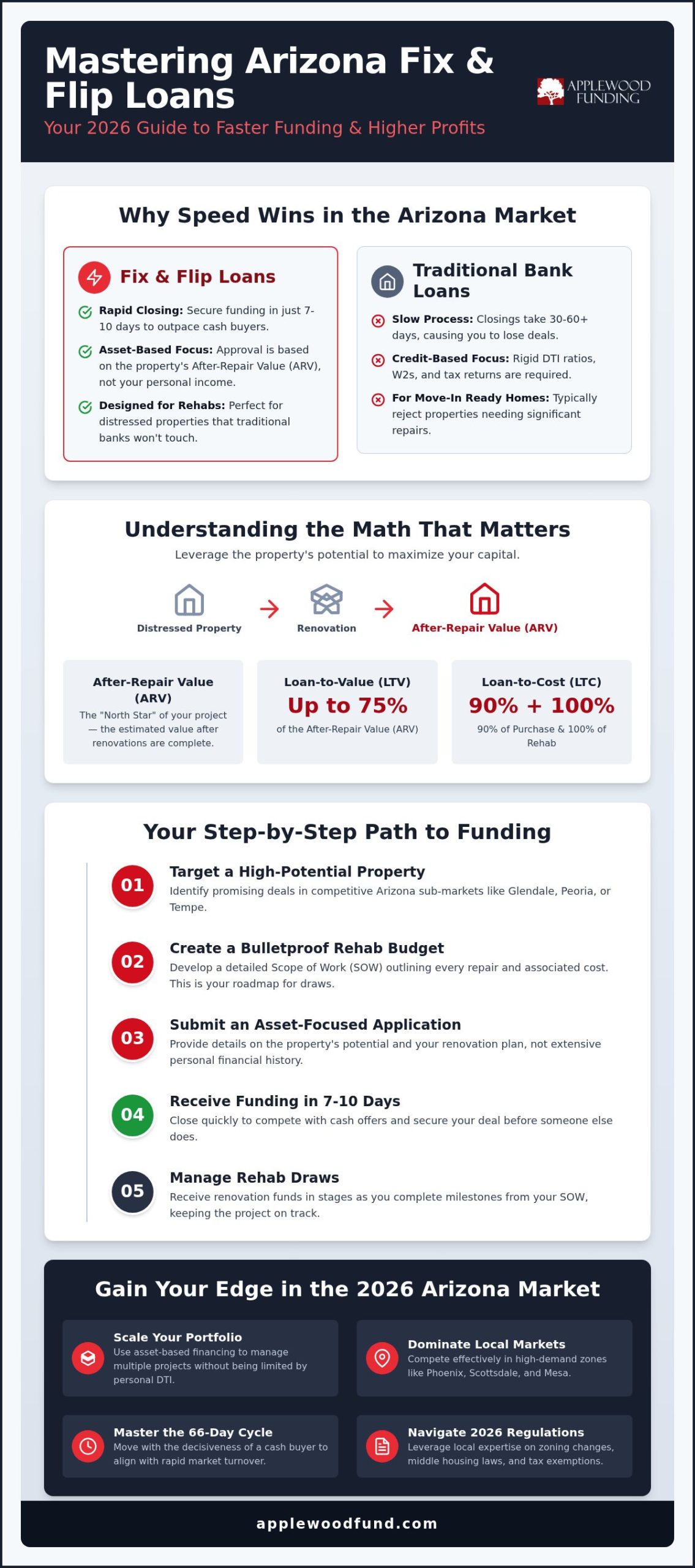
Lenders typically look at two main ratios: Loan-to-Value (LTV) and Loan-to-Cost (LTC). In Arizona, most hard money lenders cap the LTV at 75% of the ARV. This protects the lender while giving you the leverage needed to move fast. LTC is different. It measures the loan amount against the total project cost, including the purchase price and rehab. High-leverage fix and flip loans might cover 90% of the purchase price and 100% of the renovation budget. This allows you to keep your cash for the next deal rather than tying it up in drywall and flooring.
Mastering the Rehab Draw Process
Getting the loan is only half the battle. You need to access the money. Lenders don’t just hand over the full rehab budget at closing. Instead, they release funds in stages called “draws.” This process relies on a detailed Scope of Work (SOW). Your SOW is your roadmap. It lists every repair, from the HVAC system to the kitchen cabinets. To keep your project on schedule, manage your contractors with military precision. If they miss a milestone, you miss a draw. This can stall your project and increase your holding costs.
Calculating Your Profit Margin
The old 70% rule says you should never pay more than 70% of the ARV minus rehab costs. In 2026, with Arizona’s median listing price hitting $467,000, this rule is a baseline, not a law. You must account for holding costs, origination points, and closing fees. Don’t over-improve. A luxury kitchen in a Glendale starter home won’t give you the same return as it would in Scottsdale. Know your neighborhood. If you’re ready to run the numbers on your next deal, reach out to our Phoenix team for a quick scenario review. We’ll help you ensure the math actually works before you sign the contract.
Hard Money vs. Traditional Loans: Why Speed Wins in Arizona
Speed is your primary competitive edge in the 2026 Arizona market. While a traditional bank might take 45 days to navigate its committee, Applewood Funding Inc can fund your project in as little as 7 to 10 days. This timeline isn’t just a convenience; it is your defense against institutional buyers. As Forbes notes, Fix and flip loans are tactical instruments meant for short-term growth, not long-term debt. Don’t fall for the low-rate trap. A 6% interest rate on a property you lost because the lender was too slow is a total loss. A slightly higher rate on a successful flip is simply the cost of doing business and winning. Before committing to this financing path, it’s worth reviewing the full hard money loan pros and cons so you can make a fully informed strategic decision.
Institutional lenders are built for stability, not velocity. They require mountains of paperwork that don’t fit the fast-paced nature of Arizona real estate. Short term fix and flip financing allows you to bypass the bureaucratic crawl. You can submit an offer with a 10-day close, making your bid as strong as a cash offer. This agility is what separates the hobbyist from the professional flipper who closes multiple deals per quarter. In a market where homes sell in an average of 66 days, you can’t afford to spend 45 of those days just waiting for an approval letter.
When Banks Say No: The Distressed Property Barrier
Conventional lenders have strict habitability requirements. If a house in Phoenix or Mesa is missing a kitchen, has exposed wiring, or lacks a functioning HVAC system, a bank won’t fund it. They want turn-key collateral. We want potential. Private money is the only viable path for properties that traditional appraisers won’t touch. If the property is currently un-livable by institutional standards, it’s a prime candidate for private capital. We fund the renovation vision, not just the current state of the drywall. This allows you to target the most distressed, high-margin properties that your competitors have to skip.
The Flexibility of Private Lending
Private lending offers terms that banks simply can’t match. We provide interest-only payment structures to keep your monthly carrying costs low while you are in the middle of a heavy rehab. This preserves your cash flow for unexpected contractor needs. Most importantly, we don’t punish you for being efficient. Our fix and flip loans lack the heavy prepayment penalties common in the banking world. When you finish your project ahead of schedule, you pay off the loan and move to the next deal immediately. This flexibility ensures your capital is always working, not sitting idle in a bank’s processing queue.
How to Qualify for a Fix and Flip Loan: A Step-by-Step Checklist
Qualifying for fix and flip loans in Arizona doesn’t have to be a bureaucratic nightmare. While traditional banks focus on your tax returns from three years ago, private lenders focus on the deal sitting in front of you right now. Success depends on your ability to present a professional, data-backed project. If you want to move from “applicant” to “funded” in record time, follow this checklist to ensure your project meets our underwriting standards. For a deeper dive into exactly what documentation and deal metrics lenders evaluate, review the complete fix and flip loan requirements outlined in our 2026 pre-funding checklist before you submit your application.
- Step 1: Identify a High-Potential Property. Focus on sub-markets like Glendale, Peoria, or Tempe. These areas are seeing consistent demand in 2026 for renovated starter homes and middle-housing duplexes.
- Step 2: Prepare a Comprehensive Budget. A vague estimate won’t cut it. You need a line-item renovation budget and a realistic timeline that accounts for Arizona’s current labor availability.
- Step 3: Verify the ARV. Secure an appraisal or a Broker Price Opinion (BPO). This confirms that your projected sale price aligns with recent neighborhood comps.
- Step 4: Define Your Exit Strategy. Are you selling to a retail buyer or refinancing into a long-term hold? We need to see how you plan to pay off the bridge debt.
- Step 5: Partner with a Local Expert. Work with a team like Applewood Funding to finalize underwriting. Our local knowledge of the Valley helps us move faster than any out-of-state “algorithm” lender.
Documentation You Actually Need
We don’t need a mountain of paperwork; we need the right paperwork. To keep the process moving, have your purchase contract and entity documents ready. Most investors use an LLC or Corporation to hold title. We also require a detailed Scope of Work (SOW). If you’ve flipped houses before, include a brief experience bio. Your track record is a powerful tool; seasoned flippers often qualify for better rates and higher leverage because they’ve proven they can execute a plan. If you’re a self-employed investor whose tax write-offs have made traditional mortgage qualification difficult, our guide to bank statement loans for self-employed borrowers in 2026 explains how to qualify based on your actual cash flow instead of your tax returns.
The Exit Strategy: Selling vs. Refinancing
Most flippers aim for a quick retail sale to capitalize on the 2026 median listing price of $467,000. However, many Arizona investors are shifting toward the BRRRR method. This involves flipping the property and then refinancing it into one of our Rental Property Loans for a long-term hold. This strategy builds generational wealth while letting you pull your initial capital back out for the next deal. Whatever your path, a clear exit is mandatory. Ready to get started? You can apply for your next loan today and get a decision before the weekend.
Partnering with Applewood Funding Inc for Rapid Arizona Closings
In the high-stakes world of Arizona real estate, your lender’s location is just as important as the property’s zip code. National lenders often treat Scottsdale and Tucson as identical data points on a map. We know better. Partnering with Applewood Funding Inc gives you the “Arizona Advantage,” combining deep local market intelligence with a capital structure designed for speed. Our fix and flip loans are built by people who understand the unique demands of the high country and the fast-moving sub-markets of the Valley. We don’t just provide funding; we provide a local alliance that understands your specific neighborhood dynamics.
Managed by Joel McDaniel (NMLS 175371), our team operates with a high-energy, solution-first approach. We’ve seen the “bank says no” scenario play out too many times for talented flippers. Our “No Red Tape” philosophy means we prioritize the viability of your deal and your ability to execute, not just a rigid credit score threshold. We fund the professional entrepreneur who needs a short term fix and flip financing solution to seize a fleeting opportunity. Stop being a number in a national queue. Start working with a team that values your local expertise and your business goals.
Local Expertise from Sedona to Flagstaff
Whether you’re targeting a mid-century renovation in Tucson or a luxury cabin flip in Sedona, local logistics can make or break your timeline. National apps struggle with specialized Arizona appraisals and rural inspections. Applewood Funding Inc maintains an extensive network of local appraisers and inspectors from Flagstaff to the border. This ensures that your fix and flip loans move through underwriting without the geographic friction that stalls out-of-state lenders. We support the Arizona investor community by being present, accessible, and deeply invested in the state’s growth. We know the local sub-markets because we are part of them.
Ready to Flip? Let’s Get Funded
If you’re a self-employed investor or a non-traditional borrower, you’ve likely hit a wall with big-box banks. We’re here to help you climb over it. Our application process is designed for clarity and rapid response, focusing on your exit strategy and the property’s potential. Don’t let another prime opportunity slip away while waiting for a committee’s permission. Your next project deserves a lender that moves at the speed of your ambition. Apply for your Arizona Fix and Flip Loan now! and experience the difference of a local, solution-first partner who actually knows the Arizona market.
Take Control of Your Arizona Investment Future
The 2026 market doesn’t wait for slow approvals or institutional red tape. Success comes to those who treat capital as a tactical tool for speed and scale. By mastering the math of After-Repair Value and aligning with a partner who understands the Arizona landscape, you turn every distressed property into a high-margin opportunity. You’ve learned how to qualify fast and why asset-based fix and flip loans are the engine for your rapid growth. Now it’s time to execute.
At Applewood Funding, we specialize in hard money solutions when traditional banks fail. We prioritize your deal’s potential over your credit score. Our fast, asset-based approvals ensure you never lose another property to a cash buyer. Don’t let bureaucracy stall your portfolio. Get Your Fix and Flip Deal Funded Today! and experience the difference of local Arizona expertise. Your next successful exit is just one application away. Let’s build your legacy together.
Frequently Asked Questions
Can I get a fix and flip loan with bad credit?
You can secure a fix and flip loan even with a less-than-perfect credit score. Unlike traditional banks that prioritize your personal financial history, private lenders like Applewood Funding focus on the property’s potential and your exit strategy. We evaluate the After-Repair Value (ARV) to determine the loan’s viability. This asset-based approach allows investors with credit challenges to fund profitable deals in competitive markets like Phoenix or Scottsdale without institutional roadblocks.
How much down payment is required for a fix and flip loan in Arizona?
Arizona investors typically need a down payment of at least 7% to 10% of the purchase price. While some national lenders require 15% or 20%, local hard money options often provide higher leverage to help you keep more cash in your pocket. The exact amount depends on your experience level and the deal’s Loan-to-Cost (LTC) ratio. We work with flippers in Mesa and Glendale to structure down payments that maximize their scaling potential.
Do fix and flip loans cover the cost of renovations?
Yes, most fix and flip loans are structured to cover both the purchase price and 100% of the renovation costs. These funds are typically released in stages called “draws” as you complete specific milestones in your Scope of Work. This ensures you have the necessary capital to finish high-quality rehabs in areas like Tempe or Peoria without using your own personal savings for every contractor payment or material purchase.
How fast can Applewood Funding close a fix and flip loan?
Applewood Funding aims to close and fund deals in as little as 7 to 10 days. We understand that speed is the only way to win in a market where the median home price is rising and inventory is tight. Our local team in Phoenix handles underwriting in-house to bypass the delays found at national banks. This rapid turnaround helps you beat out cash buyers and secure distressed properties before they disappear from the market.
Can I use a fix and flip loan for my primary residence?
You can use a fix and flip loan for a primary residence if you partner with a lender that offers owner-occupied hard money options. While many private lenders only fund non-owner-occupied investment properties, Applewood Funding provides specialized solutions for Arizona homeowners who want to renovate their own houses. This is a rare and powerful tool for those who can’t get traditional construction financing due to a property’s current distressed condition.
What is the typical interest rate for a hard money flip loan in 2026?
In 2026, interest rates for hard money fix and flip loans in Arizona typically range from 8% to 12.5%. The average rate recorded in the second quarter of 2026 was 9.95%. Your specific rate depends on factors like your flipping experience, the loan-to-value ratio, and the complexity of the project. While these rates are higher than conventional mortgages, the speed and flexibility they provide are essential for winning deals in Scottsdale or Mesa. If you’re weighing whether this financing tool is right for your situation, our detailed breakdown of hard money loan pros and cons can help you make a confident, data-driven decision.
What happens if my renovation goes over budget?
If your renovation goes over budget, you are typically responsible for covering the additional costs out of pocket. Lenders fund based on the initial Scope of Work agreed upon at closing. To protect your profit margins, we recommend including a 10% to 15% contingency fund in your original budget. Investors in cities like Flagstaff or Sedona often face unexpected material costs, so having a clear financial buffer is vital for successful project completion.
Do I need an LLC to get a fix and flip loan?
Most lenders prefer that you hold the property in a legal entity like an LLC or Corporation for investment-based fix and flip loans. This provides liability protection and fits the commercial nature of professional flipping. However, if you are pursuing an owner-occupied project, you may be able to close in your personal name. We help flippers in Tucson and Peoria determine the best entity structure to ensure a smooth and rapid closing process. Self-employed investors who struggle to qualify through traditional income documentation may also benefit from exploring bank statement loans as an alternative mortgage qualification path when transitioning a flip into a long-term hold.