

Considered Using A Hard Money Lender?
August 29, 2023
Bank Statement Loans: 2026 Guide for Self-Employed
September 1, 2026Owner Occupied Hard Money Loans: Fast Funding for Your Primary Residence

You found the perfect house. The yard is big. The neighborhood is quiet. The price is right. Then the bank’s red tape hits. They demand sixty days to close and a mountain of W2s you don’t have as an entrepreneur. If you’re tired of losing out to cash buyers, owner occupied hard money loans offer the speed you need to compete. Traditional lenders operate on rigid checklists. They ignore your actual financial strength. Watching your dream home slip away while you wait for a loan officer to call back is a nightmare you don’t have to endure.
It’s frustrating when the system fails you just because you don’t fit into a neat little box. We agree that your ability to buy a home should be based on your assets, not just a credit score or a corporate paycheck. This article reveals how to leverage private financing as a high-speed alternative to conventional lending. You’ll learn how to secure funding for your primary residence in days, not months, even with credit or income challenges. We’ll preview the TRID-compliant path to fast closing, the strategic use of home equity for immediate needs, and how to bridge the gap toward an eventual conventional refinance.
Key Takeaways
- Understand how owner occupied hard money loans serve as a tactical bridge, prioritizing your home’s equity over a standard credit score.
- Navigate the 2026 regulatory landscape, including TRID and Dodd-Frank protections that ensure your private loan is both fast and compliant.
- Learn how to leverage a 10-14 day closing window to outmaneuver traditional buyers who are stuck in the bank’s 60-day underwriting cycle.
- Review the specific qualification requirements for 2026, including Loan-to-Value (LTV) targets and bank statement documentation for self-employed borrowers.
- Find out how to work directly with national private lenders who cut through institutional layers to fund deals that banks won’t touch.
What is an Owner-Occupied Hard Money Loan in 2026?
Forget the bank’s endless checklists and the cold, impersonal rejection letters. An owner-occupied hard money loan is a specialized, short-term financial tool. It’s an asset-based loan secured by your primary residence. While a traditional mortgage lender spends months digging through your tax returns, this financing prioritizes the equity in your property and your plan for the future. In 2026, savvy homeowners are turning to private capital because it moves at the speed of the modern market. It’s not a debt trap. It’s a strategic bridge to the home you want right now.
Traditional 30-year mortgages have their place, but they’re slow. They’re built for people with perfect paper trails and 60 days to spare. Owner occupied hard money loans are built for speed. If you have significant equity or a large down payment, your credit score shouldn’t be the only thing that matters. We look at the value of the home and your exit strategy. That usually means refinancing into a conventional loan once your credit improves or your old house sells. It’s about providing a solution when the institutional system stalls.
Consumer Purpose vs. Business Purpose Loans
While this guide focuses on consumer-purpose residential loans, those seeking commercial or corporate capital can check out Black Onyx Corporation, LLC for specialized business financing solutions.
The biggest difference in 2026 lending is where you sleep at night. Most private lenders only fund business purpose deals for fix and flip investors. They avoid primary residences because the regulations are tighter. These are consumer purpose loans. They fall under the Truth in Lending Act (TILA). This law provides you with critical disclosures and protections. You need a lender who understands What is a Hard Money Loan in a consumer context. We don’t hide from the paperwork; we master it to get you funded.
Common Scenarios for Primary Residence Hard Money
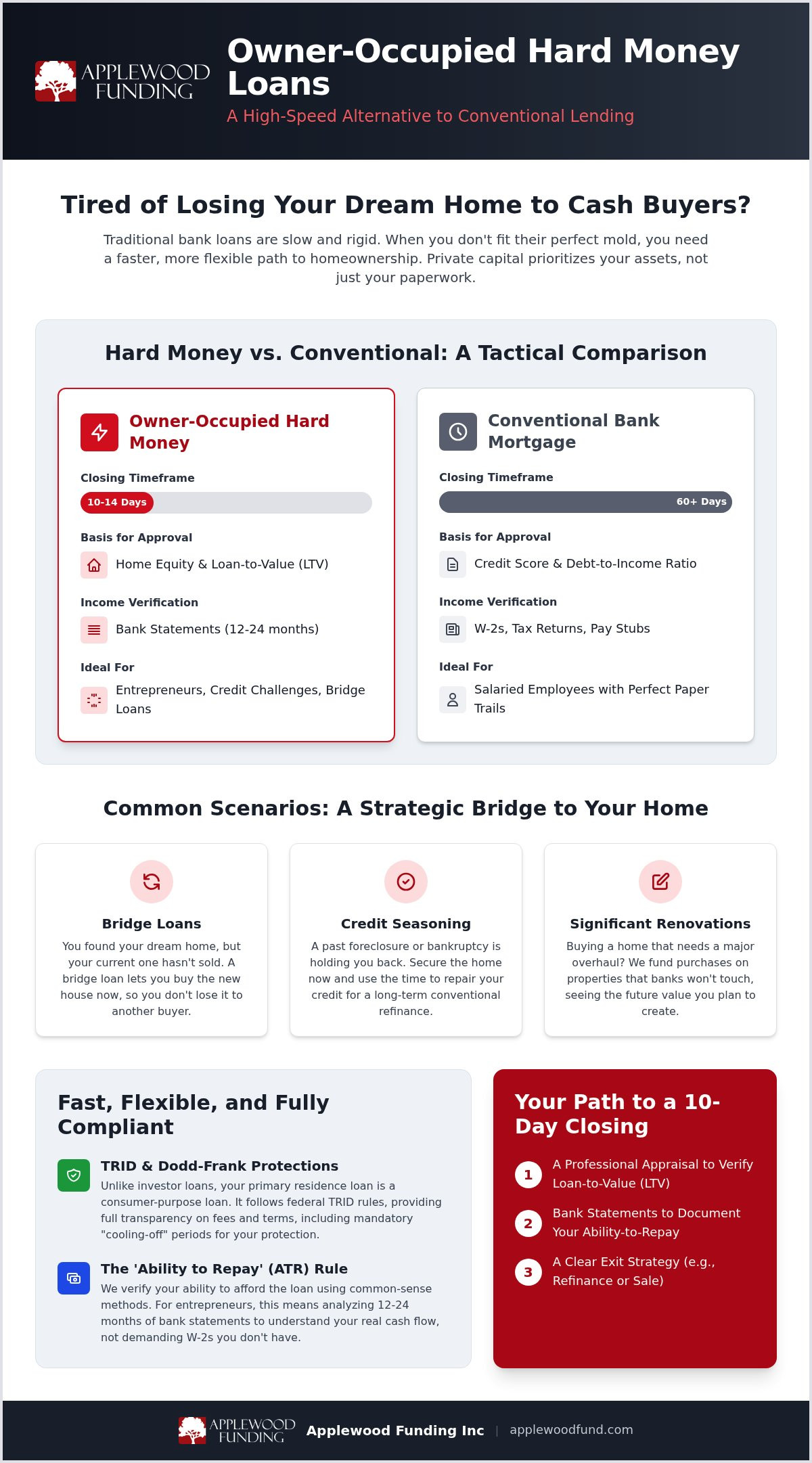
Why choose this path? It’s usually about timing or unique property conditions. Banks are rigid; private capital is flexible. Here are the most common reasons homeowners use this strategy:
- Bridge Loans: You found your dream home but your current one hasn’t sold yet. Don’t lose the new house to a cash buyer while you wait on a listing. For those looking to sell in West Michigan, awhomesofbellabayrealty.com provides a strategic guide to navigating the local market effectively.
- Credit Seasoning: A past foreclosure or bankruptcy might disqualify you from a bank loan today. Use a hard money bridge to secure the home now while you season your credit for a future refinance.
- Significant Renovations: You’re buying a property that needs a total overhaul to be livable. Banks won’t lend on un-inhabitable shells. We see the potential and fund the purchase. Investors who want to take this a step further and profit from distressed properties should explore fix and flip loans for Arizona real estate to understand how private capital can fund full renovation projects at speed.
The Compliance Hurdle: TRID and Dodd-Frank Explained
Most hard money lenders run away from primary residence deals. Why? Compliance. It’s complex. It’s time-consuming. While a fix-and-flip loan for an investment property can often close on a handshake and a deed, owner occupied hard money loans are different. They’re consumer-purpose loans. That means they follow the TILA-RESPA Integrated Disclosure (TRID) rules. These federal regulations are designed to protect you from surprise fees and predatory lending. We don’t see these rules as a hurdle; we see them as a standard for professional lending.
Speed is our priority, but compliance is our foundation. Navigating these laws requires an NMLS-licensed originator who understands the nuances of consumer law. Joel McDaniel (NMLS 175371) brings that expertise to every deal. We handle the mandatory “cooling off” periods, such as the three-day window after you receive your Closing Disclosure, with total transparency. We work in the background during these waiting periods to ensure your funds are ready the moment the clock hits zero. You get the protection of a bank loan with the agility of private capital.
The ‘Ability to Repay’ (ATR) Rule
Federal law requires lenders to verify that you can actually afford the loan. This is the Ability to Repay (ATR) rule. Even though we focus on your home’s equity, we can’t ignore your income. However, we don’t use the bank’s rigid “W2 or nothing” mindset. If you’re an entrepreneur or freelancer, we look at 12 to 24 months of bank statements to verify your cash flow. This common-sense approach ensures the loan solves your immediate problem without creating a future financial burden. It’s about setting you up for a successful exit, not just a quick closing.
Documentation You Will Actually Need
Preparation is the key to a 10-day closing. To keep the process moving, you’ll need three main pillars of documentation. First, a professional appraisal is essential to verify your Loan-to-Value (LTV) ratio. Second, have your bank statements ready to prove your income history. Finally, we need a clear, written exit plan. We want to know exactly how you’ll transition out of this short-term bridge. Whether you’re selling another property or seasoning your credit for a future refinance, a solid plan is your ticket to approval. If you’re self-employed and ready to move, you can check our bank statement loan requirements to get your documents in order today.
Compliance doesn’t have to mean a 60-day wait. By combining strict adherence to TRID with our streamlined internal processes, we cut through the red tape that stops traditional banks. We provide the disclosures you need and the speed you want. It’s a balanced approach that keeps your dream home within reach while keeping your financial interests protected under federal law.
Hard Money vs. Conventional Mortgages: A Tactical Comparison
Banks are built on history. They want to see your 2022 tax returns and your 2023 credit hiccups. They act like historians, obsessed with the past. We act like strategists. We look at what you have now and where you’re going. While a traditional lender takes 45 to 60 days to move a file through three layers of underwriting committees, owner occupied hard money loans close in as little as 10 to 14 days. This isn’t just about convenience. It’s about tactical advantage. You’re trading a rigid, slow process for a nimble, asset-based solution that recognizes the value of your home today. Understanding the full strategic picture of hard money vs traditional mortgage financing can help you make the right call before you ever submit an application.
Traditional mortgages demand “turn-key” perfection. If a house has a dated kitchen or needs a new roof, a bank might walk away. We don’t. We lend on potential. We focus on the equity you have or the down payment you’re bringing to the table. This flexibility allows you to secure properties that conventional lenders find “un-financeable.” You get custom terms that fit your specific life transition, not a one-size-fits-all product from a corporate handbook.
When Speed Becomes Your Greatest Asset
In a hot market, sellers won’t wait for your bank’s appraisal delays. They want certainty. When you walk in with private funding, you’re effectively competing with cash buyers. You bypass the “subject to financing” contingency that kills so many deals in escrow. You also avoid the logistical nightmare of the “double move.” Moving your family into a temporary rental while waiting for a bank to approve your new mortgage is expensive and exhausting. A bridge loan is a short-term financing tool designed to provide immediate liquidity, allowing a homeowner to purchase a new property before their current residence is sold. Securing your new home instantly means you only pack the moving truck once. Real estate investors who want to capitalize on this same speed advantage in the renovation space can learn how fix and flip loans help investors outpace cash buyers in Arizona’s 66-day market cycle.
The True Cost of a Bank ‘No’
Rejection hurts more than your feelings. It hits your wallet. When a bank denies you at the 45-day mark, your earnest money is often at risk. You’ve already paid for inspections and appraisals. You’ve spent weeks of your life on paperwork that led to a dead end. Following Consumer Financial Protection Bureau regulations ensures that these fast-moving loans remain transparent and compliant, but the real value is the guaranteed closing.
Some borrowers worry about interest rates. Look at the math. Paying a higher rate for 12 months is often significantly cheaper than losing a dream home, forfeiting a deposit, and starting your search over. Before committing to this strategy, reviewing a complete breakdown of hard money loan pros and cons will help you weigh the higher costs against the speed and flexibility you gain. The origination fee is an investment in certainty. You aren’t just buying a house; you’re buying the right to own it today. Don’t let a bank’s red tape cost you your future equity.
Qualifying for Your Loan: A 2026 Homeowner’s Checklist
Stop guessing if you qualify for private funding. Traditional banks hide behind black-box algorithms, but our process is transparent and asset-driven. To secure owner occupied hard money loans, you need to focus on four critical pillars. First, calculate your Loan-to-Value (LTV) ratio. In 2026, most private lenders look for a maximum LTV of 65% to 75%. This means you need significant equity or a substantial down payment. This “skin in the game” protects both parties and ensures the deal is viable from day one.
Second, get your bank statements ready. If you’re self-employed, we don’t care about the deductions on your tax returns that make your income look smaller. We want to see 12 to 24 months of deposits that prove your real cash flow. Third, identify your property’s unique value. We lend on the “as-is” condition, meaning we can fund houses that banks reject due to minor deferred maintenance. Finally, you must formalize your exit strategy. We aren’t looking for a 30-year relationship; we’re looking for a successful bridge to your next financial milestone.
Mastering the Exit Strategy
Lenders approve loans based on how they end, not just how they start. A “hope” is not a plan. You need a concrete roadmap for repayment. The most common exit is refinancing into a conventional mortgage once a credit seasoning period expires, such as two years after a bankruptcy or foreclosure. Another strong option is the documented sale of a secondary asset, like a rental property or a business interest. We look at your exit strategy from a risk perspective. A clear, documented path to repayment is the fastest way to get your file moved to the top of the pile.
The Role of Home Equity
Equity is your greatest shield. When you have 25% to 35% equity in your primary residence, you’re positioned to withstand market shifts. This equity also opens doors for strategic borrowing. For example, you can use a cash-out hard money loan to fund a business expansion or cover personal emergencies while staying in your home. This is about using your home as a tool, not just a place to sleep. By borrowing against your equity for a short term, you can solve immediate liquidity problems without the 60-day wait of a traditional HELOC. If you want a full picture of whether this approach fits your financial goals, studying the hard money loan pros and cons for 2026 gives you the objective framework to decide with confidence.
Ready to see if your equity measures up? Apply for your owner-occupied bridge loan today and get a decision from a real person, not a computer. We prioritize your future potential over your past credit hiccups, giving you the speed you need to win in today’s housing market.
Applewood Funding Inc: National Private Lending for Your Home
Most private lenders are local or regional. They stay within their comfort zones, leaving borrowers in other states stranded when they need fast capital. Applewood Funding Inc breaks that mold. We provide owner occupied hard money loans across the United States. Whether you’re in a booming coastal market or a quiet rural county, we have the national reach to fund your primary residence. We cut through the geographic red tape that stops our competitors. You need a partner who sees the value in your property and your unique situation, not just your zip code.
Stop talking to entry-level loan officers who have to “check with their manager” for every minor detail. When you work with Applewood Funding Inc, you get direct access to decision-makers like Joel McDaniel (NMLS 175371). We operate with high energy because we know your deal is on a clock. There are no corporate committees or cold, institutional layers here. We move at the speed of your transition. Our team understands the self-employed borrower. We know that a “Bank Statement” lifestyle is a sign of success, not a red flag. We don’t punish you for being an entrepreneur; we provide the asset-based capital that traditional banks refuse to offer.
Why Borrowers Trust the Applewood Advantage
Experience matters in the rare world of consumer-purpose private lending. It’s a field many lenders avoid due to the regulatory weight. We’ve mastered the complexity of these deals so you don’t have to worry about the details. Our commitment is simple: transparency, speed, and your ultimate success. We don’t just provide a loan. We provide the capital to win in a competitive environment. We position ourselves as your ally, helping you navigate the bridge from private money to long-term conventional stability. We value results over bureaucracy.
Getting Started with Your Funding Request
You don’t have weeks to wait for an answer while a bank “processes” your file. That’s why we offer a no-obligation initial review. You get a clear “Yes” or “No” fast. Within the first 48 hours of your application, our team performs a deep dive into your equity and exit strategy. We tell you exactly what’s possible without the typical bank runaround. If the deal makes sense, we push it toward a 10 to 14-day closing. We focus on the solution, not the obstacles. Don’t let another dream home slip away while you wait for a traditional lender to find their pen. Apply for your owner-occupied loan now and take control of your housing future with a team that values your time as much as you do.
Take Control of Your Home Purchase Today
Traditional banks live in the past. We focus on your future. You’ve learned how owner occupied hard money loans serve as a high-speed alternative to the 60-day bank slog. This isn’t just a loan; it’s a strategic tool for homeowners who need to move now. We handle the complex TRID disclosures and compliance hurdles so you can focus on packing your boxes. You deserve a lender that understands your unique financial story and values your equity over a rigid checklist.
Applewood Funding Inc provides national US coverage with a specific focus on bank statement income for entrepreneurs and self-employed borrowers. Managed by Joel McDaniel (NMLS 175371), we offer direct access to decision-makers who value your property’s potential more than a past credit hiccup. Stop waiting for a loan officer to call you back while your dream home slips away to a cash buyer. We move at the speed of your deal to ensure you don’t miss out.
Secure Your Home with Fast Hard Money Funding Today
Don’t let red tape stand in your way. You have the equity and the plan; we have the capital to make it a reality. Your new front door is closer than you think. Let’s get you funded.
Frequently Asked Questions
Can I get a hard money loan on my primary residence?
Yes, you can secure a hard money loan for your primary residence. While many private lenders avoid these deals because of federal consumer protections, Applewood Funding specializes in owner occupied hard money loans. We navigate the regulatory red tape to provide you with speed and flexibility. These loans are ideal for homeowners who don’t fit the rigid banking box but have significant equity in their property.
What is the maximum LTV for an owner-occupied hard money loan?
The maximum Loan-to-Value (LTV) ratio for these loans typically ranges between 65% and 75%. This means you need a down payment or existing equity of at least 25% to 35%. Private lenders require this “skin in the game” to mitigate risk since they prioritize the asset’s value over your credit score. Having substantial equity ensures that both the borrower and the lender are protected throughout the short-term loan period.
How long does it take to close a private consumer loan?
Closing a private consumer loan generally takes between 10 and 14 days. This timeline is much faster than the 45 to 60 days required by traditional banks. Managed by Joel McDaniel (NMLS 175371), our team navigates mandatory federal “cooling off” periods required by TRID. We work aggressively in the background during these windows to ensure your funding is ready the moment the legal requirements are met. This speed is your greatest competitive advantage.
Do I need a high credit score for a hard money home loan?
You don’t need a perfect credit score to qualify. Hard money lending is asset-based, so we focus on the value of your home rather than just your past financial history. While we do review your credit, a lower score won’t automatically trigger a rejection if you have strong equity and a clear exit strategy. We look for solutions that help you bridge the gap toward a future conventional refinance.
Can I use bank statements instead of tax returns for my home loan?
Yes, we offer bank statement loans for self employed borrowers specifically designed to replace traditional tax return requirements. If your tax returns don’t reflect your true income due to business deductions, we use 12 to 24 months of bank deposits to verify your cash flow. This approach allows entrepreneurs to qualify for owner occupied hard money loans based on their actual ability to pay. It’s a common-sense solution for people who run successful businesses but lack a traditional W2.
What is the typical term length for a primary residence bridge loan?
Primary residence bridge loans usually have term lengths ranging from 12 to 24 months. These are not 30-year mortgages; they are tactical tools meant to solve a temporary liquidity or credit issue. The goal is to provide you with immediate capital so you can secure a property or cash out equity. You should use this time to improve your credit or sell another asset to transition into a permanent financing solution.
Are owner-occupied hard money loans more expensive than investment loans?
These loans often carry higher costs than standard investment property loans. The reason is the extensive compliance work required by federal laws like TRID and the Dodd-Frank Act. Consumer-purpose lending involves more disclosures, licensed oversight, and legal paperwork. While the upfront points and interest might be higher, the value lies in the speed and the ability to secure a home that a traditional bank would simply refuse to fund.
What happens if I can’t refinance the hard money loan in time?
You must have a realistic backup plan. If your primary exit strategy, such as a refinance, falls through, you might need to sell the property to satisfy the debt. Some lenders may offer an extension, but this isn’t guaranteed. We focus heavily on your exit strategy during the application process to ensure you have a viable path forward. A “hope” is never a plan; a documented strategy is your best protection.