


When to Use a Hard Money Loan: Strategic Advantage vs. Last Resort in 2026
September 13, 2026Bank Statement Loans 2026: The Ultimate Guide for Self-Employed Borrowers

Why should your tax professional’s success at finding deductions become your mortgage lender’s reason to say “no”? You’ve built a thriving business in Phoenix or Scottsdale. You have the cash flow. You have the stability. Yet, traditional banks treat your hard-earned write-offs like a financial red flag. It’s exhausting to deal with endless paperwork requests only to be rejected by a system built for W2 employees. You shouldn’t miss out on your dream home just because you’re a smart entrepreneur.
We understand the hustle. This guide shows you how to secure a mortgage using your actual cash flow instead of tax returns. Discover how bank statement loans empower self-employed professionals to qualify based on real-world deposits. We’ll walk you through the 2026 requirements, explain how to leverage 12 to 24 months of statements, and show you why Applewood Funding, led by Joel McDaniel (NMLS 175371), is the fast alternative to slow credit unions. It’s time to get the professional treatment your business deserves and close on that Arizona property with confidence.
Key Takeaways
- Stop letting smart business deductions block your home ownership goals and learn how to qualify using your gross deposits instead of net income.
- Master the documentation requirements for bank statement loans to ensure your application moves through underwriting without typical bank delays.
- Identify the critical differences between personal and business accounts to maximize your qualifying income and secure the best possible terms.
- Follow our streamlined checklist to clean up your financial records and eliminate “income inflation” red flags before you apply.
- Leverage local Arizona insights to close on your Phoenix or Scottsdale home faster than a traditional credit union can process a single tax transcript.
Why Traditional Mortgages Fail the Self-Employed (And How Bank Statement Loans Fix It)
Traditional banks live in a W2 world. They want predictable paystubs and simple tax returns. For a self-employed professional in Phoenix, that is a massive problem. You are smart. You use legal deductions to keep more of your money. But when you apply for a standard mortgage, those deductions are exactly what disqualify you. It is the “Tax Return Trap.” Your accountant says you are doing great; your banker says you are broke. Banks look at your history, but we look at your hustle.
In 2026, the industry has finally moved away from the clunky “Non-QM” label toward “Alternative Lending.” This is no longer a niche product for the few. It is a mainstream necessity for the 16 million Americans who work for themselves. Whether you are a 1099 contractor, a gig economy specialist, or an established business owner, your income is real. It just doesn’t show up on a 1040 form. Bank statement loans bridge this gap by looking at your actual cash flow rather than your taxable bottom line.
The Problem with Traditional Debt-to-Income (DTI) Ratios
Big banks calculate your ability to pay based on “net taxable income.” If you reinvested $50,000 into new equipment or traveled for client meetings, that money vanishes from your qualifying income. Traditional underwriting doesn’t understand reinvestment. It treats your business growth like a personal expense. This creates a heavy emotional toll. You are building an empire in Scottsdale, yet you are “unbankable” at the local credit union. It feels like you are being punished for your success. We believe your business deductions should not be a barrier to your dream home.
Bank Statement Loans as the Modern Solution
We look at your actual cash flow. A bank statement serves as the primary evidence of your financial health, allowing us to see the money coming into your business before the deductions hit. We calculate your qualifying income by averaging 12 or 24 months of gross deposits. Bank statement loans are the entrepreneur’s bridge to homeownership. 2026 is the year of the alternative borrower in Arizona because the market moves too fast for old-school paperwork. Applewood Funding, managed by Joel McDaniel (NMLS 175371), provides the speed you need. We don’t wait for tax transcripts. We focus on your deposits and your drive. If the money is in the bank, you should be in the house.
How Bank Statement Loans Work: Qualifying Without Tax Returns
Qualifying for a mortgage shouldn’t feel like a legal interrogation. Most traditional lenders demand years of tax returns to prove your worth. We don’t. Bank statement loans are designed to bypass the bureaucracy by looking at your actual deposits. This process falls under the category of non-qualified mortgages. Unlike a standard Qualified Mortgage, these loans prioritize your real-time cash flow over your taxable bottom line. It’s about your ability to pay today, not what you reported to the IRS years ago.
You don’t need a perfect 800 credit score to get started. While a score of 680 or higher often unlocks the most competitive terms, a minimum of 620 is generally enough to qualify. You should also prepare for a minimum down payment of 10%. This isn’t just about a number on a screen. It’s about showing a consistent pattern of success in your Arizona business.
Personal vs. Business Bank Statement Programs
Choosing the right account type is critical for your income calculation. If you use personal bank statements, lenders often give you 100% credit for every eligible deposit. This is the cleanest path for freelancers and sole proprietors. However, if you use business bank statements, lenders apply an “Expense Factor” to estimate your costs. This standard ratio is usually 50%. If you have a high-margin business with low overhead, we can often adjust this factor with a letter from your CPA. If you’re unsure which path fits your business, you can talk to our Phoenix team, led by Joel McDaniel (NMLS 175371), to compare your options.
Calculating Your Qualifying Income
The math is straightforward. Lenders look at either 12 or 24 months of history. A 24-month look-back offers more stability and can sometimes result in better rates. The formula is simple: (Total Eligible Deposits – Disallowed Deposits) / Number of Months. Consistency in monthly deposits is more important than one massive month. Lenders want to see a steady stream of income, not a single lucky break. Transfers between your own accounts and large one-time gifts are usually disallowed. We focus on the revenue your business actually generates. It’s a human-led process that respects the reality of being an entrepreneur in 2026.
Comparing Your Options: Bank Statement Loans vs. Traditional Mortgages
Banks want you to wait. They want you to beg. They want every receipt from the last three years. We don’t. When you compare traditional mortgages to bank statement loans, the difference isn’t just paperwork. It’s time. A conventional lender often takes 45 to 60 days to close. In a competitive Phoenix market, that is an eternity. You will lose the house before the bank even opens your file. Applewood Funding, managed by Joel McDaniel (NMLS 175371), moves at the speed of your business. We focus on results, not red tape.
You should expect a higher down payment requirement. While a W2 employee might qualify with 3% down, self-employed borrowers typically need 10% to 20% for these alternative programs. This is the reality of the 2026 lending market. It’s the “Alternative Risk” premium. It’s the price you pay to skip the tax return interrogation and secure a home based on your actual success.
The Cost of Speed and Flexibility
Rates for bank statement loans are slightly higher than conventional ones. Why? Because the lender performs a manual, human-led review of your income instead of relying on an automated algorithm. Don’t let a small rate difference stop you. Think about the opportunity cost. If you wait another year to “show more income” on your taxes, that Scottsdale home might cost significantly more by the time you’re “ready.” Use the “Refinance Strategy.” Buy the home now. Lock in your property. Refinance later if rates drop or your tax strategy shifts. Don’t let the Arizona housing rush leave you behind.
Documentation Comparison Checklist
The mountain of paperwork required by big banks is designed to protect their bureaucracy, not your interests. We’ve simplified the process. Compare the two paths below to see which fits your timeline:
- Conventional Path: 2 years of full tax returns, W2s, 4506-T transcripts, and 30 days of paystubs.
- Bank Statement Path: 12 months of statements, a valid business license, and a simple CPA letter.
Choosing the right path depends on your priorities. If you need a fast approval based on actual cash flow, the choice is clear. For a deeper look at how these compare to other fast-funding options, check out our guide on Hard Money vs Conventional Loans: Speed Over Red Tape. We help you skip the mountain of transcripts and get straight to the closing table in record time.
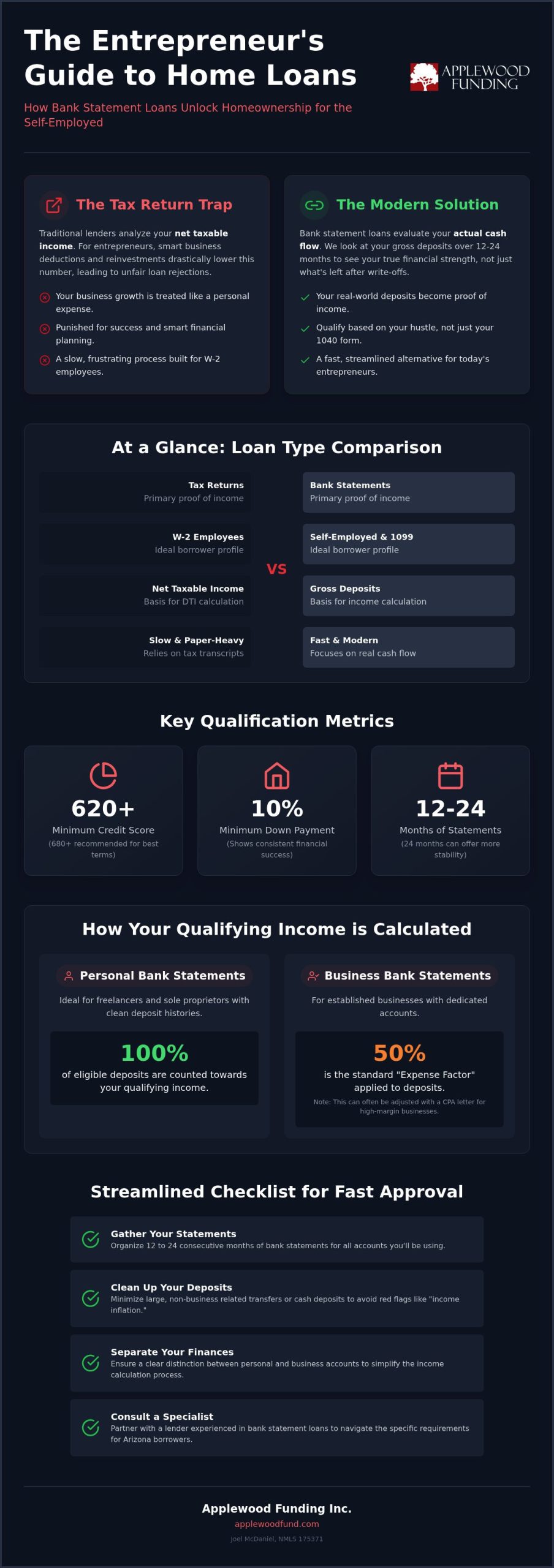
Checklist for Success: How to Prepare Your Application for Fast Approval
Preparation is the difference between a fast closing and a frustrating rejection. Don’t wait until you find the perfect house in Scottsdale to organize your files. Start now. A clean application moves through underwriting in days. A messy one stays stuck in a pile of questions. Follow these four steps to ensure your bank statement loans application is bulletproof.
- Separate your personal and business finances immediately. Mixing accounts creates confusion and slows down the audit.
- Eliminate non-business deposits. Transfers from friends or one-time sales of personal items look like “income inflation” to an underwriter.
- Secure a CPA letter. You must prove you have been in business for at least two years.
- Maintain a healthy reserve. Aim to have 6 to 12 months of mortgage payments tucked away in the bank.
Cleaning Up Your Statements
Overdrafts are the #1 reason for denial. A single NSF (Non-Sufficient Funds) flag can derail your entire bank statement loans application. Underwriters see it as a sign of financial instability. If you have a large deposit that isn’t from a client, explain it before the underwriter asks. Transparency builds trust. You should also avoid taking massive business draws right before you apply. It looks like you’re draining the business to cover the down payment, which can raise red flags about your company’s long-term health. Clean accounts win every time.
The Power of the CPA Letter
Applewood values a human expert’s verification over an automated IRS transcript. Your CPA letter is a powerful tool. It needs to state your ownership percentage and verify the overall health of your business. This letter provides the context that bank statements alone might miss. It proves you’re a stable professional, not just someone with a lucky month of sales. For a full breakdown of what else you might need, review our Hard Money Loan Requirements for Homeowners. We look for reasons to fund you, not reasons to fail you.
Our team, led by Joel McDaniel (NMLS 175371), knows how to navigate the complexities of self-employed income. We don’t get bogged down in the bureaucracy that stops big banks. Ready to see if your cash flow qualifies? Contact our Phoenix mortgage team today and let’s get your application moving toward a fast approval.
Securing Your Arizona Home Loan with Applewood Funding
Arizona is moving fast. The Phoenix and Scottsdale markets don’t wait for big box lenders to finish their 60-day cycles. You need a partner who understands the local dirt. National lenders use generic underwriting that treats a Mesa entrepreneur the same as a W2 worker in Chicago. It doesn’t work. We specialize in bank statement loans because we know how Arizona business owners operate. We focus on your cash flow, not a computer-generated rejection letter. If you have the deposits, you have the power.
Applewood Funding provides direct access to decision-makers. You won’t get stuck in a call center queue. You get the expertise of Joel McDaniel (NMLS 175371) and a team that values your time. We move from application to funding in record time. While traditional banks are still requesting your 2024 tax transcripts, we are already reviewing your deposits and preparing your closing documents. We treat your business with the respect it deserves. We see your hustle as an asset, not a liability.
Arizona’s Alternative Lending Experts
We serve Glendale, Peoria, Tempe, and Mesa with specialized local knowledge. Big box lenders fail here because they don’t understand the unique Arizona real estate landscape. They see risk where we see opportunity. They see a “non-standard” borrower; we see a successful neighbor. Our bank statement loans allow you to compete with cash buyers in Scottsdale by proving your financial strength quickly. One of our rarest solutions is Owner Occupied Hard Money Loans: Fast Funding for Your Primary Residence. Most private lenders avoid primary residences entirely. We don’t. We provide the speed of hard money for the home you actually live in, giving you a massive advantage in a competitive market.
Your Next Steps to Homeownership
Getting started is simple. You don’t need to fear a hard credit pull just to see your options. We offer quick quotes for our bank statement loans based on your actual deposits. During your first consultation, we’ll look at your business health and find the program that fits your specific needs. We’ll discuss your goals and your timeline. No judgment. No red tape. Just a clear path to your new home. Whether you’re an established business owner or a 1099 professional, we have the tools to make it happen. Stop waiting for the “perfect” tax return that may never come. Start building your future in the Valley today. Get Your Bank Statement Loan Quote from Applewood Funding Today!
Take Control of Your Arizona Home Purchase
Your business success should be your greatest asset, not a hurdle to homeownership. By choosing bank statement loans, you’ve discovered a path that respects your actual cash flow and rewards your entrepreneurial drive. You don’t have to wait for another tax season or sacrifice legal deductions just to prove your worth to a big-box lender. Whether you are scaling a startup in Phoenix or managing a steady consultancy in Scottsdale, the home you want is within reach when you use the right financial tools.
Applewood Funding, led by Joel McDaniel (NMLS 175371), stands as a local Arizona market specialist dedicated to your success. We offer rare solutions like Owner-Occupied Hard Money and provide a human-led alternative to automated bank rejection. We move at the speed of your business to ensure you never miss an opportunity in this fast-paced market. Stop letting tax returns stop your home purchase. Get funded by Applewood today! We are ready to help you close fast and start your next chapter with total confidence.
Frequently Asked Questions
Can I get a bank statement loan with a 600 credit score?
You generally need a minimum credit score of 620 to qualify for this program. While traditional lenders might demand much higher scores for non-standard products, we focus on your overall financial health and business stability. If your score is slightly below the threshold, we might look at other asset-based solutions or owner-occupied hard money options. Keeping your credit profile clean of recent major delinquencies is often more important than a perfect score.
Do bank statement loans require a larger down payment than FHA loans?
Yes, expect to provide a larger down payment than you would with an FHA loan. While FHA programs allow for as little as 3.5% down, bank statement loans typically require at least 10%. This higher entry point offsets the risk of not using tax returns to verify income. It’s a fair trade-off for the speed and flexibility you get by avoiding the mountain of IRS paperwork required by big banks.
How do lenders calculate income if my business has high overhead?
Lenders typically apply a standard expense factor, often around 50%, to estimate your net income from business deposits. If your business has high margins but high overhead, we can often use a letter from your CPA to justify a lower expense ratio. This human-led underwriting ensures your qualifying income reflects the reality of your Arizona business rather than a generic industry average that doesn’t fit your specific situation.
Can I use bank statement loans for an investment property in Phoenix?
You can absolutely use these loans for investment properties in Phoenix, Scottsdale, or anywhere in the Valley. Applewood Funding provides specialized rental property loans that focus on the property’s potential cash flow and your documented bank deposits. It’s a powerful tool for entrepreneurs looking to build a real estate portfolio without the constraints of traditional debt-to-income ratios that rely on heavily-deducted tax returns.
What is the difference between a 12-month and 24-month bank statement loan?
The main difference is the length of the look-back period used to average your monthly income. A 12-month program is faster and focuses on your most recent business success. A 24-month program provides a broader picture of stability and can sometimes result in more favorable terms. Most Arizona borrowers choose based on how much their business income has fluctuated over the last two years to maximize their qualifying amount.
Are bank statement loans considered ‘hard money’?
Not exactly. While Applewood specializes in both, bank statement loans are technically “Non-QM” or alternative mortgage products. They are designed for long-term financing, whereas hard money is often used for short-term needs like fix-and-flip projects. Both fall under the umbrella of alternative lending that prioritizes your actual assets and cash flow over traditional bank bureaucracy. We help you choose the right tool for your specific financial timeline.
Do I need a Profit and Loss (P&L) statement to qualify?
You don’t always need a formal P&L statement to get approved. In many cases, 12 to 24 months of statements and a simple CPA letter verifying your business ownership are enough. Some programs might request a self-prepared P&L to understand your margins, but our goal is to keep the process simple. We value the professional verification of your accountant over the automated rejection systems used by standard credit unions.
Can I get a bank statement loan for a primary residence in Arizona?
Yes, securing a loan for your primary residence is one of our core specialties. Applewood Funding, managed by Joel McDaniel (NMLS 175371), focuses on providing owner-occupied solutions that many national private lenders avoid. Whether you’re buying a home in Glendale or Peoria, we use your business cash flow to get you into your house without the headache of tax return verification. We are local experts who understand the Arizona market.