

How Hard Money Loans Work: The 2026 No-Nonsense Guide to Fast Funding
September 11, 2026Hard Money Loan vs. Conventional Loan: Speed vs. Stability in 2026
You found the perfect Scottsdale fixer-upper, but the bank wants 45 days to “review” your file. In the 2026 Arizona market, that property is gone in 48 hours. Missing out on a lucrative deal because of a financing contingency feels like a punch in the gut. You need a solution that moves as fast as the market does. Understanding the nuances of a hard money loan vs conventional loan is the difference between closing a deal this week or watching a competitor walk away with your profit.
We know the frustration of strict DTI requirements and endless red tape. Banks focus on your past; you focus on the property’s future. This article promises to reveal the critical differences between traditional stability and private capital velocity. You’ll discover how to choose the right leverage for your specific Arizona real estate goals without the 45-day wait. We help you move past the gatekeepers.
We’re diving deep into the total cost-benefit of private money. We’ll show you how self-employed investors are leveraging equity to bypass bank delays. We’ll also break down when to prioritize a low interest rate and when to pay for the speed that wins the bid. It’s time to stop waiting for approvals and start closing deals.
Key Takeaways
- Learn how to leverage property equity and future value instead of relying solely on your credit score or tax returns.
- Understand the tactical math of a hard money loan vs conventional loan to decide if speed or long-term interest rates serve your current goal.
- Discover why the After Repair Value (ARV) is the true star of private lending and how it helps you fund properties banks won’t touch.
- Identify specific scenarios, like fix-and-flips or self-employed bridge needs, where private capital provides a massive competitive edge in the Arizona market.
- Master the total cost-benefit analysis of origination points versus the high opportunity cost of waiting months for a bank to close.
The Fundamental Tug-of-War: Speed vs. Stability
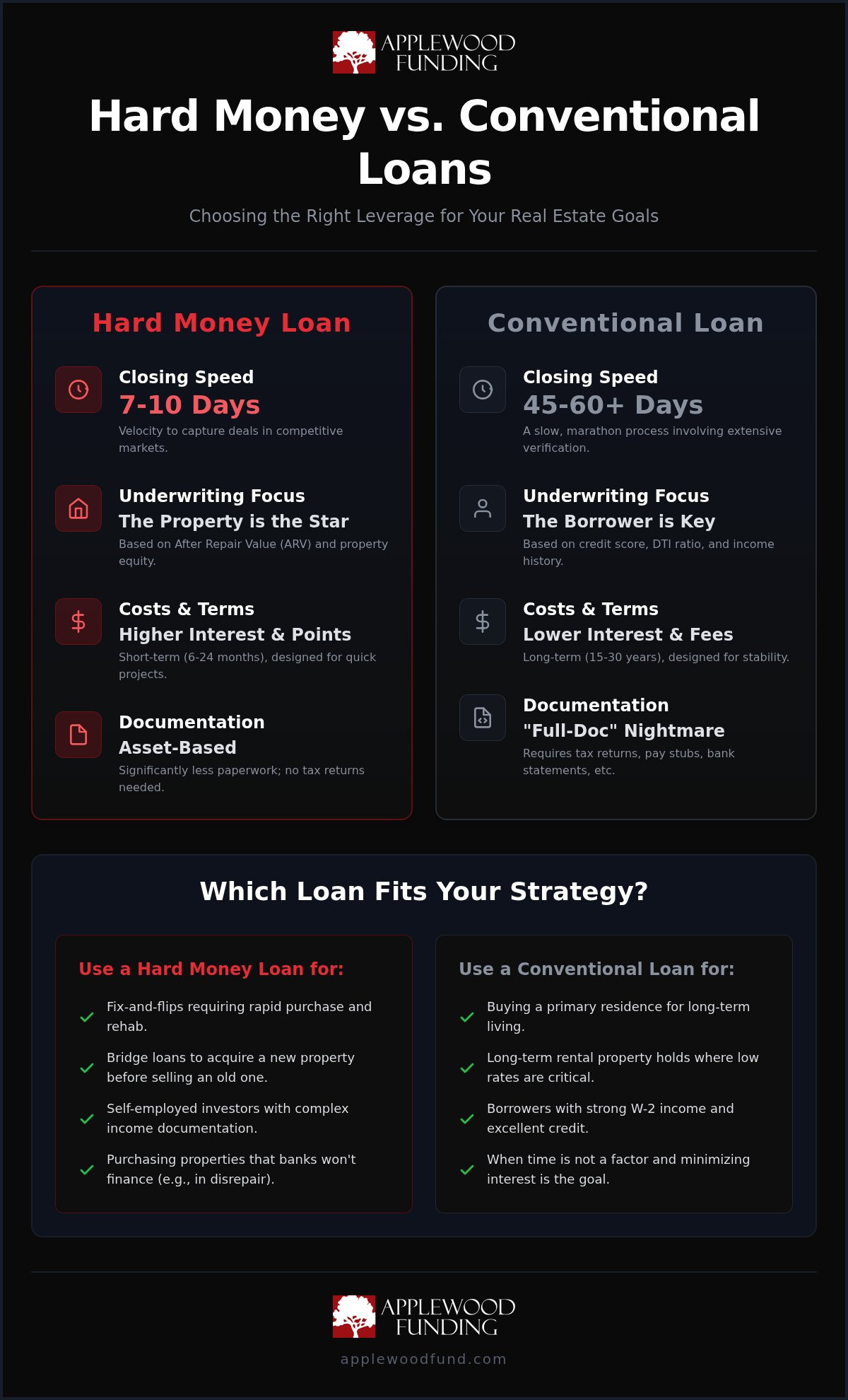
Banks are historians. They want to see every tax return from the last three years, every pay stub, and every bank statement. They lend based on your past. Private lenders are different; they’re visionaries. They look at the property’s potential and the equity on the table today. This fundamental difference defines the hard money loan vs conventional loan debate. One offers the stability of low rates over decades. The other offers the velocity needed to capture a deal before it vanishes into a competitor’s portfolio.
In a competitive market like Arizona, speed isn’t just a luxury. It’s a high-stakes financial strategy. Waiting 60 days for a traditional bank to clear their red tape can cost you a $50,000 profit margin on a fix-and-flip. While you’re waiting for an underwriter to ask for the third copy of your 2024 tax returns, another investor with fast capital has already closed and started demolition. You didn’t just lose a house; you lost the equity growth and the momentum that comes with it.
What is a Conventional Loan?
A conventional loan is the standard path for most long-term buyers. These are institutional funds, often government-backed, that follow strict guidelines from Fannie Mae or Freddie Mac. The process is a marathon of documentation. Lenders obsess over your debt-to-income (DTI) ratio and your W-2 history. If you’re self-employed or have an unconventional income stream, you’re often looking at a mountain of paperwork. Even in the best conditions, 30 to 45 days is the industry floor for closing. You get the reward of a lower interest rate, but you pay for it with your time, your privacy, and your flexibility.
What is a Hard Money Loan?
If a conventional loan is a marathon, this is a 100-meter sprint. To understand what a hard money loan is, think of it as short-term, asset-based financing. These loans come from private companies rather than massive, slow-moving banks. The underwriting focuses on the property’s value and equity rather than your personal credit history or tax returns. It’s about the deal, not just the borrower.
This approach bypasses the “Full-Doc” nightmare that stops so many deals in their tracks. You don’t need to prove your entire life story to get a green light. At Applewood Funding, we prioritize rapid deployment. While banks are still verifying your employment history, we’re moving from application to funding in days. It’s about giving you the leverage to act when the right opportunity appears in Scottsdale or Phoenix. When comparing a hard money loan vs conventional loan, remember that you aren’t just paying for capital. You’re buying the ability to outmaneuver the competition and secure your future profits.
Underwriting Realities: People vs. Property
Banks look at you. We look at the house. This shift in focus is the defining line when comparing a hard money loan vs conventional loan. A traditional bank spends weeks digging through your history to decide if you’re a safe bet. A private lender looks at the asset to determine if the deal makes sense. It’s a choice between being judged by your past or being funded for your future potential.
Entrepreneurs and the self-employed often hit a brick wall with traditional lenders. You might have a thriving business in Phoenix, but if your tax returns show heavy write-offs, the bank sees “zero income.” Private capital doesn’t care about your W-2. We care about equity. If you’re tired of the “Full-Doc” nightmare, you can talk to a local Arizona specialist about your options today. We move when you’re ready.
Conventional Underwriting: The 5 C’s of Credit
Traditional banks follow a rigid framework known as the 5 C’s of Credit: Character, Capacity, Capital, Collateral, and Conditions. They prioritize “Character” and “Capacity” above all else. This means your credit history and your documented ability to repay are the primary gates. A single late payment from two years ago can trigger an automatic rejection. Banks use the debt-to-income ratio, which is the percentage of your gross monthly income that goes toward paying debts, as their ultimate gatekeeper. If that number is too high, the deal is dead. It doesn’t matter how much equity the property has or how great the deal looks on paper.
Hard Money Underwriting: The Asset is King
In the private lending world, the property is the star. We focus on the After Repair Value (ARV) and the Loan-to-Value (LTV) ratio. We need to see a healthy equity cushion that protects the investment. While conventional lenders need a 620+ credit score just to open your file, hard money lenders offer flexibility. We look for a clear exit strategy. How will you pay off the loan? Will you sell the house or refinance into a long-term rental loan? This focus on the “what” instead of the “who” is central to How Hard Money Loans Work: The 2026 No-Nonsense Guide to Fast Funding.
You should always weigh the costs and risks of hard money against the potential profit of a fast close. In a market moving as fast as Arizona’s, being judged on your property’s value rather than your personal tax returns is often the only way to win. It’s about securing the asset first and worrying about the long-term refi later. Speed wins deals. Documentation kills them.
Breaking Down the Costs: Interest Rates, Points, and Terms
Comparing a 7% bank rate to a 12% private capital rate is like comparing a marathon runner to a sprinter. They aren’t running the same race. When you analyze a hard money loan vs conventional loan, looking only at the interest rate is a trap. You have to look at the total cost of capital over the life of the deal. A bank’s lower rate is designed for a 30-year commitment. A private lender’s higher rate is a tactical tool for a 12-month window. If you’re flipping a house in Phoenix, the “expensive” loan that closes in five days is often more profitable than the “cheap” loan that takes two months to fund.
Duration changes everything. Conventional mortgages are built on 15 or 30-year amortizations, meaning you’re slowly chipping away at the principal. Hard money loans are typically 12 to 24-month terms with interest-only payments. This structure maximizes your monthly cash flow during a renovation. You aren’t paying down the house; you’re using the money to bridge the gap to your exit. This Hard money loan overview clarifies that these asset-based structures prioritize flexibility over long-term debt service.
The True Cost of a Conventional Mortgage
Stability has a high entry price. Beyond the interest rate, conventional loans hit you with Private Mortgage Insurance (PMI) if you don’t have 20% down, along with substantial closing costs. There’s also a hidden “red tape” cost. If interest rates rise while you’re stuck in a 45-day underwriting cycle, your projected monthly payment could jump before you even sign. You get the peace of mind of a fixed-rate 30-year term, but you sacrifice the ability to move quickly on distressed assets that won’t wait for a bank’s committee to meet.
Hard Money: Paying for Velocity
With private capital, you’re paying for speed and convenience. This usually comes in the form of “points,” which are one-time fees paid at closing. One point equals 1% of the loan amount. While this adds to your upfront cost, it buys you a seat at the table for deals that require a cash-like close. Most private loans also lack the rigid prepayment penalties found in some commercial bank products. You can find a deeper dive into these trade-offs in our Hard Money Loan Pros and Cons: 2026 Strategic Guide. We focus on getting you the capital you need to win the bid, then getting out of your way so you can execute your strategy. It’s about using the right tool for the right job.
Strategic Scenarios: When to Choose Hard Money Over a Bank
Choosing between a hard money loan vs conventional loan isn’t just about credit scores. It’s about the condition of the asset and the speed of the opportunity. Conventional banks have a strict “habitability” requirement. If a house in Mesa is missing a kitchen or has a stripped HVAC system, a bank won’t even send an appraiser. They want finished products. Private capital sees the skeleton of a great deal where the bank sees a liability. We fund the potential, not just the present state.
Bridge loans are another tactical power move. You find your next home in Flagstaff but haven’t sold your Phoenix condo yet. A bridge loan lets you strike now so you don’t lose the property to a faster buyer. You can also use cash-out strategies to tap into existing equity. This capital can fuel business growth or consolidate high-interest debt that’s dragging down your monthly cash flow. It’s about using your property as a tool for progress.
Investment Wins: Scaling Your Portfolio
In Scottsdale and Phoenix, properties are often snatched up before the “For Sale” sign even hits the dirt. To compete, you need to beat all-cash offers. Using private capital leverage allows you to act like a cash buyer. You can scale from managing one flip to three simultaneously because you aren’t tied up in 45-day bank cycles. For a deeper look at maximizing these opportunities, check out our Fix and Flip Loans: The Investor’s Guide to Arizona Real Estate Funding in 2026. Speed is your greatest competitive advantage.
The Primary Residence Power Play
Many lenders claim hard money is strictly for investors. That’s a myth that hurts Arizona families. Self-employed residents often have the equity but lack the “bankable” tax returns traditional lenders demand. You can use private funding to secure your dream home today, then refinance into a conventional mortgage once you meet those rigid institutional criteria. We specialize in these Owner Occupied Hard Money Loans: Fast Funding for Your Primary Residence because we believe entrepreneurs deserve a seat at the closing table.
Don’t let a slow bank stop your momentum. If you have a deal that needs a fast, common-sense look, apply with an Arizona hard money expert and get a decision based on your equity, not just your paperwork.
Navigating the Arizona Market with Applewood Funding
Big banks operate in time zones thousands of miles away. They don’t know the difference between a property in Scottsdale and one in Flagstaff. When you weigh a hard money loan vs conventional loan, the identity of the lender matters as much as the terms. We live and work in the Valley. We understand the heartbeat of the Arizona real estate market. This local perspective allows us to see value where out-of-state committees see only risk. We don’t just lend on numbers; we lend on the dirt we know.
Speed is our signature. We don’t have layers of bureaucracy. We have decision-makers. While a conventional bank is still routing your file through three different departments, we’re already reviewing your equity. We move you from application to funding in days. It’s about giving you the agility to win. Whether you’re eyeing a fix-and-flip or need a bank statement loan as a self-employed entrepreneur, we bridge the gap that traditional institutions leave wide open.
Local Decisions, Local Impact
Market nuances matter. A big bank might miss the growth potential in Glendale or the specific appraisal requirements in Scottsdale. Our team, led by Joel McDaniel, brings deep NMLS expertise to every deal. You get direct access to the people making the call. There are no faceless loan committees here. We know the Arizona real estate pulse because we’re part of it. This reliability makes us the preferred partner for investors who need a lender that actually understands the local market dynamics. We value your time and your vision.
Ready to Move? Your Next Steps
Stop overthinking the hard money loan vs conventional loan choice and start acting. If you have a property with equity, you have leverage. Preparing for a quote is simple. Gather your property details, your exit strategy, and your vision for the asset. You don’t need to dig up years of tax returns or worry about a W-2 headache. We focus on the deal, not your paperwork history.
Our application process is designed for speed. We prioritize your results over bureaucracy. We offer rare owner-occupied hard money options and flexible solutions for those the traditional system ignores. Don’t let another 45-day bank delay kill your momentum. Take control of your financing and Get Your Arizona Hard Money Quote Today. We’re ready to fund your next win.
Take Control of Your Arizona Real Estate Strategy
Success in the 2026 Arizona market doesn’t go to the person with the most paperwork. It goes to the person who acts first. Deciding between a hard money loan vs conventional loan isn’t about finding a “better” product; it’s about choosing the right tool for your specific timeline. If you need 30 years of stability, go to a bank. If you need to beat an all-cash offer in Scottsdale or secure a primary residence when the bank says no, you need a partner who understands equity.
Applewood Funding provides that edge. Managed by Joel McDaniel (NMLS 175371), we specialize in the Phoenix, Scottsdale, and Mesa markets. We’re the rare owner-occupied hard money experts who value your property’s potential over your tax returns. Stop letting red tape stand between you and your next closing. You have the equity. We have the capital. It’s time to move.
Secure Your Fast Arizona Funding—Apply with Applewood Today
Frequently Asked Questions
Can I get a hard money loan for a home I plan to live in?
Yes, you can. While many private lenders avoid primary residences due to complex regulations, Applewood Funding specializes in Owner Occupied Hard Money Loans across Arizona. This is a rare and powerful solution for homeowners who need to move quickly or have unconventional income. It’s a strategic way to secure your dream home in Phoenix or Scottsdale when a traditional bank’s red tape stands in your way.
Why is a hard money loan more expensive than a conventional loan?
You’re paying for speed, flexibility, and the lender’s increased risk. When comparing a hard money loan vs conventional loan, the higher interest rate reflects the fact that private capital is deployed in days rather than months. Banks offer lower rates because they spend weeks scrutinizing your past. Private lenders prioritize your property’s equity and the future value of the deal, providing you with the velocity to beat competitors.
Do hard money lenders check your credit score?
Most private lenders will look at your credit report, but it isn’t the deciding factor. Unlike conventional mortgages that require a 620+ score for basic approval, hard money underwriting focuses on the property’s value and your equity stake. If you have a solid asset in Mesa or Tempe and a clear exit strategy, your credit score matters far less than the quality of the real estate deal itself.
How fast can a hard money loan close compared to a bank?
A hard money loan can fund in as little as 3 to 10 days. In contrast, a traditional bank usually takes 30 to 45 days to navigate their institutional loan committees and documentation requirements. This speed is a massive advantage in competitive Arizona markets like Peoria or Glendale. It allows you to act like a cash buyer and close on lucrative opportunities that wouldn’t wait for a bank.
What is the typical down payment for a hard money loan in Arizona?
Most Arizona private lenders look for a down payment between 20% and 35%. This creates a Loan-to-Value (LTV) ratio of 65% to 80%, which provides the equity cushion needed for asset-based lending. The exact amount depends on the property type and whether it’s a fix-and-flip or a primary residence purchase. Having more skin in the game often leads to better terms and faster approval from our local decision-makers.
Can I use a hard money loan if I am self-employed with no W-2?
Absolutely. Self-employed entrepreneurs in the Valley often struggle with traditional W-2 requirements. Applewood Funding offers Bank Statement Loans for Self-Employed borrowers, allowing you to prove your income through deposits rather than tax returns. This bypasses the Full-Doc nightmare and lets you leverage your business’s actual cash flow to secure property in Sedona, Flagstaff, or Tucson without the usual bank hurdles.
What happens if I can’t pay back a hard money loan?
Hard money loans are asset-based, meaning the property itself serves as the collateral for the debt. If you default, the lender has the right to take possession of the property through foreclosure to recover their capital. This is why having a rock-solid exit strategy is essential. Whether you plan to sell the renovated asset or refinance into a long-term mortgage, you must have a clear path to repayment before signing.
Can I refinance a hard money loan into a conventional mortgage later?
Refinancing is the most common exit strategy for our clients. You can use a hard money loan vs conventional loan to win a bidding war or buy a distressed property that banks won’t touch. Once the property is repaired or you’ve met the bank’s seasoning requirements, you can transition into a 30-year fixed-rate mortgage. This allows you to capture the asset today and secure long-term stability later.