


Private Money Cash Out Refinance: Tap Property Equity Fast in 2026
September 22, 2026Construction Loans: Fast Private Financing for Ground-Up Builds in 2026
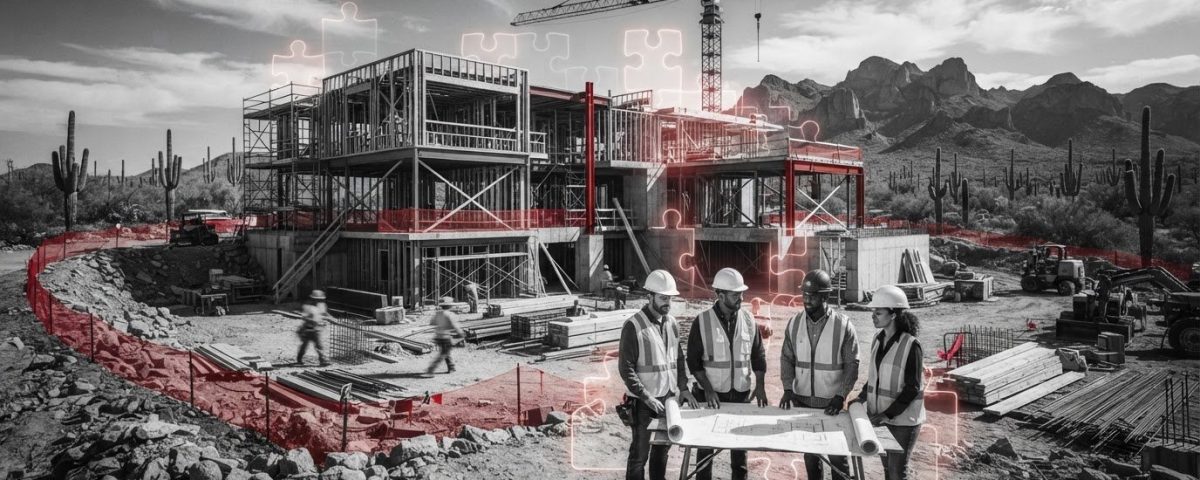
Traditional banks take 60 to 90 days to underwrite paperwork while prime dirt slips away and subcontractors walk off. If you are an active builder or investor, waiting months for conventional construction loans kills momentum and destroys profit margins.
You know the frustration firsthand. Big banks grill self-employed borrowers over tax returns, flatly refuse raw land development, and drag out draw schedules while your jobsite sits frozen. When heavy machinery sits idle, every wasted day burns real cash.
Private financing flips the script entirely. Discover how private construction loans cut through red tape to fund your ground-up builds and land projects fast, putting you in control of your timeline.
Below, we break down how direct asset-based underwriting works, how rapid draw disbursements keep crews building, and how to partner with direct Arizona lenders who value project equity over endless paperwork.
Key Takeaways
- Private construction loans bypass traditional bank bureaucracy by securing approval in days, prioritizing project equity over W-2 tax returns.
- Discover the critical documentation needed to lock in financing quickly, including line-item budgets, architectural plans, and licensed contractor agreements.
- Master milestone-based draw schedules to ensure prompt site inspections and uninterrupted cash flow for your subcontractors.
- Learn how direct asset-based lending solves common funding gaps for raw ground, unentitled lots, and ground-up builds.
- Gain a strategic edge by working with a direct Arizona lender with boots-on-the-ground knowledge across Phoenix, Tucson, and surrounding markets.
What Is a Construction Loan and How Does Private Financing Work?
A construction loan is a short-term, specialized credit facility engineered to fund two critical phases: buying dirt and going vertical. Unlike standard mortgages that issue a lump-sum payoff for a completed structure, private construction financing distributes capital incrementally as your project advances from raw acreage to finished real estate.
The mechanics are straightforward. Your approved capital sits in an escrow account. As your general contractor hits physical milestones, your lender releases portions of the budget through structured progress draws. Private asset-based lenders look at deals through a practical lens. Rather than dissecting personal debt-to-income ratios or two years of W-2 tax forms, they prioritize collateral value, builder equity, and project viability. Custom homebuilders and real estate investors lean on this model to secure maximum leverage, keeping projects on schedule without tying up all their liquidity.
Ground-Up Construction vs. Renovation Financing
Building from zero is fundamentally different from rehabilitating an existing footprint. While residential rehabs rely heavily on cosmetic updates and interior redesigns covered by fix and flip loans, ground-up development carries distinct structural requirements. Lenders need fully approved architectural blueprints, civil engineering assessments, grading plans, and municipal permits in hand before clearing vertical funds. Every component, from sewer taps to roof trusses, must be accounted for on paper.
Standalone Construction Loans vs. Construction-to-Permanent Mortgages
Traditional banks push rigid one-time-close mortgages that package construction financing and a 30-year note into a single, restrictive box. Standalone private construction notes give developers far greater agility:
- Interest-only payments: You pay interest solely on disbursed funds, not the full committed credit line, preserving your cash reserves during framing and finishing.
- Flexible timelines: Short-term loan structures adapt to supply-chain realities instead of locking you into institutional red tape.
- Clear takeout paths: Once your certificate of occupancy is signed, you can sell for immediate profit or transition the finished build into long-term rental financing.
Private Construction Loans vs. Bank Financing: Evaluating the Trade-Offs
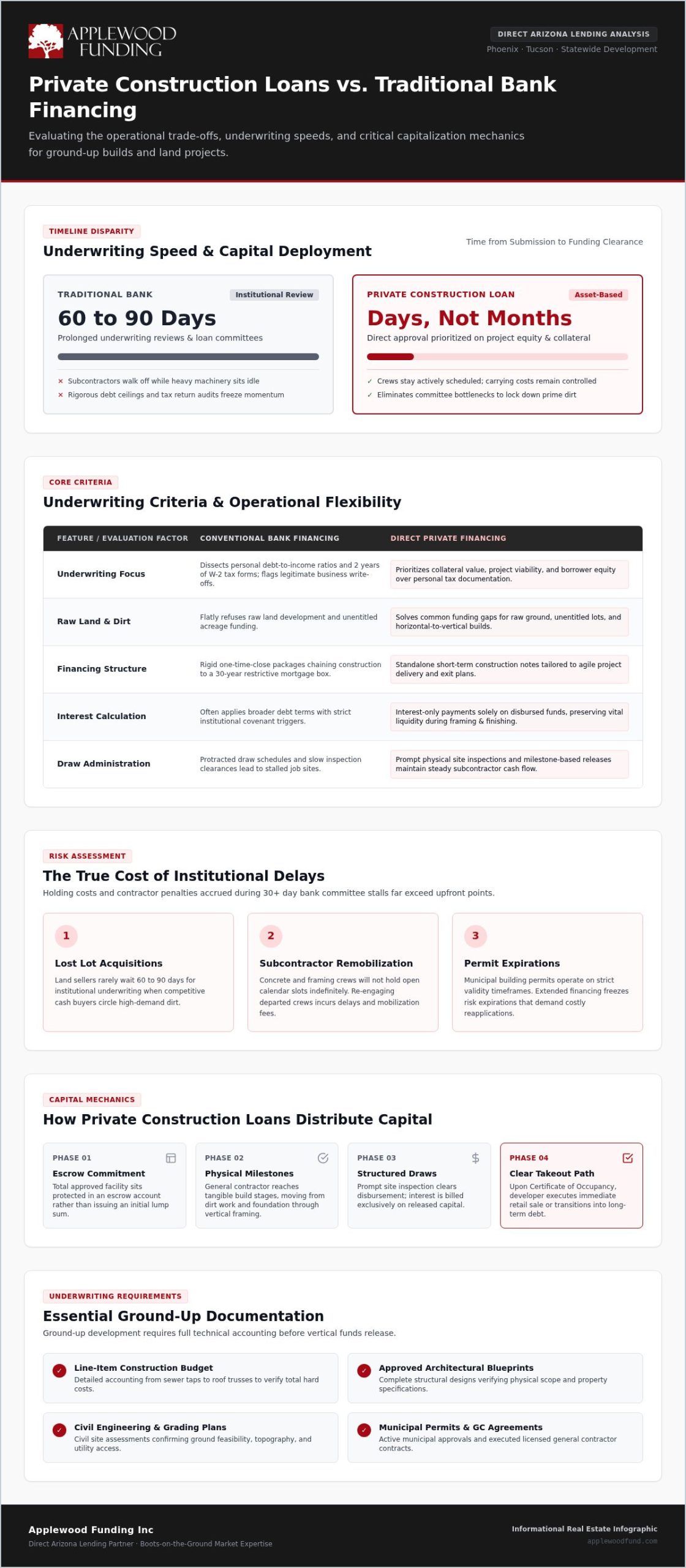
Paper interest rates don’t tell the whole story. Conventional banks lure developers with lower nominal rates, but they bury files under 60 to 90 days of underwriting reviews and loan committees. In high-demand development markets, that sluggish turnaround kills deals before the first shovel hits the dirt.
Private capital solves this operational bottleneck. While retail institutions dissect personal debt ratios and historic tax filings, asset-based private lenders evaluate ground-up construction loans by looking directly at the collateral, borrower equity, and project viability. When you secure loan clearance in days rather than months, your crews stay on schedule and your carrying costs stay under control.
The True Cost of Bank Underwriting Delays
Waiting on a bank approval committee creates expensive ripple effects across your jobsite. Every thirty-day stall can trigger severe compounding costs:
- Lost lot acquisitions: Land sellers rarely wait three months for institutional financing when cash buyers are circling.
- Subcontractor remobilization: Framing and concrete crews will not hold open calendar slots indefinitely; once they leave for another build, getting them back costs time and extra mobilization fees.
- Permit expirations: Municipal approvals run on tight expirations, meaning financing stalls often require costly reapplications.
According to guidebooks like Forbes’ breakdown on How To Get a Construction Loan, navigating institutional requirements means jumping through endless hoops including rigorous credit thresholds and restrictive debt ceilings. For an active builder, the holding costs and contractor penalties accrued during those delays far exceed the upfront points of agile private debt.
Underwriting Criteria: Project Equity vs. Personal Balance Sheets
Conventional mortgage guidelines rely on rigid formulas designed for typical W-2 employees. Self-employed custom builders and full-time developers often write off legitimate business expenses, showing reduced net income that triggers automatic bank declines. When conventional lenders hesitate, exploring alternatives such as bank statement loans or asset-backed notes keeps deals moving.
Private lenders care about the completed asset value and your operational ability to execute the scope of work. By underwriting the actual build rather than your tax write-offs, direct lenders approve projects conventional loan committees won’t touch. If you need quick feedback on your project numbers, you can connect directly with our lending team to evaluate your site and financing options without bureaucratic delays.
Core Qualification Requirements for a Private Construction Loan
Asset-based financing cuts through red tape, but direct lenders still demand operational discipline. Instead of scrutinizing personal debt ratios, lenders underwrite your project’s physical and financial structure. While the Consumer Financial Protection Bureau outlines regulatory basics in What is a construction loan?, private construction loans depend on clear equity, tangible collateral, and proven build execution.
Lenders evaluate your position through two core metrics: Loan-to-Cost (LTC) and Loan-to-After-Repair-Value (LTARV). LTC gauges total capital required against what you have personally invested, while LTARV caps exposure based on the completed property’s appraisal. Stronger collateral yields better terms.
Detailed Plans, Specs, and the Construction Budget
Every viable application starts with a clean line-item construction budget. You need precise trade breakdowns covering earthwork, slab, mechanicals, finishes, and clean-up. Build in an explicit contingency reserve. Material price shifts happen fast, and healthy reserves protect your bottom line from surprise cost spikes. Fully approved municipal building permits must accompany your architectural blueprints before vertical draws fund.
Builder Credentials and General Contractor Verification
A flawless set of plans means nothing without the operational muscle to execute them. Private lenders vet your general contractor thoroughly:
- Active licensing: Current state contractor license in good standing.
- Comprehensive insurance: General liability coverage and builder’s risk policies protecting the build site.
- Documented track record: A resume of recently completed ground-up builds matching your current project’s scope.
Owner-builder applications face heavier scrutiny. Unless you hold a valid contractor license and verifiable build history, hiring an experienced third-party general contractor speeds up underwriting and keeps your project moving.
Land Equity and Down Payment Considerations
You don’t always need liquid cash sitting in a checking account to meet down payment thresholds. If you already own your lot, your equity counts directly toward your required cash contribution. Paid cash for raw dirt two years ago? That market equity acts as real capital on your balance sheet.
If you hold substantial equity tied up in other real estate holdings, leverage it. Utilizing cash out hard money loans against existing rental assets or commercial dirt lets you pull liquidity for your upcoming build. Cross-collateralizing existing real estate gives active developers maximum purchasing power without selling income-producing properties.
Navigating the Construction Draw Schedule and Site Inspections
Cash flow dictates your project’s pace. A construction draw schedule serves as the operational engine for your jobsite, linking your budget directly to completed work. Instead of issuing capital upfront, lenders hold funds in escrow and disburse payments in stages as physical milestones are verified on-site. Managing this process smoothly keeps your crews paid, your materials delivered, and your build moving forward.
Traditional banks often take 7 to 14 business days to approve a single draw request, leaving trades unpaid and waiting. Direct private construction loans compress that inspection cycle to a few days. Faster turnaround prevents costly work stoppages and keeps your general contractor’s schedule intact.
Phases of a Typical Construction Draw Schedule
A standard ground-up residential schedule breaks disbursements into distinct physical phases:
- Phase 1: Site prep and foundation: Excavation, grading, underground utilities, and the poured concrete slab or footings.
- Phase 2: Framing and building envelope: Structural lumber, roof trusses, exterior sheathing, weatherproofing, windows, and exterior doors.
- Phase 3: Systems rough-ins: Complete rough plumbing, electrical wiring, HVAC ductwork, and municipal rough-in sign-offs.
- Phase 4: Interior finishes: Insulation, drywall, cabinetry, interior trim, tile, and paint.
- Phase 5: Final completion: Fixture installation, exterior flatwork, final inspections, and securing the Certificate of Occupancy.
Streamlining Inspections and Managing Lien Waivers
Quick releases require proactive management. When your contractor nears the end of a milestone, submit your draw request immediately alongside high-resolution site photos and progress documentation. Direct lenders review progress quickly, sending local inspectors who verify that completed work matches the submitted budget lines.
Protecting clear title is non-negotiable. Before releasing funds from any completed draw, collect conditional lien waivers from all active subcontractors and material suppliers. Once the wire hits, swap those for unconditional lien waivers for the paid work. This discipline prevents mechanic’s liens from clouding your title and stopping future funding draws dead in their tracks.
If you are ready to finance your next build with an agile lending partner who understands jobsite momentum, submit your project plans today to lock in your financing and keep your crews working.
Securing Construction and Land Financing in Arizona with Applewood Funding
National banks evaluate Arizona real estate from corporate back offices thousands of miles away. They don’t understand Sonoran desert soils, rapid submarket growth, or local municipal utility hurdles. Applewood Funding operates as your direct private lending partner, bridging capital gaps for builders and developers across Phoenix, Scottsdale, Mesa, Glendale, Flagstaff, and Tucson.
We provide specialized Construction and Land Loans built for active jobsites. By focusing on collateral equity and build feasibility rather than institutional red tape, we keep your capital fluid and your equipment running.
Arizona Market Expertise: From Infill Lots to Custom Builds
Building across Arizona presents specific municipal and site challenges. Urban infill projects in Phoenix or Mesa frequently hit Maricopa County zoning hurdles, right-of-way dedications, and unexpected utility extension fees. Outlying raw parcels require clear evaluations of dry utilities, road access, and water availability. Luxury custom homes in Scottsdale, Paradise Valley, and Flagstaff demand loan structures tailored to high-end architectural finishes and specialized trades.
Sluggish institutions hesitate when land parcels don’t fit into generic conforming boxes. We assess the physical ground, local buyer demand, and the completed asset value. Whether you are building an investor spec home or a custom residential build, our local underwriting ensures your construction loans match real-world market values.
Your Fast Path to Project Funding
Securing private capital should be fast and transparent. We don’t bury your file under endless committees or dissect years of personal write-offs. Getting started takes just three core assets: your architectural blueprints, your line-item construction budget, and your parcel details.
Joel McDaniel (NMLS 175371) works directly with builders and real estate investors to structure customized financing around your build milestones. Avoid costly bank delays, protect your project timeline, and fund your dirt with confidence. Apply for Arizona Construction Loans at Applewood Funding to get your plans evaluated and put your crews to work.
Build Faster with Direct Arizona Construction Financing
Waiting months on sluggish institutional approvals puts prime lots and profitable timelines at serious risk. Private construction loans eliminate that costly drag by putting equity, project feasibility, and jobsite momentum first. When your lender disburses draws in days rather than weeks, your subcontractors stay productive and your completion dates hold firm.
You need a local financing partner who knows the ground you are building on. Managed by lending expert Joel McDaniel (NMLS 175371), Applewood Funding provides direct, asset-based lending across Phoenix, Scottsdale, and statewide. We understand local market dynamics, evaluate collateral rapidly, and structure draw releases designed to keep your heavy machinery moving.
Don’t let endless underwriting red tape stall your jobsite. Take command of your build schedule and Get Your Construction Project Funded Fast with Applewood Funding. Your vision is ready for dirt; let’s get building.
Frequently Asked Questions
How fast can a private construction loan close compared to a bank?
A private construction loan can close in a matter of days or weeks, while traditional banks typically take 60 to 90 days. Direct private lenders bypass committee reviews and corporate underwriting red tape. Evaluations focus on project viability, land equity, and builder capability. In fast-paced Arizona markets like Phoenix and Scottsdale, rapid funding ensures you don’t lose prime lots to competing cash buyers.
Can I use land equity toward my construction loan down payment?
Yes, existing equity in your land counts directly toward your down payment and total capital requirements. If you already own your building parcel free and clear, or hold substantial equity in it, lenders credit that market value to your balance sheet. You don’t have to drain your cash reserves to break ground when your dirt already provides strong collateral backing.
What happens if material costs exceed my original construction budget?
Cost overruns are covered first by the contingency reserve line item built into your approved construction budget. Direct lenders require this reserve specifically to absorb material price fluctuations, municipal fee adjustments, or jobsite surprises. If cost increases exhaust the reserve, you must supply additional capital or modify terms with your lender to keep trade contractors working and prevent construction stoppages.
Are construction loans available for self-employed borrowers with no W-2?
Yes, private construction loans are readily available for self-employed builders, developers, and investors without W-2 forms. Asset-based lenders review the profitability of the build, overall collateral value, and your industry experience rather than personal tax write-offs. Your ability to execute the project successfully matters far more than traditional debt-to-income calculations that often penalize self-employed professionals.
How do construction draw disbursements work during the building process?
Draw disbursements release funds from an escrow account in structured stages as your contractor completes verified physical milestones. Once a phase like framing or mechanical rough-ins passes inspection, you submit a draw request. The lender verifies the completed scope, confirms lien waivers from subcontractors, and wires the funds. Private lenders process these releases in days, preventing costly jobsite shutdowns.
Can I get a private construction loan for an owner-occupied custom home?
Yes, specialized private lenders like Applewood Funding offer flexible financing options for owner-occupied residential construction across Arizona. While standard private shops avoid primary residences entirely, asset-based solutions can bridge the gap from groundbreaking to completion. Once your final Certificate of Occupancy is issued, you can transition the loan into a conventional long-term mortgage or pay off the note.
What is the typical term length for a private ground-up construction loan?
Typical term lengths for private ground-up construction loans range from 12 to 24 months. These short-term notes give you sufficient runway to complete site prep, vertical framing, interior finishes, and municipal sign-offs. After securing your Certificate of Occupancy, you simply exit the debt by selling the completed property or refinancing into a permanent long-term loan.