


Spec Home Financing: A Practical Guide for Arizona Builders
October 7, 2026LTV Definition: What Loan-to-Value Means for Your Mortgage

What does a mortgage percentage tell you about how much of a property’s value a lender is financing? That’s the key to the ltv definition: loan-to-value compares a loan amount with the property value used in the calculation. The figures can be easy to mix up, and the percentage does not tell the whole story.
LTV can help show how a property supports a loan and how much value may remain as equity, but it isn’t an approval verdict on its own. In this guide, you’ll learn the formula, work through examples, and see how a lender’s property valuation can affect the calculation.
We’ll also explain how LTV differs from combined loan-to-value (CLTV), what to consider when exploring financing, and why the percentage is only one part of the picture. If you’re weighing property-backed financing in Arizona, including an owner-occupied hard money loan, understanding LTV can help you prepare for a more focused conversation.
Key Takeaways
- The mortgage ltv definition compares a loan amount with the property value used in the calculation. It is different from customer lifetime value.
- Keep property value, loan balance, and equity separate to understand what each figure says about the property and financing.
- Use CLTV to consider multiple property-secured balances when relevant, and identify which liens are included.
- To estimate LTV, note the loan figure, valuation, any additional liens, and the date of each figure.
- Treat LTV as one useful detail in a property-financing discussion, alongside the borrower’s circumstances and transaction context.
LTV Definition: What Loan-to-Value Means in a Mortgage
In a mortgage, LTV means loan-to-value. It is not customer lifetime value, a business metric that estimates the revenue a customer generates over time. The ltv definition is straightforward: loan-to-value expresses the loan amount as a percentage of the property value used in the calculation. This puts borrowing and property value on the same scale, making their relationship easier to understand.
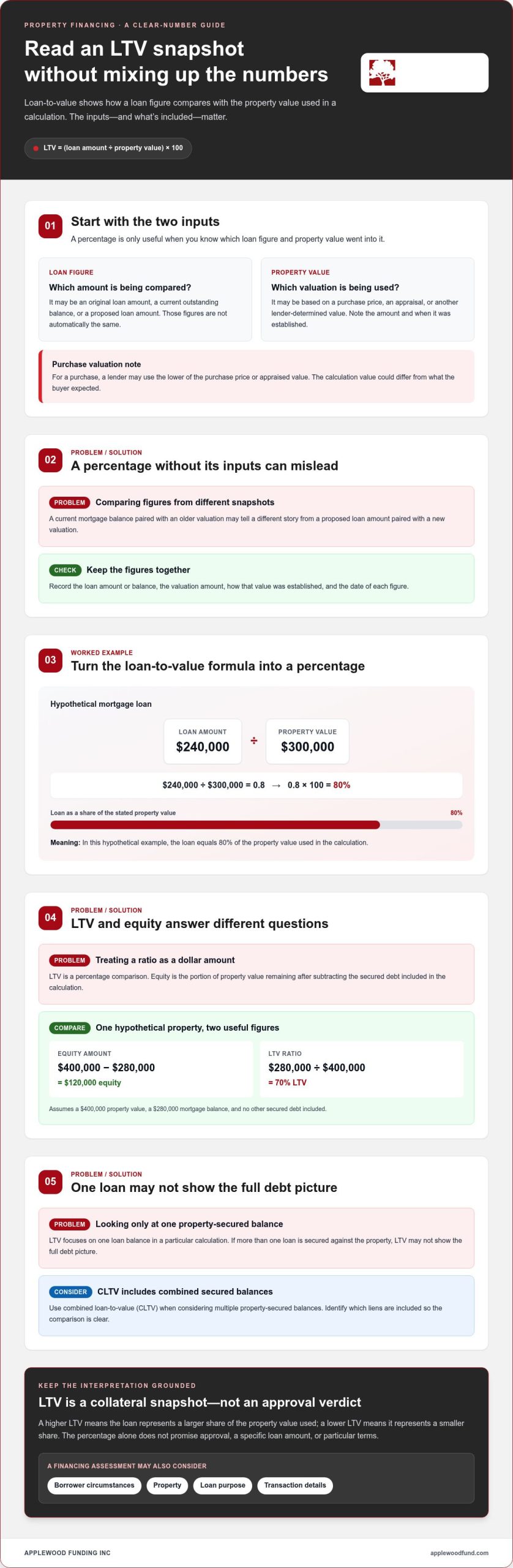
Mortgage loan-to-value (LTV) is the loan amount divided by the property value used in the calculation, multiplied by 100 to express the result as a percentage. The Loan-to-value ratio is used in real estate and other lending contexts, but the figures behind the calculation matter. A percentage is meaningful only when you know which loan amount and property value were used.
How do you calculate a mortgage LTV ratio?
Use this formula:
LTV = (loan amount ÷ property value) × 100
For a simple hypothetical example, imagine a mortgage loan of $240,000 and a property value of $300,000. Divide the loan amount by the property value, then convert the decimal to a percentage:
- $240,000 ÷ $300,000 = 0.8
- 0.8 × 100 = 80%
Result: The hypothetical LTV is 80%. The loan equals 80% of the property value used in this example. A lender may use a different valuation or calculation detail. For a purchase, a lender may use the lower of the purchase price or appraised value, so the figure used could differ from what the buyer expected.
What does a higher or lower LTV indicate?
LTV compares the amount borrowed with the property value in the calculation. A higher ratio means the loan represents a larger share of that value. A lower ratio means it represents a smaller share. In general, a lower LTV also indicates more property equity relative to the loan, though equity is a separate amount and depends on the property value and debt being considered.
For example, if the loan amount stays the same while the property value used in the calculation rises, the LTV falls. If the loan is larger relative to that value, the LTV rises. This comparison can help frame a financing discussion, but the percentage is not a decision by itself. A lender’s assessment may also consider the borrower, property, loan purpose, and transaction details. LTV is a snapshot of collateral, not a promise of approval, a specific loan amount, or particular terms.
How LTV Works: Property Value, Loan Balance, and Equity
An LTV calculation has two inputs: a loan figure and a property-value figure. If either changes, the ratio can change too. That’s why a percentage without its underlying figures can be hard to interpret. A current mortgage balance paired with an older valuation, for example, may tell a different story from a proposed loan amount paired with a new valuation.
Keep these three terms distinct:
- Property value: The value assigned to the property for a particular financing calculation. It may be based on a purchase price, an appraisal, or another figure determined through the lender’s process.
- Outstanding loan balance: The amount still owed on a loan at a specific point in time. It can differ from the original amount borrowed, especially after payments have reduced the principal.
- Equity: The portion of the property’s value that remains after subtracting the secured debt included in the calculation.
Equity is a value amount; LTV is a ratio comparing a loan figure with a property value. They’re related, but they answer different questions.
Which property value is used to work out LTV?
The relevant value depends on the financing context and the lender’s valuation process. For a purchase, both the purchase price and appraised value may matter. For other transactions, a lender may use a valuation prepared for that financing request or another lender-determined figure. Don’t assume one method applies to every loan. Timing matters too: a value from an earlier date may not reflect the figure used for a later transaction. When reviewing an estimate, note the valuation amount and how it was established.
How is equity related to loan-to-value?
Consider a hypothetical property valued at $400,000, with a mortgage balance of $280,000 and no other secured debt included. Subtract the balance from the value: $400,000 minus $280,000 equals $120,000 in equity. Using those same figures, the LTV is 70%, because the balance represents 70% of the stated property value.
That snapshot can shift in either direction:
- If the balance falls while the property value stays the same, the ratio generally falls and equity rises.
- If the property value falls while the balance stays the same, the ratio generally rises and equity falls.
- If the property value rises while the balance stays the same, the estimated ratio generally falls and equity rises, subject to the valuation used.
These are calculation effects, not promises about financing outcomes. A higher estimated value doesn’t guarantee a refinance or additional borrowing. The ltv definition helps organize the numbers, but a financing discussion also depends on the transaction and borrower context. For a property-specific conversation about Arizona financing, you can discuss your property financing questions with Applewood Funding Inc.
LTV vs. CLTV and Equity: Which Number Answers Which Question?
The ltv definition focuses on one loan balance in a particular calculation compared with the property value used for that calculation. If a property has more than one loan secured against it, however, LTV may not show the full debt picture. CLTV can describe the combined picture, while equity estimates the value remaining after secured debt is subtracted. These figures answer different questions, so don’t treat them as interchangeable.
What is the difference between LTV and CLTV?
LTV compares the loan balance included in a specific calculation with the property value. CLTV, or combined loan-to-value, can combine that balance with other property-secured balances, such as a second mortgage or home equity line of credit. Which balances count depends on the lender and financing structure. Identify what the calculation includes before comparing ratios.
| Measure | What it compares or shows | Question it helps answer |
|---|---|---|
| LTV | A loan balance relative to property value, expressed as a percentage | How large is this loan compared with the property value used? |
| CLTV | Combined property-secured balances relative to property value, expressed as a percentage | How do included liens and balances compare with the property value? |
| Equity | An estimated dollar amount after subtracting relevant secured debt from property value | What value may remain after that debt is subtracted? |
Here’s a hypothetical example. Say a property is valued at $500,000, its first mortgage balance is $300,000, and it also has a $40,000 home equity line balance. Using the first mortgage alone, LTV is 60%: $300,000 divided by $500,000. If both balances are included, the combined debt is $340,000, making CLTV 68%: $340,000 divided by $500,000. Assuming both debts are counted, estimated equity is $160,000: $500,000 minus $340,000.
Is LTV the same as home equity?
No. LTV and CLTV are percentages; equity is a value amount. In the example, the 60% LTV describes the first mortgage’s share of the property value. The $160,000 equity estimate reflects the value left after subtracting both included balances. The result depends on the valuation date and which secured debts are counted.
Equity isn’t automatically cash you can access. It’s an estimate based on property value and debt, not a loan offer or approval. Turning it into available borrowing depends on the financing structure and broader transaction. Likewise, even a favorable LTV doesn’t guarantee approval or specific terms. A lender may consider the property, borrower, requested financing, and other details alongside the ratio. Use LTV to understand one loan’s relationship to value, CLTV to frame included secured debt, and equity to estimate what may remain.
What Can Change LTV, and How Should Borrowers Use It?
An LTV estimate can shift as the loan balance, property value, or calculation context changes. A number you worked out for personal planning isn’t automatically the figure a lender will use. Keep the inputs together, label where they came from, and treat the result as a snapshot rather than a promise.
What information helps you estimate LTV?
Gather the figures before calculating. Use a current balance for the loan being considered, a reasonable property-value estimate, and any other secured balances if you want to understand combined LTV. Record the date and source for each figure. A personal estimate can help organize your questions, but it isn’t a lender valuation.
Use this short process:
- Choose the loan figure. For an existing loan, use a current balance rather than the original amount borrowed. For proposed financing, clearly label the amount as a requested loan figure.
- Write down the property value. Note whether it’s a purchase price, your own estimate, or a valuation prepared for financing, along with its date.
- List other secured balances. If you want a combined view, include relevant liens or property-secured credit balances. Which ones count can depend on the lender and financing structure.
- Calculate and label the result. Divide the loan figure by the property value, multiply by 100, and mark the result as a personal estimate or lender-calculated figure.
How should you interpret an LTV estimate before seeking financing?
Use the percentage to frame a conversation, not to predict its outcome. Paying down secured debt can reduce the loan figure in a calculation. A change in assessed or otherwise lender-used property value can also move the ratio, even if the balance stays the same. Neither change guarantees that a lender will use a particular value or that a lower LTV will lead to approval, a specific loan amount, or particular terms.
For example, if a hypothetical $300,000 balance is compared with a $400,000 value, the estimate is 75%. If the balance later falls to $285,000 and the value remains unchanged, the estimate becomes 71.25%. If the valuation changes instead, the ratio changes for a different reason. Keep the dates visible so you don’t compare mismatched figures.
Bring the property, requested financing, and your broader circumstances into the same discussion. Arizona borrowers considering owner-occupied property financing can explore the owner-occupied hard money loan guide as they prepare property-specific questions. To discuss those questions with Applewood Funding, start a property-financing conversation.
Using LTV in an Arizona Property-Financing Conversation
An LTV estimate can help organize a property-financing conversation, but it’s only one part of the picture. For borrowers in Arizona, the property, financing purpose, requested loan, and borrower’s circumstances all provide important context. Bring clear, dated information and treat any preliminary calculation as a starting point, not a decision or promise.
What should you bring to an LTV discussion?
Start with the property address and a plain-language explanation of what you’re trying to accomplish. Include available loan-balance information and identify which figures are current. If you have a property-value estimate, note its source and date. It can help frame the discussion, but it isn’t necessarily the valuation used in a lender’s calculation.
Also list other liens or secured balances on the property. They may matter if the financing discussion involves a combined loan-to-value calculation. Keep the information organized:
- Property: Address and intended use, such as an owner-occupied home.
- Financing goal: What you hope to accomplish and the type of financing you’re exploring.
- Loan information: Available balances, clearly labeled with their dates.
- Value context: Any estimate or appraisal you have, with its source and date.
- Other secured debt: Known liens or balances that could affect the combined picture.
How can an Arizona borrower take the next step?
Summarize the question you want answered, the property context, and your financing goal. That makes it easier to discuss which loan and property-value figures are relevant, whether other secured balances may matter, and what additional context the transaction requires. Your personal LTV estimate is not final. Keep its assumptions visible and be ready to explain where each number came from.
Applewood Funding is a private lender focused on owner-occupied hard money loans and serves Arizona borrowers, including in the Phoenix area. Borrowers across Phoenix, Scottsdale, Glendale, Peoria, Tempe, Mesa, Sedona, Flagstaff, and Tucson can use the owner-occupied hard money loan guide to learn more about this financing path. If your goal involves accessing property equity, review the cash-out hard money loan guide as you consider the questions to raise. Neither an LTV estimate nor a guide determines individual eligibility; the property and transaction need to be considered alongside the borrower’s circumstances.
Bring your property details and financing question into a focused conversation. Discuss your Arizona property-financing question with Applewood Funding.
Turn Your LTV Questions Into a Clear Next Step
Use what you’ve learned to sharpen the question you want a financing conversation to answer. Rather than focusing only on whether a percentage seems high or low, consider what decision you’re weighing and what information would help. The ltv definition gives you a useful starting point, but a property-financing decision deserves a fuller view of your goals, the transaction, and the details that still need clarification.
A practical next step is to write down the outcome you’re exploring, the assumptions behind your estimate, and the main point you want to understand. That keeps the conversation focused and helps separate what you know from what still needs to be evaluated for your situation.
Applewood Funding works with Arizona borrowers exploring property-backed financing, including owner-occupied hard money loans. If you’re ready to discuss how your property and goals fit into the picture, start a property-specific financing conversation. Bring a clear question and move forward one decision at a time.
Frequently Asked Questions
What does LTV mean in a mortgage?
In a mortgage, LTV is short for loan-to-value, a way to express a loan in relation to the property value considered for financing. This ltv definition is mortgage-specific, not customer lifetime value, a business metric. When reviewing a loan estimate, check which property value and loan figure the ratio refers to. Those inputs give the percentage its meaning and make it easier to compare financing scenarios.
How do you calculate loan-to-value?
Divide the loan amount by the property value used for the calculation, then multiply by 100. For example, a hypothetical $180,000 loan divided by a $240,000 property value equals 0.75; multiplied by 100, that’s 75% LTV. For a useful estimate, make sure the loan and value figures refer to the same financing scenario. Label your result as an estimate if the lender hasn’t determined the valuation.
Is a lower LTV better?
A lower LTV generally means the loan represents a smaller share of the property value in the calculation, which can indicate more equity relative to that loan. But “better” depends on what you’re evaluating. The ratio alone doesn’t say whether financing fits your plans, what terms may apply, or whether a lender will approve an application. Consider it alongside your loan purpose, property details, and broader financial picture.
Does LTV use the purchase price or appraised value?
It depends on the transaction and the lender’s valuation process. In a purchase, both the contract price and an appraisal may be relevant, and the value used for LTV may not match a buyer’s initial estimate. For planning, keep both figures and their dates handy rather than assuming one automatically controls. Use the lender’s calculation for the specific financing request when reviewing its terms.
Can LTV change after I pay down my mortgage?
Yes. If the balance used in the calculation decreases and the property value stays the same, the resulting LTV will generally decrease too. For an updated estimate, use your current principal balance rather than simply adding up monthly payments, since a payment may include interest or other amounts. A new valuation can also change the ratio, so note the dates of both inputs when comparing estimates.
Does LTV determine whether I qualify for a hard money loan?
No. LTV is one consideration, not a complete eligibility decision or a promise of a particular loan amount. Applewood Funding is a private lender focused on owner-occupied hard money loans and serves Arizona borrowers in Phoenix, Scottsdale, Tucson, and other communities. A property-specific conversation can consider the financing goal and borrower context alongside the property. An individual outcome can’t be inferred from an LTV estimate alone.