
Mesa, Arizona Private Lenders: How to Choose the Right Financing
October 4, 2026Private Financing for Arizona Home Builders: Funding Guide
The lowest headline rate isn’t always the best fit for a home-building project. When traditional financing doesn’t match your timeline, documentation, or project structure, private financing for home builders can provide another way to fund the work. The key is matching capital to the project, not choosing by rate alone.
Land acquisition, construction, and project completion can each call for a different funding plan. Unclear terms or mismatched timing can make it harder to budget and keep a build moving. Compare each financing option against the project’s specific costs, milestones, and repayment plan.
This guide explains where private financing may fit in an Arizona builder’s capital plan, what to compare beyond the interest rate, and how to prepare a focused funding request. You’ll consider project risk, draw timing, repayment plans, and the information that makes a financing discussion more productive. Applewood Funding Inc offers construction and land loans for Arizona real estate projects, including projects in Phoenix and surrounding markets.
Key Takeaways
- Private financing for home builders can suit projects where conventional funding doesn’t align with the timeline, documentation, or stages of development.
- Map funding needs from land acquisition through construction and the planned sale or other repayment event.
- Compare use of funds, collateral, loan term, payment structure, and repayment plan, not just the headline rate.
- Prepare a clear funding request with a project summary, documented costs, specific capital needs, and a realistic budget that identifies contingencies.
- Applewood Funding Inc offers construction and land loans for Arizona real estate projects, including builds in Phoenix-area markets.
When Arizona home builders consider private financing
A home-building project doesn’t always fit the structure of a standard residential mortgage. Private financing for home builders is nonbank funding arranged around a real estate project and its plan, such as acquiring land, paying for construction, or bridging a timing gap between project stages. This differs from a buyer’s mortgage to purchase a home to live in. For a neutral overview of the broader concept, see private money investing.
The right financing depends on what needs funding, the project’s current stage, and how the loan will be repaid. Private capital still requires a clear picture of the property, proposed work, costs, and repayment plan. Prepare those details before comparing terms.
Which builder projects may need private capital?
Consider three project types. A ground-up build may need funding for a site and construction as work progresses. A spec home may call for capital to build a property intended for sale, with repayment tied to that exit. A small development may have phased needs, such as acquiring land first and arranging funds for later work as a separate stage.
In each case, land readiness, construction scope, and project stage shape the financing discussion. A Phoenix-area site that needs substantial preparation presents a different plan from a build on a ready-to-develop lot. Costs, schedules, and constraints also vary from one property to another in Phoenix, Mesa, and other Arizona markets.
Private financing versus conventional construction financing
Conventional construction financing generally follows a lender’s established criteria and documentation process. Private financing may allow a lender to assess the project in light of its specific real estate plan and collateral. That difference doesn’t mean approval is assured, timelines are faster, or requirements are lighter. Feasibility, documentation, collateral, and repayment still matter.
Before comparing options, clarify the amount and purpose of the funding, the construction stage it supports, and the event expected to repay it. Then review the written terms and how the structure fits the project schedule. For a closer look at ground-up funding considerations, read the construction loan guide.
How private financing can align with a Phoenix-area build
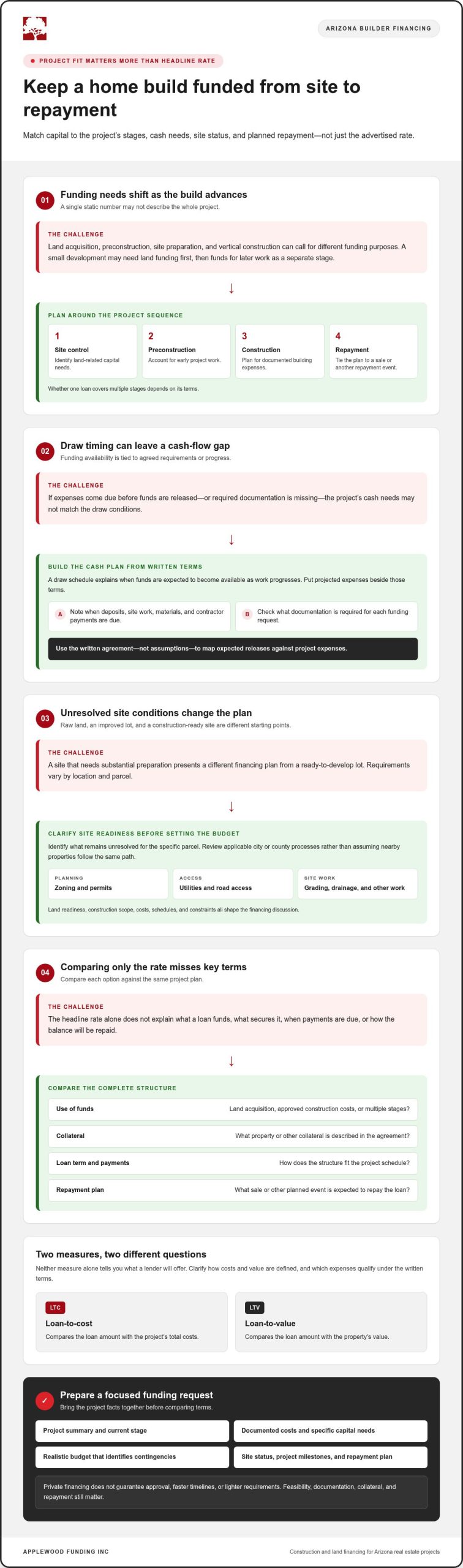
Plan for a home build as a sequence of capital needs, not one static number. A builder first secures control of a site, then addresses preconstruction work, site preparation, and vertical construction. As the project advances, the funding purpose may shift from land-related costs to documented building expenses. At completion, a sale or another planned repayment event may close the financing loop. Whether one loan covers multiple stages depends on its terms.
Two measures can help describe a project, but they answer different questions. Loan-to-cost (LTC) compares the loan amount with the project’s total costs. Loan-to-value (LTV) compares the loan amount with the property’s value. Neither measure alone tells you what a lender will offer. Clarify how the lender defines costs and value, and which expenses are eligible under the written terms.
What does a construction draw schedule mean?
A draw is a release of loan funds tied to agreed project requirements or progress. The draw schedule explains when funding is expected to become available as work moves forward. Put projected expenses beside those terms: note when deposits, site work, materials, and contractor payments are due, and what documentation is required for each request. A mismatch between cash needs and release conditions can create a funding gap, so build the schedule from the written agreement rather than assumptions.
How land readiness affects the financing plan
Raw land, an improved lot, and a site prepared for construction are different starting points. Before building a budget, identify what remains unresolved: zoning and permits, utility access, road access, grading, drainage, or other site work. Requirements vary by location and parcel. For a Phoenix, Mesa, or Scottsdale project, review the relevant city or county processes for that specific site instead of assuming nearby properties follow the same path.
Public programs can also serve particular types of developers. For example, the USDA describes Arizona housing site loans for eligible nonprofit organizations and tribes. That program is distinct from private builder financing, but it illustrates why the borrower, site, and funding purpose all matter.
Bring the project stages, cost assumptions, site status, and repayment plan into one clear overview. This gives a financing discussion a practical starting point. Builders assessing an Arizona project can also discuss construction and land financing with Applewood Funding Inc.
How to compare private financing options for home builders
A useful comparison starts with the project, not the advertised rate. Private financing for home builders can be structured around land, construction, or a combination of project stages. Compare each option against the same plan: what needs funding, what secures the loan, when payments are due, and how the balance will be repaid.
| Comparison point | Questions to answer |
|---|---|
| Use of funds | Does the financing address land acquisition, approved construction costs, or multiple stages? |
| Collateral | What property or other collateral secures the loan, and how is it described in the agreement? |
| Term | Does the loan term fit the project schedule, including possible delays and completion? |
| Payment structure | When are payments due, and what are the documented draw conditions and fees? |
| Repayment plan | Will repayment come from a sale, refinance, or another defined source? |
Which financing structure fits the project stage?
Land-focused financing may suit a site acquisition or development need. Construction financing is associated with building activity and project costs covered under the agreement. Some plans use separate financing for each stage; others may coordinate land and construction needs. The right structure depends on the project’s status, collateral, documentation, and funding sequence. Compare how each option supports the next milestone, not just the project’s overall label.
What terms should builders compare before deciding?
Read the written terms for repayment timing, fees, extension provisions, collateral, draw conditions, and assumptions tied to the project’s exit. A rate that looks attractive on its own may not reflect the full cost or the risk of a term ending before the expected sale or refinance. Make the repayment plan realistic and account for possible schedule changes. Actual terms vary by lender, borrower, property, and project documentation.
Test the plan against a delay before choosing. If construction takes longer or the intended sale is postponed, what options does the agreement provide, and what costs may change? Review the hard money loan pros and cons guide for another perspective on weighing flexibility against financing risks.
What Arizona builders should prepare before seeking private financing
A focused funding discussion starts with a clear project story. Explain what you’re building, the property’s current status, how much capital you need at each stage, and what event is expected to repay it. For private financing for home builders, an organized package connects the funding request to the project plan and makes key assumptions easier to assess.
Build a clear project and budget package
Bring the core details together in one place. Include the property location and site status, plans or project scope, expected schedule, contractor information, and projected costs. Add a sources-and-uses summary showing where project funds will come from and where they’re expected to go, such as acquisition, site preparation, or building work.
Make the budget useful, not just optimistic. Identify contingency assumptions separately so it’s clear which figures are estimates and which costs are supported by current documentation. Describe the intended exit in plain language, whether that’s a sale, refinance, or another repayment source, and explain the assumptions behind its timing.
- Confirmed: property details, completed work, documented costs, and approvals already received.
- Estimated: projected costs, schedules, or values that may change as the project advances.
- Pending or assumed: approvals not yet issued, site conditions not yet verified, or other unresolved items.
This distinction makes uncertainty visible and helps prevent preliminary estimates from being mistaken for settled facts.
Make the Arizona project context easy to understand
Name the city and the authority responsible for relevant reviews. Zoning, permitting, access, and utility requirements can depend on the specific parcel and jurisdiction, so verify details with the applicable local authority rather than treating Arizona as one uniform approval process. For a Phoenix project, identify which items fall under the city’s review; for an unincorporated Maricopa County site, identify the county-level process where applicable.
Track each item as confirmed, in progress, or unresolved. A pending permit, unclear utility connection, or unverified access route can affect the project schedule and cost assumptions. Show how you’re accounting for it, and don’t present an expected approval as final. Clear documentation won’t remove project risk, but it gives everyone a more accurate basis for discussing scope, funding needs, and repayment.
Prepare your project overview and discuss construction or land financing with Applewood Funding’s Arizona lending team.
Explore private construction and land financing with Applewood Funding
A financing decision should fit the project’s stage, the purpose of the funds, the written loan terms, and the plan for repayment. A builder acquiring a site has different funding questions from one preparing for construction or managing a project through completion. Consider those pieces together. The goal is to understand how the funding structure relates to the work, not to choose by a headline rate or assume one approach suits every build.
Applewood Funding Inc is an Arizona private lender offering construction and land loans. For builders exploring alternatives to conventional financing, these loans address land and building needs for real estate projects. The financing discussion takes account of the borrower and project, including scope, stage, documentation, and repayment strategy.
When a private lender may be worth discussing
Consider a project-specific financing discussion if conventional financing doesn’t align with the planned work or funding sequence. Start with the exact need: land acquisition, construction activity, or a defined stage of a larger build. Then connect that need to the project schedule and intended repayment source. Private financing for home builders is best evaluated in light of the project’s scope, timing, collateral, and exit plan.
Bring the assumptions into the discussion, too. If a permit is pending, a cost is still an estimate, or repayment depends on a future sale or refinance, identify that plainly. A transparent overview helps frame the questions that need to be addressed. Approval, rates, and terms depend on the specific financing review.
Take the next step with an Arizona financing team
Prepare a concise project summary before discussing funding. Include the property location and current status, what the financing would cover, current budget assumptions, the expected schedule, and how you plan to repay. Keep confirmed details distinct from estimates and unresolved items. That gives the conversation a practical starting point and keeps the focus on the project’s actual needs.
Applewood Funding Inc’s construction and land loans are options for Arizona builders evaluating private capital for a real estate project. Bring your project outline and budget assumptions, then discuss your home-building financing needs and potential next steps.
Move Your Arizona Build Toward a Clear Funding Plan
The right financing conversation starts with a clear view of the project: its current stage, what the funds will cover, and how repayment is planned. Compare written terms beyond the headline rate, including collateral, payment structure, fees, and timing. Keep confirmed details separate from estimates or pending approvals so the funding request reflects the project as it stands.
Private financing for home builders can be worth exploring when a project’s needs don’t align with conventional financing. Applewood Funding offers construction and land loans for Arizona real estate projects. Builders in Phoenix, Scottsdale, Glendale, Peoria, Tempe, Mesa, Sedona, Flagstaff, and Tucson can bring their project overview and current budget assumptions to discuss the financing need.
Discuss your home-building financing needs and take a practical next step toward your project’s funding plan.
Frequently Asked Questions
What is private financing for home builders?
Private financing for home builders is nonbank funding for a real estate project, structured around its purpose, property, and repayment plan. It differs from a standard mortgage for a buyer who plans to live in the home. A builder may use it for land acquisition, construction, or a specific project stage. The proposed work, collateral, documentation, and repayment strategy all shape the financing discussion.
Can a home builder use private financing to build a spec home?
Yes, a builder may explore private financing for a spec home, a property built for sale rather than for a specific buyer to occupy. The funding request should explain the site, construction scope, budget, expected schedule, and intended repayment from the sale or another source. Whether financing fits depends on the borrower, property, project documentation, and loan terms, so don’t assume every spec build will be treated alike.
How does private construction financing work for home builders?
Private construction financing funds building activity according to the written loan terms. Funding may be released through draws tied to agreed project requirements or progress, so builders should coordinate projected expenses with the documented process. Before committing, understand eligible costs, payment obligations, draw conditions, loan term, and repayment plan. Private financing for home builders isn’t automatically faster or easier to qualify for; project details and borrower circumstances matter.
What do private lenders look for in a home-building project?
Private lenders commonly assess the property and collateral, project feasibility, construction scope, budget, relevant documentation, and repayment plan. A builder can make the discussion clearer by separating confirmed facts from estimates and pending approvals. For example, identify whether permits are issued or still in process, and show how projected costs connect to the funding request. Specific review criteria vary by lender, borrower, property, and project.
Is private financing more expensive than a conventional construction loan?
It can be, though the full comparison depends on the specific financing terms. Private construction financing may carry a higher borrowing cost than conventional options, so compare more than the stated interest rate. Review fees, payment structure, term, extension provisions, draw conditions, and repayment timing together. Then weigh the total cost and financing risk against how well the structure fits the project schedule and planned exit.
Can private financing cover both land and construction?
It may be possible to coordinate funding for land and construction, but the structure depends on the lender and project. Some plans use separate stages or loans, while others may address multiple needs under documented terms. Applewood Funding offers construction and land loans for Arizona real estate projects. Discuss the site status, building scope, funding purpose, and repayment plan so the project’s needs are clear.
What should Arizona home builders prepare before contacting a private lender?
Prepare a concise project summary, current budget, sources-and-uses outline, funding amount and purpose, schedule, and repayment plan. Include site details and construction scope, and identify estimates or contingency assumptions clearly. Verify zoning, permits, access, and utilities with the relevant local authority. For projects in Phoenix, Scottsdale, Glendale, Peoria, Tempe, Mesa, Sedona, Flagstaff, or Tucson, name the property’s jurisdiction and its approval status.