


Asset-Based Mortgage: How to Qualify and Choose the Right Loan in 2026
October 1, 2026Private Lender for Self-Employed Borrowers: Find the Right Arizona Home Loan

Can a private lender for self employed borrowers look beyond the income shown on a tax return? That question often comes up when business deductions lower taxable income, even though money continues to flow through the business. The key is matching your income records and property plans to a financing option that fits.
If your earnings change with the season or business cycle, it can be difficult to know which records to gather or how a lender may evaluate them. Bank statement loans offer one way to document self-employed income through account activity rather than relying only on tax-return income. The right approach still depends on your financial picture and whether you plan to occupy the home.
This guide explains how lenders may assess self-employed income, how bank statement loans compare with owner-occupied hard money financing, and what to prepare before discussing options. You’ll also learn how the property’s intended use shapes the decision, so you can have a more focused home-loan conversation in Arizona.
Key Takeaways
- Separate the lender type from the loan structure to identify which financing path may fit your situation.
- A private lender for self employed borrowers may consider bank deposits alongside business activity, recurring obligations, and available assets.
- Compare bank statement and owner-occupied hard money financing by property use, income evidence, repayment planning, and tradeoffs.
- Start with the property’s purpose and occupancy, then organize income records, debts, assets, and a realistic payment picture.
- Applewood Funding offers bank statement loans for self-employed borrowers and owner-occupied hard money loans as distinct financing options.
Private Lender for Self-Employed Borrowers: Why Income Can Be Hard to Show
Your business may bring in steady cash while your tax return shows modest net income. That difference can reflect legitimate deductions that reduce taxable profit, not necessarily a lack of money moving through the business. Lenders need to understand what income is available to support a home payment, not just how much the business collected.
Consider a Phoenix contractor with busy months during one part of the year and fewer projects during another, or a Scottsdale consultant who reinvests a substantial share of revenue in staff, equipment, or marketing. Deposits, expenses, and owner withdrawals can look very different from a salaried worker’s regular paycheck. Neither pattern automatically qualifies or disqualifies a borrower. The important step is presenting the full financial picture clearly.
Why self-employed income can look different on paper
Self-employment means earning income directly through a business or independent work rather than receiving wages from an employer. Income may arrive in uneven deposits, and seasonal work can make one month look very different from the next. Business costs matter too: gross receipts are not the same as personal funds available for a mortgage after operating expenses and other obligations.
Owner compensation can add another layer. A business owner may leave money in the company, pay themselves on a changing schedule, or use funds for both business and personal needs. A lender reviewing an application needs to understand these movements in context. The goal is to show how income flows and what remains available, rather than treating every deposit as spendable income.
What a private lender means for a homebuyer
A private lender for self employed homebuyers is a nonbank financing source that evaluates a loan application under a particular program’s approach to income, property, and repayment. “Private lender” describes the type of lender, not one standard loan. The documents reviewed and the factors emphasized depend on the loan structure and the property’s purpose.
A bank statement mortgage may provide an alternative way to document self-employed income by examining account activity under the program’s guidelines. A hard money loan is a distinct path that may place greater emphasis on the property and its value. Neither approach means finances are ignored, and one is not a universal substitute for the other.
Self-employment alone does not determine the outcome. Income evidence, available assets, existing obligations, the property, and a realistic repayment plan all help frame the discussion. Start by identifying how you’ll use the home and how your business income reaches you. That gives a lender a clearer starting point for considering which financing approach may fit.
How Private Lenders Review Self-Employed Income and Bank Statements
Bank statement review can offer an alternative way to document self-employed income, but it does not mean a lender will ignore tax returns, debts, or other parts of your finances. A private lender for self employed borrowers may consider deposits alongside business activity, recurring obligations, available assets, and the property involved. The exact records and calculations depend on the loan program.
Which records can help show business income?
Gather documents that show how your business earns and uses money. Depending on the loan structure and how you’re paid, useful records may include personal or business bank statements, tax documents, 1099 forms, and profit-and-loss statements. The IRS Self-Employed Individuals Tax Center offers tax information for people who work for themselves. A lender’s documentation review serves a different purpose: assessing the loan application.
If you already keep business and personal transactions separate, preserve that organization. It can make deposits, transfers, and expenses easier to explain without treating every dollar entering an account as personal income.
How lenders consider variable income and deductions
Deposits tell only part of the story. A lender may look at whether incoming funds reflect regular business revenue, then consider operating costs and recurring personal obligations that affect repayment capacity. A seasonal dip or a large business expense may prompt questions about the broader pattern. Income consistency needs to be understood in context, rather than treated as a universal pass-or-fail rule.
Business bank deposits can exceed taxable income because deposits reflect money received, while taxable income may be reduced by deductible business expenses. The IRS explains self-employment tax and related responsibilities, but a lender’s income calculation follows the specific loan program’s approach. Don’t assume every deposit will count the same way.
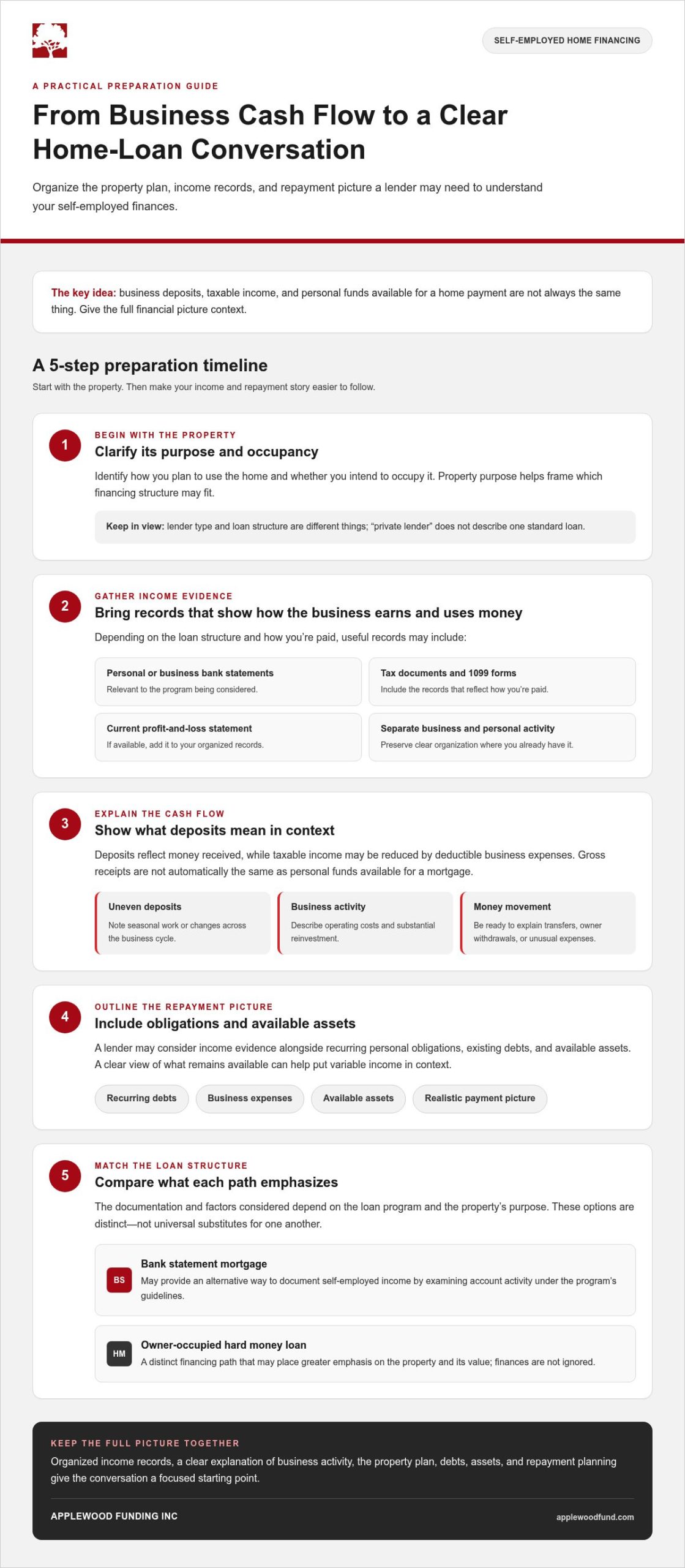
Before discussing an application, organize the records you already have:
- Personal and business bank statements relevant to the program.
- Recent tax documents and any 1099 forms.
- A current profit-and-loss statement, if available.
- A simple explanation for large deposits, transfers, or unusual expenses.
- A list of recurring debts and assets that may support repayment.
Keep records complete and easy to follow. If you’re weighing bank statement financing for a home purchase, discuss your income records and property plans with Applewood Funding to explore how the documentation and loan purpose fit together.
Bank Statement Mortgage or Hard Money Loan: Which Fits Your Situation?
These financing paths address different needs. A bank statement mortgage focuses on documenting income through records accepted for that program. Hard money financing is generally asset-based, with the property playing a central role in the evaluation. Neither label tells you everything about repayment obligations or whether a loan fits your plans. The Consumer Financial Protection Bureau’s overview of different kinds of loans is a useful starting point for understanding that loan structures can vary.
| Comparison | Bank statement mortgage | Owner-occupied hard money |
|---|---|---|
| Income evidence | Bank activity and other records accepted under the program help document cash flow. | Asset-based review emphasizes the property, while repayment obligations still need careful consideration. |
| Property purpose | May suit a home purchase where self-employed income needs a different documentation approach. | A specialized path for a home you intend to occupy, not a universal fit for a primary residence. |
| Repayment planning | Consider income patterns, ongoing debts, and whether the expected payment fits your finances. | Map out how you’ll meet the obligations and what your longer-term repayment strategy is. |
| Main tradeoff | Program criteria still apply, and deposits don’t automatically count as qualifying income. | Property-focused evaluation doesn’t remove the need to assess total obligations and repayment plans. |
When a bank statement mortgage may be worth exploring
If business deductions make tax-return income less representative of your cash flow, a bank statement approach may be worth discussing. It uses account activity as an alternative way to document income, based on records and calculations accepted for that program. The lender still reviews the application against applicable criteria. Explore bank statement loan options for self-employed borrowers as a financing path to consider, not a promise of qualification.
When owner-occupied hard money needs closer consideration
Owner-occupied hard money may be a specialized option when conventional financing doesn’t fit the situation. Before proceeding, examine the full obligations, how payments fit your budget, your repayment strategy, and the implications of occupying the property. Applewood Funding offers owner-occupied hard money loans, a distinct path that is not a substitute for every homebuyer’s financing needs.
Which should you explore first? Match the structure to the property’s purpose and the evidence you can provide. A private lender for self employed borrowers can offer different financing approaches, but each still requires a clear-eyed review of total obligations and a workable repayment plan.
Prepare for a Private Lender Conversation in Phoenix or Across Arizona
A focused conversation starts with the property, not a stack of paperwork. Whether you’re considering a home in Phoenix, Scottsdale, or elsewhere in Arizona, clarify how you’ll use it and how your self-employed income supports repayment. Then organize the details that help a lender understand your finances.
- Define the property purpose and occupancy. State whether you plan to live in the home as your primary residence or use it as an investment property. The purpose matters because financing paths can differ by intended use.
- Map your income sources and business activity. Note your business structure, how you pay yourself, where customer payments are deposited, and whether income changes by season or project. Summarize major business deductions and explain unusual deposit patterns consistently.
- Gather records and list obligations. Organize income documents relevant to the loan structure, along with recurring personal and business debts. Make a clear snapshot of available assets and business cash reserves, distinguishing funds needed to operate the business from money you could use toward housing costs.
- Build a realistic payment picture. Review household expenses, business needs, and existing obligations before estimating what payment is sustainable. Prepare questions about the documentation used, repayment structure, and how the loan terms would affect your budget.
Review the full financing picture before choosing
Don’t compare options based on assumptions or a headline payment alone. Review the written disclosures for each financing option, including payment obligations and loan terms, then consider how those commitments fit alongside variable income and business expenses. A reserve that looks available on paper may be needed for payroll, taxes, inventory, or a slower business period.
For a private lender for self employed borrowers, a clear summary can make the discussion more productive: identify the property use, explain how income flows through your business, and show how you’re thinking about repayment. Bring questions as well as documents. If income fluctuates, describe the pattern and what drives it rather than presenting one unusually strong month as typical.
Connect your records to your property plans, then weigh the obligations carefully. Discuss your Arizona home-loan situation with Applewood Funding and bring your income documentation and intended property use into the discussion.
Explore Self-Employed Home Financing with Applewood Funding
Your next step is to connect your income records to your property plans. Applewood Funding offers bank statement loans for self-employed borrowers, providing an alternative way to document income through records accepted for the program. A useful financing discussion considers your full situation: how you earn, how money moves through your business, and what kind of property you intend to buy.
Match the conversation to your income and home goals
Be ready to explain your income sources, deposit patterns, business expenses, and any seasonal or project-based changes. Then clarify whether the property will be your primary residence or serve another purpose. These details help frame the financing discussion and identify records that may be relevant.
Bank statement financing and owner-occupied hard money are separate options. A bank statement loan focuses on documenting self-employed cash flow through accepted records. Owner-occupied hard money is a specialized alternative with a different evaluation approach, and it isn’t a universal fit for a homebuyer. For more context on income documentation, review the bank statement mortgage guide for self-employed borrowers.
Applewood Funding Inc is managed by Joel McDaniel (NMLS 175371). As you explore options, focus on fit: how the loan structure relates to your property plans, what repayment obligations it creates, and whether the proposed payments make sense alongside household and business needs.
Take the next step with an Arizona lending team
Self-employed borrowers in Phoenix, Scottsdale, Tempe, Mesa, Glendale, Peoria, Sedona, Flagstaff, Tucson, and surrounding Arizona communities can discuss their scenario with Applewood Funding. Be ready to talk through your income documentation, property purpose, and questions about potential next steps. A clear starting picture helps keep the conversation practical and focused.
Before moving forward with a proposed structure, review its written terms and repayment obligations carefully. Understand how payments fit your budget and business cash flow. Contact Applewood Funding about Arizona home financing to discuss your self-employed income and home plans.
Move Forward with a Clearer Home-Loan Plan
Your business income deserves context. Bank statement loans can offer self-employed borrowers an alternative way to document cash flow, while owner-occupied hard money is a separate, specialized financing path. A productive discussion starts with your property purpose, the records you can provide, and a realistic plan for repayment.
Choosing a private lender for self employed borrowers isn’t only about finding a lender outside a bank. It’s about understanding how the financing structure evaluates your income and property, then weighing the full obligations before deciding how to proceed. Applewood Funding Inc, managed by Joel McDaniel (NMLS 175371), offers both bank statement loans for self-employed borrowers and owner-occupied hard money loans. They are distinct options, not a guarantee of approval or a fit for every borrower.
Bring your income documentation and home-buying plans into a focused conversation. Contact Applewood Funding about Arizona home financing to discuss your scenario and potential next steps. With a clearer picture of your records, property goals, and repayment plan, you can move forward with greater confidence.
Frequently Asked Questions
Can I get a mortgage from a private lender if I am self-employed?
Yes, a private lender may consider a self-employed borrower, but self-employment alone doesn’t guarantee approval. The review depends on the loan program, income records, property purpose, assets, and repayment plan. Some programs use bank statements or other alternative records to assess income. If you’re buying in Phoenix, Scottsdale, or elsewhere in Arizona, compare the proposed structure and obligations with your financial goals before moving forward.
What documents do self-employed borrowers need for a private mortgage?
Required documents vary by loan structure. A file may include personal or business bank statements, tax documents, 1099 forms, profit-and-loss statements, identification, and information about debts and assets. Organize records that show where income comes from and how it changes over time. For an Arizona home-loan discussion, keep business and personal transactions clearly identified where possible, and talk through how the program evaluates your documents.
How do bank statement loans verify income for self-employed borrowers?
Bank statement loans use eligible account statements as an alternative way to review self-employed cash flow. A lender may assess deposits and account activity under the program’s guidelines, but deposits don’t automatically equal qualifying income. Account ownership, business expenses, and the pattern of incoming funds can all matter. Prepare clear records showing how your income is earned, whether you work in Tempe, Mesa, or another Arizona community.
Is a bank statement mortgage the same as a hard money loan?
No. A bank statement mortgage uses eligible bank records as an income-documentation approach. Hard money financing is generally asset-based, so the property plays a central role in the evaluation. The loan structure, property purpose, review process, and repayment considerations can differ. Arizona borrowers should compare the actual written terms and obligations, rather than choosing based on the lender label alone. Make sure the repayment plan fits your finances.
Can I use a private lender to buy a primary residence in Arizona?
Some private lending options address owner-occupied financing, but the property’s occupancy and loan structure matter. Applewood Funding offers owner-occupied hard money loans as a specialized option. This doesn’t mean the option fits every homebuyer or situation. Borrowers in Phoenix, Scottsdale, Glendale, Peoria, Sedona, Flagstaff, Tucson, and surrounding Arizona communities should consider their circumstances, property, and repayment plan, then review the proposed terms and disclosures before deciding.
How much of my self-employed income will a lender count?
There isn’t one calculation that applies to every lender or program. A private lender for self employed borrowers may review deposits, business expenses, income patterns, assets, debts, and other records according to the selected program. Don’t assume gross business receipts equal qualifying income. For an Arizona home purchase, prepare a clear picture of both business cash flow and household obligations so the program’s income calculation can be discussed in context.
What happens if my business income changes from month to month?
Variable income doesn’t automatically rule out a mortgage, but its source and pattern may need explanation. Organize bank statements and business records to show seasonal cycles, project-based earnings, or one-time deposits. Also outline recurring business and household obligations, plus how you’d manage payments during slower periods. For borrowers in Phoenix and across Arizona, the applicable loan program determines how these details factor into its review.