


Peoria Rental Property Financing: A 2026 Investor’s Buying Guide
September 28, 2026Bridge Lending Explained: How Bridge Loans Work in 2026

What if the financing that gets you to closing becomes the biggest risk after it? A purchase or project deadline can arrive before sale proceeds, refinancing, or other funds are ready. Bridge lending may help cover that timing gap, but only if you have a realistic way to repay the loan.
It makes sense to look for financing that fits your timeline, but speed alone isn’t a plan. Before moving forward, understand the repayment deadline, total loan costs, and what happens if a sale or refinance takes longer than expected.
This guide explains how bridge lending works in 2026, how it compares with hard money and conventional financing, and what risks to consider before borrowing. You’ll learn what lenders may review, which questions to ask about terms and fees, and what to prepare when discussing a real estate financing need in Arizona. The goal is to help you decide whether bridging the gap makes sense for your situation, not just your deadline.
Key Takeaways
- Bridge lending is designed to cover a temporary financing gap. Whether it fits depends on the transaction, property, and repayment plan.
- Check the loan documents to confirm what secures the loan, when repayment is due, and whether an extension is possible and under what conditions.
- Bridge loans and hard money loans can overlap. Compare the purpose, underwriting, costs, and written terms instead of relying on the label.
- Stress-test your exit plan by considering how you would manage payments if a sale or refinance takes longer than expected.
- Before discussing financing in Arizona, gather property details, transaction timing, available equity, and information about your proposed repayment source.
What Is Bridge Lending, and What Financing Gap Can It Fill?
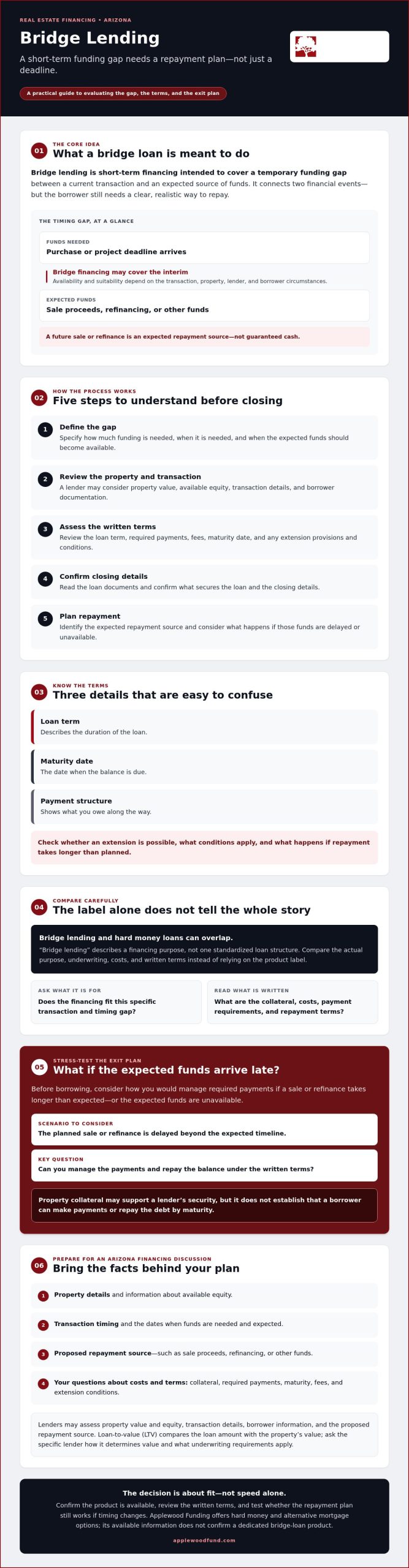
Bridge lending is short-term financing intended to cover a temporary gap between transactions. For example, a buyer may need funds to complete a purchase before proceeds from selling an existing property are available. The loan can connect those financial events, but the borrower still needs a clear plan to repay it.
Bridge lending is short-term financing used to cover a temporary funding gap between a current transaction and an expected source of funds. The Bridge loan overview provides broader background on how these loans are used in real estate and other settings. In practice, “bridge lending” describes a financing purpose, not one standardized loan structure. Terms, collateral, and repayment requirements vary by lender and borrower circumstances.
How a bridge loan connects two financial events
Imagine a homeowner has an accepted offer on a new home, but proceeds from selling their current home won’t arrive before the new purchase is scheduled to close. A bridge loan might provide funds for the purchase in the interim, with the expected repayment source being the sale proceeds. If that sale is delayed, however, the borrower may need to manage the loan for longer than planned.
This is an illustrative example, not a promise of availability or suitability. Actual loan structures depend on the lender, borrower, property, and transaction documents. Other timing gaps may involve a real estate investment or project where expected refinancing or sale proceeds aren’t available when funds are needed.
Who may consider bridge lending in Arizona?
Homeowners, buyers, and real estate investors in Arizona may explore this type of financing when they can identify a specific mismatch between when funds are needed and when they expect funds to be available. For example, a Phoenix buyer might be coordinating a new purchase with the pending sale of another property. Phoenix is just an example, not an indication of special local loan rules or a guarantee that a lender will approve a transaction.
Start by documenting the funding need, important transaction dates, and expected repayment source. Treat a future sale or refinance as a plan to test, not guaranteed cash. Applewood Funding offers hard money and alternative mortgage options, but its available information doesn’t confirm a dedicated bridge-loan product. Ask whether an available option may fit your situation, and verify current product availability and Arizona-specific details before proceeding.
How Bridge Lending Works: Collateral, Terms, and Repayment
Bridge lending follows a sequence: define the timing gap, review the property and transaction, agree on written terms, close, and then repay from a planned source. Each step matters. The loan term, payment schedule, maturity date, and repayment source are related, but they are not interchangeable.
- Define the gap. Specify how much funding you need, when you need it, and when the expected funds should become available.
- Review the property and transaction. A lender may consider the property’s value, available equity, transaction details, and borrower documentation.
- Assess the terms. Compare the loan term, required payments, fees, maturity date, and any written extension provisions. The loan term describes its duration; the maturity date is when the balance is due. The payment structure shows what you owe along the way.
- Close the loan. Review and sign the loan documents, confirming the collateral and closing details.
- Repay the balance. Identify the expected source, such as sale proceeds, a refinance, or other funds, and consider what you’ll do if those funds are delayed or unavailable.
Real estate may secure a loan, but don’t assume which property or assets are pledged. Check the loan documents. Collateral value may support a lender’s security, but it doesn’t establish that a borrower can make required payments or repay the debt by maturity.
What lenders may review
Lenders may assess the property’s value and available equity alongside the purchase, sale, or project details. They may also request information about the borrower and proposed repayment source. Loan-to-value, or LTV, compares the loan amount with the property’s value and may affect how a lender views risk. There’s no universal threshold for every loan. Ask the specific lender how it will determine value and what underwriting requirements apply.
Plan for repayment and closing
Don’t focus only on the amount due at closing. Check payments throughout the loan, the maturity date, fees, and whether an extension is possible and subject to conditions. Forbes offers additional guidance to help borrowers evaluate a bridge loan. For an Arizona transaction, have qualified professionals confirm title and closing details for your situation.
Before discussing financing, gather property information, the transaction timeline, available equity, and your repayment plan. You can also review Applewood Funding’s mortgage options and ask whether an available option may fit. Its available information doesn’t confirm a dedicated bridge-loan product, so verify availability and terms directly.
Bridge Lending vs. Hard Money and Conventional Loans
These labels describe different aspects of a loan. “Bridge” usually refers to the purpose: covering a temporary gap. “Hard money” describes a lending approach that may emphasize property and other assets. A conventional mortgage follows a different lending process, though timelines and underwriting vary by lender. Compare the written terms, not just the name.
| Feature | Bridge loan | Hard money loan | Conventional mortgage |
|---|---|---|---|
| Purpose | Cover a temporary funding gap between transactions | May finance a property purchase, project, or other real estate need | Often used to buy or refinance property with longer-term financing |
| Typical duration | Short-term; exact term varies | Often short-term, though terms vary | May be structured for a longer repayment period |
| Underwriting focus | May consider the property, transaction, and repayment plan | May place greater weight on collateral and property value | May involve detailed review of borrower finances and property |
| Repayment plan | Often tied to a sale, refinance, or another expected source | Depends on the specific loan and borrower’s plan | Typically repaid through scheduled payments over the loan term |
| What’s uncertain | Approval, timing, terms, and whether the exit plan succeeds | Eligibility, terms, and how the lender evaluates the asset | Approval, processing time, and final terms |
This is a general comparison, not a promise about every loan. Ask each lender how it defines the product, what it reviews, and what repayment requires. Bridge loans and hard money loans can overlap: depending on its terms, a hard money loan may serve a bridge purpose. The purpose explains why you’re borrowing; the underwriting approach explains how the lender evaluates the request.
When a bridge loan may fit better than conventional financing
A time-sensitive purchase may have a closing deadline that doesn’t align with expected sale proceeds or the timeline of a conventional mortgage process. That mismatch may lead someone to consider bridge lending. But a loan label doesn’t guarantee approval, faster access, or a particular closing date. Weigh any timing benefit against the full payment obligations and the risk of a delayed sale or refinance.
When hard money and bridge lending overlap
Asset-based underwriting may support some bridge-style transactions, but each lender sets its own criteria and terms. Don’t assume a bridge loan is automatically hard money or that every hard money loan is intended to bridge a timing gap. Before comparing options, review the loan’s purpose, collateral, costs, maturity, and repayment plan. A guide to hard money loan pros and cons can also help you weigh the trade-offs. Use the lender’s written offer to assess the specific loan.
How to Evaluate a Bridge Loan and Stress-Test Your Exit Plan
A bridge loan is only as dependable as its documented repayment plan. Before accepting an offer, read the written terms and consider what happens if your expected sale, refinance, or other funding source arrives late. A deadline in the loan documents won’t make those funds available.
Questions to ask before accepting an offer
Get clear answers in writing. Compare the full payment schedule and obligations, not just the expected payoff date. Ask the lender to explain anything you don’t understand before signing.
- What property or other collateral secures the loan?
- Which lender fees and third-party expenses may apply? Request a complete written breakdown.
- What is the maturity date, and what payments are due before then?
- What are the consequences of missing a payment or failing to repay by maturity?
- Can the loan be extended? If so, what conditions, costs, and approval steps apply?
- What happens if the planned sale, refinance, or other funding arrives after the maturity date?
Review the loan documents alongside any disclosures the lender provides. Don’t treat a possible extension as automatic. Confirm its terms and conditions in writing.
Stress-test the exit plan
Start with your primary repayment source and the evidence behind it. For a planned sale, consider its current status and what could delay closing. For a refinance, identify what must happen before it can be completed. Don’t assume approval or timing. Then model a delay: if funds arrive after the loan matures, how will you make scheduled payments and address the balance?
Set out a backup plan that doesn’t rely on an optimistic sale price or an assumed refinance. Consider whether available funds or another realistic source could cover a delay. Check your household or project budget against ongoing loan payments and essential obligations. If repayment could put those obligations at risk, the timing benefit may not justify the exposure.
Bridge lending can address a temporary funding need, but it also creates a firm repayment responsibility. Compare offers using their written terms, payment duties, maturity dates, and extension provisions. Don’t rely on verbal estimates or assume an extension will be granted. Ask the lender for current disclosures and clarify how each cost or requirement applies to your transaction.
If you’re weighing a real estate financing need in Arizona, discuss your financing situation with Applewood Funding and ask whether an available option may fit. Its available information doesn’t confirm a dedicated bridge-loan product, so verify current availability and terms directly.
Explore Your Financing Options with an Arizona Lending Conversation
Before pursuing bridge lending, clarify three things: the size and timing of the funding gap, the written loan terms, and how you’ll repay if your first plan is delayed. A focused conversation with a lender can help you understand whether an available financing option matches the transaction. It can’t replace reviewing the documents or testing your repayment plan.
What to prepare for a first financing discussion
Bring a concise summary of the property, transaction, and repayment plan. The lender can tell you what additional documents it needs. Start with:
- The property address, estimated value, and details of any current liens.
- The transaction timeline, including when funds are needed and relevant purchase, sale, or project milestones.
- The amount of available equity and any income or asset information the lender requests.
- Your expected repayment source and information that supports its timing and availability.
- A short summary of the funding gap, your preferred outcome, and a backup plan if expected funds are delayed.
Clear details make it easier to discuss the actual financing need instead of focusing only on a loan label. Be prepared to explain what must happen before repayment funds become available.
Ask how an available alternative loan could fit
Describe the transaction plainly, then ask which confirmed financing options, if any, may match its purpose. Applewood Funding offers owner-occupied hard money loans, fix-and-flip loans, rental property loans, construction and land loans, bank statement loans for self-employed borrowers, and cash-out hard money loans. Its available information doesn’t confirm a dedicated bridge-loan product, so don’t assume one is available or suitable.
Ask for proposed terms in writing. Confirm the collateral, payment obligations, maturity date, fees, any extension conditions, and what happens if your repayment source arrives late. Verify availability, eligibility, and timing directly with the lender. Then compare the offer with your timeline and backup plan before deciding.
If you’re in Arizona and want to discuss your real estate financing situation, contact Applewood Funding to ask whether one of its available mortgage options may fit. Bring your property details, transaction dates, equity information, and proposed repayment source so the conversation can focus on your specific funding gap.
Make Your Next Financing Move With a Clear Plan
Bridge lending can help address a timing gap, but the benefit only makes sense when the repayment plan is realistic. Before moving forward, define when you need funds, review the full written terms, and consider what happens if your sale, refinance, or other repayment source is delayed.
Loan labels can overlap, so compare the actual purpose, collateral, payment obligations, maturity date, and exit plan. A clear backup plan matters as much as the expected outcome. Don’t let a deadline push you into terms you haven’t had time to understand.
Applewood Funding offers owner-occupied hard money loans and other alternative mortgage solutions. Its available information doesn’t confirm a dedicated bridge-loan product, so ask which options are currently available and whether one may fit your situation. Applewood Funding is managed by Joel McDaniel, NMLS 175371; verify current licensing details directly.
Have a real estate financing question in Arizona? Discuss your Arizona financing needs with Applewood Funding. Bring your property details, timeline, and repayment plan to help make the conversation specific and useful.
Frequently Asked Questions
What is bridge lending in real estate?
Bridge lending in real estate is short-term financing intended to cover a temporary gap between a funding need and an expected source of money. A buyer might need funds to complete a purchase before proceeds from selling another property are available. The loan’s structure, collateral, and repayment terms depend on the lender and transaction. A planned sale or refinance isn’t guaranteed, so consider how you’d repay if timing changes.
How does a bridge loan work?
A bridge loan provides funds for a defined short-term need, often with real estate as collateral. The lender reviews the property, transaction, borrower information, and proposed repayment source, then sets terms in loan documents. Those documents explain payment duties and the maturity date, when the balance is due. Repayment may come from a sale, refinance, or other funds. Confirm the collateral and every obligation in writing before signing.
When should someone consider a bridge loan?
Consider one when a specific real estate transaction requires funds before another expected source becomes available, and you have a credible way to repay. For example, a buyer may face a purchase deadline before an existing property sale closes. Compare the timing benefit with the total obligations, maturity date, and risk of delay. If repayment depends on an uncertain sale or refinance, test a backup plan before moving forward.
Are bridge loans the same as hard money loans?
No, though the terms can overlap. “Bridge” generally describes the loan’s purpose: covering a temporary funding gap. “Hard money” generally describes an asset-focused lending approach. Depending on its terms, a hard money loan could serve a bridge purpose, but not every hard money loan is designed to bridge transactions. Compare collateral, underwriting, payment structure, costs, and repayment requirements instead of relying on the product label alone.
How much does bridge lending cost?
There isn’t one standard cost for bridge lending. The amount depends on the lender’s written offer and may include interest, lender fees, and third-party expenses. Ask for a complete written breakdown, including when each amount is due and whether any costs can change. Compare total obligations and payment schedules across offers. Don’t rely on a verbal estimate or assume a quoted rate reflects every cost.
What happens if I cannot repay a bridge loan on time?
Consequences depend on the loan documents and the lender’s terms. A missed payment or unpaid balance at maturity may trigger default provisions and additional costs. If real estate secures the loan, the property could be at risk. Contact the lender as soon as you see a delay and ask what options, if any, are available. Don’t assume an extension is automatic. Consider qualified legal or financial advice about your specific situation.
Can I get a bridge loan in Arizona?
Bridge financing may be available for some Arizona transactions, but availability, eligibility, terms, and closing timelines depend on the lender and borrower circumstances. If you’re in Phoenix, Scottsdale, Glendale, Peoria, Tempe, Mesa, Sedona, Flagstaff, or Tucson, confirm directly that a lender considers your property and transaction. Applewood Funding offers hard money and alternative mortgage solutions, but a dedicated bridge-loan product isn’t confirmed. Ask which available option, if any, may fit.