


Tucson Bank Statement Mortgage Lenders: How to Compare Your Options in 2026
September 27, 2026Peoria Rental Property Financing: A 2026 Investor’s Buying Guide
The loan with the lowest rate may be the wrong choice for a Peoria rental. The right peoria rental property financing depends on the property, the numbers, your timeline, and how you plan to repay or exit the investment. A conventional loan may suit one deal, while another may call for a different financing path.
It’s natural to focus first on the loan label or monthly payment. But cash flow, down payment, borrower documentation, and lender requirements can all affect what’s workable. If the terms aren’t clear, comparing conventional and private financing can feel like guesswork. Start with the deal, then compare the options against it.
This guide explains how to compare financing paths for a Peoria rental, review property and borrower factors a lender may assess, and identify questions to resolve before applying. It also includes a practical checklist of deal details and documents to gather. Use it to prepare for a lender conversation, then confirm current availability and terms directly with the lender.
Key Takeaways
- Choose peoria rental property financing based on the property, rental strategy, timeline, and exit plan, not just the loan name.
- Compare conventional and private or hard money options by purpose, potential fit, evaluation factors, and terms to verify.
- Separate projected rent from verified income and operating expenses when assessing a deal’s cash flow.
- Organize purchase or refinance details, property information, rent assumptions, and borrower records before approaching lenders.
- Applewood Funding lists rental property loans and alternative real estate lending; confirm Peoria availability and specific terms directly.
What Peoria Rental Property Financing Needs to Solve
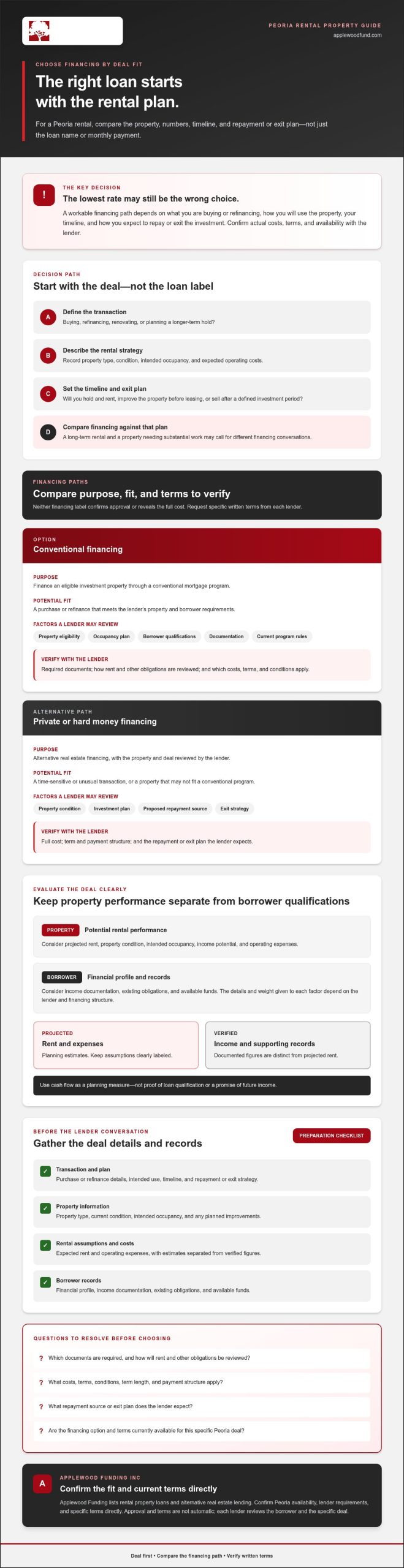
Start with the deal, not the loan label. The right peoria rental property financing should fit the property you’re buying or refinancing, how you intend to use it, and what you plan to do next. Financing for a long-term rental may not suit a property that needs substantial work before it can be rented. Define the strategy before comparing loan types.
Rental financing also serves a different purpose from a mortgage on a home you occupy. The property is part of an investment plan, so its condition, intended occupancy, income potential, and costs may matter alongside your financial profile. Real estate investing involves weighing these property and financing choices as part of a broader investment decision. Approval and terms are not automatic; each lender reviews the borrower and the specific deal.
Start with the Peoria property and investment plan
Define the transaction before comparing options. Are you buying, refinancing, renovating, or planning a longer-term hold? Record the property type, current condition, intended occupancy, and expected operating costs. A single-family home planned as a long-term rental presents a different use case from a multi-unit property or a home that needs repairs before tenants can move in.
Be specific about the exit plan, too. You might intend to hold and rent the property, complete improvements before leasing it, or sell after a defined investment period. This helps focus the lender conversation on the purpose of the financing and the expected repayment path. It also gives you a way to test whether the proposed financing fits the deal instead of choosing based on the loan name alone.
Separate property performance from borrower qualifications
Assess two sides of the application separately. The property’s projected rent and operating expenses help you estimate its potential performance. Your financial profile, income documentation, existing obligations, and available funds are separate considerations. A lender may review both, but the details and weight given to each depend on the lender and financing structure.
Rental property financing is funding used to acquire, refinance, or improve a property intended to generate rental income.
Use cash flow as a planning measure, not proof of loan qualification or a promise of future income. Estimate rent and property expenses realistically, and label assumptions separately from verified figures. Then ask the lender how it reviews each item and what supporting documents it needs. This gives your Peoria financing discussion a useful starting point without assuming approval or terms.
Compare Financing Options for a Peoria Rental Property
Compare financing by what the deal needs to accomplish. Conventional financing may suit a rental purchase that meets a lender’s property and borrower requirements. Private or hard money financing may be worth discussing when the property, timeline, or investment plan calls for a different review. Neither label tells you the full cost or confirms approval. Request specific written terms from each lender before choosing.
| Option | Purpose | Potential fit | Evaluation factors | Questions to verify |
|---|---|---|---|---|
| Conventional financing | Finance an eligible investment property through a conventional mortgage program. | A purchase or refinance that meets the lender’s property and borrower requirements. | Property eligibility, occupancy plan, borrower qualifications, documentation, and current program rules. | Which documents are required? How are rent and other obligations reviewed? What costs, terms, and conditions apply? |
| Private or hard money financing | Provide alternative real estate financing, with the property and deal reviewed by the lender. | A time-sensitive or unusual transaction, or a property that may not fit a conventional program. | Property condition, investment plan, proposed repayment source, and exit strategy. | What is the full cost? What is the term and payment structure? What repayment or exit plan does the lender expect? |
When conventional financing may fit the investment
Explore conventional financing if your property type, intended use, and documentation align with a lender’s current requirements. Be ready to explain the rental plan and provide the records requested for your borrower profile and the property. Don’t assume one lender’s rules apply everywhere. Ask the lender to confirm current program requirements, qualification factors, costs, and terms for your specific Peoria, Arizona, deal.
When to ask about private or hard money financing
Ask whether private or hard money financing may fit if timing, property condition, or deal structure makes a conventional path uncertain. Treat this as a lender-review conversation, not a shortcut or guaranteed approval. If the financing is shorter-term, map out how you expect to repay it, such as through a refinance or sale, and consider what could affect that plan. For more context, review a guide to hard money loan pros and cons before comparing offers.
For either path, compare the full written quote, not just the headline rate. Check fees, repayment schedule, term, conditions, and costs that could affect projected cash flow. Confirm that the lender can consider the property’s location and intended use in Peoria, Arizona. Applewood Funding lists rental property loans and alternative real estate lending; investors can discuss a rental property financing scenario and confirm whether current availability and terms fit the specific deal.
How Lenders May Evaluate a Peoria Rental Deal
A lender’s review may cover four connected factors: the property, your borrower profile, the intended rental use, and how you expect to repay the financing. Peoria is in Maricopa County, but that geographic context does not establish what a particular home will rent for or whether it meets lender requirements. Verify local market figures with current, property-specific information, and confirm program rules and lender criteria directly. When comparing Arizona investments in Phoenix, Scottsdale, Glendale, Peoria, Tempe, or Mesa, use evidence tied to the property and its immediate market. Sedona, Flagstaff, and Tucson are also distinct locations to assess on their own, rather than assuming rent or expenses from one city apply to another.
For conventional financing, Freddie Mac’s overview of investment property mortgages can help explain how investment-property loans differ from owner-occupied mortgages. The lender’s current guidelines still determine how they apply to your application.
Review rental income, expenses, and cash flow
Build a realistic operating picture, and label estimates as projections. Asking rent is not the same as collected rent, and gross rent is not cash flow. A lender may ask how you arrived at your income assumptions and which expenses you included. Compare assumptions with property-specific evidence, such as lease records where available, and current tax, insurance, and maintenance information.
- Rent: Separate signed or documented rent from an estimate of future income.
- Vacancy: Include an allowance for periods without a paying tenant.
- Operating costs: Account for property taxes, insurance, maintenance, and management expenses where applicable.
Debt service coverage ratio, or DSCR, is generally a comparison of a property’s income with its debt obligations. It can be a useful analytical concept, but don’t assume a particular lender uses it or that Applewood Funding offers a DSCR product. Ask how the lender calculates income and expenses for the financing under review.
Assess the property, borrower, and exit plan
Property condition, valuation, occupancy strategy, and planned improvements may affect how a lender views the deal. Explain whether the property is ready to rent, needs work, or will be used under another rental plan. Be prepared to discuss relevant borrower records, which may include income information, assets, existing obligations, and ownership details. The lender will specify what it needs; no single document list applies to every loan.
A clear repayment strategy shows how the financing is expected to be paid back, not just how the property may earn rent. Describe whether repayment depends on rental income, a refinance, a sale, or another plan, and identify assumptions that could change the outcome. For peoria rental property financing, keep projected property performance separate from verified income and borrower qualifications. Ask how the lender evaluates each part before relying on a projection or assuming the deal will qualify.
Prepare Your Peoria Rental Financing Application
An organized file makes it easier to explain your deal and compare financing options. It doesn’t guarantee approval, and each lender may request different information. Begin by defining the transaction, gathering property and borrower records, comparing written offers, and confirming every term and condition before moving forward.
Build a lender-ready property and borrower file
Make the proposed deal easy to understand. Gather the relevant items you have, then ask the lender what else it needs:
- Transaction details: Purchase contract for an acquisition, or current loan details and the requested refinance amount for a refinance.
- Property information: Address, property type, occupancy plan, known condition issues, and details of planned improvements.
- Income and expenses: Rent assumptions, available lease or rent records, and estimates for taxes, insurance, maintenance, vacancy, and management costs. Label projections clearly and support them with property-specific evidence where possible.
- Borrower records: Relevant income, asset, and liability information, organized according to the lender’s instructions.
Keep estimates separate from confirmed facts. For example, label proposed rent as a projection if the property isn’t leased yet. If renovations are part of the plan, outline the work and expected costs. If the project is primarily a renovation and resale, a fix-and-flip financing guide may be more relevant to your research.
Compare written terms before moving forward
When a lender provides an offer, compare the complete terms rather than focusing on a single number. Ask about the interest rate, fees, loan term, payment structure, prepayment provisions, and any extension options. Confirm whether renovation funds, reserves, or other conditions apply to that specific offer. Rates, costs, eligibility, and availability vary, so request the details in writing and ask for clarification on anything you don’t understand.
Then test the repayment plan. Check how payments fit your projected rental income and operating costs, and consider what happens if repairs, vacancy, or a refinance take longer than expected. A projection is not a promise. Review financial implications with a qualified financial professional, and seek legal guidance for questions involving contracts or loan documents.
Before committing, confirm the final terms, required documents, outstanding conditions, and any deadlines directly with the lender. Applewood Funding lists rental property loans and alternative real estate financing, but specific structures, terms, and Peoria availability need to be confirmed. Discuss your rental property financing scenario with Applewood Funding and ask what information is needed to review your deal.
Discuss Rental Property Financing in Peoria with Applewood
You’ve matched the financing question to the property, rental plan, and intended exit. The next step is to bring those details to a lender and ask how they apply to your specific deal. Applewood Funding Inc lists rental property loans and alternative lending for real estate investors. This does not establish a particular loan structure or current availability for every Peoria property, so verify those details directly.
Check whether the offering fits your rental strategy
Explain whether you’re buying, refinancing, or planning improvements, and how you expect the property to be used. Ask whether the lender can review that scenario and which financing options, if any, may fit. Confirm current Peoria availability, eligibility requirements, and all written terms. An inquiry or prequalification can help clarify next steps, but it doesn’t guarantee approval or establish final loan terms.
Make the conversation specific. Share what you know and identify what is still an estimate. This gives the lender a clearer basis to explain what it can assess and what additional information it may need. Don’t assume a general description of rental property lending means a particular product or qualification method applies to your deal.
Take the next step with deal details ready
Before reaching out, prepare a concise deal summary. Include the property address, purchase or refinance purpose, current condition, planned use, estimated project figures, timing needs, and repayment or exit plan. Have relevant borrower and property records available if requested. A lender may have its own documentation process, so ask what to provide rather than relying on a universal checklist.
Get clear answers before comparing or accepting an offer. Ask which documents are required, how fees and repayment work, which conditions apply, and what exit options are available if your original plan changes. Request applicable terms in writing, then compare the complete offer with your property assumptions. For questions about financial or legal implications, consult qualified professionals.
Ready to discuss your deal? Discuss your Peoria rental financing needs with Applewood Funding Inc. Share the property details and investment plan, then confirm current availability and the terms that apply to your situation. This is a practical next step toward evaluating peoria rental property financing without assuming a product, approval, or timeline before the lender reviews the deal.
Turn Your Rental Plan into a Clear Financing Conversation
The strongest peoria rental property financing choice starts with the deal. Match the loan path to the property, rental strategy, timeline, and repayment plan. Compare conventional and private options using complete written terms, and keep projected rent separate from verified income and operating costs.
Before contacting a lender, organize the property details, purchase or refinance purpose, rent and expense assumptions, borrower records, and intended exit. This preparation helps focus the discussion, but it doesn’t guarantee approval. Applewood Funding lists Rental Property Loans and provides alternative real estate lending for investors. Confirm directly whether financing is currently available for your Peoria property, along with applicable eligibility, documentation, fees, rates, and terms.
To review a specific deal, discuss your Peoria rental financing needs with Applewood Funding and ask what information is needed to assess your plans. A prepared conversation is a practical step toward making an informed investment decision.
Frequently Asked Questions
What financing options are available for a rental property in Peoria?
Options may include conventional mortgages, private or hard money loans, and other investor financing, depending on the property and lender. Some programs are limited to eligible owner-occupied multi-unit properties, so check occupancy rules before relying on them for a rental investment. For peoria rental property financing, compare each option’s purpose, documentation, full costs, repayment structure, and fit with your exit plan. Confirm current requirements and availability directly with the lender.
Can I use a hard money loan to buy a Peoria rental property?
Possibly, if a lender reviews the purchase and determines that its financing fits the property and investment plan. Hard money is a form of alternative real estate lending, but don’t assume every hard money loan is designed for a rental purchase. Ask whether the lender will consider your specific Peoria, Arizona, property, what terms and costs apply, and how repayment is expected to work. Approval is not guaranteed.
How do lenders evaluate rental property financing?
Lenders may assess the property’s condition and value, your borrower profile, intended use, projected rental income, operating costs, and repayment plan. They may distinguish documented rent from estimates and consider expenses such as taxes, insurance, maintenance, vacancy, and management. The factors and documents vary by lender and financing structure. Present assumptions clearly, support them with property-specific records where possible, and ask how the lender will evaluate each part of your Peoria deal.
Do I need a good credit score for a rental property loan?
Credit may be one part of a lender’s review, but there isn’t one universal score that guarantees eligibility across rental loans. Requirements can vary with the lender, property, financing structure, and borrower’s overall profile. Ask which credit and financial factors apply to the specific offer, and whether other parts of your application are considered. Don’t assume that a strong score alone secures approval or determines the loan’s terms.
Can rental income help me qualify for financing?
Rental income may be considered by some lenders, but how it’s documented and calculated depends on the loan program. A signed lease or payment history is different from projected rent for a property you haven’t leased. Lenders may also account for operating expenses, vacancy, and debt obligations. Keep estimates separate from verified income, and ask the lender what evidence it accepts. A rent projection alone doesn’t establish qualification or guarantee approval.
What should I compare before choosing a rental property lender?
Compare written offers across the full rate, fees, loan term, payment structure, prepayment provisions, and any conditions or extension options. Ask what documents are required, how rental income and property expenses are assessed, and what repayment plan the lender expects. Check whether the proposed terms support your hold or exit strategy. Confirm current availability for the Peoria property, and review financial or legal questions with qualified professionals before committing.
Does Applewood Funding offer rental property loans in Peoria, Arizona?
Applewood Funding lists Rental Property Loans and alternative real estate lending for investors, and its company information identifies Peoria, Arizona, among its locations. However, that doesn’t confirm current availability for every property or borrower. Contact the lender with the property details and intended use, then verify the applicable loan structure, eligibility requirements, documentation, fees, rates, and repayment terms directly. An inquiry or prequalification does not guarantee approval or final terms.