


Hard Money Loans for Bad Credit: How Equity Secures Real Estate Funding in 2026
September 24, 2026Scottsdale Private Money Loans: A 2026 Borrower’s Guide

What if the right Scottsdale private money loan isn’t the one with the fastest pitch, but the one that fits your property’s use and your exit plan? “scottsdale private money loans” may sound like a straightforward route when a bank isn’t a fit, but underwriting and repayment can look very different for an investment property and an owner-occupied home.
Before speaking with a lender, ask how the property and its intended use will affect the review, which costs and repayment terms apply, and whether the loan fits how you plan to use the home. Investor financing isn’t automatically appropriate for a primary residence, so clarify occupancy and intended use early.
This guide will help you compare Scottsdale private money loan options, weigh the trade-offs, and decide whether this type of financing fits your situation. You’ll learn what to ask about property-based underwriting, total borrowing costs, repayment, and your plan to pay off or refinance the loan. You’ll also find out what information to gather before requesting a review, so you can compare lenders on relevant terms, not speed alone.
Key Takeaways
- Assess whether scottsdale private money loans fit your property, intended use, and realistic repayment plan before focusing on lender speed.
- Compare written offers carefully, including how each lender defines interest, points, fees, maturity, extensions, and prepayment terms.
- Weigh private financing against conventional options by comparing documentation, property fit, process, and repayment structure, rather than making assumptions about cost or qualification.
- Prepare for a lender review by defining your purpose, confirming occupancy, organizing property and project details, and asking which financial records are needed.
- Applewood Funding lists several Arizona financing categories, including owner-occupied hard money loans. Fit, eligibility, terms, and availability require an individual review.
Scottsdale Private Money Loans: What They Are and Who They May Suit
Private money loans are real estate loans from nontraditional lenders that consider the property, borrowing purpose, repayment plan, and written loan terms. The term describes a broad category, not a single underwriting formula. Lenders may weigh a property’s value and condition differently, and may also consider the borrower’s experience, finances, and exit strategy.
In Scottsdale and across Maricopa County, start with the project rather than assuming approval will be fast. The property serves as collateral, but its value isn’t necessarily the only consideration. Review the proposed rate and fees, payment schedule, maturity date, and what happens if your planned sale, refinance, or other payoff takes longer than expected. The overview of a hard money loan explains common terminology, but you still need to review the individual lender’s terms.
Which Scottsdale borrowers consider private money financing?
Real estate investors may explore private financing for a purchase, renovation, rental property, or another real estate project. A self-employed borrower may also ask whether an alternative documentation option, such as a bank statement loan where available, fits their situation. These are possibilities, not promises of eligibility.
For example, an investor might seek funds to renovate a property and plan to repay the loan after a sale. Another borrower might be considering a rental purchase and expect rental income to support the repayment plan. In either case, test the assumptions and ask what property and borrower information the lender will review.
How property use changes the financing conversation
Be precise about occupancy from the first conversation. A primary residence, second home, rental property, and investment project are different scenarios. Intended use can affect which loan options are appropriate, what underwriting applies, and which disclosures or other requirements may be relevant. Requirements vary by loan and lender, so verify the details for your situation instead of applying investor-loan assumptions to a home you’ll occupy.
If you plan to live in the property, ask directly whether the financing is designed for owner occupancy and what review applies. Applewood Funding Inc lists owner-occupied hard money loans among its offerings, but fit, eligibility, terms, and availability require an individual review. For more context, consult an owner-occupied hard money loan guide and be prepared to explain who will live in the property, how you’ll use it, and how you intend to repay the loan.
How to Compare Scottsdale Private Money Loan Options
Compare written offers side by side, not by a headline rate or verbal estimate. For scottsdale private money loans, fit depends on whether the lender considers your property, intended use, and repayment plan, and whether the documented terms work for you. Rates, fees, and eligibility vary by lender and scenario, so check that you’re comparing like with like.
Which loan terms deserve a close review?
Review the full cost structure. Ask how the interest rate is calculated, what points and other fees apply, and when each amount is due. Confirm the payment schedule and maturity date. If an extension may be available, ask about its conditions and cost. Read how the documents address late payments, default, and prepayment. If a term is unclear, request a written explanation before comparing offers.
How to assess lender fit in Scottsdale
Ask whether the lender considers your specific property type, location, occupancy, and loan purpose. Request a clear list of required documents and review steps for your scenario. For questions about mortgage processes and consumer protections, consult the Consumer Financial Protection Bureau’s homebuying resources. Check licensing and disclosure questions against current official sources or with a qualified professional.
Use a simple worksheet to compare the same information for each offer. Record details from the lender’s written proposal, and mark anything not yet confirmed as a question.
| Comparison item | What to record |
|---|---|
| Lender | Company or lender name and your main contact |
| Loan purpose | Purchase, renovation, rental, or other stated use |
| Collateral | Property offered as security and any stated requirements |
| Total documented costs | Rate, points, fees, payment details, and how each is defined |
| Term | Payment schedule, maturity date, and written extension conditions |
| Exit plan | Expected payoff source and the assumptions behind it |
Compare the same categories for every offer. A proposal that looks attractive at first may have different payment timing, extension terms, or prepayment conditions. If you want to discuss a specific financing scenario, you can discuss your financing scenario with Applewood Funding Inc. Confirm product fit, eligibility, terms, and availability through an individual review.
Private Money vs. Other Scottsdale Financing: Match the Option to Your Goal
Choose financing by matching the property, occupancy, purpose, and payoff plan, not by assuming one route is automatically faster or easier. Scottsdale private money loans may be worth evaluating for a real estate project, but private financing can also involve different costs, shorter repayment periods, or conditions that don’t suit your plan. Compare actual written offers with any conventional or other mortgage options you qualify for.
Documentation, process, property fit, and repayment structure can differ. A conventional mortgage may suit a borrower whose finances, property, and timeline meet its requirements. A private lender may assess the property and project alongside borrower information, but criteria and processes vary. Neither route guarantees a particular cost, decision, or funding timeline. The Corporate Finance Institute’s overview of private money loan risks and regulations is another starting point for understanding potential trade-offs.
| Financing route | May be worth evaluating for | Trade-offs to check |
|---|---|---|
| Conventional mortgage | Borrowers and properties that fit the lender’s requirements and timeline | Documentation, eligibility, property standards, payment structure, and closing process |
| Private real estate financing | A defined purchase, renovation, rental, construction, or other property-related purpose | Written costs, collateral terms, maturity, payment schedule, and a credible payoff plan |
| Alternative documentation option | Self-employed borrowers asking whether bank statement documentation may fit | Eligibility, required records, terms, and whether the option suits the intended occupancy |
When might a private lender be worth evaluating?
A time-sensitive purchase or renovation can make it sensible to compare a private lender’s process with other available options. Treat timing as something to verify, not a promised outcome. Consider the property’s equity and condition, the project’s purpose, and your financial documentation. Applewood Funding lists fix-and-flip, rental property, construction and land, cash-out hard money, and bank statement loans for self-employed borrowers. Product fit, eligibility, terms, and availability depend on an individual review.
Stress-test the exit plan. If repayment depends on selling or refinancing, ask what happens if the sale takes longer or refinancing isn’t available on your expected terms. A short-term loan without a realistic payoff strategy can create pressure quickly.
When should you consider another financing route?
Consider conventional or other mortgage options if their requirements, property fit, repayment structure, and timeline work for you. For a primary residence, don’t assume investor financing applies. Confirm that a proposed loan is suitable for owner occupancy and ask what requirements and protections apply to your situation before proceeding. Compare the terms against your goals, not just the proposed process.
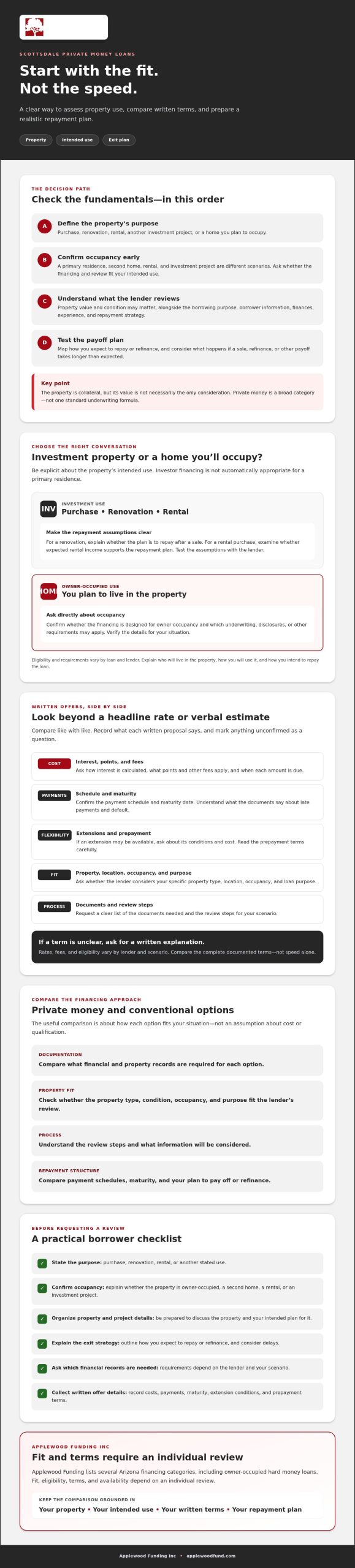
Scottsdale Borrower Checklist: Prepare Before Requesting a Private Loan
A focused request starts with a clear plan. Before discussing scottsdale private money loans, work through these steps so a lender can understand the property, intended use, and proposed repayment plan without filling gaps with assumptions.
- Define the purpose. Explain whether funds are for a purchase, renovation, rental, construction, or another real estate need.
- Confirm occupancy. State whether the property will be your primary residence, a second home, a rental, or an investment project.
- Organize property details. Gather the address, parcel information, condition, access details, and how you estimated the property’s value. Note existing financing and any known liens.
- Document the repayment plan. Identify the expected source of repayment, such as a sale, refinance, or other funds, and the assumptions behind its timing.
- Compare the written terms. Review the full cost breakdown, payment obligations, maturity date, and conditions that could affect payoff.
What information should you have ready?
Prepare the property address, intended use, basis for the estimated value, existing financing details, requested loan purpose, and anticipated timeline. For a project, summarize the planned work, scope, and expected costs. Ask which records apply to your scenario rather than assuming every lender requests the same package.
Documents to ask about may include:
- Identification and income or asset records
- Property information, including available valuation materials
- Existing loan or lien details and insurance information
- Project scope, contractor estimates, or other relevant third-party reports
Also ask how the lender will assess value and what title, lien, insurance, or valuation checks are needed. For a Scottsdale property, verify parcel and access information, current condition, and project details through appropriate current sources. If zoning, permitting, or legal questions arise, confirm them with the relevant official source or a qualified professional. Don’t assume a property’s existing use establishes what work or future use is allowed.
Questions to ask before signing
Request a complete written breakdown of costs, payment obligations, maturity conditions, and any extension terms. Ask what happens if the project, sale, or refinance takes longer than planned, and how late payment, default, or early payoff is addressed in the documents.
Before signing, have qualified Arizona legal and tax professionals review questions within their expertise. If you’re preparing a Scottsdale loan request, discuss your financing scenario with Applewood Funding Inc and ask which documents and terms apply to your intended property use.
Explore Scottsdale Private Money Loan Options with Applewood Funding
Applewood Funding Inc serves Arizona, including Scottsdale, and offers several real estate financing categories: owner-occupied hard money loans, fix-and-flip loans, rental property loans, construction and land loans, bank statement loans for self-employed borrowers, and cash-out hard money loans. These options serve different purposes. A category’s name alone doesn’t establish that it fits your property, occupancy, or repayment plan.
Owner-occupied hard money financing is a specialized scenario. If you plan to live in the property, say so upfront and ask what review, terms, and disclosures apply. Don’t assume an investor-purpose loan works for a primary residence. Product fit, eligibility, terms, availability, and timelines must be confirmed directly for your situation.
What to include when contacting a lender
Make your first conversation useful. Share the property location, how you’ll use it, what you need the funds for, and how you expect to repay the loan. Be clear about whether the property is owner-occupied, a rental, or part of an investment project. If you’re self-employed, ask whether a bank statement loan may be relevant and which documentation the lender would need to assess that possibility.
Bring these key details together before asking which current options may fit:
- Property address and intended occupancy
- Financing purpose and expected timeline
- Expected repayment source, such as a sale, refinance, or other funds
- Questions about required financial and property records
Ask the lender to clarify any requirements that depend on your particular property or use. This keeps the discussion focused without assuming every borrower or Scottsdale property follows the same path.
Your next steps after an initial review
Once you receive a written proposal, compare it with your realistic repayment plan. Check the documented costs, payment obligations, maturity date, and any conditions that could affect payoff. Confirm applicable disclosures and terms before making a commitment. If the property will be your primary residence, review owner-occupied financing separately and make sure the proposed loan is intended for that use.
Ready to explain your scenario? Share the property’s location and use, your financing purpose, and your expected repayment plan when you Discuss your Scottsdale financing needs. Applewood Funding Inc can review whether a listed financing category may be relevant. Confirm all terms, eligibility, availability, and timelines directly.
Make Your Next Financing Conversation Count
Choosing scottsdale private money loans starts with fit, not a promise of speed. Match the financing to the property’s use and purpose, then assess the written terms against a realistic payoff plan. Compare documented costs, repayment timing, collateral requirements, and what happens if your exit takes longer than expected.
Before contacting a lender, have the property details, occupancy, project purpose, and repayment source ready. That clarity helps you ask focused questions and judge whether an option deserves a closer look. Owner-occupied financing requires particular care. Don’t assume investor terms apply to a home you plan to live in.
Applewood Funding lists Scottsdale among its Arizona service locations. Its listed options include owner-occupied hard money loans, its primary offering, along with fix-and-flip, rental, construction and land, bank statement, and cash-out financing. Product fit, eligibility, terms, and availability depend on your individual scenario.
Ready to take the next step? Discuss your Scottsdale financing needs and share your property use, financing purpose, and repayment plan. A clear starting point can help you move forward with confidence.
Frequently Asked Questions
What are private money loans in Scottsdale?
Private money loans in Scottsdale are real estate loans from nontraditional lenders, often structured around property collateral, a specific borrowing purpose, and a repayment plan. Underwriting varies by lender. A review may consider property value and condition, occupancy, borrower information, and the planned exit. The phrase scottsdale private money loans describes a broad category, not one standard product. Applewood Funding lists Arizona service locations including Scottsdale, Phoenix, Glendale, Peoria, Tempe, Mesa, Sedona, Flagstaff, and Tucson. Confirm current loan availability directly.
Can I get a private money loan for an owner-occupied home in Arizona?
Possibly, but an owner-occupied home needs a loan designed for that use, and not every private lender offers one. Applewood Funding lists owner-occupied hard money loans, but eligibility, terms, availability, and applicable requirements depend on an individual review. Tell the lender you plan to live in the property. Before proceeding, confirm the required disclosures and protections for your specific loan with current official sources or a qualified professional.
How do Scottsdale private money lenders evaluate a property?
Evaluation methods differ, but a lender may review the property’s location, condition, estimated value, intended use, and available equity. It may also ask about title, existing liens, insurance, and the planned repayment source. For a renovation or construction project, expect questions about the work and project scope. Ask how value will be assessed, which reports are needed, and how property findings could affect the written loan terms.
Are private money loans faster than conventional mortgages?
Not automatically. Timing depends on the lender’s process, the property, the loan purpose, the required review, and how quickly complete documents are available. A conventional mortgage may fit a borrower and property well, while a private option may suit a different scenario. Compare actual process steps and expected timing with each lender. Don’t choose short-term financing based on an assumption about speed. Confirm the timeline and make sure the repayment plan is realistic.
What documents do I need to apply for a private money loan?
Requirements vary, so ask the lender for a document list tailored to your property and purpose. You may be asked for identification, income or asset records, property details, existing financing information, and project scope or cost estimates. Be ready to state the property address, occupancy, intended use of funds, and expected repayment source. Organized information can help the lender understand the scenario, but it doesn’t guarantee eligibility or approval.
What should I compare before choosing a private money lender?
Compare written terms, property and borrower eligibility, collateral requirements, payment structure, and the lender’s communication process. Review the complete cost breakdown, including how interest, points, and other fees are defined. Check the maturity date, extension conditions, prepayment terms, and how late payment or default is addressed. Ask for unclear terms in writing. A useful comparison focuses on the full obligation and repayment fit, not just a headline rate.
What happens if I cannot repay a private money loan on time?
The outcome depends on your signed documents and applicable requirements. Late charges, default provisions, or enforcement against the property serving as collateral may be possible, but don’t assume an extension or refinance will be available. If repayment looks uncertain, contact the lender promptly and review your options before the due date. Consider asking a qualified Arizona attorney to explain your obligations and potential consequences under the loan documents.