


Rental Portfolio Loans in Arizona: A Practical Investor’s Guide
September 30, 2026Asset-Based Mortgage: How to Qualify and Choose the Right Loan in 2026

Could your assets support a mortgage application even if your income paperwork doesn’t tell the full story? An asset based mortgage may give a lender another way to assess your financial capacity, but having substantial assets doesn’t automatically mean you’ll qualify. Lenders may consider eligible assets, the property, and your repayment plan, and their methods can vary.
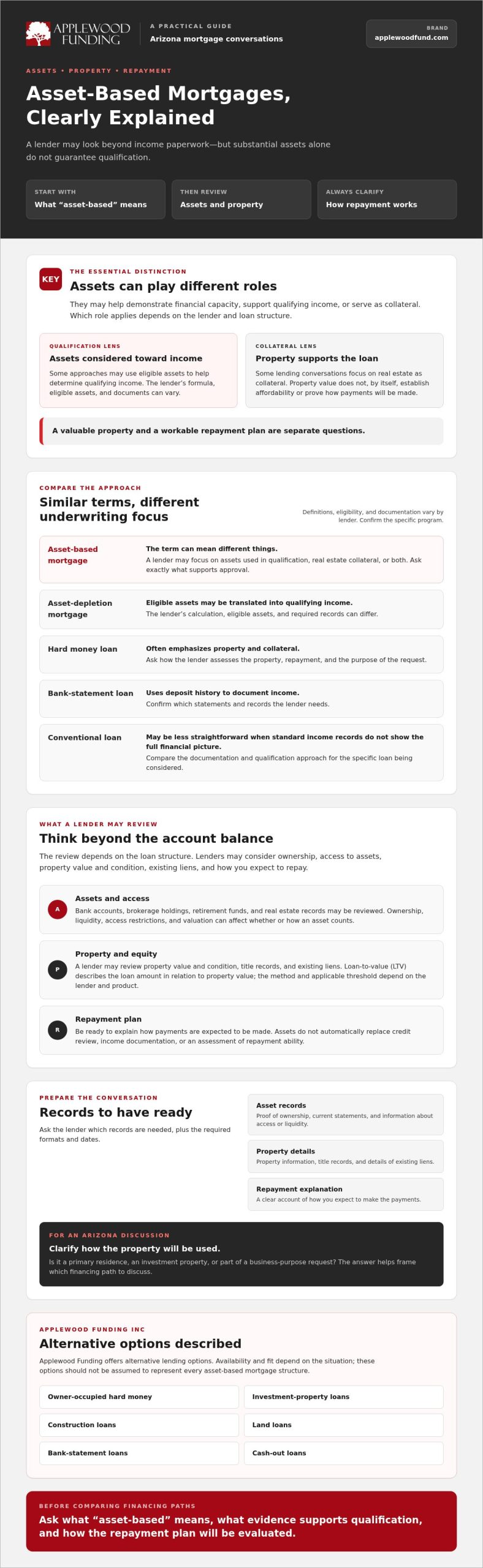
The terminology matters. An asset-based mortgage isn’t necessarily the same as an asset-depletion mortgage, which may convert assets into qualifying income, or a hard money loan, which often emphasizes the property and collateral. Bank statement loans take a different approach, using deposit history to document income. Before applying, find out which method a lender means and what actually supports qualification. This guide explains what lenders may review, what records to prepare, and what questions to ask when comparing financing paths in Arizona. It also covers how Applewood Funding’s alternative lending options may relate to your situation, without assuming every asset-based mortgage structure is available. Start with the assets, then check whether the property and repayment plan fit.
Key Takeaways
- An asset based mortgage can refer to different underwriting approaches. Ask how the lender defines the term and what supports qualification.
- Compare asset-based, asset-depletion, hard money, bank-statement, and conventional loans by their underwriting focus, documentation, and intended use.
- Prepare records showing asset ownership and liquidity, property details, existing liens, and your repayment plan. Property value alone doesn’t establish affordability or guarantee approval.
- Before discussing financing in Arizona, clarify whether the property is a primary residence, an investment, or part of a business-purpose request.
- Applewood Funding offers alternative options including owner-occupied hard money, investment-property, construction, land, bank-statement, and cash-out loans. Ask which, if any, fits your situation.
What Is an Asset-Based Mortgage? Understand the Two Common Meanings
An asset-based mortgage is financing where a lender considers assets, property, or both when assessing a borrower or securing a loan. The phrase doesn’t have one consistent meaning across lenders. One lender may use it for a loan backed mainly by real estate collateral. Another may use it to describe a qualification method that counts eligible assets toward qualifying income.
That distinction matters. Asset-based lending broadly refers to borrowing supported by assets pledged as collateral. In mortgage conversations, however, the assets under review might include property equity, cash or savings, and investment holdings. Which assets count, how they’re valued, and whether they support qualification or secure the loan depend on the lender’s rules.
Collateral value and documented ability to repay are separate questions. A valuable property may support a loan, but it doesn’t by itself show that the borrower can manage payments. Ask the lender what “asset-based” means in its program, which assets it considers, and how it evaluates repayment.
Asset-based lending versus asset-depletion mortgages
An asset-depletion approach may estimate qualifying income from eligible assets, using a lender’s formula to translate those assets into income for underwriting. In property-secured lending, by contrast, real estate collateral is central to the loan structure and risk assessment. The terms can overlap in casual conversation, but they describe different ways assets may factor into a mortgage. Definitions, eligible assets, calculations, and required documents vary by lender.
Who may consider an asset-based mortgage?
Self-employed borrowers with uneven earnings, retirees with substantial investments, and property owners with significant equity may research these options. Their financial strength may not show up neatly in standard income records, or their income may fluctuate from month to month. That can make a conventional application less straightforward, even when the borrower has resources. Still, assets don’t automatically replace credit review, income documentation, or an assessment of how payments will be made.
For example, a retiree might have investment holdings but limited wages, while a business owner may have strong assets and seasonal income. Each should ask whether the lender is evaluating assets as a source of qualifying income, as collateral, or both. Don’t assume that a large account balance or substantial home equity meets the lender’s requirements. First identify the type of asset-based mortgage being discussed, then confirm what evidence and repayment plan the lender expects. For borrowers managing unconventional income or complex scenarios that require a personalized approach, discover LoansByJB (The Nuhome Team) for specialized mortgage solutions.
How Lenders Evaluate Assets, Property Equity, and Repayment Ability
An asset based mortgage review can involve more than adding up account balances or estimating a home’s value. Lenders may look at who owns the assets, how quickly they can be accessed, what the property is worth, what debts or liens are attached, and how you expect to repay the loan. The exact review depends on the loan structure.
Underwriting criteria differ by product and lender, so confirm the requirements for the specific loan you’re considering. Ask which records are needed, how assets and property will be valued, and whether calculations such as qualifying income from assets apply. Don’t assume another lender’s checklist or formula will be used.
Which assets and property details may matter?
Bank accounts, brokerage holdings, retirement funds, and real estate records are examples of assets lenders may review. Eligibility isn’t automatic. Ownership, access restrictions, liquidity, and the method used to value an asset can affect whether or how it counts. Ask whether the lender needs current statements, proof of ownership, or other documentation, and verify the required formats and dates directly.
For property offered as collateral, the lender may consider its value and condition, review title records, and identify existing liens. Loan-to-value, or LTV, describes the loan amount in relation to the property’s value. A lower LTV means the proposed borrowing is smaller compared with that value, but there’s no single threshold that applies to every product or lender. Confirm how the lender determines value and calculates LTV for your application.
How repayment capacity fits into asset-based underwriting
Collateral helps a lender understand what secures a loan. It doesn’t prove that monthly payments are affordable or guarantee approval. Depending on the product, lenders may also assess income, cash flow, reserves, credit history, and a proposed exit strategy, such as selling or refinancing a property. Verify with the lender which factors matter and what documentation supports them.
Be specific about the repayment plan. If you expect rental income, explain the assumptions behind it. If you plan to sell, consider what happens if the sale takes longer than expected. An expectation that a property will appreciate isn’t the same as a documented plan to repay. Assets don’t erase the obligation to repay, and using property as collateral can put it at risk if payments aren’t made.
Before discussing a request, organize a clear summary of your assets, property, current liens, expected cash flow, and repayment plan. Arizona borrowers can review alternative mortgage options and ask which documentation and underwriting approach applies to their situation.
Asset-Based Mortgage vs. Hard Money, Bank-Statement, and Conventional Loans
Loan labels can overlap, but the underwriting focus can differ. An asset-based mortgage may consider eligible assets or property collateral. An asset-depletion approach may use eligible assets to calculate qualifying income. Hard money often centers on real estate collateral, while bank-statement loans use deposit records to assess income. Conventional mortgages generally rely on documented income, credit, and other standard underwriting factors. No approach is universally best. The fit depends on your purpose, finances, property, and the lender’s program.
| Loan approach | Primary underwriting focus | Possible borrower use case | Records to ask about | Key question |
|---|---|---|---|---|
| Asset-based | Eligible assets, property collateral, or both, depending on the lender’s meaning | A borrower whose financial picture includes substantial assets | Asset ownership and value, property details, repayment information | Are assets qualifying income, collateral, or both? |
| Asset-depletion | Eligible assets converted into qualifying income under a lender’s method | A borrower with assets but limited or irregular documented income | Statements and records required to verify eligible assets | Which assets and calculation method apply? |
| Hard money | Often the property’s value and collateral | A borrower seeking financing tied to real estate, including an investment or owner-occupied purpose where available | Property, title, lien, and repayment or exit-plan details | How do purpose, collateral, and repayment plan affect the terms? |
| Bank-statement | Deposits shown in bank records as an alternative way to document income | A self-employed borrower whose tax documents may not show the full income picture | Bank statements and other lender-requested financial records | Which deposits count, and how are they assessed? |
| Conventional | Documented income, credit, and standard underwriting requirements | A borrower whose records align with the lender’s conventional criteria | Income, employment, asset, credit, and property documentation | Which program requirements apply to my application? |
When asset-based and hard money financing are not the same
Both approaches may consider assets, but that doesn’t make them interchangeable. An asset-based structure might assess financial assets for qualification, while hard money often gives substantial weight to real estate collateral. Clarify whether the property is owner-occupied, an investment, or tied to a business purpose. Intended use can affect which loan structures a lender may consider. For more context, read this hard money loan pros and cons guide, owner-occupied hard money loan guide, and bank statement loan guide.
Compare more than approval
Look beyond whether you may qualify. Compare the repayment schedule, total obligations, collateral at risk, and a realistic exit strategy. Ask each lender to explain fees and terms in writing, then review the proposed loan documents carefully. If the terms or obligations aren’t clear, consider consulting a qualified professional before you commit.
How to Prepare for an Asset-Based Mortgage Conversation in Arizona
Go into a lender conversation with a clear picture of what you’re requesting. An organized overview helps you ask sharper questions and understand what the lender needs to assess your situation. Start with four points: define the loan’s purpose, gather financial records, identify the property or other collateral, and explain how you plan to repay.
Be precise about occupancy and use. Is the property your primary residence, an investment, or connected to a business purpose? These distinctions can affect which financing options a lender may consider. For a Phoenix property or a home elsewhere in Arizona, including Scottsdale, Glendale, Peoria, Tempe, Mesa, Sedona, Flagstaff, or Tucson, confirm directly whether the property and intended use fit the lender’s guidelines. Ask about any applicable Arizona requirements, and verify legal or regulatory questions with qualified professionals rather than relying on general assumptions.
Documents and details to organize before applying
Prepare a working file, but ask the lender for its exact checklist before ordering documents or authorizing a valuation. Requirements can vary by loan and lender.
- Asset records: Recent bank, brokerage, or retirement account statements, plus documentation showing ownership and access.
- Property details: The property address, known condition issues, available ownership records, and information about existing liens or debts secured by the property.
- Income and cash flow: Income records and a practical summary of recurring expenses, even if assets are central to the inquiry.
- Repayment plan: Explain how you expect to make payments and, if relevant, what your exit strategy is.
Ask which records need to be current, what valuation documents are required, and whether the lender needs your authorization to verify information. Don’t assume that a particular statement, appraisal, or calculation will satisfy every program.
Questions Arizona borrowers should ask a lender
- How do you define an asset-based mortgage for this specific loan?
- Which assets and property types may be considered, and how are they evaluated?
- How will occupancy and loan purpose affect the underwriting approach?
- What repayment structure, conditions, and collateral consequences should I understand?
- Which requirements apply to this property and transaction in Arizona?
Ask for explanations of the proposed terms and conditions in writing. Review the loan documents carefully, and consult qualified legal, tax, or financial professionals if you need help understanding the implications. A private lender such as Applewood Funding may discuss alternative financing categories, but the right fit depends on the specific property, purpose, assets, and repayment plan.
Ready to discuss the property, purpose, and repayment plan behind your request? Discuss your Arizona mortgage options.
Explore Applewood Funding’s Alternative Mortgage Options
Applewood Funding is a private lender with several alternative financing categories. These options may be relevant to borrowers whose property plans or financial documentation call for a conversation beyond conventional lending. They don’t mean Applewood offers every structure described as an asset based mortgage, including a specific asset-depletion program. Availability, eligibility, terms, and fit depend on lender review.
Financing categories include:
- Owner-occupied hard money loans
- Rental property and fix-and-flip loans
- Construction and land loans
- Bank statement loans for self-employed borrowers
- Cash-out hard money loans
Match the financing conversation to your property and purpose
Start with how you’ll use the property. For a primary residence, ask about owner-occupied financing and the requirements that apply to your situation. For an investment, clarify whether the project involves a rental property, a fix-and-flip, construction, or land. These are distinct financing needs, so describe your plan rather than assuming one loan type fits them all.
Bring the full picture: property location and condition, intended use, available assets, income documentation, desired timeline, and repayment plan. Clear details help the lender identify which options may be worth discussing. They don’t guarantee approval or specific terms.
What to expect from the next step
A useful initial conversation focuses on fit and requirements. Be ready to share where the property is, what you want to accomplish, how you expect to repay, and which records you can provide. Ask what additional documentation the lender needs and how it will assess the property and your request. Don’t assume a discussion means you’re approved or that funding will happen by a particular date.
Before deciding, review any proposed terms and obligations carefully. Make sure you understand the repayment structure, the property securing the loan, and the consequences of missed payments. If anything is unclear, ask for a written explanation and consider seeking qualified professional advice.
Have a property or financing goal in mind? Contact Applewood Funding about mortgage options to discuss your intended use, documentation, and repayment plan.
Take the Next Step With a Clear Financing Plan
An asset based mortgage can mean different things, so first confirm whether a lender is evaluating assets as collateral, as a source of qualifying income, or both. Then look beyond property value. Asset ownership, documentation, repayment capacity, loan purpose, and the lender’s specific criteria all matter.
Compare options by how they’re underwritten and repaid, not just by whether they may address an income-documentation challenge. Before speaking with a lender, prepare your property details, available asset and income records, intended use, and repayment plan.
Applewood Funding offers alternative options including owner-occupied hard money and bank-statement loans. These aren’t the same as a dedicated asset-depletion program, and availability for your property and loan purpose should be confirmed directly. Ready to discuss your situation? Discuss your Arizona mortgage options with Applewood Funding.
Go in with clear questions and a practical plan. A focused conversation can help you identify which financing paths are worth exploring.
Frequently Asked Questions
What is an asset-based mortgage?
An asset-based mortgage is a broad term for mortgage financing where a lender considers assets or property collateral as part of its review. The phrase may also describe a program that uses eligible assets to help calculate qualifying income. These approaches aren’t identical. Ask the lender whether assets support qualification, secure the loan, or both, and confirm which assets and property types its specific program considers.
How does an asset-based mortgage work?
The lender reviews factors relevant to its program, which may include asset ownership and liquidity, property value, existing liens, credit, income or cash flow, and your repayment plan. Some programs may calculate qualifying income from eligible assets; others may focus more on real estate securing the loan. Documentation and calculations differ. Ask what the lender will verify and how it will assess affordability before proceeding.
Can I qualify for a mortgage using assets instead of income?
Possibly, but don’t assume assets fully replace income documentation or repayment review. Some mortgage programs may use eligible assets to calculate qualifying income, while other asset-focused loans may rely more heavily on collateral. Lenders set their own rules for asset eligibility, calculations, credit review, and repayment evidence. Ask whether the program considers assets as income or collateral, and what records you’ll need to support the application.
Is an asset-based mortgage the same as a hard money loan?
No, the terms don’t necessarily mean the same thing. An asset-based mortgage may refer to asset-based qualification or property-secured lending, while hard money often places significant weight on real estate collateral. Purpose and repayment structure can differ too. Applewood Funding offers hard money options, including owner-occupied and fix-and-flip loans, but that doesn’t mean every asset-based mortgage structure is available. Confirm the lender’s definition and program details.
What documents may I need for an asset-based mortgage?
Prepare recent asset statements, property information, ownership records, details of existing debts or liens, and income or cash-flow records. A lender may also ask for documents related to property value, credit, or your repayment plan. The exact checklist depends on the loan and lender. Before ordering reports or submitting sensitive records, ask which documents are required, how current they must be, and whether any authorizations are needed.
Can Arizona homeowners use an asset-based mortgage for a primary residence?
It depends on the lender, program, property, and intended use. Arizona homeowners in Phoenix, Scottsdale, Glendale, Peoria, Tempe, Mesa, Sedona, Flagstaff, and Tucson can ask whether a specific option is available for their property and situation. Applewood Funding offers owner-occupied hard money loans, but availability and eligibility require lender review. Confirm applicable requirements directly, and don’t assume an owner-occupied loan uses asset-depletion underwriting.
What should I compare before choosing an asset-based mortgage?
Compare how each option evaluates assets, income, credit, and property, then examine the repayment schedule, total obligations, collateral at risk, and any exit strategy. Ask the lender to explain fees, conditions, and terms in writing. Check that the financing purpose matches your occupancy and property plans. Review the loan documents carefully, and consult a qualified professional if you need help understanding the financial or legal implications.