

Financing for a Property That Won’t Get Insurance in Tempe
November 26, 2026Tucson Commercial Bridge Loans for Property Buyers

A strong deal can matter more than a spotless tax history. For a Tucson commercial bridge loan, qualification often centers on the property’s current value, available equity and a workable repayment plan. Bridge financing may be worth exploring when a commercial purchase or improvement project does not fit a traditional lender’s timeline.
It’s reasonable to want a clear picture before moving forward. This guide explains who may qualify, how lenders assess property and repayment plans, and what can shape rates and origination points. You’ll also learn how short-term financing can support a time-sensitive closing, what to plan for when transitioning to long-term financing, and when another loan structure may better suit your project. The goal is to help you understand the trade-offs and make an informed financing decision.
Key Takeaways
- Understand which property, equity and repayment-plan factors can shape bridge-loan qualification, even when a deal doesn’t fit conventional underwriting.
- Spot property conditions and tight closing schedules that can make traditional commercial financing difficult.
- Learn how interest-rate structures and origination points affect the total financing picture before choosing a loan.
- Build the refinance plan around the time a property may need to establish operating history and qualify for permanent financing.
- See how a bridge loan can help keep a purchase moving when conventional commercial financing timelines don’t match the deal.
Who Qualifies for Bridge Financing?
Qualification often depends on the property’s as-is value, available equity and a credible repayment plan. In Tucson, the property and purpose of financing shape the review alongside borrower information.
Eligible Commercial Property Types
Commercial bridge financing may be considered for income-producing buildings, multifamily properties, retail or office space, industrial buildings and parking lots. Land and construction projects involve different collateral and project details. A Tucson location alone does not determine eligibility: the property’s condition, intended use and repayment plan matter. Downtown Tucson and South Tucson are examples of areas where comparable sales and local demand may inform an evaluation.
Property Value and Underwriting Factors
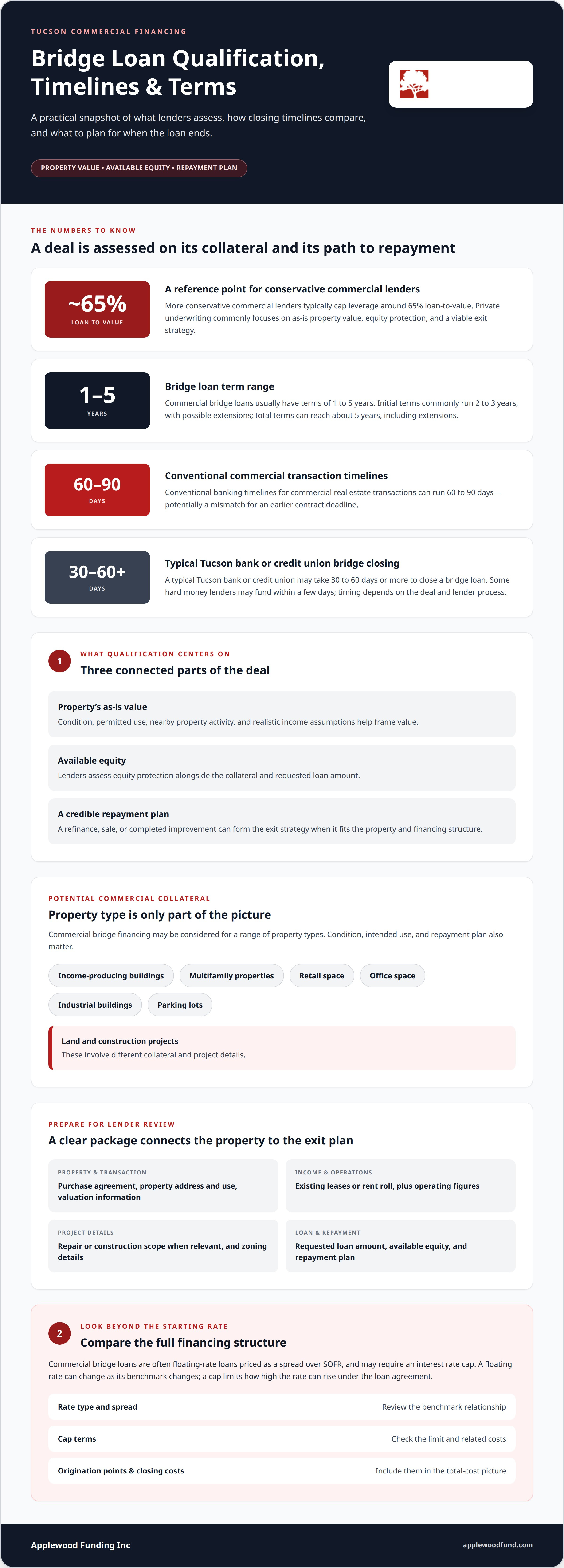
Private underwriting commonly weighs the property’s as-is value, equity protection, and a viable exit strategy rather than relying mainly on historical tax filings. More conservative commercial lenders typically cap leverage around 65% loan-to-value. Zoning and permitted use help establish whether the planned operation fits the site. In Tucson, nearby property activity and realistic income assumptions also help frame value and repayment capacity.
Commercial bridge loans usually have terms of 1 to 5 years. Initial terms commonly run 2 to 3 years, with possible extensions; total terms can reach about 5 years, including extensions. The lender assesses the project’s timeline and exit plan when setting terms. A refinance, sale, or completed improvement can form the repayment strategy, provided the plan fits the property and financing structure.
To evaluate a Tucson commercial bridge loan, a lender needs property and transaction details, not just a borrower’s financial history. A typical review package includes the purchase agreement, property address and use, valuation information, existing leases or rent roll, operating figures, and a repair or construction scope when relevant. It should also spell out the requested loan amount, available equity and repayment plan. Zoning details help show whether the proposed use aligns with the site’s permitted use.
Property type alone does not decide qualification. A leased multifamily building, vacant retail property and parking lot each raise different questions about income, condition and value. Private financing puts the collateral and repayment path at the center of the assessment. A clear connection between current value, planned improvements and the exit strategy makes the financing picture easier to evaluate.
Why Choose a Private Money Lender for Tucson Bridge Loans?
A private lender may be a fit when a commercial deal needs capital before conventional financing can move. In Tucson, property condition and the contract’s closing date can help guide that decision.
Traditional Financing Challenges
Traditional lenders may decline commercial properties with high vacancy, outdated or damaged features, or an inadequate closing timeline. A vacant Tucson retail building, for example, may not match a lender’s expectations for stable operating income. Conventional banking timelines for commercial real estate transactions can run 60 to 90 days. A borrower facing an earlier deadline may need to consider financing structured around the property and transaction.
Arizona Bridge Lender Options
Arizona borrowers can compare private bridge lenders with local banks and credit unions. A typical Tucson bank or credit union may take 30 to 60 days or more to close a bridge loan, while some hard money lenders may fund within a few days. Speed depends on the specific deal and lender process. Focus on whether the lender considers the property type, location, condition, and planned exit.
Local and national lenders may approach a Tucson transaction differently. A local lender may know the area’s property market, while a national lender may have experience across multiple states. Compare the same details for each: eligible collateral, underwriting priorities, term structure, extension provisions and timing. For example, if you’re buying an older office building, understand how each lender assesses its current condition and renovation plan.
Arizona bridge lender rankings based on loan counts can be a starting point, but they do not tell the whole story. Check what each ranking counts, such as commercial versus residential investment loans, the period covered and whether Arizona deals are included. A high total may reflect activity in other states or property types. The key question is whether the lender’s experience matches your Tucson commercial purchase and repayment plan.
Tucson search results may also show lenders with different collateral rules and geographic coverage. A lender appearing in a Tucson search may serve the wider Arizona market or focus on a narrower loan category. Compare the actual fit: commercial property eligibility, acceptable condition, closing process and how the property’s value factors into the loan. A multifamily acquisition and a vacant retail purchase can require different underwriting.
For a Tucson transaction, discuss your commercial financing scenario and compare the proposed structure with your closing deadline and exit plan.
Arizona bridge loan interest rates and origination points
Compare the full financing structure, not just the quoted interest rate. For Arizona commercial bridge lending, the rate type, payment schedule, origination points and closing costs all affect the total borrowing cost.
Commercial bridge loans are often floating-rate loans priced as a spread over SOFR, and may require an interest rate cap. A floating rate can change as its benchmark changes, while a cap limits how high the rate can rise under the loan agreement. Review the spread, cap terms and related costs together to understand the structure beyond its starting rate.
Many commercial bridge loans are interest-only during the initial term. The borrower pays interest without reducing principal through scheduled payments, so the balance generally remains due at payoff. This can preserve cash for planned work on a Tucson property, but it makes the repayment plan especially important. A refinance or sale must address the outstanding balance, not just the monthly payment.
Origination points are an upfront charge calculated as a percentage of the loan amount. They are different from the interest rate: points are assessed at origination, while interest accrues over the loan term. Review how points are calculated, when they’re due, and whether they’re financed or paid at closing. Compare them with the rate and payment schedule rather than treating them as a minor detail.
Loan amounts depend on factors such as collateral value, leverage, property condition, and the transaction’s purpose. Arizona bridge loans cited for the third quarter of 2026 had an average loan amount of $1,250,318, but that market figure is not a quote for an individual Tucson deal. A lender sizes financing against the specific property and repayment plan. Credit may also inform the assessment, though collateral and deal structure remain important in private lending.
Keep the closing budget separate from ongoing interest. Before closing, understand the loan amount, origination points, interest calculation, payment frequency, rate-cap terms and any payoff provisions in the proposed documents. Then estimate the cost over the planned holding period. A short hold and a delayed refinance can result in different total interest, even with the same initial loan structure.
Pricing depends on the transaction and is provided after a quote request; property value, leverage, collateral, term and repayment plan can all shape the cost. For Arizona borrowers, a practical next step is to compare proposed payments and upfront charges with the property’s operating budget and expected exit. That makes the trade-offs clearer before closing.
Transitioning from bridge financing to long-term financing
Bridge financing works best when the repayment plan is in place before acquisition. In Tucson, investors may use the interim period to complete repairs, improve occupancy or stabilize income, then pursue a refinance or sale. Match each property milestone to a realistic permanent-financing path rather than treating a bridge loan as the final mortgage.
A commercial property may need 12 to 24 months of operating history before permanent lenders or buyers price it well. That period can give an owner time to document leases, address vacancies, and show more consistent property performance. A Tucson multifamily building with unfinished units, for example, may need completed improvements and signed leases before its income picture supports a refinance.
Commercial permanent loans usually have terms of 5 to 20 or more years. Their longer horizon differs from short-term bridge financing, so the refinance review should account for the property’s condition, income, existing debt, and planned leverage. A lender assessing a stabilized office building will consider its operating profile alongside value. Prepare a clear record of completed work, lease changes, and property income to support the transition.
Repairs and tenant improvements can be central to a bridge plan. List the work needed to make the space usable, attract tenants or support existing leases. Separate essential repairs from upgrades, then connect each item to the leasing or operating plan. For example, a Tucson retail property with outdated interiors may need improvements before prospective tenants commit. Keep the scope and progress aligned with the refinance timeline.
Investors may use bridge financing when a purchase deadline arrives before permanent financing can be arranged, or when a property needs work before it can support term financing. Arizona commercial bridge financing can provide temporary funding during that transition. At a trustee sale or auction, a buyer may face a firm closing date and limited time to arrange capital. The planned improvements, available equity and repayment route still need to work together.
Build the transition around clear checkpoints: acquisition, repairs, leasing, operating records and refinance preparation. At each stage, compare progress with the original repayment plan. If tenant improvements take longer, the refinance date may need to move. If leasing progresses as planned, updated income records can help show the property’s performance. Tucson’s University of Arizona is a local economic anchor, but underwriting still depends on the individual property and its documented results.
Before the bridge loan closes, identify the intended permanent financing and the documentation it will require. A written plan helps investors track work, income and timing without relying on a last-minute refinance. Keep the repayment plan in view from day one.
How commercial bridge loans help buyers close quickly
A commercial bridge loan may help a Tucson buyer act when a property purchase has a firm deadline and conventional financing cannot keep pace. The lender assesses the property, transaction and repayment plan, connecting the purchase to a later refinance or sale. Speed can matter for a retail building or multifamily acquisition, but the loan’s short-term cost and repayment plan still deserve close attention.
Commercial bridge loans may move faster because private underwriting can focus on the collateral and transaction rather than the full process used for permanent financing. A hard money loan is often a type of private, asset-based financing, so the terms can overlap. For a Tucson office property needing repairs, focus on the lender’s structure, terms and approach to the property, not just the loan’s label.
Residential and commercial bridge loans serve different property uses. A residential bridge loan may support an investment home or residential property purchase, while a commercial loan can finance assets such as retail space, offices or multifamily buildings. A buyer acquiring a Tucson apartment building should expect underwriting to consider its commercial use and income profile. The property’s classification affects how the lender evaluates collateral and repayment.
How do Tucson commercial bridge loans compare with SBA loans and conventional commercial mortgages? Bridge financing is generally a short-term tool for a time-sensitive purchase or property transition, with repayment planned through refinancing or sale. SBA and conventional commercial mortgages are generally intended for longer-term financing and may involve different underwriting and closing processes.
Equity and property condition help determine whether bridge financing fits. Consider a Tucson retail property that needs tenant improvements before it can attract occupants. A bridge loan may provide a path to acquisition and planned work while the borrower prepares the building for stable operations and a later mortgage. The repayment plan still needs to be achievable, since the outstanding balance must be paid off.
Use a clear sequence to keep the purchase on track: align the closing date, property review and financing documents; identify repairs or leasing work; then connect those milestones to the repayment plan. For example, an investor buying a vacant commercial building should account for the time needed to complete improvements and establish income before refinancing. A faster close only helps when the next financing step is realistic.
If you’re evaluating a Tucson purchase, discuss your bridge financing needs and the property’s closing timeline.
Applewood Funding
Applewood Funding helps property buyers consider financing options when a commercial deal, renovation, or rental plan needs a different lending approach. Its offerings include Owner Occupied Hard Money Loans, Fix and Flip Loans, Rental Property Loans, and Construction and Land Loans. These may suit borrowers whose plans involve an owner-occupied property, improvements, rental income, or development. For a Tucson purchase, bring the property details, intended use, closing timeline, and repayment plan into the financing discussion. That context helps connect the project with a relevant loan type and clarify the next steps. Contact Applewood Funding to discuss your property financing needs.
Move Your Property Plan Forward
The next step is to match the financing choice to the outcome you want from the property. A Tucson commercial bridge loan should support a defined business plan, not be a decision made under deadline pressure alone. Consider how the purchase fits your investment goals, what role the property will play and how the financing affects your next move.
Applewood Funding offers Owner Occupied Hard Money Loans, Fix and Flip Loans and Rental Property Loans. These options suit different property plans, from occupying a home to improving or holding a rental investment. Start with your intended use and the project details that shape your financing needs.
Bring your property plan into focus and contact Applewood Funding to discuss your loan. A clear next step can help you move ahead with purpose.
Frequently Asked Questions
Are bridge loans interest-only?
Many commercial bridge loans are interest-only during the initial term, so scheduled payments cover interest without paying down principal. The remaining balance still needs repayment at maturity, often through a sale or refinance. For example, a buyer planning to renovate a Tucson office building should account for both monthly payments and the payoff amount. An interest-only structure can preserve project cash, but it doesn’t reduce the debt owed.
How fast can a bridge loan close?
Closing speed depends on the lender’s process and how quickly the transaction’s property, title and financing details are ready. A cash purchase with a clear title may proceed differently from a deal requiring extensive property review or more complex ownership documentation. Ask how underwriting, appraisal, title work and funding are sequenced. For a Tucson purchase with a firm deadline, align those steps with the contract’s closing date early.
What Is a Commercial Bridge Loan and How Does It Work?
A commercial bridge loan is short-term financing secured by commercial real estate and designed to address a temporary funding need. A buyer might use it to acquire a property before arranging permanent financing or hold a building while completing planned work. The loan agreement sets the repayment terms and maturity. Before closing, map out the payoff source, such as refinancing or selling the property.
What’s the difference between a bridge loan and a hard money loan?
A bridge loan describes a loan’s temporary role, while hard money generally describes private, asset-focused lending. The terms can overlap: a hard money loan may serve as bridge financing for a short-term property transaction. For a Tucson investor, the label alone does not explain the structure. Review the collateral, payment terms, maturity and repayment plan to understand what the proposed loan does.
What is a commercial bridge loan and how does it work in Tucson, Arizona?
A Tucson commercial bridge loan provides temporary financing tied to a commercial property and a defined repayment plan. Underwriting may consider the building’s current condition, local property value, permitted use, equity and the borrower’s exit strategy. For example, an investor acquiring a building with vacant suites may plan to improve and lease the space before refinancing. Tucson location informs the review, but does not determine approval by itself.
Which Tucson lenders offer commercial bridge loans?
Tucson borrowers may find commercial bridge financing through private lenders and some banks or credit unions. Underwriting priorities and closing processes can differ, so compare how each handles your property type, condition, requested structure and repayment plan. A lender experienced with occupied multifamily buildings may assess a vacant retail property differently. Look for clear explanations of collateral requirements, payments, maturity and the steps between approval and funding.
What are current commercial bridge loan rates and fees in Tucson?
Rates and origination charges depend on the loan structure and transaction, so one figure cannot describe every Tucson deal. A floating rate may change with its benchmark, and origination points are an upfront charge calculated as a percentage of the loan. Compare the expected total borrowing cost for your planned holding period, including payment terms and any rate-cap provisions. This helps distinguish a low initial rate from a suitable overall structure.
What loan-to-value ratios and loan amounts do Tucson commercial bridge lenders offer?
Loan-to-value and loan size depend on the property’s assessed value, condition, equity, and the lender’s leverage limits. More conservative commercial bridge lenders typically cap leverage at around 65% loan-to-value. That isn’t a guaranteed offer or a rule for every Tucson transaction. A lender may also consider the property’s income and exit plan when sizing financing. Keep residential-investment averages separate from commercial property terms.