

Arizona Hard Money Interest Rates for Phoenix Real Estate
November 23, 2026Scottsdale DSCR Loan Lenders for Rental Property Investors
Your rental property’s income can do more qualifying work than your personal pay stubs. Scottsdale DSCR loan lenders generally assess whether eligible rent supports the property’s monthly payment, with typical guidelines calling for a debt service coverage ratio (DSCR) of 1.0-1.25 or higher. The calculation compares gross monthly rent with monthly principal, interest, taxes, insurance, and HOA dues.
That approach can make DSCR financing worth exploring if you’re self-employed, investing from out of state, or building a rental portfolio. It shifts the focus toward the property’s income and expenses, while the lender still reviews the full application and property details. A DSCR of 1.0 means eligible rent equals the included monthly obligation; a higher ratio shows more rent relative to that payment.
This guide explains how rental income and property expenses affect qualification, what lenders may review for Scottsdale properties, and what to expect during the application process. It also covers rental-property financing options when traditional income documentation doesn’t reflect how you earn or invest.
Key Takeaways
- Learn how property-based qualification differs from conventional investment financing, and where your personal finances may still enter the review.
- See how taxes, insurance, HOA dues, vacancy, repairs, and utilities can affect a rental property’s cash flow and loan assessment.
- Understand the key application and closing stages, including why DSCR loans are generally described as closing in 21 to 30 days.
- Explore why rental-income-focused financing can suit self-employed and out-of-state investors, and what property and borrower details matter.
- Get context on Scottsdale short-term rentals, including how Arizona law allows local permits and rules while barring cities and towns from prohibiting them, according to the Arizona Legislature.
What is a DSCR loan?
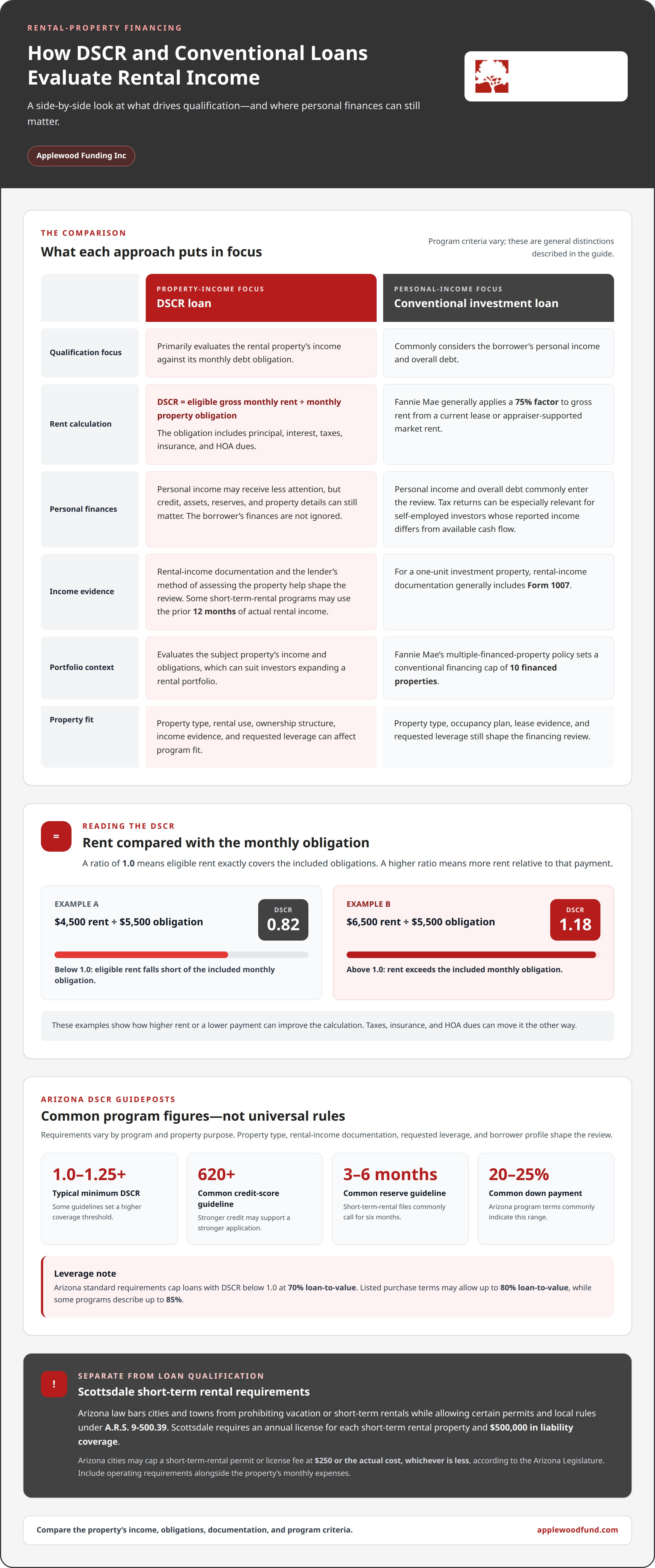
A debt service coverage ratio (DSCR) loan qualifies a rental property partly through its income, rather than relying only on the borrower’s personal earnings. The core calculation divides eligible gross monthly rent by monthly principal, interest, taxes, insurance, and HOA dues. A DSCR of 1.0 means rent exactly covers those included obligations. At 1.20, rent covers debt service by 120%, giving the lender a stronger income-to-payment picture.
For a Scottsdale property, the rent estimate and monthly obligation work together. For example, $4,500 in eligible monthly rent divided by a $5,500 property obligation produces a DSCR of 0.82. With $6,500 rent and the same obligation, the ratio becomes 1.18. These examples show how higher rent or a lower payment can improve the calculation, while taxes, insurance, and HOA dues can move it the other way. Scottsdale DSCR loan lenders assess these property-specific inputs together.
Arizona DSCR requirements vary by program and property purpose. Typical Scottsdale guidelines call for a minimum DSCR of 1.0-1.25+, a credit score of 620 or higher, and 3-6 months of reserves. Arizona program terms commonly indicate a 20 to 25% down payment. These are guideposts, not universal rules. Property type, rental-income documentation, requested leverage, and borrower profile shape the review.
The minimum DSCR can affect eligibility and leverage. A ratio below 1.0 means eligible rent falls short of the included monthly obligation. Arizona standard requirements cap loans with DSCR below 1.0 at 70% loan-to-value. For purchases, listed Arizona program terms may allow up to 80% loan-to-value, while some programs describe up to 85%. Compare Scottsdale DSCR loan lenders by their coverage thresholds and how they assess leverage for your property purpose.
- Credit: A 620 score is a common minimum guideline; stronger credit may support a stronger application.
- Down payment: Arizona program terms commonly indicate 20 to 25%.
- Reserves: Guidelines commonly call for 3-6 months, with six months for short-term rental files.
- Coverage: A 1.0 ratio breaks even on included obligations; some guidelines set a higher threshold.
Short-term rental plans also involve Scottsdale rules beyond loan qualification. Arizona law bars cities and towns from prohibiting vacation or short-term rentals while allowing certain permits and local rules, under A.R.S. 9-500.39, according to the Arizona Legislature. Arizona cities may cap a short-term-rental permit or license fee at $250 or the actual cost, whichever is less, according to the Arizona Legislature. Scottsdale requires an annual license for each short-term rental property and $500,000 in liability coverage. Include these operating requirements in your rental plan alongside the property’s monthly expenses.
Do DSCR loans use my personal income?
DSCR qualification generally focuses on the property’s rental income compared with its monthly debt obligation. Personal income may receive less attention than with conventional financing, but credit, assets, reserves, and property details can still matter. DSCR financing does not mean the borrower’s finances are ignored.
Conventional investment loans commonly consider personal income and overall debt. Fannie Mae generally applies a 75% factor to gross rent from a current lease or appraiser-supported market rent. For a one-unit investment property, rental-income documentation generally includes Form 1007. This can make tax returns especially relevant for self-employed investors whose reported income differs from available cash flow.
Portfolio size can change the comparison. Fannie Mae’s multiple-financed-property policy sets a conventional financing cap of 10 financed properties. A DSCR loan instead evaluates the subject property’s income and obligations, which can suit an investor expanding a rental portfolio. Property type, occupancy plan, lease evidence, and requested leverage still shape program fit.
Local banks, mortgage brokers, and national DSCR lenders differ in how they assess financing. A local bank may apply its own criteria, while a broker can present options from its lender network. National DSCR lenders may use standardized property-income guidelines. For Scottsdale investors, Scottsdale DSCR loan lenders can differ in eligible property types, documentation, underwriting, and closing procedures.
Investors may find DSCR financing through private and specialty mortgage lenders, mortgage brokers, and lenders with rental-property programs. These options can suit different borrower and property profiles. Compare Scottsdale DSCR loan lenders based on whether their programs fit the property’s rental use, ownership structure, and income documentation.
Short-term rentals and Airbnb properties can qualify under some DSCR programs. Depending on the program, a short-term rental file may use the prior 12 months of actual rental income. A lender’s approach to rental history and income evidence can affect how the property is assessed. Scottsdale investors must also account for local operating rules, which are separate from loan qualification.
DSCR programs may consider single-family homes, condos, and multifamily buildings, but eligibility depends on the property type and lender criteria. Condo reviews may include project details, while multifamily underwriting can assess building income and units. For a portfolio across locations, organize property and ownership records for each asset before closing. Phoenix investors buying in Scottsdale also need financing that fits the property and rental plan.
If you’re weighing property-based financing against income-documentation requirements, talk through your financing scenario before structuring the purchase.
Property expenses including taxes, insurance, HOA, vacancy, repairs, and utilities
A Scottsdale rental’s rent estimate is only part of the financial picture. The monthly payment, property taxes, insurance, and HOA dues affect the housing obligation used in a DSCR calculation. Vacancy, repairs, and utilities also affect operating cash flow, even when they fall outside the calculation’s principal, interest, taxes, insurance, and HOA components. Track the qualifying payment separately from the property’s broader operating budget.
Start with the rent evidence. A current lease can show contracted income, while a market-rent assessment can help evaluate an unleased property. Scottsdale’s citywide median gross rent was $2,013 per month for 2020-2024, a broad benchmark rather than a rent estimate for every home. Compare the subject property’s location, condition, layout, and rental strategy with its own supporting rent documentation.
Next, assess how recurring costs affect the calculation. Arizona property taxes and insurance premiums contribute to the monthly housing obligation. Include HOA dues when applicable, and review the association’s current charges and property requirements. For a condo, HOA costs can make the monthly obligation higher than for a similar home without association dues.
Vacancy creates a separate cash-flow risk. When a unit has no tenant, it brings in no rent, while taxes, insurance, and HOA costs continue. Repairs can also reduce usable cash flow, especially when work is needed between tenants. Account for utilities if the owner pays them. Include these operating costs in your investment analysis instead of treating gross rent as spendable income.
This distinction matters when assessing a property. These figures illustrate inputs investors may review, not a universal result for Scottsdale. The property’s rent documentation and monthly obligations determine its ratio. Even a strong headline rent figure may leave less room after operating expenses.
For a practical review, organize the figures into three groups:
- Income: Lease terms, supported market rent, and any short-term rental history.
- Included housing costs: Principal, interest, property taxes, insurance, and HOA dues.
- Operating costs: Vacancy, repairs, and owner-paid utilities.
Keep property records separate from borrower tax returns. Tax returns show the borrower’s broader financial picture, while the property analysis focuses on documented rent and costs. This separation helps investors compare a purchase with a potential cash-out refinance using the same property-level view. Before choosing a financing structure, confirm that the rent assessment and expense assumptions reflect the property’s actual use and condition.
DSCR loan application and closing timeline
A DSCR lender helps Scottsdale borrowers compare options by reviewing property income, expenses, requested leverage, and loan purpose. For a purchase or refinance, that comparison clarifies how rent coverage and borrower details fit the application.
Underwriting and Closing Steps
Underwriting connects the borrower’s application with the property’s income and condition. The lender reviews rental evidence, market rent where applicable, monthly obligations, credit, reserves, and property details. A short-term rental file may use the prior 12 months of actual rental income under some programs. Clear records help the underwriter assess coverage and identify gaps before closing.
- Application review: The lender organizes borrower, ownership, and loan-purpose information.
- Property analysis: Rent documentation is compared with the payment and included expenses.
- Condition review: Property valuation and title work support the collateral decision.
- Closing preparation: Final terms and required signing documents are coordinated.
For a refinance, the review also considers the existing property debt and the requested new loan structure. Make the comparison useful by distinguishing purchase needs from refinance goals, then providing consistent rent and property information for each option under review.
Estimated Closing Times
DSCR loans are generally described as closing in 21 to 30 days. A Scottsdale lender directory reports an average closing time of 14 days. These figures describe different timelines, not a guaranteed date for every borrower. Appraisal scheduling, title findings, rental-income documentation, and underwriting questions can affect how quickly a file moves.
Keep the process moving by responding promptly to requests for documents or clarification. For example, a mismatch between a lease and the rent figure in the application can prompt additional review. Short-term rental files may also need a clear income history, while an unleased property may rely on supported market rent.
Ask how underwriting, valuation, and closing coordination are sequenced. This helps you compare loan options beyond the initial quote. Review the proposed payment, coverage calculation, leverage, documentation requirements, and expected milestones together. A lower payment may improve coverage, while a different loan structure may better match the purchase or refinance purpose.
For Scottsdale investors, a realistic closing plan starts with a complete borrower file and consistent property records. Track application milestones, respond to underwriting requests, and keep lease or rent evidence current through closing. These steps help the lender evaluate the property and move the transaction forward.
DSCR loans for self-employed and out-of-state buyers
Self-employed investors may have business income that differs from their available cash flow. DSCR loans put the main qualification focus on eligible rental income and the Arizona property’s monthly obligations. This can help when tax-return deductions reduce reported income, but borrower credit, reserves, assets, and property details may still matter.
The key distinction is how the loan’s repayment is assessed. A conventional mortgage application may closely weigh personal income, debts, and tax documentation. A DSCR review focuses on whether the rental property’s income supports its payment. It does not eliminate the borrower’s financial review. Instead, it gives the property’s income a direct role in the decision.
For an out-of-state buyer, clear coordination is especially useful. The buyer may live elsewhere while purchasing a Scottsdale property, so property records, ownership details, rent evidence, and transaction documents need to align. The lender evaluates the Arizona property and its intended rental use. The borrower should also understand how local operating requirements affect the business plan.
Short-term rentals call for a sharper income story. Some DSCR programs document short-term rental income using the prior 12 months of actual rental income. A new rental without that history may be assessed differently from an established property. The distinction matters for investors who plan to use seasonal bookings or platform income to support expected cash flow.
Before applying, organize the scenario around four points:
- Borrower profile: Explain self-employment, existing obligations, available reserves, and property ownership.
- Property purpose: Identify whether the Arizona purchase is a long-term rental, short-term rental, or refinance.
- Income support: Present lease information or rental history that matches the intended use.
- Distance and coordination: Keep purchase, title, and property information consistent while managing the transaction remotely.
Investors with multiple properties should track each asset’s rent and payment separately. A portfolio may include different property types, markets, leases, and operating histories. Reviewing each property individually helps clarify which asset supports the financing request and prevents income from one rental from obscuring weaker cash flow elsewhere.
For self-employed buyers, the practical takeaway is simple: business tax treatment and rental-property performance answer different questions. For an out-of-state buyer, the priority is consistent documentation and a clear Arizona property plan. Use a financing conversation about your Arizona rental scenario to connect those pieces before moving toward an application.
Applewood Funding Inc
Applewood Funding Inc helps rental-property investors explore financing suited to their plans. If you’re evaluating a Scottsdale property, bring its rent information, expenses, intended use, and your purchase or refinance goal to the discussion. These details help shape a financing request around the property and your next step.
Applewood Funding Inc offers Rental Property Loans for investors seeking financing for long-term rental holdings. Other options include Owner Occupied Hard Money Loans, Fix and Flip Loans, and Construction and Land Loans. The right fit depends on the property and financing purpose.
Ready to discuss your rental property plans? Contact Applewood Funding Inc to talk through your financing needs.
Put Your Scottsdale Investment Plan in Motion
Make your next financing conversation about the investment you want to build, not just the loan you want to obtain. Decide whether the property supports long-term portfolio growth, a near-term acquisition, or a change in your current strategy. Then identify the ownership structure and operating plan that fit your goal. These choices give the financing discussion a clear direction.
When comparing scottsdale dscr loan lenders, focus on how each proposed structure fits your plan after closing. Consider the flexibility you need if the property’s use or your portfolio changes. Financing should support a sound investment decision, not push you toward a property or strategy that doesn’t fit.
Ready to discuss how your plans align with available financing? Talk with Applewood Funding Inc. about your investment goals. Take the next step with a clear plan and keep building toward the portfolio you want.
Frequently Asked Questions
What DSCR do lenders look for?
Scottsdale DSCR guidelines commonly set minimum coverage between 1.0 and 1.25 or higher. A ratio of 1.0 means eligible rent matches the property obligations counted in the calculation; a higher ratio shows more income relative to those costs. Lender criteria vary by program and property profile. When reviewing an offer, compare the required ratio with the lender’s rent assumptions and the payment used in its calculation.
What minimum credit score and down payment do Scottsdale DSCR lenders require?
Typical Scottsdale guidelines call for a credit score of 620 or higher, with Arizona program terms commonly indicating a 20 to 25% down payment. The required contribution can depend on the requested loan-to-value ratio and property scenario. Review how the lender calculates the purchase value and down payment, then consider the cash needed for reserves separately. A down payment is not the only cash requirement to plan around.
What DSCR ratio and rental-income documentation do lenders require?
Typical minimum DSCR guidelines range from 1.0 to 1.25 or higher. Lenders may evaluate rental income using an existing lease, a supported market-rent assessment, or rental history for a short-term rental. A one-unit investment property using rent to qualify conventionally generally requires Form 1007 as part of appraisal documentation. For short-term rental financing, some DSCR programs use the prior 12 months of actual rental income.
What are the Arizona and Scottsdale rules affecting DSCR rental-property loans?
Arizona law bars cities and towns from prohibiting vacation or short-term rentals, while allowing certain permits and local rules, under A.R.S. 9-500.39, according to the Arizona Legislature. Arizona cities may cap a short-term-rental permit or license fee at $250 or the actual cost, whichever is less, according to the Arizona Legislature. Scottsdale also requires an annual license and $500,000 in liability coverage for each short-term rental property.
How long does DSCR loan approval and closing take in Scottsdale?
DSCR loans are generally described as closing in 21 to 30 days. Approval and closing are separate milestones: underwriting first reviews borrower, rental, and property information, followed by final closing coordination. A complete file can help avoid delays caused by unclear lease details, inconsistent rent figures, or outstanding property documentation. For a Scottsdale short-term rental, include the relevant income records and local operating information in the transaction file.
What are the risks, prepayment penalties, and reserve requirements for Scottsdale DSCR loans?
Key risks include rent falling short of the payment, unexpected operating costs, and a DSCR below the program’s threshold. Typical Scottsdale guidelines call for 3-6 months of reserves; short-term rental files may require six months. Prepayment terms vary by loan, so review the signed documents for any penalty, its duration, calculation, and exceptions before closing. Also assess whether the property can maintain cash flow if occupancy or expenses change.