
Hard Money Loans for Mesa Partnership Buyouts and Buy-Ins
November 25, 2026Financing for a Property That Won’t Get Insurance in Tempe
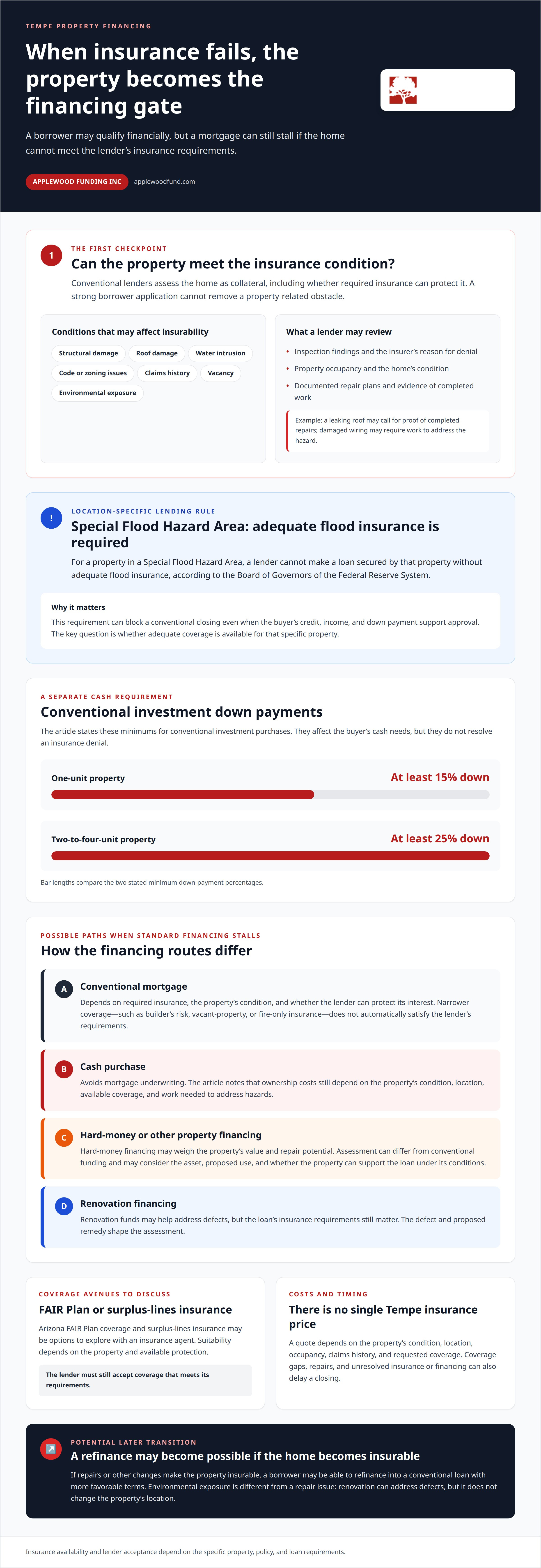
An insurance denial can derail a conventional mortgage. Financing for a property that won’t get insurance in Tempe depends first on why coverage was declined and whether adequate insurance can be obtained. Banks and mortgage lenders may require minimum coverage as a loan condition, according to the Federal Emergency Management Agency. For a property in a Special Flood Hazard Area, a lender can’t make a loan secured by that property without adequate flood insurance, according to the Board of Governors of the Federal Reserve System.
Insurance problems do not all have the same cause or outcome. Structural damage, code or zoning issues, claims history, vacancy, and environmental exposure can affect insurability, and each may change how a lender views the property. This article explains why a Tempe home may be rejected by insurers, how environmental risks can complicate conventional financing, and what financing options may fit when a standard mortgage is not workable.
Key Takeaways
- Learn which property conditions, from structural damage to code issues, can lead insurers to decline coverage.
- Understand why flood exposure and other location risks can affect both insurance options and mortgage eligibility.
- See why a conventional lender may hesitate when a home can’t meet its insurance requirements.
- Explore how private, asset-based financing may assess a property and potential repairs differently.
- Find out how Arizona FAIR Plan and surplus-lines coverage may factor into a property’s insurance and financing picture.
Challenges of conventional mortgage financing
A conventional mortgage depends on more than a borrower’s credit and down payment. The lender also evaluates the property as collateral, including whether required insurance can protect it. If an insurer declines coverage because of a damaged roof, water intrusion, or another serious defect, conventional funding can stall before closing. A strong application cannot remove a property-related obstacle.
Investment property loans bring another hurdle: their down payment requirements are generally higher than those for a primary residence. A conventional investment purchase requires at least 15% down for a one-unit property and 25% for a two-to-four-unit property. Those figures don’t solve an insurance denial, but they show how property use and loan type affect the buyer’s cash needs. Underwriting also considers the home’s condition and whether the lender can secure its interest.
Can a buyer use cash, a hard-money loan, or a renovation loan to buy an uninsurable home? Cash avoids mortgage underwriting, while hard-money financing may weigh the property’s value and repair potential. Renovation funds may help address defects, but the loan’s insurance requirements still matter.
How much does insurance cost for high-risk or hard-to-insure homes in Tempe, Arizona? There is no single Tempe price. An insurer’s quote depends on the property’s condition, location, occupancy, claims history, and requested coverage. Because each quote reflects that home’s risk profile, a general figure would not reliably predict its premium.
Will lenders accept builder’s risk, vacant-property, or fire-only insurance instead of homeowners insurance? Acceptance depends on the lender’s coverage requirements and whether the specific policy meets them. A policy with narrower protection does not automatically satisfy a mortgage condition. Mortgage lenders may require minimum insurance coverage, according to the Federal Emergency Management Agency.
What information and repairs may a lender require to assess an uninsurable property’s insurance and mortgage eligibility? The lender may review inspection findings, the insurer’s reason for denial, occupancy, and documented repair plans. For example, a leaking roof may call for evidence of completed repairs, while damaged wiring may require work to address the hazard. The defect and proposed remedy shape the assessment.
Which Arizona insurance agencies or programs help find coverage for hard-to-insure properties? Arizona FAIR Plan coverage and surplus-lines insurance are options to explore with an insurance agent. Their suitability depends on the property and available protection. The lender must still accept coverage that meets its requirements.
For a property in a Special Flood Hazard Area, the rule is stricter. The Board of Governors of the Federal Reserve System states that a lender cannot make a loan secured by the property without adequate flood insurance. That requirement can block a conventional closing even when the borrower qualifies financially.
Environmental and location risks
A Tempe property’s location can shape both insurance availability and mortgage approval. Flood or wildfire exposure can make a home difficult to insure under standard policies. That affects real estate financing because a conventional lender considers whether the property can protect the loan as collateral. Separate location-related concerns from repair issues: a sound roof will not remove a flood exposure designation, and renovation will not change the property’s location.
Flood exposure has a direct financing consequence in a designated area. The Board of Governors of the Federal Reserve System states that a lender cannot make a loan secured by a property in a Special Flood Hazard Area without adequate flood insurance in place. A home purchase can therefore face a financing barrier even when the buyer’s credit, income, and down payment support approval. The key issue is whether required coverage is available for that specific property.
Wildfire exposure creates a different insurance challenge. A standard insurer may reject or limit coverage for a property it considers exposed to wildfire risk. That can narrow the policies available to an owner, including someone buying an occupied home or rental property. If coverage does not meet a conventional loan’s requirements, the buyer may not qualify for that financing, regardless of projected rental income or available equity.
What risks and costs come with buying an uninsurable property in Tempe? The buyer may face coverage gaps, repair obligations, and a delayed closing while financing and insurance remain unresolved. Total ownership costs depend on the property’s condition, location, available coverage, and work needed to address identified hazards. A renovation plan can define the work, but it does not eliminate environmental exposure.
Location can also affect a later refinance. If repairs or other changes make the home insurable, a borrower may be able to refinance into a conventional loan with more favorable terms. Until then, a hard-money loan or other property financing may be assessed differently from conventional funding. Lenders consider the asset, proposed use, and whether the property can support the loan under its conditions.
Tempe buyers should consider how environmental exposure affects the whole transaction, not just the insurance premium. For example, restricted coverage on a rental property can affect expected income and renovation timing. A home near a mapped flood risk may require adequate flood coverage for a lender to proceed. These issues can influence qualification, closing, and whether a later refinance is realistic.
For a property with flood or wildfire concerns, align the insurance picture with the financing plan before relying on conventional approval. The property’s location, available policy terms, repair needs, occupancy, and intended use all matter. If environmental exposure is complicating funding, discuss the property financing situation as part of the next step.
Can you get a mortgage in Arizona for a property that is uninsurable?
Sometimes, but a conventional mortgage is often difficult when a home cannot qualify for insurance. Traditional lenders may decline owner-occupied properties that cannot obtain coverage. A bank or mortgage lender may require minimum insurance coverage as a loan condition, according to the Federal Emergency Management Agency. Without coverage that meets the lender’s requirement, an otherwise qualified Arizona borrower can face a financing obstacle.
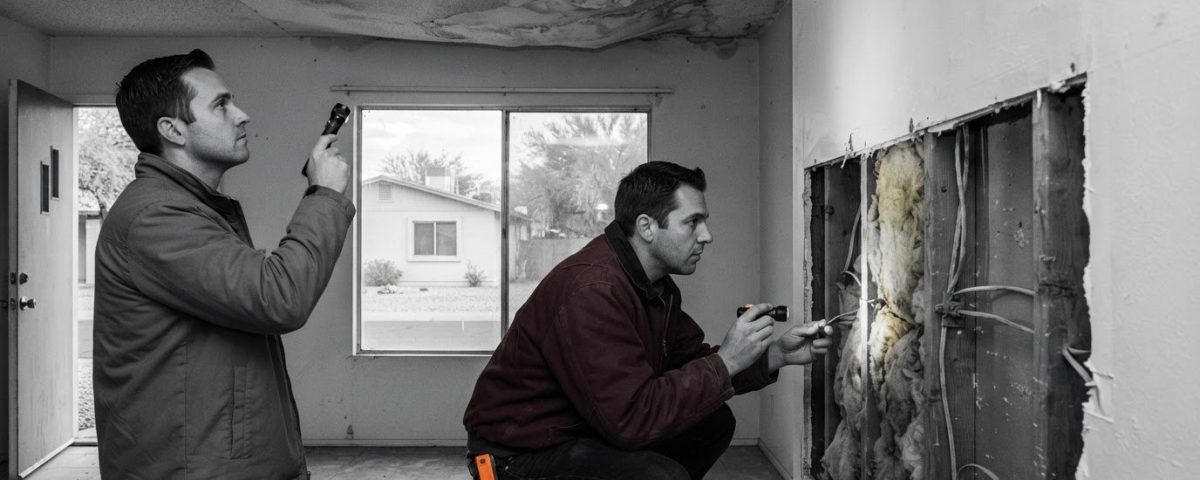
“Uninsurable” can describe different problems, not one universal property condition. An insurer might decline a home because of extensive structural damage, building-code or zoning noncompliance, or repeated claims for similar issues. A compromised foundation and unpermitted construction raise different concerns. Identifying the insurer’s stated reason helps show whether the barrier involves repairs, compliance, claims history, or another property-specific factor.
The distinction matters because mortgage underwriting assesses both the borrower and the collateral. Good credit and sufficient income help establish the borrower’s ability to repay. They do not resolve a roof leak, extensive water damage, or an electrical system that contributes to an insurance denial. A Tempe buyer can meet borrower-focused criteria and still encounter difficulty financing the home itself.
Property use also shapes the lending conversation. A buyer seeking an owner-occupied mortgage faces a different situation from an investor purchasing a rental property. For either purpose, the lender’s insurance condition remains central. For example, someone planning to occupy a home with significant water damage needs to account for the insurance obstacle as well as the property’s condition.
Repairs can improve a property’s prospects when they address the reason coverage was denied. If a leaking roof is repaired, documentation of the work can help clarify the home’s condition for an insurer and lender. Fixing a defect does not automatically establish coverage. The key question is whether insurance becomes available on terms the lender accepts before mortgage funding and closing.
Financing for a Tempe property that will not get insurance may require a different route from a conventional mortgage. Cash buyers avoid mortgage underwriting, while alternative lenders may assess property value, condition, and repair potential. These approaches do not remove the need to understand the insurance problem. Distinguish between a property that needs specific repairs and one facing ongoing location or risk concerns.
Consider two Arizona homes. One has a damaged roof and an insurer’s denial tied to its condition; the other has a history of repeated claims. Repairing the first home may address the cited problem, while the second calls for attention to its claims history and available coverage. That difference affects how buyers assess the property, potential financing, and the path toward insurability.
What financing options are available for an uninsurable property in Tempe?
When conventional mortgage underwriting stalls, financing options depend on the property’s use, condition, equity, and insurance barrier. Cash removes mortgage underwriting from the purchase, but leaves the buyer responsible for the full acquisition and repair plan. Buyers who need funding may find that a private hard money lender assesses the property’s current and potential value alongside the circumstances of the transaction.
Hard money is asset-based financing. Property value can carry more weight than borrower creditworthiness or insurance status, but that does not mean insurance concerns disappear. The lender still evaluates the property and proposed loan. For example, a Tempe home needing roof repairs may be viewed differently from one with persistent flood exposure.
Investment-property terms can also shape the cash required. Arizona hard-money investment-property loans typically call for a 25 to 30% down payment, or sufficient property equity for a refinance. These loans are short-term and may run for up to 3 or 4 years. For a rental, hard-money financing generally requires at least 25% down and may be amortized over 30 years, with a balloon payment due after the agreed term.
Repair-focused funding may suit a property whose insurance problem relates to correctable defects. Some hard-money financing may include funds for renovations intended to help a home meet insurance requirements. For instance, a documented plan to repair water damage can clarify how the buyer expects to address a condition affecting coverage. This differs from financing a property whose main concern is ongoing environmental exposure.
Construction and land financing may be relevant when the project involves substantial work or development rather than a straightforward purchase of an existing home. The scope matters: a home needing targeted repairs presents a different financing case from land requiring construction. Lenders consider the property’s present condition and potential value when assessing the request.
For a rental property, projected use and the property itself form part of the financing picture. Arizona hard-money rental-property loans generally require a down payment of at least 25%. The loan structure can include a balloon payment, so the borrower’s plan for repayment or refinance matters alongside repairs and insurance.
Once a property becomes insurable, a borrower may be able to refinance into a conventional loan with more favorable terms. That can make hard money a possible bridge for some investment purchases, not a substitute for a long-term exit plan. Compare the repair path, available coverage, loan structure, and the property’s expected use. For financing for a Tempe property that will not get insurance, those details help determine which route is practical.
Can an Arizona FAIR Plan or surplus-lines insurer cover a Tempe property that standard insurers reject?
Arizona FAIR Plan coverage and surplus-lines insurance are potential routes when a standard insurer rejects a Tempe home. They do not provide identical protection. The property’s specific risk, the policy’s terms, and the lender’s insurance requirements all shape whether either option helps with a purchase or refinance.
Start with the reason for the denial. Flood or wildfire exposure can make a home difficult to insure under standard policies. A Tempe property facing wildfire concerns presents a different underwriting issue from one with flood exposure. The insurance route must address the actual risk, not simply replace the name of the standard carrier on the application.
A FAIR Plan is one option to explore after a standard-market rejection. Surplus-lines coverage is another route buyers may encounter for risks standard insurers decline. Neither name alone tells a buyer what protection a specific policy provides. Compare the policy’s covered risks, exclusions, limits, and conditions, along with the insurer’s decision to cover the property.
Mortgage financing adds a separate test. A policy can exist without meeting a lender’s coverage requirements. For example, a Tempe buyer might obtain coverage for one identified hazard while the lender requires protection the policy does not provide. That gap can affect loan approval and closing. Treat insurer acceptance and lender acceptance as related but distinct parts of the transaction.
Property use matters, too. A vacant home, an occupied residence, and a rental property can present different circumstances for insurance assessment. Conditions at the same Tempe address can also change after repairs or a change in occupancy. Keep the insurer’s stated reason for rejecting standard coverage in view, then assess whether an alternative policy addresses that issue and fits the planned use.
For an investment property, financing terms should account for both coverage and the property’s condition. A private lender may assess the property’s current and potential value, while the insurance route determines whether the asset has protection relevant to the loan. If a policy does not meet the lender’s requirements, the buyer may need another financing approach or a different coverage solution before closing.
Don’t assume that an Arizona FAIR Plan or surplus-lines policy automatically makes a property conventionally financeable. The decision turns on the exact policy and the lender’s requirements. If coverage complications are affecting a Tempe purchase, discuss financing options for the property alongside its insurance situation.
A history of multiple claims for similar issues can cause insurers to categorize a property as too risky to cover. Arizona’s HOME Plus program offers down payment and closing cost assistance of up to 4 to 5 percent of the loan amount. It is available statewide and does not require the buyer to be a first-time homebuyer.
Applewood Funding: Rental Property Loans
Applewood Funding Inc offers Rental Property Loans for investors financing a Tempe rental home. If an insurance denial has stalled conventional financing, the property’s intended use, condition, and value help frame the financing discussion. A rental purchase differs from an owner-occupied home, so match the loan type to your plan.
For a property requiring substantial renovation before it can be rented, Fix and Flip Loans may fit the project’s purpose. For a home you plan to occupy, Owner Occupied Hard Money Loans address a different borrowing need. The right path depends on the property and how you intend to use it, not simply on the insurer’s rejection.
Bring the property details and your intended use into the conversation. Contact Applewood Funding Inc to discuss financing options for your Tempe property.
Turn the Property Challenge Into a Clear Next Step
The next step is to connect the home’s condition, intended use, and insurance situation to a financing plan. For financing for a property that won’t get insurance in Tempe, start with your goal: buying a home to occupy, renovating it for resale, or holding it as a rental. That purpose helps frame which loan type may fit the project.
Applewood Funding offers Owner Occupied Hard Money Loans, Fix and Flip Loans, and Rental Property Loans. Each serves a different property plan, so focus the conversation on what you’re buying and what you intend to do with it. Clear details about the property and your intended use can make the next discussion more focused.
You don’t have to solve every financing question at once. Take the next step and discuss the property, its insurance challenge, and your plans with Applewood Funding Inc. A clear plan starts with the right conversation.
Frequently Asked Questions
Why are some houses deemed uninsurable?
Insurers may deem a house uninsurable when its condition or risk profile makes coverage unacceptable to them. Unresolved damage, unpermitted work, or repeated claims can raise concerns beyond a single repair. The label does not always mean the home can never be insured; it describes the insurer’s decision under current conditions. Understanding the specific reason helps distinguish a correctable property issue from an ongoing risk.
Why might a property in Tempe, Arizona be denied homeowners insurance?
A Tempe property may be denied coverage because of its condition, claims history, occupancy, or environmental exposure. For example, an insurer may view a vacant or abandoned home as more vulnerable to damage, theft, or vandalism. Flood or wildfire exposure can also make standard coverage difficult to obtain. The reason matters: a vacancy concern differs from a location risk, and each can affect which coverage options may fit.