


Sedona Spec Home Loans for Builders and Investors
November 5, 2026How to Get Proof of Funds in Phoenix and Check Its Validity

A strong Phoenix property offer can lose momentum when its proof-of-funds letter is outdated. If you’re working out how to get a proof of funds letter in Phoenix, start with the date: these letters are typically valid for 30 days from issue. A bank can provide documentation showing available funds, while a fix-and-flip offer may need additional lender verification if the purchase depends on financing.
Before submitting an offer, it helps to have clear, current documentation of the funds available for the purchase. To get a proof of funds letter in Phoenix, request one from the financial institution that holds your funds, then confirm it shows the amount available and identifies you as the account holder. This guide explains what the letter proves, what to include, and how it differs from a preapproval or lender commitment. It also covers how private financing can fit into a Phoenix fix-and-flip offer.
Key Takeaways
- Proof-of-funds letters are typically valid for 30 days from the issue date, but sellers may have their own freshness requirements.
- Request documentation from the financial institution holding your funds, and allow time for processing, especially if funds need to be moved between accounts.
- For a high-value purchase, be prepared for extra verification of the funds, the account holder, and access to the money.
- A proof-of-funds letter shows available capital; a preapproval letter describes potential borrowing and serves a different purpose.
- For a Phoenix fix-and-flip offer that depends on financing, a lender commitment may help document the funding behind the offer.
How long is a Proof of Funds Letter valid?
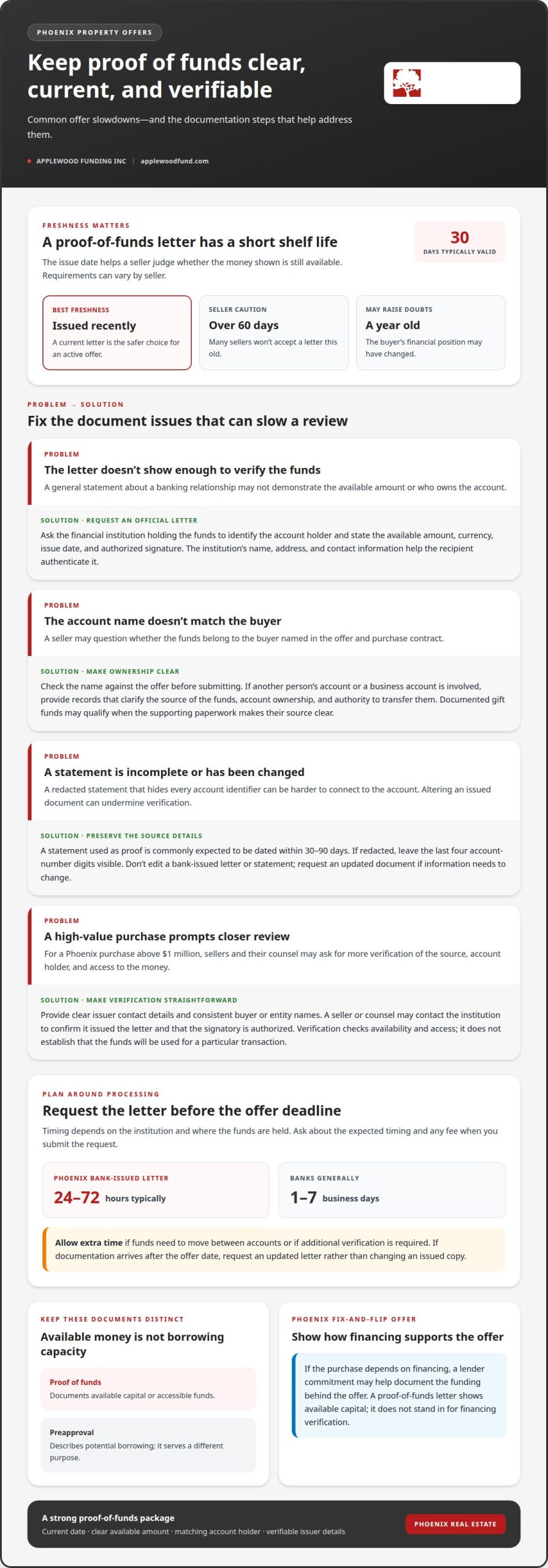
A proof-of-funds letter is typically valid for 30 days from its issue date. The date matters because a Phoenix seller wants evidence of funds that remain available, not a snapshot that may no longer reflect the account. A year-old letter can raise doubts about whether the buyer’s financial position has changed. Many sellers also won’t accept a letter older than 60 days, so a newer document is the safer choice for an active offer.
Request the letter from the bank or financial institution that holds your funds. Banks and credit unions commonly issue letters for deposit-account holders. The institution determines whether requests are made through online banking, by phone, or at a branch in Phoenix. An in-person visit may not be necessary, so ask how the institution accepts requests.
Which banks and credit unions in Phoenix issue proof-of-funds letters? Start with the institution holding your checking or savings account, since it can verify the balance directly. Investment-account providers may also document eligible assets, but the funds must be accessible for the purchase.
When requesting a bank proof-of-funds letter, provide the account holder’s name and explain its purpose, such as supporting an offer on a Phoenix property. State the amount you need to demonstrate and request an official letter showing the available balance, currency, issue date, and authorized signature. Confirm that the name matches the buyer named in the offer. Getting this detail right can help prevent a mismatch from slowing the review.
What documents do Phoenix banks require? Requirements vary by institution, but be ready to identify the account and authorize its verification. Recent bank statements can support the request; a statement used as proof is commonly expected to be dated within 30-90 days. If you submit a redacted statement, leave the last four account-number digits visible so the account can be connected to the document.
A statement and an affidavit serve different purposes. A statement records account activity and balance; an affidavit can explain a detail, such as why funds belong to the buyer when the account name differs. Don’t edit either document to change what the bank issued. If another person’s account is involved, documented gift funds may qualify, but the supporting paperwork should make their source clear.
Plan for the bank’s processing window. A Phoenix bank-issued letter typically takes 24 to 72 hours, while banks generally provide letters within 1 to 7 business days. Ask about the fee and expected timing when submitting the request, especially if your offer deadline is close. If the bank’s approval or documentation arrives after the offer date, request an updated letter rather than altering an issued copy.
Additional verification for high-value real estate purchases
For a Phoenix real estate purchase above $1 million, sellers and their counsel may request additional proof-of-funds verification. A standard letter can show funds available on a stated date, but a high-value offer may prompt closer review of the source, account holder, and access to the money. This can happen even when a bank or lender doesn’t require proof of funds. Sellers may want enough documentation to assess whether the offer can proceed.
A credible letter should make its issuer and contents easy to identify. Look for the financial institution’s name, address, and contact information, along with the current date and an authorized signature. It should identify the account holder, state the available amount and currency, and describe the form of funds. The institution’s contact details give the recipient a way to authenticate the document.
For example, a letter showing a checking account balance should identify the account holder and the amount available, not just state a general relationship with the bank. The name should match the buyer named in the offer and purchase contract. If it doesn’t, the seller may question whether the funds belong to the buyer. A bank statement used as proof should come from the account holder’s bank and carry an authorized employee’s signature.
Verification focuses on whether funds are available and whether the buyer can access and authorize their transfer for the purchase. It doesn’t establish that the buyer will use those funds for a particular transaction. A proof-of-funds letter also differs from a preapproval: one documents available money, while the other describes potential borrowing. Keep these documents distinct when presenting an offer.
Before relying on a letter, review four common trouble spots: an insufficient balance, missing bank letterhead or seal, a name mismatch, and missing signature or verification details. A seller or counsel may contact the issuing institution using its listed information to confirm that it issued the letter and that the signatory is authorized. Don’t alter a letter after issuance, since a modified document can undermine the verification process.
Business buyers may also need to make the relationship between the purchasing entity and the documented funds clear. If the account belongs to a company but the offer names a separate entity, the names alone may not explain who controls the money. Additional records can clarify account ownership and transfer authority. For a purchase involving financing, explore Phoenix property financing options as part of preparing a well-supported offer.
Timeframes for obtaining proof of funds documentation
A proof-of-funds document shows available money or accessible capital for a real estate transaction. The schedule depends on where the funds sit, which institution holds them, and whether verification is needed. If the money is already in one checking or savings account, a buyer may obtain a letter in a single day. A bank’s broader processing window can range from 1 to 7 business days.
In Phoenix, a bank-issued letter typically takes 24 to 72 hours. Moving money between banks can add several days, while gathering scattered records or resolving account ownership questions can stretch the process to a few weeks. Build the timeline around the slowest step, not the quickest estimate. A private lender commitment letter may be issued within 24 hours when underwriting is straightforward. A title or escrow company with an existing relationship may provide funds verification in 4 to 24 hours.
Accepted documentation depends on liquidity and access. Checking, savings, and money market accounts can show cash available for a purchase. Treasury bills, documented gift funds, accessible inheritance funds, and proceeds from a pending property sale may also support proof. Some investment accounts qualify if restrictions don’t prevent access. Stocks, bonds, mutual funds, retirement accounts, and cryptocurrency may not establish readily available funds because of market changes, withdrawal limits, or volatility.
Timing can fail at review, too. A document may be rejected if its balance falls short, its account holder’s name conflicts with the buyer’s name, or its available funds cannot be accessed for closing. Missing institution details or an authorized signature can also make verification difficult. For example, a statement showing assets in a relative’s account doesn’t establish the buyer’s access by itself. A documented gift may clarify the connection.
Protect personal information when sharing documentation. Send only the records needed to establish the amount and access to funds, and use the secure submission method provided by the intended recipient. A redacted statement can conceal unrelated transactions, but leave enough account and institution information visible for authentication. Don’t alter a bank-issued letter or statement to change its meaning. If the seller’s representative or escrow team needs confirmation, provide a direct verification path through the issuing institution.
For a smoother closing, organize source documents before an offer deadline. Keep the current letter, supporting statements, and any gift or sale records together. Confirm that each document names the right account holder and shows a consistent available balance. If one item is delayed, identify the missing verification step early. Funds already in one place are generally easier to document than money still moving between institutions.
Proof of funds for Phoenix fix-and-flip offers
A Phoenix fix-and-flip offer needs evidence that matches how the purchase will be funded. A buyer using cash can document available funds with a bank letter or statement. A buyer relying on financing needs documentation that reflects lender support, rather than presenting borrowed capital as cash already held in an account. This distinction matters when a seller compares offers or sets a short escrow timeline.
Sellers may ask for proof of funds when a buyer makes a cash offer, purchases an investment property or short sale, or arranges a double closing. Each situation has different verification needs. Real estate investment groups like lpsrealestategroup.com routinely manage direct acquisitions through cash offers and creative finance solutions where upfront funding verification is essential. For a cash purchase, the account holder’s available balance should support the offer. For a financed fix-and-flip transaction, a lender commitment letter can show the intended funding source and demonstrate financing support.
Consider a Phoenix investor facing a 48-hour escrow. A bank request alone may not fit that schedule, especially if funds must move between accounts. A private lender commitment can be issued within 24 hours when underwriting is straightforward. That timing gives an investor a route to document financing while the transaction moves quickly, though the letter should accurately describe the commitment rather than imply funds are already deposited.
One example involves a $150,000 cash offer supported by a hard-money lender letter for a $150,000 loan commitment. The figures align, making the proposed funding source clear to the seller. In either case, the letter should describe the capital available for the transaction and avoid suggesting a larger or different amount.
Plan for asset access early. Stocks may need to be converted to cash and seasoned in an account; the guidance recommends doing this at least two months before an offer. Home equity may need to be made accessible before it can support proof of funds. If an offer on a distressed property depends on both cash reserves and financing, keep the records distinct so the seller can see what is liquid and what comes from a lender.
For a $220,000 distressed single-family home offer, an investor may present lender verification and a redacted bank statement as backup. That combination can clarify both the financing plan and the buyer’s available funds. The takeaway for Phoenix fix-and-flip buyers is direct: match each document to its funding source, amount, and role in the transaction. Don’t label a loan commitment as personal cash, and don’t let an outdated offer amount create confusion.
What is a proof of funds letter and what information does it include?
A proof-of-funds letter is usually a one-page statement from a financial institution confirming access to a stated amount of capital as of a specific date. For a Phoenix home offer, it helps show that money is available for a down payment, escrow, closing costs, or a cash purchase. It isn’t a loan, guarantee, or promise that the funds will be used for that property.
The letter should make its source and purpose clear at a glance. A credible document typically includes these seven elements:
- Official financial institution letterhead and the issue date.
- The account holder’s full name, matching the buyer on the offer.
- The available balance or stated financial capacity.
- The currency, such as USD.
- The form of funds, such as cash on deposit.
- A partially masked account number, when included.
- Institution contact details and a path for verification.
Those details help a seller understand what the document demonstrates. For example, a letter that identifies an account holder and shows a current USD balance connects the buyer to funds in a usable account. An account number may be masked for privacy while enough information remains to identify the account. A vague statement of financial strength without an amount or currency is harder to assess.
Checking and savings balances are common proof because they’re readily accessible. Money market accounts may qualify for the same reason. Documented gift funds, accessible inheritance proceeds, and funds from a pending property sale may also support proof. A letter can describe cash on deposit, an available line of credit, marketable securities, or a combination, but its wording must accurately reflect the funds’ form and availability.
Liquidity matters. Stocks and bonds can fluctuate, while mutual funds may not be considered liquid enough for proof. Retirement accounts can involve early withdrawal penalties, and cryptocurrency prices can shift quickly. A certificate of deposit may qualify when there’s no significant early withdrawal penalty. These distinctions matter because a letter should demonstrate capital that can support an immediate transaction, not simply assets the buyer owns.
For a mortgage purchase, proof of funds can document a cash down payment while a preapproval addresses potential borrowing. Keep the documents separate; they answer different questions. A bank statement can provide backup when it identifies the account holder, balance, and issuing bank. For financing options related to a Phoenix property purchase, discuss your property financing needs.
Applewood Funding
Applewood Funding Inc helps Phoenix buyers explore financing when a property offer depends on more than cash already held in a bank account. Its lending options include owner-occupied, fix-and-flip, rental-property, and construction and land loans. The right fit depends on the property and project. If financing is part of your plan, contact Applewood Funding Inc to discuss your property plans and how financing may fit the purchase.
Prepare your next property move
Planning how to get a proof of funds letter in Phoenix is one part of preparing a strong offer. Next, match your documentation to the way you intend to buy. If financing is part of the plan, keep that funding path clear instead of presenting a loan as cash already in your account. An organized offer helps everyone understand what supports the purchase.
Applewood Funding Inc offers Owner Occupied Hard Money Loans, Fix and Flip Loans, and Rental Property Loans. These options may suit property plans that call for financing rather than a cash-only purchase. Discuss the property, your intended use, and how financing fits your offer to help determine what information to prepare as you move forward.
Contact Applewood Funding Inc to discuss your property plans, and take your next step with a clear path forward.
Frequently Asked Questions
Can I combine funds from several banks in one letter?
Usually, each bank documents only the accounts it holds, so you may need separate letters. Submit them together as one proof-of-funds package, with each document identifying its account holder and available balance. For example, if your down payment is divided between two banks, include documentation from both. Keep the records organized so the seller can see how the amounts relate to the same purchase without counting funds twice.
What does POF mean?
POF means “proof of funds.” In a real estate transaction, it refers to documentation showing money available for a purchase. It can support a cash offer or demonstrate funds set aside for a down payment and closing costs. It doesn’t mean a mortgage has been approved. Keep POF records separate from preapproval paperwork, which addresses potential borrowing rather than cash held or accessible.
What funds qualify as POF?
Liquid or readily accessible funds can qualify as proof of funds. Common examples include checking, savings, and money market balances. Documented gift funds, accessible inheritance proceeds, and proceeds from a pending property sale may also support a purchase. The key distinction is access: an asset’s value alone doesn’t show that its money can be transferred for the transaction.
What is a POF letter?
A POF letter is a financial institution’s document stating the buyer’s available funds as of a particular date. It gives a seller evidence of financial capacity, not loan approval or a guarantee of closing. For example, a buyer making a cash offer can use a bank letter to support the offer. A buyer using a mortgage may show POF for the cash portion and separate financing documentation.
How long does it take to get a proof of funds letter in Phoenix?
If you’re working out how to get a proof of funds letter in Phoenix, account for both the institution’s processing time and any fund transfers. A bank-issued letter typically takes 24 to 72 hours, while banks generally provide letters within 1 to 7 business days. Funds already held in one account may be documented sooner than funds moving between institutions. Start the request before your offer deadline.
How much do banks charge for a proof of funds letter in Phoenix?
The fee depends on the institution and its process. Ask about the charge when submitting your request, and clarify whether it covers the official letter or only a related account document. This helps you plan for the paperwork before sending an offer without confusing a bank document fee with property financing costs.
What account balances or funds qualify for a proof of funds letter?
Checking, savings, and money market balances are common because they’re accessible. Treasury bills and some investment accounts may qualify when funds are available without restrictions. Stocks, bonds, mutual funds, retirement accounts, and cryptocurrency may be less suitable because of market movement, withdrawal limits, or volatility. If funds belong to another person, supporting gift documentation helps explain their connection to the buyer’s purchase.
Do Phoenix home sellers and real estate agents accept bank statements instead of a proof of funds letter?
Some sellers accept bank statements, but acceptance depends on their requirements for the offer. A useful statement identifies the account holder, shows the balance, and comes from the account holder’s bank. To get a proof of funds letter in Phoenix when a statement may not meet the seller’s needs, request an official letter from the institution. Redact unrelated transactions while preserving the information needed to identify the account.