
Flagstaff Construction Lenders for Home Builds
November 4, 2026Sedona Spec Home Loans for Builders and Investors

A Sedona spec home loan may fit a ground-up project when you plan to build without an upfront buyer and sell the finished home for a profit. These projects typically use construction financing with terms of 12-24 months. Approval may consider your creditworthiness, credit score, loan amount, and down payment.
That still leaves the key question: what makes a project financeable, and how much equity might you need to bring? It’s not just about the house. The project plan, your borrowing profile, and the financing structure all matter. This guide explains which Sedona builds may qualify, how lenders assess leverage and borrower equity, what documents can help prepare an application, and how construction financing compares with bank and hard money options. You’ll get a clearer picture of the trade-offs before choosing a path for your next build.
Key Takeaways
- A spec project may qualify when you’re building without an upfront buyer and plan to sell the completed home. The property plan and borrower profile both matter.
- Prepare personal and business tax returns from the past three years, along with clear project details, to support a construction loan application.
- Estimate your available equity early. Loan-to-cost and after-repair-value leverage use different measures, so understand which one shapes the financing structure.
- Compare bank and hard money construction financing by reviewing leverage, project fit, and the basis used to calculate the loan amount.
- Spec loans are designed around a build-and-sell project, while traditional mortgages are structured for a home purchase. Match the financing to the property’s purpose.
Preparing a loan application and project documents
A strong application connects the builder’s experience, the Sedona property, and a realistic construction plan. Organize the documents early so a private lender can assess the project, borrower, and requested financing together.
Loan Application Documents
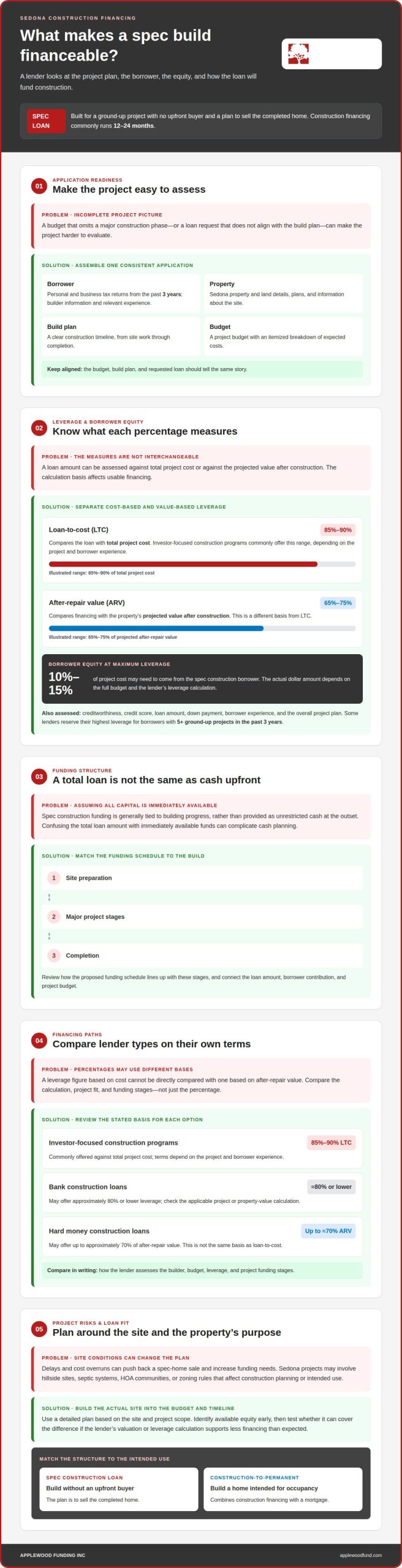
Prepare personal and business tax returns from the past three years, along with a clear project budget and construction timeline. Include property and land details, plans, builder information, and an itemized breakdown of expected costs. These materials show how the project will move from site work to a completed home.
The lender may consider creditworthiness, credit score, loan amount, and down payment. Present a consistent application: the budget, build plan, and requested loan should align. For example, an estimate that leaves out a major construction phase can make the project harder to assess.
Loan Ratios and Financing Limits
Loan-to-cost (LTC) compares the loan with total project cost. Investor-focused construction programs commonly offer 85%-90% LTC, depending on the project and borrower experience. After-repair value (ARV) compares financing with the projected value after construction; common leverage is 65%-75% of ARV. These are different measures, so review which one sets the usable loan amount.
At maximum leverage, spec construction borrowers may need to contribute 10%-15% of project cost. The actual dollar amount depends on the full budget and the lender’s leverage calculation. Loan limits therefore come from the project’s costs, projected completed value, and borrower contribution, rather than one universal figure.
Spec construction funding is generally structured around building progress, rather than providing all construction capital as unrestricted cash at the outset. Ask how the proposed funding schedule lines up with major project stages, from site preparation through completion. A clear schedule helps the builder plan cash needs and coordinate work without confusing the total loan amount with funds immediately available.
Construction-to-permanent loans typically combine construction financing with a mortgage for a home intended for occupancy. A spec construction loan instead finances a build without an upfront buyer, with the goal of selling the completed home. The intended use and exit plan shape which structure fits.
In Sedona, banks and private construction lenders are the main lender categories to explore; mortgage brokers specializing in construction financing can help identify relevant programs. Compare how each assesses the builder, project budget, leverage, and funding stages. Ask for terms in writing so you can evaluate the financing structure against the build plan.
Delays and cost overruns can push back the sale of a spec home and increase project funding needs. Sedona projects may also involve hillside sites, septic systems, HOA communities, or zoning rules that affect construction planning or intended use. Build a detailed timeline and budget around the actual site and project scope.
Leverage, borrower equity, and down payments
Leverage describes how much project financing a lender may provide against cost or projected completed value. For the borrower, the other side of the equation is equity: funds contributed toward land, construction, or other project costs. The lender also weighs experience, credit profile, loan size, and project plan. Assess the required contribution alongside the proposed loan amount.
Loan-to-cost (LTC) measures the loan against total project costs. Loan-to-value (LTV) compares the loan with a property’s value, while after-repair-value (ARV) considers its projected value after construction. These measures are not interchangeable. A lender may also weigh a builder’s track record; some reserve their highest leverage for borrowers with 5+ ground-up projects in the past three years.
Plan for equity before committing to a Sedona build. The amount depends on the lender’s leverage calculation, project budget, and borrower experience. A larger cash contribution can reduce the amount borrowed, but it also ties up more capital during construction. Identify the sources of your funds and match them against the project cost plan to make any financing gap clear.
Read monthly payment estimates carefully. That illustration describes a conventional purchase, not a spec construction loan, so it doesn’t establish the monthly payment for a construction-financed build.
The assumptions matter. That purchase example can show how a down payment affects the amount borrowed, but it isn’t a spec-loan quote. A spec project has its own budget, valuation basis, equity contribution, and financing terms. Keep those calculations separate when comparing monthly estimates.
For a spec build, focus on the loan’s calculation method and when payments apply during the project. Ask for a breakdown that connects the proposed loan amount, borrower contribution, and project budget. Then test whether your available equity can cover the difference if the lender’s valuation or leverage calculation supports less financing than expected. To discuss how equity fits a construction project, review construction financing options.
Comparisons with bank and hard money financing
For a Sedona real estate project, compare financing by leverage, valuation basis, and fit with your build plan. Bank construction loans may offer approximately 80% or lower leverage. Hard money construction loans may offer up to approximately 70% of after-repair value (ARV). Those percentages use different calculations, so they don’t show an equal share of the same project cost.
A bank loan’s leverage figure describes financing relative to the applicable project or property value calculation. The lender’s process and borrower qualifications also shape the offer. If your project documentation and financing plan fit bank criteria, this route may be worth evaluating. Compare the proposed loan amount and required equity, not just the headline percentage.
Hard money construction financing may be assessed against the home’s projected ARV. That can make the completed-home valuation central to the financing decision. For a Sedona spec build, present a clear picture of the land, construction scope, and expected finished property. Understand how the ARV figure affects the loan amount and funds available.
Don’t treat 80% of one calculation as automatically more financing than 70% of another. First identify the denominator: project cost, property value, or ARV. Then compare the resulting loan amount, equity needed, and funding structure. For example, a project with substantial construction costs may look different under an ARV-based calculation than under a cost-based one.
Use a consistent comparison process for each financing proposal:
- Record the lender’s leverage percentage and whether it uses project cost or ARV.
- Compare the resulting loan amount with the same project budget.
- Identify the borrower equity contribution and how it fits the build’s cash needs.
- Review how the proposed funding schedule aligns with construction stages.
This comparison helps real estate investors weigh practical trade-offs. A higher stated percentage alone doesn’t show which option better supports the project. The calculation method, total proceeds, and funding timing all matter. An LLC member reviewing financing with a builder can use the same approach, keeping the project budget consistent across proposals.
Choose based on the project structure and your ability to contribute equity, not just the financing label. For a Sedona build, compare bank and hard money proposals using the same scope, cost assumptions, and finished-home valuation. If their leverage calculations use different bases, note that clearly. This keeps the comparison useful and prevents a headline percentage from driving the decision.
How spec loans differ from traditional mortgages
A spec loan finances construction before a buyer is lined up. The builder plans to sell the finished home, so the project’s budget, build plan, and expected exit matter. Spec construction loan terms typically run 12-24 months. A traditional mortgage usually finances a completed home for a buyer’s purchase, rather than a build intended for resale.
That difference changes what the financing needs to support. A Sedona spec build needs funding aligned with construction, while a traditional purchase loan centers on acquiring an existing home. The spec borrower plans to complete and sell the property. A conventional buyer considers purchase terms, down payment, and the mortgage’s ongoing payment structure.
Individuals and LLCs can pursue spec financing, with approval based on the borrower and project. Lenders may consider creditworthiness, credit score, loan amount, and down payment. Whether applying personally or through an LLC, connect the responsible party, project budget, construction plan, and repayment or sale strategy.
Traditional mortgage examples show why payment figures shouldn’t be transferred directly to a spec loan. A conventional 7/6 adjustable-rate mortgage keeps its initial rate fixed for the first seven years. Those terms describe a conventional purchase example, not financing for a spec build.
The 7/6 ARM example also illustrates a different payment risk. Its rate may rise by up to 5% at its first adjustment and up to 1% at each later adjustment. A spec loan has a construction-focused term instead, so compare the loan’s duration and project exit plan rather than assuming a long-term mortgage structure applies.
Use these distinctions to evaluate the right financing purpose:
- Spec construction: Funds a build without an upfront buyer, aiming for a sale after completion.
- Traditional mortgage: Finances a buyer’s purchase of a home, with payment terms tied to that mortgage structure.
- Construction-to-permanent financing: Combines construction financing with a mortgage for a home intended for occupancy.
For a Sedona project, first decide whether the goal is resale or occupancy. Then match the loan structure to that purpose by reviewing the term, valuation basis, borrower contribution, and intended exit. A spec loan supports a build-and-sell plan; a traditional mortgage serves a home purchase. This distinction ties the financing choice to the property’s actual use.
What is a spec home loan and how does it work?
A spec home loan finances a builder’s construction project before a buyer is secured. “Spec” means the builder takes on the project based on expected future demand, rather than an existing purchase contract. The planned exit is typically selling the completed home. The finished property and sale plan are therefore central to understanding the financing.
The process starts with a defined project. Identify the property or lot, outline the proposed build, and estimate the full project cost. The lender considers the borrower’s creditworthiness and experience alongside the budget and expected completed value. The site, build plan, and exit strategy should all describe the same real estate investment.
Once financing is arranged, the loan supports the construction plan. Use the project budget to guide spending from early work through completion. Track actual progress against the scope and keep the financial plan aligned with the build. If the scope changes, costs and projected sale outcomes may change too, so timely project updates keep decisions grounded in current details.
Consider a Sedona example: an investor plans a home for resale, not personal occupancy. The project depends on the lot, proposed home, and a realistic plan to sell after construction. A spec loan fits that build-and-sell purpose better than a traditional purchase mortgage designed for someone buying a completed home. The financing follows the project’s intended use.
Pay attention to the loan’s exit strategy from the start. Connect the expected sale to the project timeline and projected completed value. A home that takes longer to finish or attract a buyer can keep capital tied up. Construction schedules and market demand affect the practical plan, though neither guarantees a sale date or final proceeds.
Use this sequence to understand how the financing works:
- Define the property, construction scope, and intended buyer.
- Connect the project budget with the expected finished-home value.
- Align the loan structure with the build plan and sale exit.
- Track construction progress and update project assumptions when the scope changes.
Spec financing may not fit a project intended for the borrower’s own occupancy or long-term use. The purpose matters: a build planned for resale differs from a home purchase or an owner-occupied construction project. For help matching a Sedona build-and-sell plan with construction financing, discuss your construction financing needs.
Applewood Funding Inc
Applewood Funding Inc provides Construction and Land Loans for land and construction projects. If your Sedona plan is to build a home for resale, bring the project budget, site details, construction plan, and intended exit into the financing discussion. These details help frame the capital need and show how the proposed loan relates to the project.
For other property strategies, Fix and Flip Loans and Rental Property Loans address renovation and rental investment scenarios. The right direction depends on whether you’re developing land, renovating a property, or financing a rental. Keep the project purpose clear from the start.
Contact Applewood Funding Inc to discuss financing for your Sedona project.
Set Your Next Build Up for a Clear Decision
Before committing to a Sedona spec home loan, turn your financing plan into a practical decision tool. Map project milestones, expected cash needs, and the intended sale strategy together. This helps you judge whether the proposed structure supports the build from site work through completion, rather than focusing on one headline figure.
Consider how your next project may differ. A future build could involve a different lot, construction scope, or exit plan. Keep those changes in view when shaping financing, so each project is assessed on its own terms. Applewood Funding Inc offers construction, land, fix-and-flip, and rental property financing for real estate plans in Arizona, including Sedona.
Contact Applewood Funding Inc to discuss financing for your project. Bring your goals and the build you’re considering. A clear next step can help you move forward with confidence.
Frequently Asked Questions
What kind of projects qualify for spec home construction financing?
Projects planned for construction without an upfront buyer, with a later sale as the goal, fit the basic spec-home model. Sedona spec home loans may suit a builder whose plan connects the lot, proposed home, project budget, and resale strategy. Lenders also consider borrower and project details. A home intended for personal occupancy has a different purpose from a build planned for resale.
Can I access funds as my project progresses?
Construction financing can be arranged around a project’s funding needs, but the release schedule depends on the loan structure. Before work begins, map expected expenses against stages such as site preparation and later construction. This shows when capital is needed and how it relates to the build budget. Don’t assume the full loan amount will be available as cash at the start.
Can You Finance a Spec Build With No Money Down or Get 100% Financing?
Plan for an equity contribution rather than assuming a spec build can be financed with no money down. At maximum leverage, spec construction borrowers may need to contribute approximately 10%-15% of project cost. The amount depends on the financing calculation and project details. Compare the proposed loan with total project cost and projected after-repair value, then account for any funding gap.
How do spec home loans differ from traditional mortgages?
A spec loan supports a home built for resale before a buyer is secured. A traditional mortgage usually finances a buyer’s home purchase. That distinction changes the purpose and exit plan. For example, an investor building in Sedona to sell evaluates financing around construction and resale. A buyer purchasing a completed home considers a mortgage structured for the purchase and intended occupancy.
What down payment and credit score are required for a spec home loan?
There isn’t one universal down payment or credit score threshold across private construction lenders. At maximum leverage, spec construction borrowers may need to contribute approximately 10%-15% of project cost. A 650-660+ FICO score is a common starting point among private construction lenders, though requirements vary. Lenders may also weigh creditworthiness, borrower experience, loan amount, and project details.
What loan terms and draw schedules are typical for spec home financing?
Spec construction loan terms typically run 12-24 months. The term should fit the construction plan and expected sale, since a project may take over a year to complete. Draw schedules depend on the financing structure and how funds are made available. Understand how the schedule aligns with construction stages and whether the term fits the expected completion and resale plan.
How do lenders assess land value, construction costs, and projected resale value?
Lenders may compare financing with total project cost or projected after-repair value. Investor-focused construction programs commonly offer approximately 85%-90% loan-to-cost leverage and 65%-75% of after-repair value, depending on the project and borrower experience. Land value, construction estimates, and projected finished-home value inform the assessment. Loan-to-cost and after-repair-value leverage use different calculation bases.
What documents are needed to apply for a spec home loan?
An application for Sedona spec home loans should include personal and business tax returns from the past three years, along with clear project details. Explain how the property, proposed construction, budget, and planned resale fit together. Lenders may also consider creditworthiness, credit score, loan amount, and down payment. A consistent application shows how the requested financing relates to the specific build.