

Glendale AZ Private Money Lenders and Loan Timelines
November 2, 2026Local hard money lenders in Scottsdale: compare rates and loan options
The lowest quoted rate isn’t automatically the best fit for a Scottsdale investment property. Local hard money lenders in Scottsdale offer asset-based financing, where the property securing the loan carries more weight than conventional qualification measures. The right option depends on the property, project, intended use, and loan terms.
Compare the full structure, not just the rate. Hard money may help investors finance a purchase or renovation when conventional financing doesn’t fit. Loan-to-value, repayment terms, and how the funds can be used all shape whether a loan suits the plan. Applewood Funding Inc is an Arizona private hard-money lender offering owner-occupied financing, with no up-front fees, no junk fees, and no cost to apply.
This guide explains how hard money works, what to compare, and when it may suit a property in Scottsdale or elsewhere in Arizona, including Phoenix, Glendale, Peoria, Tempe, Mesa, Sedona, Flagstaff, and Tucson. You’ll also find a practical way to match a loan purpose to your goal, whether you’re buying, renovating, building, or financing a rental property.
Key Takeaways
- Hard money financing centers on the property’s value and the deal, so understand what lenders assess during application and approval.
- Compare loan-to-value, interest, origination points, repayment terms, and intended use, not just the quoted rate.
- Cash-out refinancing and investment property loans can support different goals; match the loan structure to how you plan to use the property.
- Use the lender comparison and decision guide to weigh Scottsdale options against your timeline, project, and exit plan.
- Explore financing by property purpose, including owner-occupied, fix-and-flip, rental, construction, and land projects.
What Is Hard Money?
A hard money loan is asset-based financing: the property securing it carries more weight than conventional qualification measures. For a Scottsdale real estate investor, that shifts attention to the property’s value, condition, equity, and planned use. The loan can finance a purchase or project, but the proposed borrowing still needs to fit the collateral and repayment plan.
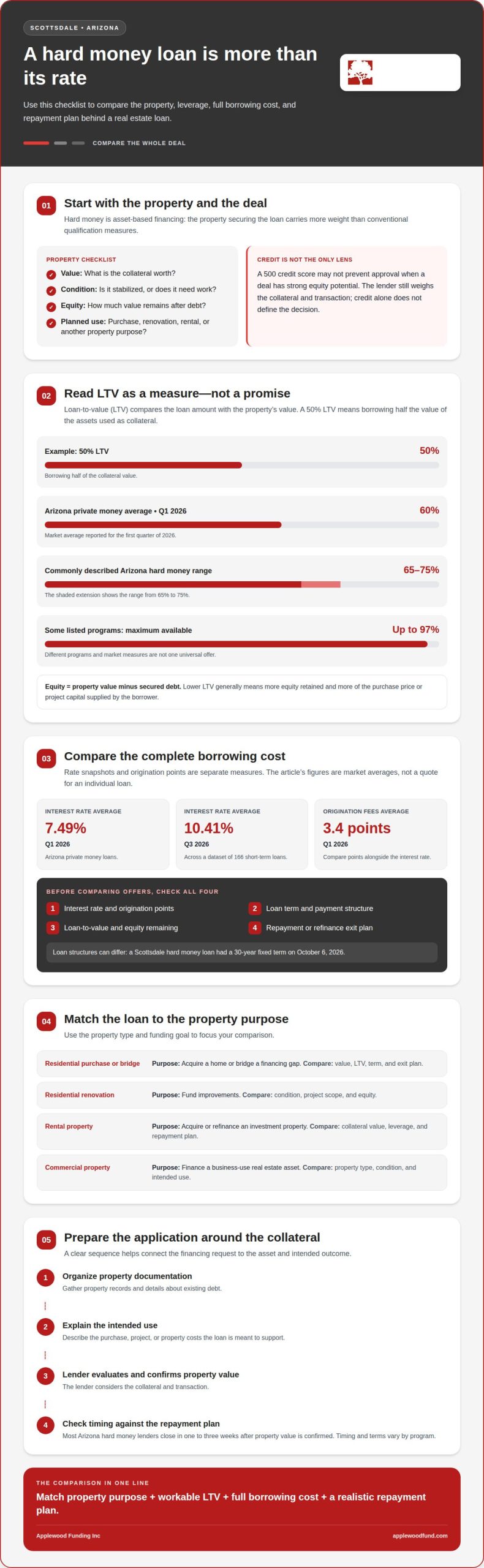
Loan-to-value, or LTV, compares the loan amount with the property’s value. A 50% LTV example means borrowing half the value of the assets used as collateral. Arizona private money loans averaged 60% LTV in the first quarter of 2026. Hard money loans in Arizona are commonly described as lending 65% to 75% of property value, while some listed programs offer up to 97% LTV. Those figures describe different program limits and market measures, not one universal offer.
Equity is the property value minus the debt secured against it. Lower LTV generally means the borrower retains more equity and brings more of the purchase price or project capital. A 500 credit score may not prevent approval when a deal has strong equity potential. Still, the lender weighs the collateral and transaction, so credit alone doesn’t define the decision.
Rates and terms vary with the property, leverage, loan purpose, and repayment plan. Arizona private money loans averaged a 7.49% interest rate in the first quarter of 2026; the average was 10.41% in the third quarter of 2026, across a dataset of 166 short-term loans. In the first quarter of 2026, average origination fees were 3.4% points. Compare the rate with points, term, payment structure, and exit plan. A Scottsdale hard money loan had a 30-year fixed term on October 6, 2026, illustrating that loan structures can differ.
Application starts with the property and deal details. Organize property documentation, explain the intended use, and respond promptly to document requests. The lender evaluates the collateral and confirms its value; most Arizona hard money lenders close in one to three weeks after that confirmation. Residential and commercial financing both depend on property type, condition, value, and proposed use, while availability and terms vary by program.
| Option | Typical purpose | Key comparison |
|---|---|---|
| Residential purchase or bridge | Acquire a home or bridge a financing gap | Value, LTV, term, exit plan |
| Residential renovation | Fund improvements to a property | Condition, project scope, equity |
| Rental property | Acquire or refinance an investment property | Collateral value, leverage, repayment plan |
| Commercial property | Finance a business-use real estate asset | Property type, condition, intended use |
Choose by matching the property type and funding purpose to a workable LTV, full borrowing cost, and realistic repayment or refinance plan.
Cash-out refinance and investment property loans
A cash-out refinance replaces existing property debt with a new loan and may release some equity as cash. For investors, that capital can support renovations, another purchase, or other property costs. The key calculation is the new loan amount against the collateral’s appraised value, after accounting for debt being paid off. A high valuation alone doesn’t determine usable proceeds; existing liens and the proposed loan structure matter too.
A Scottsdale investment-property loan funded on October 6, 2026, offers a concrete example. The property was appraised at roughly $415,000, and the loan was approximately $110,000. That represented about 27.1% loan-to-value, leaving the borrower with approximately 72.9% equity. The example shows how a borrower can retain substantial equity while using a property to secure financing. It isn’t a universal LTV target for Arizona real estate.
Before comparing cash-out options, map the transaction in order. Identify current mortgage balances and other liens, estimate the property’s value, and define the cash needed. Then compare the proposed loan balance with the property value and clarify how you’ll use the proceeds. Finally, match the repayment plan to your investment timeline. This helps show whether the refinance supports a workable plan.
Rental investment properties can provide collateral for financing, including single-family homes and multifamily buildings. For a rental loan, consider the property’s condition, occupancy, rental income, existing debt, and planned improvements. A building requiring repairs presents a different financing case from a stabilized rental. Applewood Funding offers Rental Property Loans, including sample rental purchase loans in Sedona and Scottsdale.
Collateral is the real estate securing the loan, so its condition and marketability matter. A Scottsdale rental home, a multifamily building, and a property undergoing renovation each present different considerations. Organize ownership details, current debt information, property records, and a clear use-of-funds plan. These details connect the financing request to the asset and intended investment outcome.
For a cash-out refinance, compare the net proceeds with the cost and purpose of borrowing. For an acquisition loan, focus on the purchase, needed work, and exit plan. For either structure, review LTV, repayment terms, and how much equity remains after closing. If the financing supports a rental strategy, explore hard money financing for investment property plans as one possible route.
When hard money financing may be appropriate
Hard money loans can fit real estate deals where property value, project needs, or timing shape the financing decision. In Scottsdale, compare the loan purpose, collateral, repayment plan, and available capital before choosing a structure.
Fix-and-Flip and Rehabilitation Financing
A fix-and-flip loan finances a property purchase and rehabilitation, with resale as the planned exit. It can suit investors whose property needs work before conventional mortgage financing fits. Underwriting centers on the asset and project, so prepare a clear scope, budget, and resale plan. Unlike rental financing, this strategy depends on completing improvements and selling or refinancing the property.
Private and Asset-Backed Financing
Private, asset-backed financing relies primarily on real estate collateral rather than conventional borrower metrics. That can help investors evaluate a property-focused deal that doesn’t fit a standard mortgage path. The lender still assesses the asset, equity, and repayment plan. Compared with fix-and-flip financing, asset-backed describes the lending approach, not a project type or exit strategy.
Timing can also shape the decision. A Scottsdale purchase with a 45-day mortgage contingency may call for a bridge loan if conventional financing cannot meet the transaction schedule. The fastest hard money programs listed in Arizona may fund in as little as 3 days. That timing is program-specific, so investors should match the closing plan to the actual deal requirements.
For rehabilitation, map the work before seeking capital. Identify the property’s condition, planned repairs, funding needs, and expected route to repayment. A property requiring substantial improvements presents a different case from a ready-to-rent home. Fix-and-flip financing is most aligned with a defined renovation and resale plan, rather than holding the property for ongoing rental income.
Short-term rental or Airbnb investment plans call for a different analysis. Consider the property’s condition, purchase or renovation needs, expected rental income, and how the debt will be repaid. A rental strategy depends on operating performance over time, while a flip relies on completing work and exiting through sale or refinance. Keep those paths distinct when comparing loan options.
Commercial and multifamily properties need property-specific review. A multifamily building, commercial space, or mixed-use asset can differ in condition, income sources, and intended use. Organize property records and explain the project clearly. For investors in Arizona, hard money may be worth exploring when collateral-based financing fits the asset and transaction. Applewood Funding offers Rental Property Loans and Construction and Land Loans.
Use this decision sequence: define the project, choose the repayment or exit plan, identify the property securing the loan, then compare the financing structure with your timeline. If the plan depends on rental operations, assess income and holding costs. If it depends on resale, focus on the rehabilitation scope and exit plan.
Arizona private money interest rates and origination points
How do Scottsdale hard money lenders compare with banks, private lenders, and DSCR lenders? Hard money underwriting emphasizes the property and transaction, while banks generally assess conventional borrower qualifications. Private lending is a broad category that can include asset-backed loans; DSCR financing focuses on whether rental income supports debt payments. Applewood Funding is a private hard-money lender, not a bank.
Are Arizona hard money lenders subject to licensing or disclosure rules? Arizona’s licensing and disclosure obligations can depend on the lender’s role and the transaction. For a specific example, Matt Prosory is licensed as a mortgage broker and loan originator in Arizona under NMLS numbers 2062278 and 1118493. Compare the written interest rate, origination points, fees, and repayment terms in each offer.
Arizona private money interest rates shifted across the reported periods. The average was 7.49% in the first quarter of 2026, then 10.41% in the third quarter of 2026, based on a dataset of 166 short-term loans. These are separate market-period averages, not a quote for a particular Scottsdale property. A lender’s offer can reflect collateral, leverage, loan purpose, and repayment structure.
Origination points also affect borrowing cost. Arizona private money lenders charged an average origination fee of 3.4% points in the first quarter of 2026. Points are an upfront loan charge expressed against the principal. Compare them alongside interest, payment structure, term, and any other stated fees. A lower interest rate may not mean a lower overall cost if upfront charges differ.
Build a side-by-side comparison before choosing. Record each offer’s rate, points, payment schedule, term, collateral requirements, and intended loan use. For a construction project, include how the funding plan relates to the work and repayment timeline. For rental property, distinguish a collateral-based offer from financing assessed around rental income. Approval criteria and structure matter as much as the advertised rate.
A lender’s Arizona focus can help you understand how its loans relate to local real estate, but location alone doesn’t establish experience with a particular property type. Compare stated service areas and loan purposes with the Scottsdale property’s location and intended use. Applewood Funding serves Arizona, including Phoenix, Scottsdale, Glendale, Peoria, Tempe, Mesa, Sedona, Flagstaff, and Tucson. Review the written loan terms alongside the property details.
Use the same checklist for every option: rate, points, total charges, collateral, approval basis, and repayment plan. Then compare the result with the project’s timeline and available capital. This keeps Arizona hard money and private lending options in view without confusing a market average with an individual loan offer.
Scottsdale hard money lender listings
How can borrowers verify and compare reputable hard money lenders in Scottsdale? Start with each listing’s business name, contact details, property types, and stated loan terms. Then compare written offers using the same criteria, including loan amount, credit requirements, collateral, equity, and closing expectations.
A directory entry is a starting point, not a ranking. When comparing local hard money lenders in Scottsdale, check that each business’s name and contact details match its own materials, then review a written loan proposal. Compare the property value used, existing liens, repayment structure, and approval process. Applewood Funding offers owner-occupied hard money loans and investment-property financing in Arizona.
| Listing or offer detail | What to compare | Why it matters |
|---|---|---|
| Business identity | Name and contact details | Creates a consistent record for communication |
| Property fit | Residential, multifamily, or commercial collateral | Shows whether the asset matches the loan purpose |
| Loan terms | Amount, interest, points, and repayment schedule | Reveals the full structure, not just one headline figure |
| Equity and underwriting | Valuation basis, existing debt, and borrower factors | Clarifies how the lender evaluates the transaction |
| Closing process | Required documents and stated milestones | Helps align the financing with the purchase timeline |
Compare actual proposals, not just listing descriptions. Lenders may assess collateral, borrower information, or project details differently. Ask how the proposed loan amount was determined and what information is needed to assess the deal. This makes differences visible without assuming one process fits every property. Applewood Funding offers no credit required and no cost to apply.
Keep a simple record for each Scottsdale option: contact person, property type, proposed amount, equity contribution, rate, points, term, and closing steps. Note the date of each written proposal so you’re comparing current terms. For real estate investors, this record connects the financing choice to the purchase, renovation, rental, or resale plan.
Compare a lender’s written proposal with its stated loan purposes and property focus. A clear explanation of the collateral, loan structure, and repayment plan is more useful than broad claims about speed or flexibility. Apply the same checks to each local hard money lender you’re considering in Scottsdale. Applewood Funding’s service area includes Scottsdale and other Arizona locations.
Choose a financing partner by matching the written terms to the property and exit plan, not by choosing the first listing or lowest advertised rate. To explore a financing route for a Scottsdale property, review hard money financing options alongside the other proposals you’re comparing.
Applewood Funding: Owner Occupied Hard Money Loans
Applewood Funding offers Owner Occupied Hard Money Loans for borrowers financing a property they plan to occupy. Owner Occupied Home OK. For an investment purchase, renovation, rental, or development plan, its Fix and Flip Loans, Rental Property Loans, and Construction and Land Loans address different financing purposes. The company is an Arizona private hard-money lender.
Start with the property, intended use, available equity, and repayment plan. Those details help frame the financing request and clarify which loan purpose fits your project. Review the proposed terms against your timeline before making a decision.
Contact Applewood Funding to discuss your property financing needs, or visit applewoodfund.com.
Turn Your Financing Comparison Into a Clear Next Step
Turn your shortlist of local hard money lenders in Scottsdale into a property-specific financing plan. Write down the property’s intended use, the capital needed, available equity, and your repayment or exit strategy. This gives you a practical way to assess whether a loan structure supports the deal, rather than letting the headline rate drive the decision.
Applewood Funding offers Owner Occupied Hard Money Loans, Fix and Flip Loans, and Rental Property Loans. Each addresses a different property purpose, so connect your financing question to the project you’re planning. Bring the key details together and discuss the options that fit your goals.
Contact Applewood Funding to discuss your financing options. Take the next step with a plan built around your property.
Frequently Asked Questions
Do these lenders only fund in Arizona?
No. A Scottsdale property doesn’t mean every lender operates only in Arizona. Applewood Funding focuses on Arizona, including Phoenix, Scottsdale, Glendale, Peoria, Tempe, Mesa, Sedona, Flagstaff, and Tucson. Distinguish where a lender works from where a particular property qualifies; a stated service area doesn’t, by itself, establish an office location.
Ready to Secure Your Scottsdale Capital?
Start by matching your property purpose with an appropriate loan option, then organize the property and financing details for discussion. Applewood Funding states: “No Up-Front Fees – No Cost to Apply,” “No Credit Required,” and “Owner Occupied Home OK.” Its stated term range is “Flexible Terms From 3 to 360 Months,” and it says, “You Will Get the Lowest Rates GUARANTEED.” Just text or call 602-497-4444 to get started.
What loan amounts are available?
The amount available for a particular property depends on the collateral, existing debt, equity, and loan purpose. An acquisition and a renovation can require different funding structures. Compare the proposed loan with the project budget and repayment plan rather than treating a sample loan amount as an approval amount.
What hard money lenders serve Scottsdale, Arizona?
Scottsdale borrowers can consider private lenders, asset-based lenders, and brokers arranging hard money financing. Applewood Funding is an Arizona-focused private hard-money lender serving Scottsdale. Compare a written proposal with the specific property and financing need. For a rental acquisition, for instance, consider whether the loan purpose fits a long-term rental plan rather than a renovation-and-resale project.
Which Scottsdale hard money lenders have local offices or Arizona-based teams?
Applewood Funding serves Arizona markets that include Scottsdale, Phoenix, Glendale, Peoria, Tempe, Mesa, Sedona, Flagstaff, and Tucson. Geographic coverage and a staffed local office are separate facts; a lender serving Scottsdale isn’t necessarily based there. Compare the business’s stated Arizona service area and contact details, then distinguish those details from any specific office address or team location listed in its own materials.
What are current hard money loan rates and fees in Scottsdale?
The reported Arizona private-money averages were 7.49% interest in the first quarter of 2026 and 10.41% in the third quarter of 2026, based on 166 short-term loans. The average origination fee was 3.4% points in the first quarter of 2026. These figures provide market context, not a Scottsdale quote. Compare each written offer’s interest, points, other charges, payment schedule, and term together.
What loan-to-value and loan-to-cost limits do Scottsdale hard money lenders offer?
Reported Arizona hard money figures include a 60% average LTV in the first quarter of 2026, a typical range of 65% to 75% of property value, and programs offering up to 97% LTV. Loan-to-cost measures borrowing against total project costs instead of property value. Compare the valuation basis, project budget, and borrower equity, since LTV and LTC describe different calculations and shouldn’t be treated as interchangeable limits.
What property types and loan purposes do Scottsdale hard money lenders finance?
Loan purposes can include owner-occupied home financing, fix-and-flip projects, rental property purchases, and construction or land development. Applewood Funding offers Owner Occupied Hard Money Loans, Fix and Flip Loans, Rental Property Loans, and Construction and Land Loans. Property type and intended use help determine which option fits. For example, a rental acquisition calls for a different financing purpose than a property being renovated for resale. Owner Occupied Home OK.