


How to Leverage Home Equity for Business: Options, Risks, and Next Steps
October 11, 2026Self-Employed Mortgage With No Tax Returns: Your 2026 Options

Can tax write-offs make your income look too low for the home you can afford? A self employed mortgage no tax returns option may offer another path. Some programs use bank account activity to assess income instead of relying on tax returns alone. That doesn’t mean no paperwork or automatic approval. Lenders still need evidence that you can repay the loan.
It’s frustrating when business deductions reduce your reported income, or when traditional mortgage paperwork feels like a poor fit for how you earn. You may still have options. This guide explains how bank statement loans work, which income and financial records lenders may review, and how credit, down payment, and other factors can affect qualification. Requirements vary by loan program and borrower.
You’ll also learn how an owner-occupied hard money loan differs from a bank statement mortgage and what to consider before choosing a path. For Arizona borrowers, Applewood Funding offers bank statement loans for self-employed borrowers and owner-occupied hard money loans. Start by organizing the records you have and identifying which financing route may fit your situation.
Key Takeaways
- A self employed mortgage no tax returns option may use alternative income records, but lenders still assess your ability to repay.
- Bank statement loans may review personal or business account activity. Organize complete records and be ready to explain unusual deposits.
- Alternative documentation changes how income is reviewed, not the need to consider credit, assets, property, and the full application.
- Arizona homebuyers can prepare by gathering financial records and noting business changes before exploring financing options.
- Applewood Funding Inc offers bank statement loans for self-employed borrowers and owner-occupied hard money as a distinct alternative.
Self-employed mortgage with no tax returns: what the phrase really means
Some mortgage programs consider income documentation other than tax returns, but requirements depend on the loan and borrower. A self employed mortgage no tax returns search often leads to alternative documentation, such as bank statements. The phrase doesn’t mean a lender skips income review, asks for no records, or approves a loan without assessing repayment ability.
Self-employed borrowers include business owners, freelancers, independent contractors, and other professionals who earn income through their own work or business. Their finances can look different from those of salaried employees, especially when revenue moves through multiple accounts or changes from month to month. Any mortgage loan involves borrowing against a property and assessing the borrower’s ability to repay.
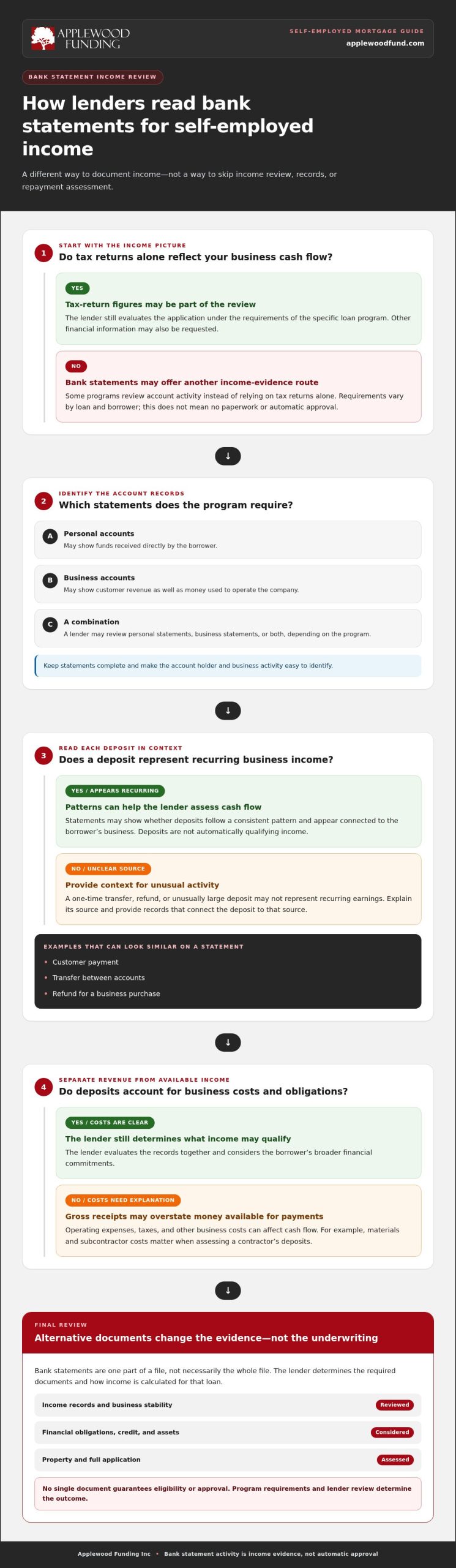
Alternative documentation changes the evidence a lender reviews; it does not remove income verification or underwriting. The goal isn’t to avoid scrutiny. It’s to present a clear, supportable picture of your finances using records that fit the loan program.
Can a mortgage lender use documents other than tax returns?
Potentially. Bank statements may help a lender review deposits and cash flow over a period of time. Depending on the program and borrower, a lender may also request a profit-and-loss statement, business documentation, or other financial information. No single document guarantees eligibility or approval. The lender evaluates the records together and applies the requirements of the specific loan.
Why tax returns may not show the full business picture
Business deductions can reduce taxable income, so tax returns may show less income than the amount moving through a business account. But deposits aren’t automatically qualifying income. Gross receipts may include funds needed for operating expenses, taxes, or other business costs. What remains available for mortgage payments is a separate consideration, and lenders may assess business stability and personal obligations as part of the full application.
Consider a contractor whose account shows steady customer payments but also substantial purchases for materials and subcontractors. Looking only at deposits could overstate the income available for a mortgage payment. Looking only at taxable income may not capture the borrower’s complete cash-flow picture either. A lender’s review needs to distinguish revenue from expenses and consider the borrower’s broader financial commitments.
That’s why “no tax returns” can be misleading. It describes a possible documentation approach, not a promise that returns will never be requested or that every program calculates income the same way. Before applying, organize records that show where deposits came from, how the business earns revenue, and which expenses affect cash flow. Clear records help explain your finances; the lender determines what documentation and income calculation the loan requires.
How self-employed bank statement mortgages assess income
A bank statement mortgage shifts the focus of income review. Instead of relying only on tax-return figures, the lender reviews the account records required by the loan program, evaluates deposits, and determines what income may qualify. The lender then considers the rest of the application, including financial obligations and the property. The method and documentation can differ by lender and loan.
Bank statement underwriting uses account activity as an alternative source of income evidence, not as a shortcut around verifying repayment ability. If you’re exploring a self employed mortgage no tax returns option, expect a review of the records behind your cash flow, not just a count of deposits.
What bank statements may reveal to a mortgage lender
Statements can show whether deposits follow a consistent pattern, how long an account has been active, and whether activity appears connected to the borrower’s business. A one-time transfer, refund, or unusually large deposit may need context because it may not represent recurring earnings. Lenders decide how to treat each deposit under their program guidelines.
Account ownership matters. Personal statements may show funds received directly by the borrower, while business statements can reflect customer revenue and money used to operate the company. A lender may review personal accounts, business accounts, or a combination, depending on the program. Keep statements complete and make the account holder and business activity easy to identify.
For example, a deposit could be a customer payment, a transfer between accounts, or a refund for a business purchase. Those entries can look similar at a glance but have different meanings. Explanations and records connecting deposits to their source can help the lender interpret the activity accurately.
What other records may support a self-employed application?
Bank statements are one part of a file, not necessarily the whole file. Depending on the loan and review, a lender may request records showing business ownership, identification, assets, debts, or other financial details. Treat these as possible categories rather than a universal checklist. The lender’s instructions determine what to provide and whether additional context is needed.
- Business records: Documents that help explain who owns the business and how it operates.
- Asset information: Records that help show available funds and relevant account ownership.
- Liability details: Information about existing debts and recurring financial obligations.
Before submitting records, make sure statements are readable, pages aren’t missing, and account activity can be explained. If your business has changed or deposits vary seasonally, prepare a brief, factual explanation and supporting records. Arizona borrowers can discuss how bank statement loans for self-employed applicants may fit their circumstances with Applewood Funding Inc’s Phoenix mortgage team.
Bank statement mortgage vs. other financing: compare the trade-offs
Choosing a mortgage path starts with a practical question: which records best explain your ability to repay? A conventional mortgage generally relies on traditional income documentation, while a bank statement mortgage may use account activity to assess income. Neither approach is automatically better. The right fit depends on your records, business finances, and the requirements of the specific loan.
Alternative documentation changes how income is reviewed, not the rest of the evaluation. Lenders may still assess credit, assets, the property, existing obligations, and repayment ability. A bank statement loan isn’t a way to bypass underwriting. For a borrower searching for a self employed mortgage no tax returns, it’s a different documentation route to explore, not a guaranteed outcome.
Use these trade-offs to frame the comparison:
- Conventional documentation: May suit borrowers whose reported income and tax records support the mortgage application. The lender’s documentation and qualification rules still apply.
- Bank statement approach: May be worth exploring when account activity offers a fuller view of business income than taxable income alone. Deposits still need review and interpretation.
- Either path: Requires a full application review. Income documentation is only one part of the lender’s assessment.
When a bank statement mortgage may be worth exploring
This route may be relevant if you’re self-employed and your account records show business deposits that aren’t apparent from taxable income alone. Deposits don’t automatically equal qualifying income, and a lender may consider expenses, income consistency, and business stability. Compare the documentation approach with your actual records before choosing a path. Applewood Funding’s bank statement loan guide offers a broader overview of this financing option.
To prepare, map each income source to the records that support it. Note which accounts receive customer payments, which expenses are paid from business funds, and whether your earnings vary with seasons or projects. This won’t determine how a lender calculates income, but it can help you understand what your records show and where an explanation may be useful.
How owner-occupied hard money differs
Owner-occupied hard money is a distinct alternative mortgage option, not another name for a bank statement loan. The two paths have different structures and shouldn’t be treated as interchangeable. Property equity and the specific loan structure may be relevant, but details depend on the loan. Applewood Funding offers owner-occupied hard money loans as a separate option for a primary residence.
Keep the decision focused: compare the income records each path may use, the broader review involved, and whether the loan structure suits your circumstances. Don’t assume a bank statement mortgage and an owner-occupied hard money loan share the same qualification process or terms. Understanding the distinction helps you discuss relevant questions and avoid choosing based on a label alone.
Prepare for a self-employed mortgage application in Arizona
Strong preparation starts before you choose a financing path. Whether you’re buying in Phoenix, Scottsdale, or elsewhere in Arizona, organize your finances so a lender can understand how your business earns income and what you can realistically commit to housing costs. If you’re exploring a self employed mortgage no tax returns option, clear records matter even when the program uses an alternative income review.
Build one organized file and keep a short explanation alongside anything that might otherwise raise questions. For example, note whether a large deposit came from a customer, an account transfer, or a one-time event. If your business changed structure, added a revenue source, or experienced a slower period, prepare a factual summary and supporting records. Don’t guess how a lender will treat an item. Make it easy to understand and let the lender explain its review.
Gather a clear picture of business and personal finances
Before discussing financing, collect the account statements and business records relevant to your income. Add a simple overview of your business, ownership, income patterns, and major changes. Then list existing debts and the funds you expect to use for the transaction. This preparation can help you spot missing records, distinguish business cash from personal funds, and describe your situation consistently.
- Organize records: Keep relevant personal and business statements together, with pages complete and readable.
- Explain activity: Identify unusual deposits, transfers, refunds, or changes in how the business earns income.
- Summarize obligations: Note current debts and funds available, separating what you know from estimates.
Questions to resolve before choosing a financing path
Start with the property. Will you live in it, or will it serve another purpose? Be clear about the intended use, since it helps identify which financing routes may be relevant. Then ask how the lender evaluates self-employed income, which records support that calculation, and whether the review considers personal or business accounts. Requirements can vary by loan and borrower.
Compare more than the document list. Understand the proposed payment obligations, how the loan is structured, what collateral is involved, and what property-related costs or responsibilities may apply. Consider how the payment fits your personal budget as well as your business cash flow. If anything is unclear, get an explanation before proceeding. A document-light-sounding label shouldn’t distract from the actual obligations.
For Arizona buyers, a prepared summary can make a financing conversation more focused. Bring your records, intended property use, and questions together, then compare the available path with your needs and repayment capacity. Discuss your Arizona home financing situation with Applewood Funding Inc.
Explore Applewood Funding’s self-employed mortgage options
If your income records don’t fit a conventional mortgage review, discuss how your business earns income and which financing options may align with your situation. Applewood Funding offers bank statement loans for self-employed borrowers. This alternative documentation route may be useful when account activity provides context, but it doesn’t guarantee approval or mean tax returns and other records will never be needed. Loan requirements and underwriting still matter.
Applewood Funding also offers owner-occupied hard money loans. This is a separate alternative mortgage option, not another name for a bank statement loan. The options have different structures and purposes, so describe your circumstances clearly rather than assuming one route fits because you’re self-employed. A focused conversation can help identify the relevant financing approach without treating either option as a guaranteed outcome.
Match the financing conversation to your documentation and property
Start with a concise picture of your business and plans. Explain what you do, how you’re paid, which income records you have, and what has changed in your business. Then describe the property you’re considering and whether you intend to occupy it. These details give the financing discussion a useful starting point and help distinguish an income-documentation question from a property-use or loan-structure question.
Before reaching out, gather the details you can readily share:
- Business and income: Your type of work, ownership role, income pattern, and available records.
- Property and occupancy: The property’s location, intended use, and whether it will be your primary residence.
- Financial picture: Existing obligations and relevant assets or funds for the transaction.
- Questions: Which documentation approach may apply, what the lender’s review involves, and what payment and collateral obligations need to be understood.
Keep the explanation factual. If deposits vary, the business recently changed, or a record doesn’t tell the whole story on its own, mention that and be ready to explain the context. The goal is a clear conversation about your actual situation, not a promise based on a product label or a quick estimate.
Take the next step with a focused mortgage inquiry
Arizona borrowers, including buyers in Phoenix, can bring these details to Applewood Funding’s Phoenix mortgage inquiry page. Whether you’re considering a self employed mortgage no tax returns route or want to understand how owner-occupied hard money differs, share your business, documentation, property, and occupancy plans. Applewood Funding offers relevant alternative mortgage options. Discuss your Arizona mortgage options with Applewood Funding.
Make your next mortgage move with clarity
Turn the question of a self employed mortgage no tax returns into a focused financing conversation. Before taking your next step, decide what matters most: how your income is documented, how the payment fits your budget, and what property you plan to buy. Bring those priorities forward, along with the records that best explain your business finances. A clear starting point makes it easier to explore a path that fits your circumstances.
Applewood Funding is managed by Joel McDaniel (NMLS 175371). Share your situation, intended occupancy, and questions. You don’t need to have every detail figured out before beginning the conversation.
Discuss your Arizona mortgage options with Applewood Funding and take the next step with a clearer picture of your financing possibilities. Your self-employed income deserves a thoughtful review, and a practical path forward can start with one focused conversation.
Frequently Asked Questions
Can I get a self-employed mortgage without tax returns?
Possibly. Some programs may consider a self employed mortgage no tax returns application using other income records, but you’ll still need to document your finances and show repayment ability. For example, a lender may ask for context if business and personal funds move between accounts. Clarify which records the specific program uses and whether tax returns may still be requested as part of its review.
What is a bank statement mortgage for a self-employed borrower?
It’s a mortgage option where account statements may help document income instead of relying primarily on tax returns. The lender reviews account history in context, not as a simple deposit total. If your business has separate operating and tax accounts, note which accounts receive customer payments and which handle expenses. That context can make the records easier to understand during an application.
Do bank statement loans require proof of income?
Yes. A bank statement loan still requires evidence for an income and repayment review, even if tax returns aren’t the main records used to assess income. A lender may ask you to explain a deposit that appears only once or clarify how clients pay you. Keep supporting records together and follow the lender’s document requests rather than assuming statements alone will be enough.
Can I qualify for a mortgage if my tax returns show low income?
Possibly, but low taxable income alone can’t establish whether you’ll qualify. A lender may consider other financial information and evaluate your complete application under the chosen program’s guidelines. Review regular household obligations alongside your business income records to get a realistic view of your monthly budget. Ask how the program assesses your income before drawing conclusions from your tax return alone.
Are bank statement mortgages and hard money loans the same?
No. A bank statement mortgage is an income-documentation approach, while hard money is a separate financing option with its own structure and review. Don’t assume they use the same criteria or serve the same needs. Applewood Funding offers bank statement loans for self-employed borrowers and owner-occupied hard money loans. Explain whether you’re buying a primary residence and how you document income to focus the financing discussion.
Can self-employed borrowers in Arizona apply for a mortgage without tax returns?
Arizona borrowers may explore programs that consider alternative income documentation, but living in the state doesn’t determine eligibility. The loan program, property, finances, and documentation all matter. Whether you’re buying in Phoenix, Scottsdale, Glendale, Peoria, Tempe, Mesa, Sedona, Flagstaff, or Tucson, prepare your business and property details before discussing options with an Arizona lender.
What documents should I prepare for a self-employed mortgage application?
Start by organizing relevant bank statements, business records, identification, debt information, and details about the property and intended occupancy. Make the file easy to review: use clear filenames, keep statement pages together, and add brief notes for unusual deposits or business changes. This is a preparation step, not a universal checklist. The lender will identify which documents apply to your loan and circumstances.