


LTV Definition: What Loan-to-Value Means for Your Mortgage
October 8, 2026Scottsdale Bridge Loans for Real Estate: A Borrower’s Guide

What if the fastest way to secure a Scottsdale property is also the wrong financing choice for your plan? Scottsdale bridge loans for real estate can help address a time-sensitive purchase or property transition, but speed alone doesn’t make a deal sound. The collateral, available equity, use of funds, and repayment exit need to work together.
If you’re facing a narrow closing window, a refinance gap, or uncertainty about lender criteria, look beyond the headline offer. Bridge financing is short-term by design, so the key question isn’t only whether the funds can support the deal. It’s how you’ll repay them, and when.
This guide explains how Scottsdale bridge financing works, how it differs from traditional mortgages and other real estate funding, and what lenders may assess about the property and your plan. You’ll also learn how to prepare a credible exit strategy before discussing financing. Applewood Funding Inc provides private, asset-based real estate lending, including fix-and-flip, rental, construction and land, and cash-out hard money financing, as well as owner-occupied hard money loans. Start with the property, the use of funds, the timeline, and the repayment path, whether your deal is in Scottsdale, Phoenix, Tempe, Mesa, Glendale, Peoria, Sedona, Flagstaff, or elsewhere in Arizona.
Key Takeaways
- See when short-term, property-backed financing may help bridge an acquisition, refinance transition, or planned sale.
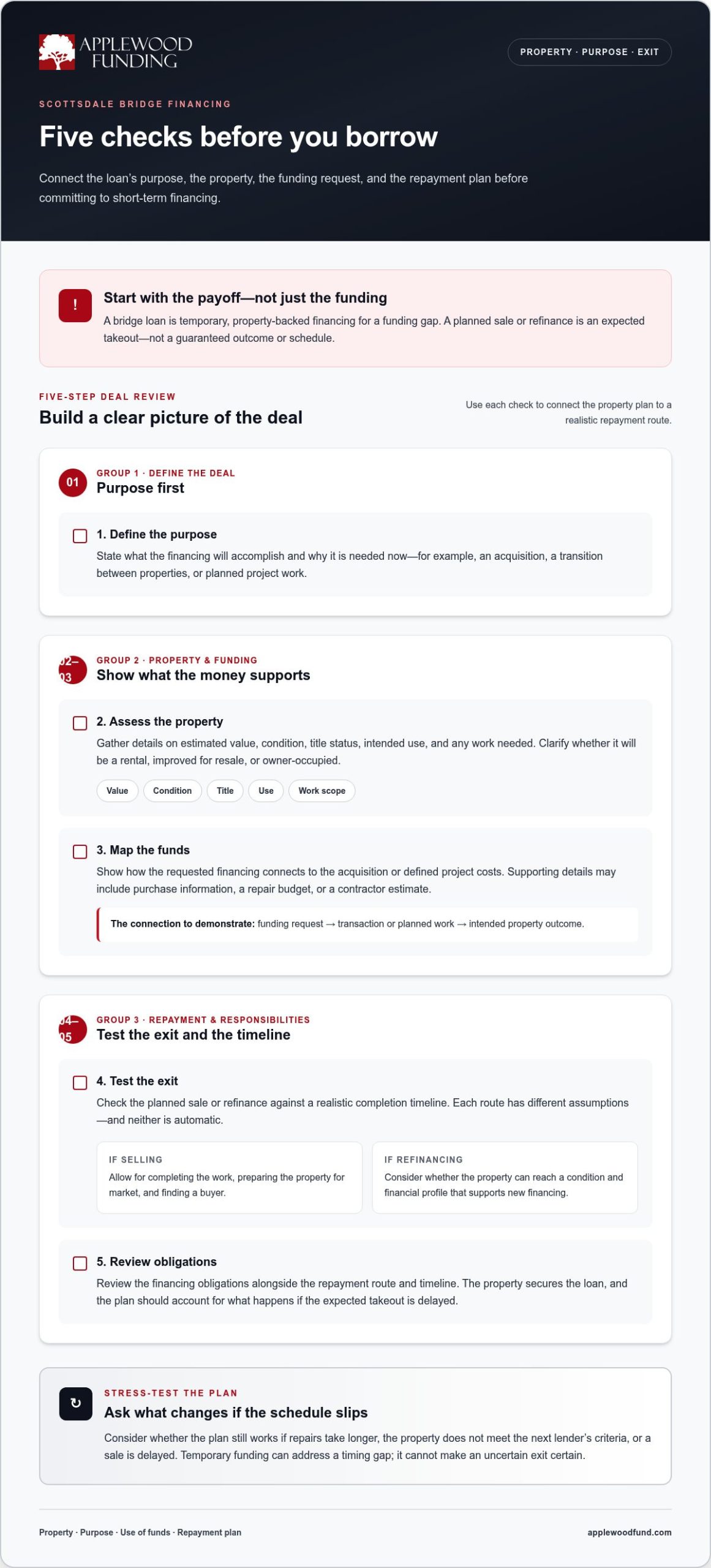
- Use a five-step review to connect the loan’s purpose, property, use of funds, repayment exit, and obligations.
- Compare scottsdale bridge loans for real estate with fix-and-flip, construction, and long-term financing by matching each to the property’s stage and plan.
- Stress-test your timeline and repayment strategy against possible changes before committing to an offer.
- Prepare for a focused financing conversation with clear property details, funding needs, timing, and an exit plan.
What Scottsdale Real Estate Investors Use Bridge Loans For
A Scottsdale deal can look attractive on paper and still leave a financing gap. A purchase may need to close before another property sells, or a property may need work before it can qualify for longer-term financing. Scottsdale bridge loans for real estate can provide temporary, property-backed funding for a defined transition. The property’s current condition, intended use, funding needs, and realistic timeline all help determine whether short-term financing fits.
When a Scottsdale property deal may need bridge financing
Picture an investor under contract on a property that needs repairs before it can be rented or refinanced. Bridge financing might fund the acquisition while the borrower completes the planned work and prepares for a refinance or sale. Another investor may have a purchase lined up but expect proceeds from selling an existing property only after the new transaction must close. In both cases, the gap between the dates is the financing challenge.
Scottsdale location alone doesn’t determine fit. Consider what the property can support today and what must change before the planned exit. A property needing improvements may call for a different financing approach from a stabilized rental. The intended use of funds matters too: acquisition, transition, and project costs should connect to a clear property plan. If you plan to occupy the property rather than hold it as an investment, state that clearly. Occupancy and loan purpose can affect underwriting and applicable requirements, so don’t assume investor-purpose criteria apply.
What a bridge loan is, and what it is not
A bridge loan is temporary, property-backed financing used to span a funding gap; the repayment plan is the specific sale, refinance, or other takeout expected to pay it off. That distinction matters. “Short-term” describes the financing’s intended role, not a guarantee that the next transaction will close on schedule or that repayment will happen by a particular date. For foundational context, see What is a Bridge Loan?
A bridge loan isn’t the same as long-term rental financing or a conventional mortgage designed for a stabilized property and an ongoing hold. Nor is it a synonym for every hard money loan. Fix-and-flip financing, for example, is tied to an improvement-and-resale plan; construction financing supports a building project. These categories can overlap, but the purpose and structure should match the project.
Temporary funding doesn’t repair weak deal economics. Before relying on a future refinance or sale, consider whether the property plan still makes sense if work takes longer, the property doesn’t meet the next lender’s criteria, or the sale is delayed. The bridge addresses a timing or financing gap. It doesn’t make an uncertain exit certain.
How Scottsdale Bridge Loans Are Evaluated: Property, Purpose, and Exit
A strong financing conversation starts with a complete deal picture, not just a requested loan amount. For scottsdale bridge loans for real estate, lenders may consider the property and its equity alongside the planned use of funds, project details, and repayment route. These are common underwriting considerations, not a universal approval formula. Each transaction is evaluated on its own facts.
What the property and financing plan need to show
Build a clear account of the property: its estimated value, condition, title status, intended use, and any work needed. Then connect each requested dollar to the transaction, such as acquisition costs or a defined project expense. A repair budget, contractor estimate, purchase details, or other relevant records can help explain the plan. The goal is to show how the property, funding request, and intended outcome fit together.
Collateral and equity matter because the property secures the financing, but no single equity figure guarantees approval. Property type, condition, existing debt, project scope, and the borrower’s plan can all affect how a lender assesses the deal. Be specific about whether the property will be held as a rental, improved for resale, or used for another purpose. If it will be owner-occupied, say so clearly, since occupancy and loan purpose can affect the financing discussion.
Build an exit strategy before you borrow
Repayment planning belongs before borrowing because a clear exit turns short-term financing from a deadline into a workable plan. A sale and a refinance are different routes, and each has assumptions to test. A sale plan depends on completing the work, preparing the property for market, and finding a buyer on a realistic schedule. A refinance plan depends on the property reaching a condition and financial profile that can support new financing. Neither outcome is automatic.
Use this five-step review to make the deal easier to assess:
- Define the purpose: State what the financing will accomplish and why it’s needed now.
- Assess the property: Gather information on value, condition, title, intended use, and project scope.
- Map the funds: Show how the requested financing connects to the acquisition or planned work.
- Test the exit: Check the sale or refinance assumptions against a realistic completion timeline.
- Review obligations: Read the written offer for payment terms, maturity date, extension provisions, and other obligations.
Then stress-test the plan. What if repairs uncover additional work? What if a contractor or closing date slips? What if market conditions change, or refinancing takes longer than expected? Identify the resources or alternate route that could help if the primary exit is delayed. A backup plan doesn’t remove uncertainty, but it can reveal whether the timeline leaves room to respond.
Bring the property details, use of funds, timeline, and exit assumptions into one concise summary. That gives a private lending discussion a practical starting point. To discuss real estate financing for a Scottsdale property, share your property financing details.
Bridge Loan vs. Fix-and-Flip, Construction, or Long-Term Financing
Loan labels can overlap. The useful distinction is what the financing is meant to accomplish, what stage the property is in, and how the debt is expected to be repaid. A bridge loan is a temporary gap solution. It isn’t a catch-all term for every hard money loan, and a property’s condition or project scope may point toward a different structure.
| Financing type | Purpose | Property stage and funds | Likely repayment route |
|---|---|---|---|
| Bridge financing | Cover a temporary acquisition or refinance gap | Property may be in transition; funds support the defined gap | Sale, refinance, or another planned takeout |
| Fix-and-flip financing | Fund a rehabilitation-and-resale project | Property needs improvements; funds connect to renovation work | Sale after the planned work |
| Construction financing | Fund a new-build project | Development or ground-up construction stage | Sale, refinance, or another project-specific takeout |
| Long-term rental financing | Support a stabilized rental hold | Property is ready to operate as a rental | Ongoing repayment during the hold |
When bridge financing differs from fix-and-flip financing
A purchase that needs temporary funding until a refinance is arranged may be a bridge scenario, even if the property needs limited work. A project centered on substantial rehabilitation and resale is more directly a fix-and-flip plan. The intended exit and scope matter more than the label. For renovation-focused decisions, see Fix and Flip Loans: The Investor’s Guide to Arizona Real Estate Funding in 2026. Consider the trade-offs discussed in Hard Money Loan Pros and Cons: 2026 Strategic Guide before weighing short-term debt.
When construction or long-term rental financing may fit better
Ground-up building has a different funding purpose from buying an existing property or covering a refinance gap. A new-build plan should account for the construction scope and funding needs; the Construction Loans guide explores that financing category. A stabilized rental has a different goal: supporting a property intended to produce rental income over time, rather than bridging a short transition.
Use the project plan to narrow the options. If the main need is temporary access to capital before a defined sale or refinance, bridge financing may fit the purpose. If most of the funds will support renovation, new construction, or a long-term rental hold, evaluate financing structured around that activity. Scottsdale bridge loans for real estate should be compared with alternatives by matching the property stage, use of funds, and repayment route, not by assuming similar labels mean similar terms.
How to Stress-Test a Scottsdale Bridge Loan Before Committing
A financing plan should still make sense when the smoothest-case timeline slips. Before committing to scottsdale bridge loans for real estate, test the deal against practical setbacks: delayed work, a slower sale, or a refinance that takes longer than expected. If the plan only works when every step happens on schedule, the risk deserves a closer look.
A practical Scottsdale deal-readiness checklist
Separate what you can document from what you’re assuming. A clear file helps reveal strengths and open questions before you take on a short-term obligation.
- Deal strengths: The property, intended use, funding purpose, and project scope are documented; the requested funds connect to the plan; the primary exit has supportable assumptions.
- Unresolved risks: The schedule has no room for delays; the sale or refinance depends on unverified assumptions; the fallback is vague; or you’re unsure how the written obligations work.
Review the purchase and financing documents together. Confirm that dates and conditions align across the acquisition, planned work, and expected exit. If the transaction raises legal, tax, or investment questions, seek guidance from an appropriately qualified professional. A lender can discuss financing terms, but that discussion isn’t a substitute for specialized advice.
Questions to resolve about timing, terms, and risk
Start with the calendar. Which deadlines could affect closing, construction, listing, sale, or refinance? What happens to the plan if a contractor, inspection, or another transaction takes longer? Then read the written offer closely. Review the payment schedule, maturity date, extension terms if any, and other charges or obligations stated in the documents. Don’t rely on a verbal summary when the signed terms control.
Next, compare those obligations with conservative project scenarios. If the property sells later than planned, can you manage the added time and expense? If a refinance is delayed or doesn’t proceed as expected, what other repayment route is available? Bridge financing is secured by property, so missing the planned exit can put the collateral at risk. Understand the default provisions and consequences set out in the loan documents before you commit.
Build a simple stress test: write down the expected timeline and exit, then revise each with a realistic delay or changed property condition. Note what additional funds, time, or alternate route each change would require. If the plan no longer works, revisit the financing structure or assumptions before proceeding. Clarity first. Commitment second.
Bring your property details, funding purpose, timeline, and repayment concerns into the financing conversation. Discuss your Arizona real estate financing needs with those pressure points in view.
Explore Scottsdale Real Estate Financing with Applewood Funding Inc
A useful financing conversation starts with the deal, not a loan label. Applewood Funding Inc provides private, asset-based real estate lending in Arizona, including Scottsdale. Its financing options include owner-occupied hard money loans, fix-and-flip loans, rental property loans, construction and land loans, bank statement loans for self-employed borrowers, and cash-out hard money loans. The right direction depends on what the property needs, how funds will be used, and how the plan is expected to repay the financing.
If you’re considering scottsdale bridge loans for real estate, bring the transition into focus. Explain what timing gap the financing would address and what you expect to happen next. A purchase awaiting a later refinance, a property being repositioned, and a stabilized rental each present different financing questions. Clear details keep the discussion tied to the actual property plan rather than assumptions about a product name.
Bring the details that make a financing conversation useful
Prepare a concise snapshot of the transaction. Include the property location, whether the request relates to a purchase or refinance, the anticipated funding needs, and any known deadlines. Describe the property’s current condition and planned work. Then outline the intended repayment route, such as a sale or refinance, and the assumptions behind its timing. You don’t need every answer settled; identifying open questions helps focus the discussion.
- Property: Location, current condition, intended use, and relevant project details.
- Purpose: What the funds will support and why the financing is needed for this stage of the plan.
- Timeline: Transaction deadlines, work milestones, and expected exit timing.
- Repayment: The planned exit and any unresolved assumptions or fallback considerations.
Match the financing conversation to the real estate plan
A renovation project centered on improving and reselling a property may align with fix-and-flip financing. A property intended for rental use may fit a rental-property financing discussion. Ground-up plans call for construction and land financing, while a cash-out hard money loan may be relevant when the plan involves accessing equity in a property. These categories describe different purposes, not automatic outcomes; the property and supporting documentation inform the financing structure.
Share the project scope, intended use of funds, and repayment plan together. If the property is occupied or will be owner-occupied, make that clear, since occupancy and loan purpose can shape the financing discussion. Applewood Funding Inc provides property-focused private lending, with terms and qualification considerations specific to the deal. The loan label alone does not establish whether a proposed structure fits.
Ready to put your Scottsdale property plan into a focused financing conversation? Discuss your Scottsdale real estate financing with the property details, funding purpose, timeline, and expected exit in hand.
Move Your Scottsdale Property Plan Forward
The next step is to turn your financing idea into a clear, property-specific plan. Before pursuing scottsdale bridge loans for real estate, put the purchase or refinance purpose, project needs, critical dates, and repayment route in one place. That makes it easier to see what the financing must accomplish and which assumptions still need work.
Applewood Funding Inc provides private real estate financing in Arizona, including Scottsdale, across owner-occupied hard money, fix-and-flip, rental, construction and land, bank statement, and cash-out categories. Managed by Joel McDaniel, NMLS 175371, the team can discuss how the property and its intended use relate to a financing structure. Terms and qualification considerations depend on the individual deal, so bring the relevant details and questions to the conversation.
Build your plan around what you know, flag what you still need to resolve, and take the next step with confidence. Discuss your Scottsdale real estate financing and move your property plan forward.
Frequently Asked Questions
How does a bridge loan work for a Scottsdale real estate investment?
A bridge loan uses real estate as collateral to fund a temporary financing need, with repayment tied to the loan documents and the borrower’s planned exit. For a Scottsdale investment, the lender may consider the property, existing debt, intended use, and proposed repayment source. Location is part of the property details: an asset in Scottsdale, Phoenix, Glendale, Peoria, Tempe, Mesa, Sedona, Flagstaff, or Tucson should be described with its own transaction and project information.
Can I use a bridge loan to buy an investment property in Scottsdale?
Potentially, if the property and transaction fit the lender’s underwriting and the repayment plan is credible. For example, an investor might seek temporary purchase financing while preparing the property for a later refinance or sale. Be ready to explain how you’ll use the funds, what the property needs, and what supports your planned exit. A purchase opportunity by itself doesn’t establish that bridge financing is suitable or that a loan will be approved.
How much equity do I need for a Scottsdale bridge loan?
There isn’t one equity requirement that applies to every Scottsdale bridge loan. A lender may assess the property’s value, existing liens, condition, requested financing, and overall repayment plan together. Equity is one part of that picture, not a stand-alone approval guarantee. Gather current information about the property and any debt secured by it, then review how the written financing terms calculate the available amount and required borrower contribution.
How quickly can a Scottsdale bridge loan close?
Closing speed depends on the transaction, documentation, property review, title work, and other requirements in the specific deal. A tight purchase deadline may make bridge financing worth discussing, but it doesn’t guarantee a particular closing date. Share the contract deadline early, along with available property and transaction documents, so the timing can be assessed against the actual steps required. Avoid committing to a purchase based on an assumed funding date.
Is a bridge loan the same as a fix-and-flip loan?
No. A bridge loan describes temporary financing for a gap or transition, while fix-and-flip financing is centered on improving a property for resale. The purposes can overlap, but the planned work and repayment route help distinguish them. If renovation is the main objective, explain the scope, budget documentation, and resale plan. If the need is simply to cover a financing transition, describe what event is expected to repay the loan.
What happens if I cannot repay a bridge loan on time?
If repayment is late, the consequences depend on the signed loan documents and applicable requirements. The loan may accrue additional amounts or enter default, and because the property secures the debt, the collateral could be at risk. Contact the lender promptly if the exit is slipping, and review any available options in writing. Consider qualified legal advice about your obligations; don’t assume an extension or refinance will be available.
Can a bridge loan be used for an owner-occupied property in Arizona?
Owner-occupied hard money financing is available as a lending category, but that doesn’t mean every bridge structure fits every primary-residence situation. Clearly disclose who will occupy the property and how the funds will be used. Occupancy and loan purpose can affect underwriting and applicable requirements, so the specific transaction should be reviewed before proceeding. For an Arizona home, get qualified legal or financial guidance if you need advice about your individual obligations.