

How to Get Proof of Funds in Phoenix and Check Its Validity
November 6, 2026Arizona private loans for borrowers with bad credit
Bad credit doesn’t automatically shut the door on private financing in Arizona. An Arizona private lender for bad credit may consider the property, loan purpose, available equity, and repayment plan alongside your credit history. The right fit depends on the financing goal and the property, not just a score.
A credit setback can make traditional borrowing feel like a dead end. You still need clear terms before you move forward, especially when interest rates and origination points affect the total cost. This guide explains which Arizona loan types may suit credit challenges, how repayment and early payoff work, and what can shape rates and points.
We’ll distinguish property-backed private loans from personal borrowing, outline details that can help explain a financing request, and show how to assess the repayment structure. Use this practical starting point to decide whether a private loan fits your goal, whether that’s buying an owner-occupied property, financing a fix-and-flip, or funding a rental or construction project in Arizona.
Key Takeaways
- Learn how private, property-backed financing differs from personal loans, and why some lenders may weigh the deal beyond a credit score.
- See which application details can matter when credit challenges are part of your borrowing history.
- Understand how payment schedules work and what to review before paying a loan off early.
- Learn why APR and interest rate aren’t interchangeable, and how points can affect the total borrowing cost.
- Explore Arizona private money rate and origination-point figures, then consider which loan structure fits your property goal.
What Kinds of Loans for Bad Credit Can You Get in Arizona?
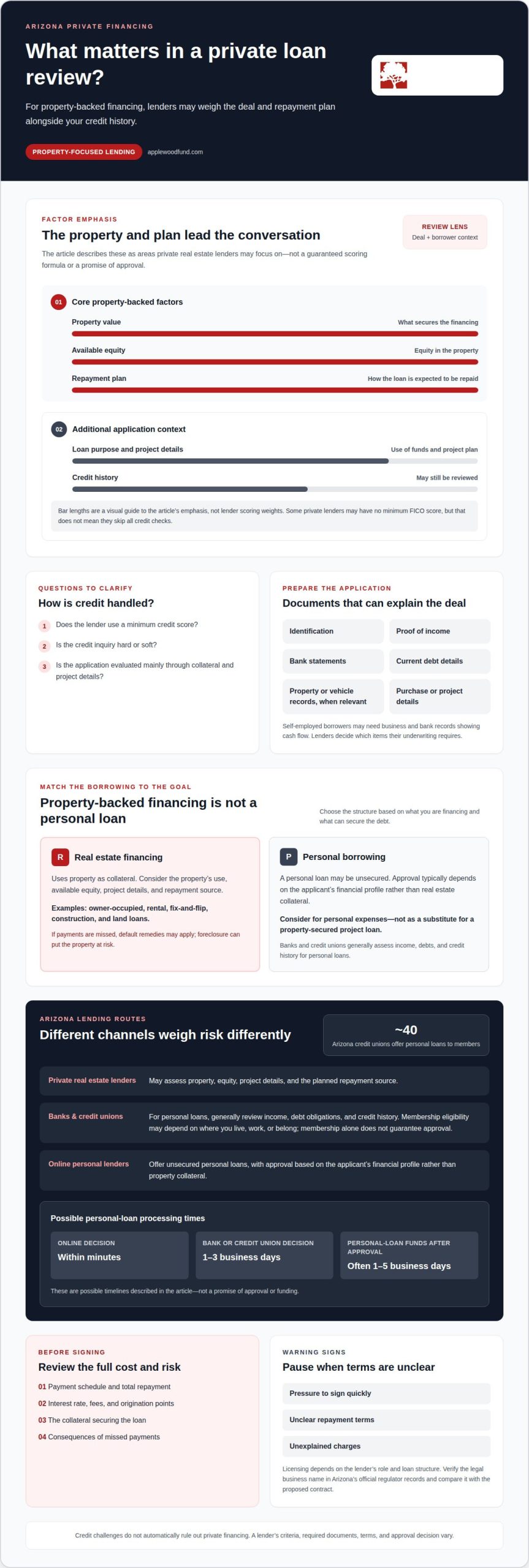
Bad credit doesn’t automatically rule out every Arizona loan. The right option depends on what you’re financing and what can secure the debt. Some property-backed private lenders focus heavily on the property’s value, available equity, and repayment plan. They may not set a minimum FICO score, but that doesn’t mean they skip all credit checks. A lender could still review your credit history to assess payment patterns, existing debts, or potential risks. Ask whether the lender uses a minimum score, conducts a hard or soft credit inquiry, or evaluates the application mainly through collateral and project details.
Personal loans work differently from real estate financing. A personal loan may be unsecured, while a property-backed loan uses real estate as collateral. With secured financing, understand what property secures the loan and the consequences of missing payments before signing. Applewood Funding Inc. focuses on real estate financing, including owner-occupied, rental, fix-and-flip, construction, and land loans.
Arizona also has around 40 credit unions offering personal loans to members. Membership is the first hurdle: eligibility may depend on factors such as where you live, work, or belong. Credit unions set their own application criteria, so membership alone doesn’t guarantee approval. For a home purchase, conventional Arizona home loans typically require a 620 credit score, while homebuyers with at least 580 may qualify for an FHA loan. Those are mortgage pathways, not private-loan approval promises.
Are Arizona private lenders required to be licensed, and how can borrowers verify a lender? Licensing depends on the lender’s role and loan structure, so don’t assume one rule applies to every private loan. Look up the lender’s legal business name in Arizona’s official regulator records and compare it with the name on the proposed contract.
What are the risks of Arizona private loans, including default, foreclosure, and predatory lending? Missing payments can trigger default remedies; when real estate secures the loan, foreclosure may put the property at risk. Pressure to sign quickly, unclear repayment terms, or unexplained charges are warning signs to take seriously.
Prepare for the application by gathering identification, proof of income, bank statements, details of current debts, and property or vehicle records when relevant. For an investment property, organize the purchase or project details and a realistic repayment plan. A self-employed borrower may need business and bank records that show cash flow. These documents help explain the deal beyond a credit score, but lenders decide which items their underwriting requires.
Personal loans and property-backed loans serve different purposes. If you need funds for a personal expense, consider whether an unsecured personal loan fits. If real estate will secure the financing, focus on the property, its use, and the repayment plan. Applewood Funding Inc. offers property-focused financing in Arizona, including owner-occupied home, rental, fix-and-flip, construction, and land loans.
Arizona lenders that consider borrowers with credit challenges
Arizona borrowers can look at several lending channels, but each weighs risk differently. Private real estate lenders assess the property, its equity, the project, and the planned repayment source. Banks and credit unions generally use personal-loan underwriting, including income, debt obligations, and credit history. Online loan finder platforms like personalloans.net also help connect borrowers with unsecured personal loans, where approval depends on the applicant’s financial profile rather than real estate collateral. A lower credit score can narrow options, but it doesn’t describe the entire application.
Start by matching the loan type to the purpose. A borrower seeking funds for an investment property can explore property-backed financing; someone covering a personal expense would need to consider an unsecured loan instead. Arizona online lenders may provide a personal-loan decision within minutes, while banks and credit unions may take one to three business days. After approval, personal-loan funds are often deposited within one to five business days. Those timelines describe possible processing, not a promise of approval or funding.
Borrowing responsibly can support credit-building over time. Choose a payment that fits reliable monthly cash flow, then pay each bill on schedule. For example, if a borrower’s income varies by season, a smaller, manageable payment can be safer than stretching for a larger loan amount. Keep balances and obligations in view before taking on new debt. Consistent payments can contribute to a stronger credit history, while missed payments can add pressure and hurt progress.
Loan limits depend on the lender and the kind of borrowing. For an unsecured personal loan, income, existing debt, and payment capacity shape the amount a lender can support. For property-backed financing, the property’s value, available equity, intended use, and exit plan help set the borrowing limit. A renovation budget should account for the work and a credible repayment source, not just the purchase price. Flexible terms don’t remove the need to plan for payments.
Compare offers by looking beyond the approved amount. Review the payment schedule, total repayment, interest rate, fees, collateral, and consequences of missed payments. An online offer with quick processing can still be a poor fit if its payment strains the budget. A property-backed loan can fit a real estate goal, but it puts the pledged property at risk if repayment fails. For a property-focused borrowing goal, explore Arizona property financing options as you weigh the structure against your project and repayment plan.
Repayment options and early payoff
Arizona bad-credit personal loans are generally repaid through fixed monthly payments over an agreed-upon term. That schedule makes the required payment predictable, but it doesn’t mean every loan has the same structure. A property-backed private loan may set payments around the project and repayment plan. Before signing, identify the amount due, payment dates, interest calculation, maturity date, and any final balloon payment. A balloon payment is a larger balance due at the end, rather than equal payments that clear the loan.
Compare the payment schedule with the money expected to repay the loan. For a renovation project, for example, the planned exit might be a sale or a refinance. Map the expected proceeds against the loan’s due date and remaining balance. If that timing slips, payments may still come due. Keep a separate reserve for scheduled payments instead of relying entirely on a future sale or refinance to arrive on time.
Early payoff starts with the written agreement. Find the prepayment terms, payoff calculation, and process for requesting a final balance. Ask how the lender applies an extra payment: it may reduce principal, cover accrued interest, or follow another contract-defined method. If interest accrues on the unpaid balance, reducing principal sooner can reduce future interest. A prepayment charge or other payoff condition can change the savings, so include it in the calculation before sending extra funds.
For example, a borrower who receives sale proceeds before the loan’s scheduled end date can compare the official payoff amount with the cost of keeping payments active. Include unpaid principal, accrued interest, and contract charges in that comparison. Get the payoff figure in writing and follow the stated payment instructions. Keep the confirmation and closing statement with the loan records; those documents show the debt was satisfied.
How do Arizona private lenders compare with banks, credit unions, and online lenders for bad credit? The loan structure matters: property-backed financing involves real estate collateral, while a personal loan may be unsecured. Compare the full obligation, including the repayment schedule and what secures the debt, rather than focusing only on the approved amount.
Alternative financing depends on the need. An unsecured loan doesn’t pledge real estate, while a secured loan ties repayment to collateral. A credit union personal loan may suit a member seeking consumer funds; property-backed financing may better match a real estate purchase or project. Compare payment size, total repayment, term, collateral, and consequences of default across each application.
Debt consolidation combines multiple debts into one new loan, when the borrower qualifies. Before using it, list each balance, interest rate, payment, and remaining term. Then compare those costs with the proposed consolidated loan’s payment schedule and total repayment. A lower monthly payment can come from extending repayment, which may increase the overall amount paid. Avoid adding new balances after consolidation, or the same debts may build again.
Use payment history as a planning tool, not a reason to borrow more. Set reminders for each due date, track the loan balance, and contact the lender promptly if a cash-flow disruption threatens a payment. A dependable schedule supports repayment discipline; borrowing only what the project or consolidation requires helps keep future obligations manageable.
APR examples and repayment schedules
APR helps compare borrowing costs, but it isn’t always the same as the interest rate. Interest measures the charge for borrowing principal; APR can also reflect certain finance charges. For an Arizona private loan, compare the quoted APR with the interest rate, points, other charges, payment schedule, and amount you’ll receive at funding. Ask what costs the APR includes before comparing it with another offer.
Consider an Arizona private money loan with an interest rate and origination points. The interest rate applies to the loan balance under the contract, while points are an upfront charge calculated as a percentage of the loan. If points are deducted from proceeds, the amount deposited may be lower than the stated principal. That difference can affect the effective borrowing cost even when the scheduled payments are based on the full principal.
Arizona private money loans averaged 7.49% interest in the first quarter of 2026 and 10.41% in the third quarter of 2026. Those are average interest rates, not APR quotes for an individual borrower. They also describe separate quarters, not one fixed rate path. A borrower’s actual costs depend on the loan terms, charges, balance, and timing of payments.
Repayment schedules can differ by loan type. Arizona bad-credit personal loans are generally repaid through fixed monthly payments over an agreed-upon term. A property-backed loan may have a different schedule, so read the contract for payment frequency, interest calculation, due dates, maturity date, and any final balloon payment. A schedule with lower regular payments can still leave a substantial balance due at maturity.
Use a simple comparison worksheet before deciding. Record the approved principal, net proceeds after upfront charges, APR, interest rate, payment amount, payment frequency, loan term, and total repayment. For example, compare two written offers using the same proposed borrowing amount and repayment period. If one offer has lower scheduled payments but a larger final balance, include that balance in the comparison.
- Confirm the basis: Check whether payments apply to principal and interest, interest only, or another structure.
- Map the dates: Match each payment and maturity date against expected income or project proceeds.
- Review payoff terms: Read how early repayment affects interest and charges.
- Check net funding: Compare the approved amount with the funds actually deposited after upfront deductions.
Your credit history can influence approval and offered terms, but the schedule determines how repayment works after approval. Don’t judge an offer by its monthly payment alone. Compare APR, total repayment, upfront deductions, and the plan for clearing any final balance.
Arizona private money interest rates and origination points
Arizona private money rates and points show why comparing only the interest rate can mislead. The average interest rate was 7.49% in the first quarter of 2026 and 10.41% in the third quarter of 2026. These are market averages for different quarters, not a quote or a guaranteed rate for an individual loan. Borrowers should compare the complete cost and payment structure.
Origination points are upfront charges calculated as a percentage of the loan amount. Arizona private money lenders charged an average origination fee of 3.4% in the first quarter of 2026. One point represents 1% of the loan amount. Points may be paid at closing or deducted from proceeds, depending on the loan terms. If deducted, the deposited amount can be lower than the principal used to calculate payments.
For a clear comparison, separate three figures in each offer: the interest rate, points, and other charges. Then identify the amount borrowed and the net proceeds after deductions. A secured loan may also involve property-related costs, while a personal loan uses a different underwriting and cost structure. Income, collateral, loan purpose, and repayment plan can all affect the terms offered by an institution.
Arizona’s average origination fee and interest rates are reference points, not a substitute for reading a contract. Ask for the annual percentage rate, or APR, alongside the interest rate. APR can include certain finance charges, while the interest rate describes the charge on the outstanding balance. Check which costs are included before comparing offers.
What Arizona laws limit private loan interest rates, fees, and collection practices? Applicable limits can depend on the loan structure, purpose, and lender status, so one rate cap should not be assumed to cover every private loan. Review the written terms for rates, points, default charges, and collection provisions; legal advice can clarify how Arizona rules apply to a specific agreement.
Use this practical review before accepting an offer:
- Compare the same basis: Put the interest rate, APR, points, and other charges side by side.
- Calculate net funding: Subtract any charges deducted at closing from the stated principal.
- Read payment terms: Confirm the payment amount, due dates, maturity date, and any final balance.
- Check early payoff terms: Find out how prepayment affects interest and charges.
The takeaway is simple: a lower interest rate can still come with higher upfront points or other costs. Compare total repayment and net proceeds, not one headline figure. For property financing, the collateral, loan purpose, and repayment plan help explain why individual terms differ from market averages.
Applewood Funding
Applewood Funding offers property-focused financing options for Arizona borrowers weighing private loans alongside credit challenges. Its offerings include Owner Occupied Hard Money Loans, Fix and Flip Loans, Rental Property Loans, and Construction and Land Loans. The right conversation starts with your property goal, the project details, available collateral, and a realistic repayment plan. Credit history matters, but it’s only one part of understanding a property-backed financing request.
Consider reaching out when you’re financing a property purchase, investment, renovation, or construction project and want to discuss how the loan structure may fit. Bring the project details and your intended repayment approach so the discussion can focus on the actual deal, not just a credit score. Contact Applewood Funding to talk through your Arizona property financing needs.
Turn your financing goal into a clear next step
Choosing an Arizona private lender for bad credit is about more than having an application considered. It’s also about deciding whether the loan’s purpose, repayment plan, and risk fit your situation. Identify what the financing needs to accomplish and what funds will repay it. A clear plan makes it easier to discuss the property and understand the terms.
Bring the property or project details, your intended use of funds, and your repayment approach to a conversation with Applewood Funding. The proposed structure and your circumstances shape which financing path may fit. Take time to understand the written terms before making a decision. If you’re ready to discuss your situation, contact Applewood Funding about your options. A focused conversation can help you take the next step with greater clarity.
Frequently Asked Questions
If I have bad credit, can I qualify for a loan?
Yes, bad credit doesn’t automatically prevent a loan application from being considered. The options depend on the loan type and what supports repayment. For example, a real estate borrower may present a property and project plan, while a personal-loan applicant may need to show income and manageable obligations. Focus on matching the request to the purpose, then review the proposed payment and repayment source before accepting terms.
What Is Considered “Bad Credit”?
“Bad credit” is a general label, not one universal score that applies to every lender or loan. Scoring models and underwriting rules differ, so the same credit history may be viewed differently across applications. Look at the full report: late payments, account balances, and recent credit activity can help explain a score. For property-backed financing, the property and transaction details may also inform the lender’s review.
Which Arizona private lenders offer loans to borrowers with bad credit?
Applewood Funding is an Arizona private lender offering real estate financing for borrowers with credit challenges. A borrower seeking an Arizona private lender for bad credit can explore property-related options for an owner-occupied home, rental property, or fix-and-flip project. Applewood Funding also offers Construction and Land Loans. Describe the property and intended use of funds so the financing discussion addresses the actual transaction.
What types of private loans are available in Arizona for bad-credit borrowers?
Arizona property-focused options include owner-occupied home loans, fix-and-flip loans, rental property loans, and construction and land loans. The right category depends on how the property will be used. A rental purchase differs from financing construction, even though both involve real estate. Applewood Funding also offers bank statement loans for self-employed borrowers and cash-out hard money loans.
What credit score, income, and collateral requirements do Arizona private lenders have?
Requirements vary by loan and lender. Applewood Funding states “No Credit Required,” but that statement does not mean every loan uses identical underwriting or collateral terms. For a property-related request, organize the property information, intended use, and repayment approach. Self-employed borrowers considering bank statement financing should prepare relevant bank statements. The specific application determines which financial and property details support the request.
What loan amounts, interest rates, fees, and terms do Arizona private lenders offer?
Loan amounts, interest rates, and repayment terms depend on the specific financing and property details. Compare the written offer’s interest rate, APR, points, payment schedule, maturity date, and total repayment rather than focusing on one figure. Applewood Funding states “No Up-Front Fees – No Cost to Apply.” Review the full loan documents for the terms that apply to your transaction before deciding whether the financing fits.
How can borrowers apply for a private loan in Arizona with bad credit?
Start by identifying the property, the purpose of the financing, and how repayment is expected to work. Then share those details with the lender and provide the requested application information. For example, a rental-property request should explain the planned use and expected repayment source. Review the written terms before proceeding, including payments, maturity, and collateral provisions. A clear application helps keep the discussion focused on the transaction.
What documents and collateral are needed for an Arizona private loan?
Prepare identification, property records, project information, and financial documents related to the requested loan. A self-employed applicant considering bank statement financing can organize relevant bank statements. For secured real estate financing, the property serves as collateral under the agreement, so provide relevant property details. Document needs vary with the loan purpose: construction financing involves different project information than a rental-property purchase.