


Bridge Lending Explained: How Bridge Loans Work in 2026
September 29, 2026
Asset-Based Mortgage: How to Qualify and Choose the Right Loan in 2026
October 1, 2026Rental Portfolio Loans in Arizona: A Practical Investor’s Guide
What if the best way to finance your next Arizona rental isn’t the same loan you used for the last one? Rental portfolio loans in Arizona can refer to different financing arrangements, and the right fit depends on more than the number of properties. Cash flow, existing debt, property plans, and documentation all shape the options worth exploring.
Comparing those options can feel complicated. One lender may focus closely on borrower income and debt, while another may weigh rental income more heavily. If records are incomplete or obligations span multiple properties, find out what a lender needs before an application slows down.
This guide explains common financing approaches, how to organize borrower, property, and rental-income details, and what to ask a potential lender. Applewood Funding Inc offers rental property loans in Arizona, but whether a particular financing structure fits your portfolio should be confirmed directly. Start with a current snapshot of your properties, then match the financing path to your cash flow and next move.
Key Takeaways
- Learn what lenders may mean by a rental portfolio loan and how financing multiple properties can differ from financing one rental.
- See which property, rent, borrower, and equity details lenders may review, and why requirements vary by loan program.
- Compare conventional, portfolio, and private or hard-money financing by purpose, property scope, and the details to verify.
- Use a property-by-property checklist to organize records for rentals in Phoenix, Scottsdale, and other Arizona locations.
- Explore whether rental portfolio loans in Arizona align with your plans, and what to confirm with a potential lender before proceeding.
Rental portfolio loans in Arizona: what investors should understand first
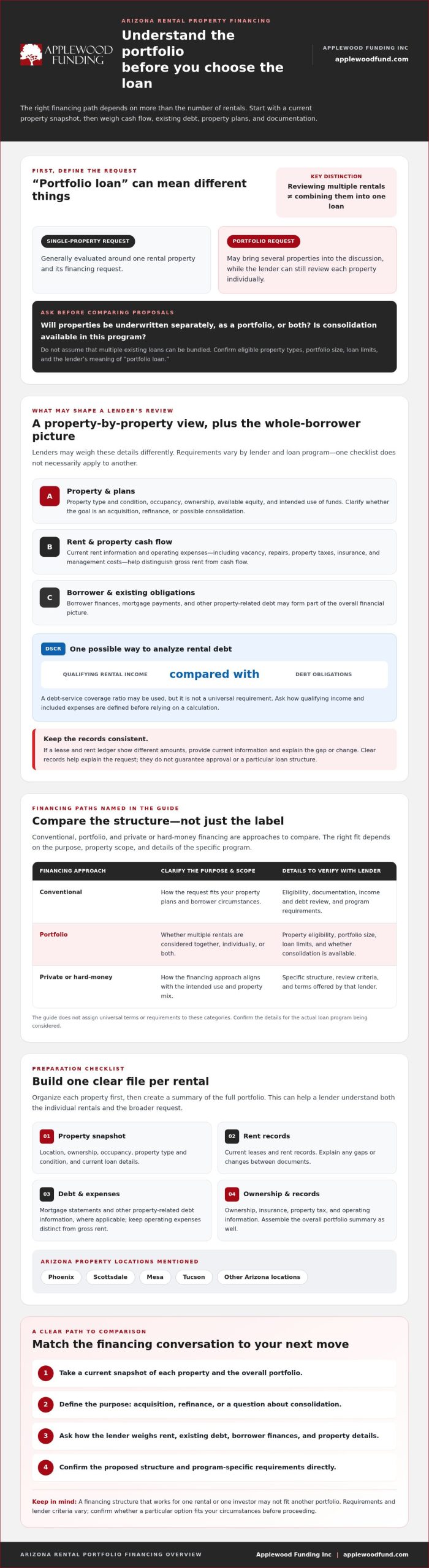
The phrase “rental portfolio loans arizona” can describe financing connected to more than one investment property, but it doesn’t mean every lender offers the same loan structure. Some lenders use “portfolio loan” for a specific product; others review several properties as part of an application without combining them into one loan. Ask what the lender means before comparing proposals.
That distinction matters. A mortgage for one rental is generally evaluated around that property and its financing request. A portfolio application may bring several properties into the discussion, whether you’re planning acquisitions, refinancing, or asking whether existing loans can be consolidated. Consolidation isn’t available in every program, so confirm the structure instead of assuming the properties can be bundled.
Start with the purpose of the financing. A lender may consider property cash flow, equity, borrower finances, and intended use, but the emphasis varies by program. The mix matters too: a group of similar long-term rentals may raise different questions from properties with varied uses or records. For rentals in Phoenix, Mesa, or Tucson, organize the information property by property, then show how each fits your broader plan. That’s more useful than focusing on the loan label alone. For a broad introduction to real estate investing, see Wikipedia’s overview.
When does portfolio financing make sense for an Arizona investor?
It may be worth exploring when you’re buying additional rentals, reviewing financing on properties you already own, or considering a refinance or consolidation. These are possible goals, not guaranteed loan options. Lender fit depends on your objectives, property mix, and borrower circumstances. Keep investment-property financing separate from an owner-occupied home loan: they serve different uses and may follow different review criteria.
What does a lender mean by a rental portfolio?
A rental portfolio is a group of investment properties considered together for financing purposes. A portfolio loan generally evaluates multiple rentals under a shared financing request, unlike a single-property mortgage tied to one rental. However, a lender may review each property individually even when considering the wider portfolio. Ask about eligible property types, portfolio size, and loan limits, since these can vary by program.
Before requesting terms, clarify whether the lender will underwrite each property separately, the portfolio as a whole, or both. Ask how rental income, existing debt, and the intended use of funds factor into the review. Clear answers help you compare financing options on substance, not just terminology.
How lenders assess Arizona rental portfolios and loan applications
A lender reviewing a multi-property request may look at each rental and the overall borrower picture. Common review areas include property type and condition, rent information, existing debt, borrower finances, available equity, and intended use of funds. The weight given to each factor depends on the lender and loan program. Don’t assume one lender’s checklist applies to another. Confirm Applewood Funding Inc-specific criteria directly.
Consistent records make a portfolio easier to understand. If a lease lists a different rent amount from your rent ledger, explain why and provide current information. Clear records help a lender assess the request, but don’t guarantee approval or a particular loan structure.
How rental income and property cash flow may factor into review
Keep the inputs distinct: gross rent is not the same as cash flow. From rent, account for operating expenses such as vacancy, repairs, property taxes, insurance, and management costs. Existing mortgage payments and other property debt also affect the financial picture. A lender may use a debt-service coverage ratio (DSCR), which compares qualifying rental income with debt obligations, to analyze a property. It’s not a universal requirement, and lenders may define qualifying income and included expenses differently. Ask how the calculation works before relying on it.
What borrower and property records should investors organize?
Build a clear file for each rental, then prepare a summary of the full portfolio. Potentially useful records include:
- A property schedule with location, ownership, occupancy, and current loan details
- Current leases and rent records, including an explanation of gaps or changes
- Mortgage statements and information on other property-related debt, where applicable
- Ownership, insurance, property tax, and operating records
- Borrower financial information relevant to the request and intended use of funds
Ask the lender for its document list and accepted formats. Requirements vary, and additional records may be requested during the review. Keep lease and property information current. Arizona landlords can also consult the state’s Arizona Residential Landlord and Tenant Act for landlord-tenant information.
If you’re comparing rental portfolio loans arizona options, bring your property schedule and financing goals to the discussion. Applewood Funding Inc offers rental property loans. You can explore rental property financing and confirm program structure, documentation, and eligibility directly.
Compare rental portfolio loans with other Arizona financing options
The right structure depends on what you’re financing and how you expect the property to perform. Conventional, portfolio, and private or hard-money financing can differ in qualification methods, property scope, and repayment terms. None is automatically faster, cheaper, or easier. Compare written terms against your acquisition, refinance, or portfolio-growth plan.
| Financing type | Common purpose and property scope | Ask about documentation | Verify before comparing |
|---|---|---|---|
| Conventional financing | Often considered for an individual investment property; eligibility and property limits depend on the program. | Which borrower income, debt, rental income, and property records are required? | Repayment structure, qualification standards, property limits, fees, and prepayment terms. |
| Portfolio lending | May involve a lender reviewing multiple rentals or retaining a loan in its own portfolio. The exact structure varies. | Are properties assessed separately, together, or both? What records are needed for each? | Eligible property types, portfolio size, loan limits, repayment terms, and flexibility. |
| Private or hard-money financing | May be considered for a specific investment or project; intended use and term depend on the lender and program. | What property, borrower, and project records are needed? | Repayment schedule, fees, extension options, payoff requirements, and exit plan. |
Which financing structure fits your portfolio plan?
For an acquisition, ask how the lender will evaluate the property and your planned use. For a refinance, clarify whether existing debt and rental income are assessed property by property. If you’re growing a portfolio, ask whether a lender can consider multiple properties under one request. Some lenders offer DSCR-based options, but don’t assume Applewood Funding Inc offers a specific program. Confirm availability and underwriting directly.
Keep the purpose clear. Financing intended to hold a rental may differ from short-term project financing with a defined exit. Match the repayment period to a realistic timeline, not an optimistic forecast.
What trade-offs should you compare before choosing?
Review qualification approach, documentation, repayment structure, fees, and flexibility side by side. Test the expected payment against conservative rental-income assumptions, accounting for vacancy, repairs, taxes, insurance, and management costs. That way, projected rent doesn’t obscure the property’s obligations. For landlord-tenant information, consult the Arizona Department of Housing’s Arizona Residential Landlord and Tenant Act.
For another perspective on trade-offs, read Hard Money Loan Pros and Cons: 2026 Strategic Guide. Investors considering rental portfolio loans arizona can also discuss rental-property financing with Applewood Funding Inc, while confirming current program details and fit.
Arizona rental portfolio loan checklist: prepare before contacting lenders
A lender conversation is more useful when your numbers, property details, and funding goal are clear. Prepare a consistent snapshot of every rental, whether it’s in Phoenix, Scottsdale, or elsewhere in Arizona, including Glendale, Peoria, Tempe, Mesa, Sedona, Flagstaff, and Tucson. Separate confirmed figures from estimates, and flag gaps rather than guessing. This gives a lender a practical starting point and helps you identify questions early.
Build a clear snapshot of your Arizona rental portfolio
Use one row per property, then summarize your plans for the portfolio. Keep the reporting period consistent across rent and expense records where possible. Include ownership and existing debt, and mark figures that are estimated, outdated, or unavailable.
- List each property. Record its location, property type, occupancy, ownership structure, and current use.
- Organize rental figures. Note current rent, lease status, rent received, vacancy, and operating costs such as repairs, taxes, insurance, and management.
- Show existing obligations. Gather current mortgage statements and list other property-related debt, if applicable.
- Define the funding goal. Identify whether you’re seeking funds for an acquisition, repairs, refinancing, or another purpose. State the amount you’re considering without treating it as a lender-approved figure.
- Explain the plan. Document your ownership structure, desired timeline, and exit assumptions, such as how you expect to repay or refinance. Mark unresolved details for discussion.
Keep supporting records close, including leases, rent records, insurance documents, tax information, and operating records. Confirm tax, legal, insurance, and property-specific questions with qualified professionals. A lender can explain its financing requirements but shouldn’t replace specialized advice for those matters.
Questions to ask before accepting a loan proposal
Get clear answers before comparing or accepting an offer. Ask which properties and ownership structures are eligible, whether underwriting considers each rental separately or the portfolio together, and what documentation is required. Request proposed repayment terms and a complete explanation of fees. Have the lender clarify prepayment terms, extension options, and default-related provisions in writing. Verify how your intended use of funds affects the proposal.
Compare written terms with conservative rental-income assumptions, not just projected rent. For rental portfolio loans arizona, program structure, eligibility, and portfolio limits vary by lender. Confirm each detail directly, including criteria specific to Applewood Funding Inc.
Ready to discuss your Arizona rental financing scenario? Share your portfolio and financing goals with Applewood Funding Inc and ask which details to confirm for your situation.
Explore Arizona rental property financing with Applewood Funding
Choosing financing for a rental portfolio starts with a clear view of the properties and your next move. Applewood Funding offers rental property loans and alternative real estate financing. The right fit depends on your goals, the properties involved, and the lender’s review. Confirm specific program structure, eligibility, rates, loan limits, and terms directly. A loan label alone can’t tell you whether a program matches your situation.
Use an initial conversation to clarify what you’re trying to accomplish. Are you purchasing a rental, refinancing existing debt, or seeking financing tied to several properties? A concise portfolio overview helps frame the discussion and gives you focused questions about available options. Flag missing records or qualification concerns so the lender can explain what information to gather.
What to share in an initial rental-loan conversation
Prepare a short summary of where your properties are, whether they’re occupied, how each is currently financed, and what you intend to do with the funds. Include your desired timeline and any documentation gaps or borrower-finance questions. Then ask which loan structures are currently available for your scenario, what property types may qualify, and what information the lender needs to assess your request.
For rental portfolio loans arizona, confirm whether a lender uses “portfolio” to describe a particular loan structure or simply a review of multiple properties. Ask how the properties, rental income, and existing obligations would be considered. Confirm Applewood Funding’s underwriting criteria and portfolio limits directly before relying on assumptions or comparing proposals.
Take the next step with an Arizona lending conversation
Bring your property summary, financing goal, and questions. Ask for proposed terms and required documentation in writing, then review the details against your plans and expected rental income. Fit and terms depend on a review of the borrower and properties. A conversation can clarify what to explore, but it isn’t a promise of approval or funding.
Ready to discuss your situation? Discuss your Arizona rental portfolio financing with Applewood Funding and share the properties and goals you want to review.
Turn Your Arizona Rental Financing Plan Into a Clear Next Step
The strongest financing choice starts with your goal, not just the loan label. Compare how options assess property cash flow, borrower finances, and documentation. Then prepare a current snapshot of each rental and ask lenders to clarify eligibility, repayment terms, fees, and portfolio limits. These steps help you evaluate rental portfolio loans arizona without assuming every lender uses the same structure.
Applewood Funding offers rental property loans. Whether you’re considering an acquisition, refinance, or another rental-property financing goal, program fit and terms depend on a review of your situation and properties. Prepare your portfolio overview and questions, then start a focused conversation.
Discuss your Arizona rental portfolio financing with Applewood Funding. A clear plan and the right questions can help you decide what to explore next.
Frequently Asked Questions
What is a rental portfolio loan?
A rental portfolio loan is financing connected to multiple investment properties, though lenders don’t all use the term the same way. One lender may offer a single loan covering several rentals; another may review multiple properties while arranging separate financing for each. Ask how the loan is structured, which properties can be included, and whether rental income and debt are evaluated individually, as a portfolio, or both.
Can I use rental income to qualify for a rental portfolio loan in Arizona?
Possibly, but the lender and loan program determine how rental income is considered. A lender may review leases, rent records, property expenses, and existing debt, while another may place more weight on borrower finances. Ask how it calculates qualifying rent, which costs it includes, and whether it uses a debt-service coverage ratio (DSCR). Don’t assume projected rent alone will meet qualification requirements for rental portfolio loans in Arizona.
How many rental properties do I need for a portfolio loan?
There isn’t one property-count rule for every lender or program. Some lenders may use “portfolio loan” when reviewing multiple properties, while others use it for a specific structure with defined eligibility. Ask whether a single rental can qualify, what minimum property count applies, and whether portfolio or loan limits exist. Confirm eligible property types too, since requirements vary by program.
Are rental portfolio loans available in Phoenix, Scottsdale, or Tucson?
Rental-property financing may be available in Arizona, but confirm a lender’s service area and program eligibility directly. Applewood Funding offers rental property loans. Its stated Arizona coverage includes Phoenix, Scottsdale, Glendale, Peoria, Tempe, Mesa, Sedona, and Flagstaff; confirm current availability for your location, including Tucson. Ask whether the lender can consider your property type, ownership structure, and financing goal in that city.
Is a DSCR loan the same as a rental portfolio loan?
No. DSCR describes one way some lenders may assess a property’s rental income against debt obligations. A rental portfolio loan describes financing associated with multiple investment properties, though lenders may define that structure differently. A DSCR loan could involve one property or, depending on the lender, more than one. Ask whether the program uses DSCR, how it calculates the ratio, and whether it finances one rental or a wider portfolio.
What documents should I prepare for a rental portfolio loan application?
Start with a property schedule showing each rental’s location, occupancy, ownership, rent, operating costs, and existing debt. Gather current leases, rent records, mortgage statements, and relevant ownership, insurance, tax, and operating documents. Include a clear description of your intended use of funds and borrower information relevant to the request. The lender’s checklist and accepted formats may differ, so ask what it needs before submitting an application.
Should I compare a portfolio loan with conventional financing?
Yes. Compare both against your financing goal, number and type of properties, documentation, qualification approach, repayment structure, and written fees and terms. Conventional financing may suit one scenario, while portfolio or private financing may be worth asking about in another. Don’t assume one option is automatically cheaper, faster, or easier. Use conservative rental-income estimates and confirm property eligibility, prepayment terms, and other conditions with each lender before deciding.