

Hard Money Loan vs. Conventional Loan: Speed vs. Stability in 2026
September 12, 2026When to Use a Hard Money Loan: Strategic Advantage vs. Last Resort in 2026

Waiting 45 days for a bank to approve your mortgage is a luxury the 2026 Arizona real estate market doesn’t afford. While traditional lenders get tangled in red tape, the best properties in Phoenix and Scottsdale are snatched up by those who can move in a week. Knowing exactly when to use a hard money loan is the difference between a closed deal and a missed opportunity. It’s not a desperate last resort for the credit-challenged. It’s a high-octane financial tool used by savvy investors to secure assets before the competition even gets an appraisal scheduled.
You likely know the frustration of losing a renovation window or being rejected by a big bank because you’re self-employed. It’s a common hurdle, but it shouldn’t stop your momentum. We’ll show you how to leverage hard money to gain a strategic edge, allowing you to close deals in days instead of months. We’ll explore how to unlock equity for new projects and why partnering with a local expert like Joel McDaniel (NMLS 175371) at Applewood Funding gives you the speed banks simply can’t match. From fix-and-flips to rare owner-occupied options, you’re about to learn how to make the Arizona market work for you.
Key Takeaways
- Stop viewing hard money as a fallback; it is a high-speed strategic tool where the property’s potential matters more than a rigid credit score.
- Master exactly when to use a hard money loan to secure Phoenix fix-and-flip opportunities before traditional banks even finish their initial review.
- Discover the rare and legal path to owner-occupied hard money loans in Arizona for homeowners who need flexibility the big banks refuse to provide.
- Learn the math of opportunity cost and why a short-term higher interest rate is often cheaper than losing a $50,000 equity gain to a slow lender.
- Understand why a direct Arizona lender provides faster appraisals and more reliable funding than national “big box” firms that don’t know the local market.
Myth vs. Reality: Why Hard Money is a Strategic Tool, Not a Last Resort
Forget the outdated stigma that private capital is only for people with a trashed credit score. That’s a relic of the past. In 2026, the reality is the exact opposite. High-net-worth investors and seasoned developers are the primary users of these funds. They don’t use them because they have to; they use them because they’re smart. They understand that in a market as aggressive as Scottsdale or Phoenix, speed is more valuable than a low interest rate. Knowing when to use a hard money loan is about recognizing when a bank’s bureaucracy will cost you the contract. If you’re waiting 45 days for a committee to approve your W2s, you’ve already lost the deal.
Traditional banks are built on risk aversion. They want to see years of tax returns and perfect debt-to-income ratios. Private lenders operate on agility. We focus on the asset itself. This shift toward private capital isn’t a sign of a weak borrower. It’s the mark of an agile one who knows how to win. When a prime property hits the market, the seller isn’t looking for the borrower with the best FICO score. They’re looking for the one who can close without contingencies in record time.
Asset-Based Lending vs. Credit-Based Red Tape
The core difference between a retail bank and a private lender is the focus of the evaluation. A bank looks at your past. We look at the property’s future. Understanding What is a Hard Money Loan? starts with the concept of collateral. Your property’s value and the equity you bring to the table are the primary drivers. While a bank might reject a self-employed entrepreneur because their tax returns are complex, we see the potential in the real estate itself.
Joel McDaniel (NMLS 175371) and the team at Applewood Funding prioritize the deal’s viability. This doesn’t mean credit is ignored, but it isn’t the deal-breaker it is at a big bank. We evaluate the After-Repair Value (ARV) and your specific exit strategy. This flexibility allows you to leverage equity to fund new projects without waiting months for a loan officer to understand your business model. It’s about looking forward, not backward.
Why Speed is the Ultimate Currency in Arizona Real Estate
In Phoenix, Glendale, and Mesa, the housing shortfall remains a massive factor in 2026. Properties are often sold before they even hit the public listings. If you can’t close in 7 to 10 days, you aren’t even in the game. Institutional buyers use cash to bully individual investors out of the market. Using a hard money bridge turns you into a cash buyer. It levels the playing field.
- Beat the Clock: Close in days. Don’t let a slow appraisal kill your momentum.
- Cash-Like Offers: Remove the financing contingencies that make sellers nervous.
- Secure the Window: Grab your renovation crew while they’re available. Don’t wait for a bank’s “clear to close” while your contractors move on to another job.
Deciding when to use a hard money loan often comes down to a simple calculation. Is the cost of the loan higher than the profit you’ll lose if the deal goes to someone else? In the current Arizona market, the answer is almost always no. Agility is your greatest competitive advantage. Use it.
Strategic Scenarios: When to Use a Hard Money Loan for Maximum Profit
Big banks want a finished product. They want a white picket fence, a working HVAC system, and a clean appraisal. But the real money in Arizona real estate is made in the mess. If you’re looking at a distressed property in Mesa or Glendale, a conventional loan is off the table. Traditional lenders simply won’t touch a home that isn’t habitable. This is exactly when to use a hard money loan to capture equity that others can’t touch. You aren’t just borrowing money; you’re buying the ability to execute a high-value strategy that a bank’s policy would otherwise kill.
Hard money serves as a financial bridge. It moves you from Point A (the acquisition of a distressed or raw asset) to Point B (a stabilized, bankable property). It’s about agility. While your competitors are still filling out W2 forms for a 30-year mortgage, you’ve already closed, renovated, and listed. Speed isn’t just a convenience; it’s a profit multiplier. Every day a project sits idle is a day that holding costs eat your margin. Private capital keeps the gears turning.
Fix-and-Flip: Funding the Rehab and the Purchase
Banks won’t lend on a house without a kitchen. We will. In the fix-and-flip world, the property’s condition is the very thing that creates the profit margin. We provide the capital to secure the property and the draws to finish the renovation. This allows you to keep your own cash liquid for the next deal. If you’re serious about scaling your portfolio, check out our Fix and Flip Loans: Arizona Guide for a deep dive into these strategies.
Using hard money for flips is about leverage. Why tie up $300,000 of your own money when you can use ours? By financing both the purchase and the rehab, you can manage multiple projects simultaneously. It’s the difference between doing one flip a year and doing five. In the competitive 2026 market, volume is the key to massive returns.
Land Development and Ground-Up Construction
Securing a prime lot in Peoria or Tempe requires a fast move. Land is a finite resource in the Valley, and institutional buyers are always hunting. You might have the vision, but if your permits are still in process, a bank won’t even open your file. Hard money construction and land loans bridge that gap. We fund the acquisition while you finalize the paperwork.
Once the project is stabilized or the “vertical” construction has reached a certain milestone, you can transition into a permanent mortgage. This move prevents project stalls and protects you from holding cost spikes. Speed is your shield. If you have a project ready to launch but need a lender who moves as fast as you do, reach out to our Arizona team to discuss your specific strategy. We understand the local dirt, and we know how to get your project off the ground.
Busting the Primary Residence Myth: Owner Occupied Hard Money
Most big-box banks will tell you that private capital is strictly for investment properties. They’re wrong. While many lenders shy away from the regulatory paperwork, owner-occupied hard money loans are a legal, viable, and powerful tool right here in Arizona. This isn’t a loophole. It’s a specialized financial product for homeowners who don’t fit into a standard mortgage box. Knowing when to use a hard money loan for your own home is about recognizing when your equity is a stronger asset than your W2. It’s a solution designed for those who have the means but lack the specific paperwork banks demand.
These loans are governed by “Consumer Purpose” protections, ensuring you have the same level of transparency as a traditional mortgage. The difference lies in the underwriting. We don’t obsess over a single credit score or a 30-year history. We look at the equity you’ve built and your ability to exit the loan. It’s a high-speed bridge to your dream home when the traditional system fails you.
When the Bank Says No: Self-Employed and Unique Income
If you’re an entrepreneur in Sedona or Flagstaff, your tax returns likely show heavy deductions. That’s good for your bottom line, but it’s a nightmare for a traditional loan officer’s debt-to-income (DTI) calculator. You have the cash. You have the equity. But the bank’s algorithm says “no.” This is where Owner Occupied Hard Money: Fast Funding changes the game. Joel McDaniel (NMLS 175371) and the Applewood team look at your bank statements and the property itself rather than just a tax transcript. We provide the flexibility that national lenders lack, allowing you to secure your primary residence without the W2 red tape.
Bridge Loans: Buying Your New Home Before You Sell the Old One
The Arizona market in 2026 doesn’t wait for you to sell your old house. If you submit an offer contingent on the sale of your current home in Scottsdale or Peoria, you’ll likely lose to a non-contingent buyer. A bridge loan allows you to buy first and sell later. You leverage the equity in your current residence to secure the next one, turning you into a “cash” buyer in the eyes of the seller. It’s a tactical, short-term move to keep you competitive. This is exactly when to use a hard money loan to avoid the nightmare of moving twice or losing your dream home to a faster bidder. It’s about using your equity to move on your own terms.
The Math of Opportunity Cost: Hard Money vs. Conventional Loans
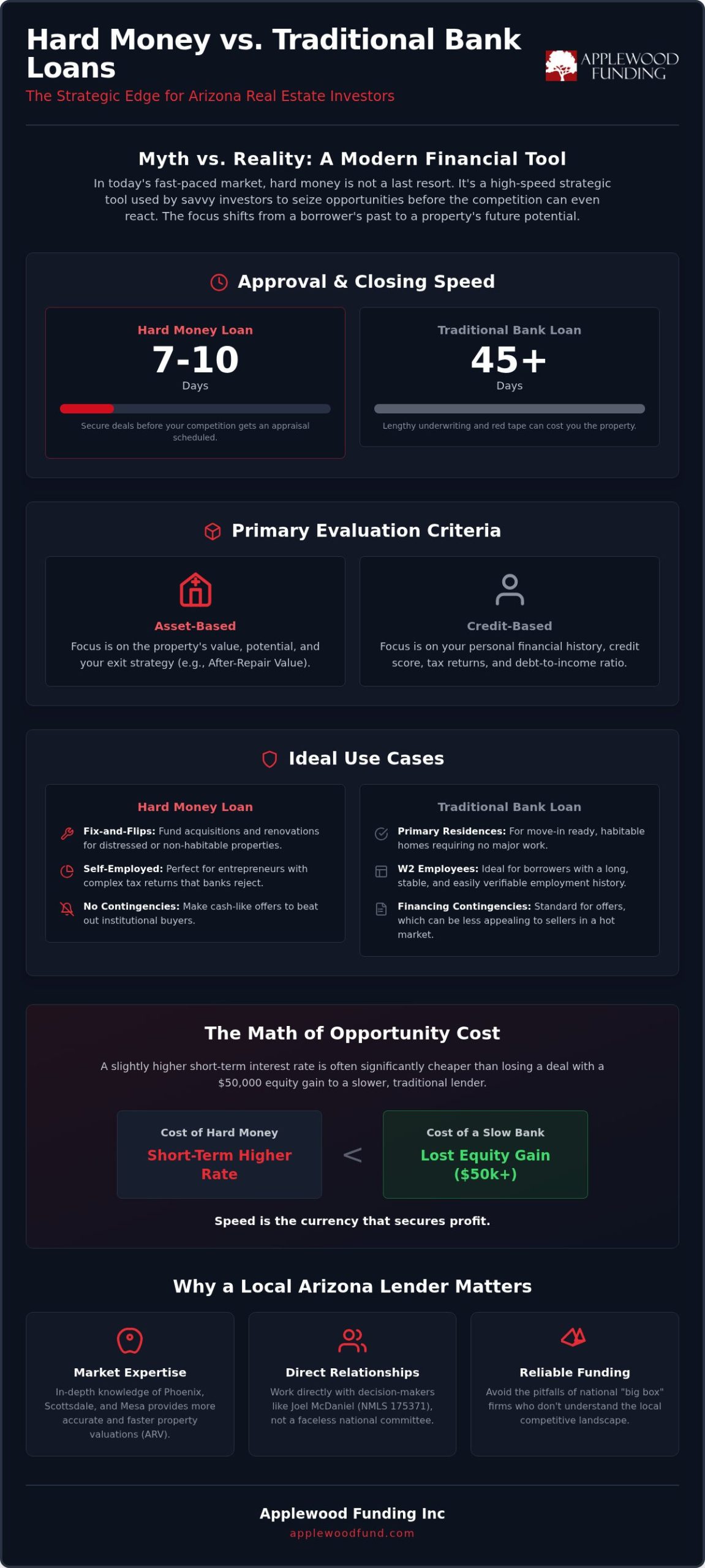
Amateur investors stare at interest rates. Professionals look at the bottom line. If you’re comparing a 6.5% conventional mortgage to a 10% private loan, the bank seems cheaper on paper. But paper doesn’t account for reality. In the high-velocity Arizona market of 2026, the real question isn’t “what is the rate?” but “what is the cost of waiting?” If a slow bank approval causes you to lose a deal with a $50,000 equity spread, that “cheap” bank loan just cost you fifty grand. Understanding when to use a hard money loan requires a shift from focusing on the cost of capital to the gross profit of the project.
Speed is a profit multiplier. When you use Cash Out Hard Money Loans to unlock liquidity from an existing property, you’re buying time and opportunity. You’re positioning yourself to strike when others are stuck in underwriting. The points and the interest are simply the cost of doing business; they’re an investment in your ability to move faster than the institutional giants. In a market where inventory is tight, the liquid borrower always wins.
Calculating Interest vs. Potential Equity Gains
Let’s look at the math. A traditional bank loan might take 45 to 60 days to close. During that time, the seller gets cold feet or a cash buyer swoops in. Even if you do close, you’ve spent two months paying holding costs on a project that hasn’t started. A hard money loan from a local expert like Joel McDaniel (NMLS 175371) can close in as little as 3 to 7 days. You pay a higher rate for those few months, but you gain two months of renovation time. That head start often pays for the entire cost of the loan through faster resale or earlier rental income.
Don’t view points as a penalty. View them as a premium for certainty. In 2026, sellers value a guaranteed close over a slightly higher offer with a financing contingency. By using private capital, you remove the “if” from the equation. You become the most attractive buyer in the room.
Exit Strategies: The Key to Hard Money Success
Hard money is never a permanent solution. It’s a bridge. Your success depends entirely on your exit strategy. Most savvy Arizona investors use private funds to “stabilize” a property. This means you buy the distressed asset, fix the major issues, and then refinance into a long-term, lower-interest conventional loan. Alternatively, you sell the property outright, pay off the bridge, and pocket the profit. You can weigh these options further by reviewing our Hard Money Loan Pros and Cons guide.
The math only works when you have a clear plan. If you’re ready to run the numbers on your next Phoenix or Scottsdale deal, get a custom quote from our lending team today. We’ll help you determine if the opportunity cost makes hard money the right move for your portfolio.
Navigating the Arizona Market: Why a Local Lender Matters
National “big box” lenders are a liability in a high-speed market. They treat a Phoenix condo like a Chicago loft, ignoring the specific micro-market trends that define Arizona real estate. They use out-of-state appraisers who don’t know the difference between Arcadia and Ahwatukee. When you’re deciding when to use a hard money loan, you need a partner who knows the local street corners. Local expertise in Phoenix, Scottsdale, and Tucson isn’t just a bonus; it’s the engine that drives your speed. We don’t need a three-week appraisal window to understand the value of a property in Peoria or Glendale. We live here. We lend here.
The personal touch is your secret weapon. At Applewood Funding, you aren’t a file number in a generic call center. You’re talking directly to a decision-maker like Joel McDaniel (NMLS 175371). There are no corporate committees. There are no layers of faceless bureaucracy. You get a direct answer from a local expert who understands the Arizona dirt. This direct access is what allows us to move at a pace that national firms simply cannot match.
Arizona-Specific Regulations and Market Speed
Escrow and title nuances in Maricopa County can easily trip up national firms. We understand the local landscape. We know the title officers and the specific requirements of Arizona lending laws. An Arizona-local proof of funds letter carries significant weight with sellers. It tells them you have a partner who is ready to move. In a market where multiple offers are the norm, that local credibility can be the deciding factor in your offer being accepted. We don’t just provide capital; we provide a local reputation that works in your favor.
Your 3rd Step: Getting Pre-Approved for Speed
Traditional banks want a mountain of paperwork. We don’t. We focus on the asset and your strategy. The documentation you need is minimal compared to a 30-year mortgage. We want to see the deal’s potential and your plan for the property. This streamlined process is designed for the modern investor who needs to move now. Don’t wait for a bank’s “clear to close” while your competition is already starting demolition.
- The 24-Hour Look: We’ll give you an answer before the weekend open house begins.
- No-Nonsense Approval: We focus on the equity and the property value.
- Direct Funding: We are the source of the capital, ensuring a smooth and predictable close.
Success in the 2026 Arizona market requires a lender who moves as fast as you do. Stop fighting the bank’s red tape and start working with a team that values your time. Apply for your Arizona hard money loan now and secure your next deal with confidence.
Take Control of Your Next Arizona Real Estate Deal
Success in the 2026 Arizona market isn’t about having the lowest interest rate; it’s about having the most reliable funding. We’ve shown that private capital is a high-octane tool for those who value speed and certainty. Whether you’re navigating a complex fix-and-flip or securing a primary residence when banks say no, your agility is your greatest asset. Mastering when to use a hard money loan allows you to strike while your competition is still stuck in a traditional lender’s underwriting queue.
Don’t let rigid credit scores or slow appraisals kill your momentum. Applewood Funding provides the local Arizona expertise you need to close in days. Led by Joel McDaniel (NMLS 175371), our team specializes in the rare owner-occupied options and fast-funding bridges that national lenders simply can’t offer. You have the vision and the equity. We have the capital to make it happen. It’s time to stop waiting and start winning.
Get Your Fast Hard Money Quote from Applewood Funding Inc and secure your competitive edge today.
Frequently Asked Questions
Can I get a hard money loan for my primary residence in Arizona?
Yes, you can. Applewood Funding Inc specializes in owner-occupied hard money loans across Arizona. While many national lenders avoid these due to regulatory complexity, we provide them for homeowners who need fast, flexible solutions. These are fully legal and regulated consumer-purpose loans. They’re perfect for business owners or those with unique income who don’t meet traditional bank criteria but have significant equity in their Phoenix or Scottsdale property.
How fast can Applewood Funding close a hard money loan?
We move as fast as the market requires. Applewood Funding can typically close a loan in 3 to 7 days. This speed is a massive advantage in competitive Arizona cities like Mesa or Glendale. Because we’re a direct lender, we bypass the corporate committees that slow down big banks. We focus on the property’s value and your exit strategy to get you funded before your competition even gets an appraisal.
What are the typical requirements for a fix-and-flip loan in Phoenix?
Our Phoenix fix-and-flip loans focus primarily on the property’s potential. We look at the After-Repair Value (ARV) and the strength of your renovation plan. You’ll generally need a down payment or existing equity, but we don’t require the perfect credit scores that banks demand. We fund the purchase and the rehab costs in draws, allowing you to scale your investment portfolio without tying up all your personal cash.
Is hard money a good idea if I have bad credit but high equity?
High equity is your strongest lever. This is exactly when to use a hard money loan to achieve your goals. Since our lending is asset-based, your property’s value is the primary security for the loan. If you have a solid exit strategy, such as selling the home or eventually refinancing, your credit score becomes secondary. We look for solutions where traditional banks only see red flags and credit-based roadblocks.
What happens if I can’t pay off the hard money loan in 12 months?
Hard money is designed as a short-term bridge. If you can’t pay off the loan within 12 months, you should communicate with us early to discuss an extension or a refinance. Most borrowers use this time to stabilize the property or improve their credit to qualify for a conventional mortgage. Having a clear exit strategy is vital. We work with our clients to ensure the loan serves as a successful stepping stone.
How do hard money rates in 2026 compare to traditional mortgages?
In 2026, hard money rates typically range from 8% to 15%, which is higher than a 6% or 7% conventional mortgage. However, you’re paying for speed and accessibility. Traditional mortgages require 45 days of documentation and perfect credit. Hard money offers funding in a week with minimal red tape. For many Arizona investors, the profit gained by securing a deal quickly far outweighs the temporary cost of a higher interest rate.
Can I use a hard money loan for land or ground-up construction?
Absolutely. We offer specialized construction and land loans for projects across Arizona, from Sedona to Tucson. Traditional banks rarely lend on raw land or ground-up projects until they’re nearly finished. We provide the capital to secure the lot and start the vertical build. This allows you to get the project moving immediately. Once the structure is stabilized, you can transition into a permanent mortgage or sell for a profit.
Do I need to show tax returns for a bank statement loan?
No, tax returns aren’t required for our bank statement loans. This product is specifically designed for self-employed borrowers in Arizona who have high cash flow but use legal deductions that lower their taxable income. We use 12 to 24 months of bank statements to verify your ability to repay. It’s a faster, simpler way to qualify for a home in Flagstaff or Peoria without the frustration of traditional W2 underwriting.