

2026 Arizona Rehab Loan Guide for Real Estate Investors
September 9, 2026Hard Money Loan Pros and Cons: 2026 Strategic Guide
A hard money loan isn’t a sign of financial failure. It’s a high speed financial bridge for investors who value time and equity over traditional red tape. If you’ve ever watched a prime Arizona property deal vanish because a bank took weeks to say maybe, you already know that slow capital is the same as no capital. It’s frustrating to have a solid strategy blocked by rigid institutional rules or a temporary dip in your credit score. To win in this market, you need a clear breakdown of hard money loan pros and cons before the next opportunity passes you by.
We understand that in the competitive 2026 real estate market, you need a lender who looks at the asset, not just the paperwork. This strategic guide helps you determine if this tool is the right power tool for your specific goals. You’ll get an objective look at the higher costs versus the massive speed advantage that lets you close deals traditional lenders won’t touch. We’ll preview exactly how to leverage your equity, manage the risks, and use fast capital to scale your portfolio across the Grand Canyon State.
Key Takeaways
- Discover why asset-based lending prioritizes your property’s equity over a perfect FICO score or traditional income verification.
- Evaluate the hard money loan pros and cons to see how lightning-fast access to capital trades off against higher interest rates.
- Slash your closing times from months to days to secure time-sensitive deals in the competitive Arizona real estate market.
- Compare institutional red tape against equity-driven funding to choose the most effective financial tool for your specific investment project.
- Nail down the two essential steps to secure your loan, starting with a rock-solid exit strategy and an accurate equity calculation.
What is a Hard Money Loan? The Asset-Based Alternative
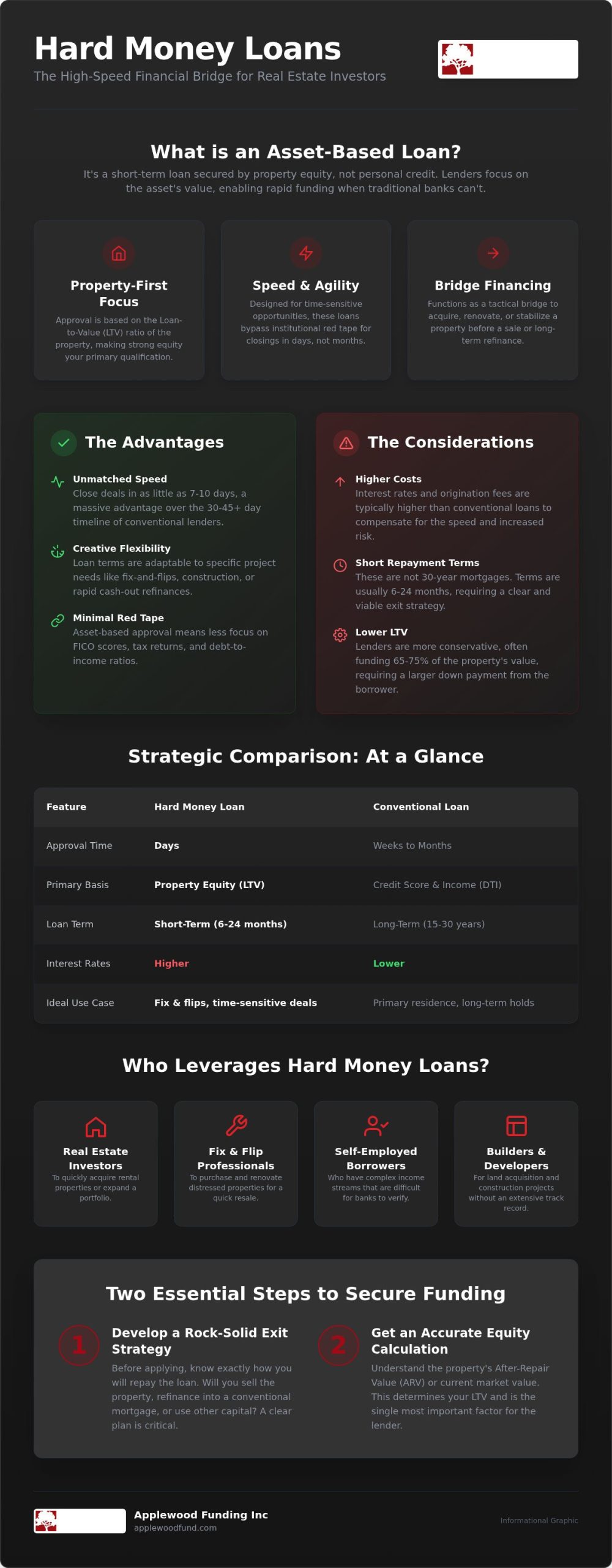
A Hard money loan is a short-term financial tool secured by real property rather than the borrower’s personal credit history. While institutional banks spend months dissecting your debt-to-income ratio, private lenders focus on the collateral. In the 2026 Arizona market, this distinction is often the difference between closing a deal and watching it slip away. Traditional institutions are increasingly risk-averse, creating a massive gap that only agile private capital can fill. Weighing the hard money loan pros and cons begins with recognizing that this is asset-based speed designed for those who value opportunity over low-interest bureaucracy.
The Mechanics of Asset-Based Lending
The engine of this process is the Loan-to-Value (LTV) ratio. Instead of buried tax returns or years of income verification, we look at the property’s current or projected value. If there’s enough equity to protect the investment, the funding moves forward. This property-first approach is why approvals happen in days. Most of these arrangements function as bridge loans, providing the capital you need to acquire, renovate, or stabilize a property. They aren’t meant for 30-year cycles; they’re tactical moves to get you to your next refinance or sale.
Who is Hard Money For?
Real estate investors are the most common users of this capital. Fix-and-flip professionals in Phoenix and Scottsdale use it to grab distressed properties before the competition even gets an appraisal. However, the 2026 landscape has widened the net. Self-employed borrowers with complex income streams often find that traditional underwriting is a dead end. At Applewood Funding Inc, we provide specialized solutions that go beyond the standard investor mold. This includes rare owner-occupied hard money options for Arizona residents who have significant home equity but don’t meet rigid institutional criteria. Whether you’re building a new rental portfolio or leveraging your primary residence, asset-based lending provides a path to “Yes” when banks only offer a “No.”
The Pros: Why Borrowers Choose Hard Money
Hard money isn’t a fallback plan. It’s a strategic tool for those who prioritize results over red tape. When you weigh the hard money loan pros and cons, the primary benefit is speed. Traditional banks operate on a 30 to 45 day cycle. In a hot market, that’s an eternity. Private lending collapses that timeline into days. A balanced look at hard money loan pros and cons proves that the cost of capital is often secondary to the opportunity cost of a missed deal.
Approval hinges on equity. If the deal makes sense and the collateral is strong, the funding follows. You don’t need a 750 FICO score or a mountain of tax returns. This asset-based model allows you to secure properties that banks won’t touch, like distressed homes needing a full gut renovation. While a traditional lender sees a liability, a hard money lender sees potential equity.
Speed as a Competitive Advantage
Winning a bidding war in Phoenix or Scottsdale requires more than a high offer; it requires certainty. Sellers prefer cash-like offers. Hard money provides that leverage. You skip the grueling underwriting process that kills deals. Documentation is streamlined. We focus on the property’s value and your exit strategy. Speed to Close is the ultimate investor currency. It’s the difference between owning the block and watching from the sidelines.
Flexibility and Creative Financing
Every project is unique. A standard 30 year mortgage is a rigid box that rarely fits a six month renovation. Hard money offers the flexibility to tailor repayment to your specific project milestones. This creative approach allows you to scale faster. You aren’t limited by debt-to-income ratios that stop traditional borrowers in their tracks. Instead, you’re limited only by the equity you can find and the deals you can close.
Common uses for this flexible capital include:
- Acquiring distressed properties using Fix and Flip Loans.
- Closing on land or construction projects without a long institutional track record.
- Leveraging existing property equity for rapid cash-out needs to fund new ventures.
This agility lets you pivot when a new opportunity strikes. You can move from one deal to the next without waiting for a bank’s bureaucracy to catch up. If you’re ready to move past the bank’s “No,” it’s time to talk to a local expert who understands the Arizona market.
The Cons: Understanding the Costs and Risks
Transparency is the foundation of a good deal. While the benefits are clear, a full analysis of hard money loan pros and cons requires a hard look at the costs. You aren’t paying for the money alone; you’re paying for the speed and the lender’s willingness to take on risks that traditional banks won’t touch. This premium is reflected in higher interest rates and upfront fees. Ignoring these factors can turn a profitable project into a financial burden if you don’t plan accordingly.
Typical interest rates in 2026 range between 9.5% and 12.5%. Compared to a standard 30 year mortgage, this is significantly higher. You also have to account for shorter repayment windows. Most hard money loans are bridge solutions lasting 12 to 24 months. If you don’t have a clear path to pay back the capital, the pressure builds quickly. The ultimate risk is foreclosure. Because these are asset-based loans, the property is the guarantee. If the project fails, the property is at stake.
The Cost of Capital
Private lenders charge more because they move faster. They don’t spend months analyzing your life history; they spend days analyzing the deal. This efficiency carries a cost. You’ll often encounter “points” at closing, which are origination fees calculated as a percentage of the loan. In 2026, expect to pay between 1.5 and 3 points upfront. While this increases your initial investment, you must weigh it against the “Cost of Doing Nothing.” If waiting for a bank means losing a $50,000 profit opportunity, a $5,000 origination fee is a small price to pay for progress.
Risk Mitigation and Exit Strategies
Success depends on your exit strategy. You need a documented plan for how you’ll pay off the loan before the term ends. A balanced view of hard money loan pros and cons shows that the biggest “con” is often a lack of preparation. Common exit paths include:
- Refinancing: Moving into a long-term traditional mortgage once the property is stabilized.
- Selling: Using the proceeds from a fix-and-flip to clear the debt.
- Cash-out: Using other assets to settle the balance.
What happens if your project takes longer than expected? Delays happen. Supply chains stall; permits get stuck. You must have a contingency plan. We encourage borrowers to build a “buffer” into their timelines. Understanding the risks doesn’t mean avoiding the tool. It means using it with your eyes wide open. If you’re ready to see how these numbers work for your specific Arizona property, our team is here to help you map out a secure path forward.
Hard Money vs. Conventional Loans: A Strategic Comparison
Choosing the right loan isn’t about finding the lowest rate. It’s about finding the right tool for the job. Conventional loans reward patience, low debt, and high credit scores. Hard money rewards speed and equity. When you weigh the hard money loan pros and cons, you’re really deciding between long-term stability and short-term tactical power. One is a marathon; the other is a sprint.
The differences are stark and immediate. Banks look at your past; private lenders look at the property’s future. If you have the luxury of time, a conventional loan is your best bet for a 30 year hold. But if a deal is on the line today, the red tape of a big-box bank will only get in your way. A comprehensive look at hard money loan pros and cons proves that speed is often more valuable than a low interest rate when a property is undervalued.
- Approval Criteria: Banks demand three years of tax returns and a perfect FICO. We focus on the asset and your exit strategy.
- Timeline: A bank takes 30 to 60 days to close. We can fund in 48 hours to 10 days.
- Cost: You pay a premium for agility. Banks offer lower rates but require months of hoops and hurdles.
The 2026 Lending Landscape
Institutional lending has become even more restrictive this year. Tightening bank regulations mean even qualified borrowers get stuck in underwriting for weeks. This makes alternative capital essential. If you’re self-employed, a Bank Statement Loan offers a middle ground by using your cash flow instead of tax returns. For those looking to access capital for their primary residence, Owner Occupied Hard Money Loans provide a bridge that traditional lenders simply won’t build.
Choosing Your Path
Don’t just look at the monthly payment. Look at the potential profit. If a conventional loan takes 60 days, will that Phoenix flip still be available? Likely not. Successful Arizona investors often use both types of lending in tandem. They use hard money to secure the property and finish renovations, then refinance into a conventional loan once the asset is stabilized. It’s a “Buy Fast, Hold Cheap” strategy that maximizes your ROI.
Before you commit, evaluate the total cost of the loan against the profit you’ll lose by waiting. Does the speed of the capital create more value than the interest it costs? If the answer is yes, you’ve found your path. Don’t let a slow bank kill a great deal. Talk to our Arizona experts today to see which strategy fits your next project.
Securing Your Hard Money Loan in Arizona: Next Steps
You’ve navigated the technicalities and weighed the hard money loan pros and cons. Now it’s time to move from theory to execution. In the fast moving Arizona market, preparation is the difference between a closed deal and a missed opportunity. You don’t need a mountain of paperwork, but you do need a clear plan. Following these steps ensures you’re ready to strike when the right property appears in Phoenix, Tucson, or the surrounding valley.
- Step 1: Identify your property and pinpoint the equity. We look at the asset first. Whether it’s a distressed flip or a primary residence, knowing the current value is your first move. Your equity is the collateral that drives the approval.
- Step 2: Finalize your exit strategy. Be specific about how you’ll pay back the loan. Whether you’re planning a traditional refinance or a quick sale, a documented plan is essential for a smooth closing.
- Step 3: Connect with a local Arizona partner. National lenders don’t understand the nuances of the Scottsdale or Mesa markets. Work with a team that knows local property values and closing customs.
- Step 4: Submit your basic file for a rapid quote. While we skip the institutional red tape, we still need the basics. Have your property details and entity documents ready for our team to review.
Understanding the hard money loan pros and cons means knowing that speed requires a bit of upfront clarity from the borrower. When you provide the right information quickly, we can fund your project while your competitors are still waiting for a bank callback.
The Applewood Advantage in Arizona
Local expertise is your secret weapon. Applewood Funding Inc, managed by Joel McDaniel (NMLS 175371), specializes in the unique Arizona landscape. We know the neighborhoods from Peoria to Tempe and understand the pace of the local market. This isn’t generic national advice; it’s boots-on-the-ground support for investors and homeowners. We provide the “Yes” when traditional institutions get stuck in their own bureaucracy. Stop letting slow capital kill your momentum. Start your fast-track application today and see the difference local knowledge makes.
Final Checklist for Borrowers
Before you sign, run through this final check. It ensures your project stays on track and your risks remain managed. A successful hard money experience is a prepared one.
- Verify LTV requirements: Ensure your equity or down payment meets the 70% to 80% Loan-to-Value standards typical for 2026 deals.
- Confirm your closing timeline: Do you need to close in 48 hours or 10 days? Be clear with your lender about your deadline.
- Prepare for a no-red-tape experience: Expect a conversation about the deal’s potential, not a colonoscopy of your financial past. Focus on the property’s value.
The Arizona market moves fast. By following these steps, you position yourself as a serious buyer who can close with confidence. Get your equity working for you and secure the funding your project deserves.
Master Your Next Arizona Real Estate Deal
The 2026 real estate market moves at a pace that institutional committees simply can’t match. Mastering the hard money loan pros and cons means recognizing that while the cost of capital is higher, the cost of a missed opportunity is often terminal for your portfolio. You’ve seen how equity serves as your primary qualifier and how a solid exit strategy protects your investment. Now, it’s about choosing a partner who understands the Arizona landscape as well as you do.
Don’t let a slow bank kill your momentum or block your access to capital. Applewood Funding Inc stands as a leader among Arizona-based private lending experts, specializing in the rare owner-occupied hard money solutions that others avoid. We pride ourselves on closing in as little as 7-10 days. This gives you the leverage to win bidding wars in Phoenix or secure your primary residence without the red tape. The right deal is out there right now. Make sure you have the financial power tool required to grab it.
Get a Fast Hard Money Quote from Applewood Funding Inc
Frequently Asked Questions
Is a hard money loan a good idea for my primary residence?
It’s a powerful tool if you have equity but don’t fit the rigid bank mold. While most private lenders avoid primary residences, Applewood Funding specializes in owner occupied hard money loans across Arizona. It’s a strategic bridge to help you secure or stay in your home while you work toward a traditional refinance. You get speed and flexibility that institutional lenders simply can’t match in the current market.
How much down payment do I need for a hard money loan in Arizona?
Most Arizona hard money deals require a down payment of 20% to 30%. This translates to a Loan-to-Value (LTV) ratio of 70% to 80%. Since these are asset-based loans, your skin in the game protects the lender’s risk. For fix-and-flip projects, the requirement might shift based on the After-Repair Value (ARV). Having more equity often leads to better terms and faster approvals when you’re competing for hot Phoenix properties.
Can I get a hard money loan with a 500 credit score?
Yes, you can. We prioritize the value of the real estate and your exit strategy over your FICO score. A 500 credit score won’t automatically disqualify you because we aren’t a traditional bank. If the property has enough equity and the deal makes sense, we can move forward. This is a core part of the hard money loan pros and cons; you pay a higher rate for the ability to bypass credit hurdles.
What is the typical interest rate for hard money in 2026?
In 2026, typical interest rates for hard money loans range from 9.5% to 12.5%. Some specialized or higher-risk deals might see rates up to 15%. These rates reflect the speed and risk the lender assumes. While these are higher than conventional mortgages, the goal is short-term use. You aren’t signing up for a 30-year commitment. You’re paying for a fast financial bridge to reach your next project milestone or property acquisition.
How fast can Applewood Funding close a hard money loan?
We pride ourselves on speed. Applewood Funding can often close a hard money loan in as little as 7 to 10 days. Traditional banks often take 45 days or longer to navigate their internal committees. In the competitive Arizona market, that delay can cost you the deal. Our streamlined process focuses on the property’s equity and your exit plan, allowing us to fund your project while other investors are still stuck in underwriting.
What happens if I cannot pay back my hard money loan on time?
Communication is your best tool if your timeline shifts. Most lenders prefer a successful payoff over a legal battle. You might be able to negotiate a loan extension for an additional fee. However, because these are asset-based loans, the property serves as collateral. If you can’t settle the debt or find a viable exit strategy, the lender has the right to initiate foreclosure to recover their capital. Always build a buffer into your project schedule.
Do hard money lenders require an appraisal?
Yes, an appraisal or a Broker Price Opinion (BPO) is almost always required. Since the property’s value is the primary security for the loan, the lender needs to verify its worth. In Arizona, we often use local experts who understand specific neighborhood trends in cities like Mesa or Glendale. This valuation ensures the Loan-to-Value ratio stays within safe limits. It protects both the lender’s investment and your equity position in the deal.
Are hard money loans regulated in Arizona?
Yes, hard money lending is regulated at the state level in Arizona. Lenders must comply with specific Arizona statutes regarding licensing and consumer protection. It’s vital to work with a reputable professional. Applewood Funding is managed by Joel McDaniel, who is NMLS licensed (NMLS 175371). This ensures your transaction follows legal requirements while still providing the speed and flexibility that traditional institutional banking lacks.