


Fix and Flip Loan Requirements: The 2026 Investor’s Pre-Funding Checklist
September 7, 2026
2026 Arizona Rehab Loan Guide for Real Estate Investors
September 9, 2026Short Term Fix and Flip Financing: The 2026 Investor’s Guide to Rapid Capital

You found the perfect distressed property in Scottsdale. The numbers work. The exit strategy is clear. But while you’re stuck waiting 45 days for a big bank to audit your life history, a cash buyer just snatched the keys. It’s a common story. You’ve got the vision, but bureaucratic red tape and high down payment requirements are holding you back. In the balanced 2026 Arizona market, speed isn’t just an advantage; it’s the only way to win. You need short term fix and flip financing that moves as fast as you do.
We know the feeling of watching a profitable flip slip through your fingers because of a slow lender. This guide will teach you how to master the mechanics of short term fix and flip financing to secure rapid capital and dominate the Phoenix real estate market. You’ll learn how to leverage the property’s potential to get high funding without the stress of traditional credit scores. We’re previewing the exact strategies to close in days, not weeks. It’s time to stop chasing deals and start closing them with the confidence of a cash buyer.
Key Takeaways
- Master how short term fix and flip financing leverages After Repair Value (ARV) to provide higher capital than traditional bank loans.
- Shift your focus from interest rates to capital speed to ensure you don’t lose high-profit deals in competitive Arizona neighborhoods.
- Learn why a solid Scope of Work and accurate neighborhood comps are the most important factors for qualifying for rapid funding.
- Identify the strategic differences between hard money and bridge loans to select the perfect financing structure for your project’s lifecycle.
- Discover how local asset-based underwriting allows you to bypass credit score hurdles and close on distressed properties in days.
What is Short Term Fix and Flip Financing?
Traditional banks want to marry you. They look for 30-year commitments and stable, slow growth. Real estate investors in the Phoenix metro area don’t have time for that. You need a sprint, not a marathon. Short term fix and flip financing is a specialized form of asset-based lending built for the 6 to 18 month lifecycle of a renovation project. It’s the financial fuel that allows you to acquire, remodel, and exit a property before the market shifts. To understand the broader strategy of these investments, it helps to review the fundamentals of What is Flipping? in a modern real estate context.
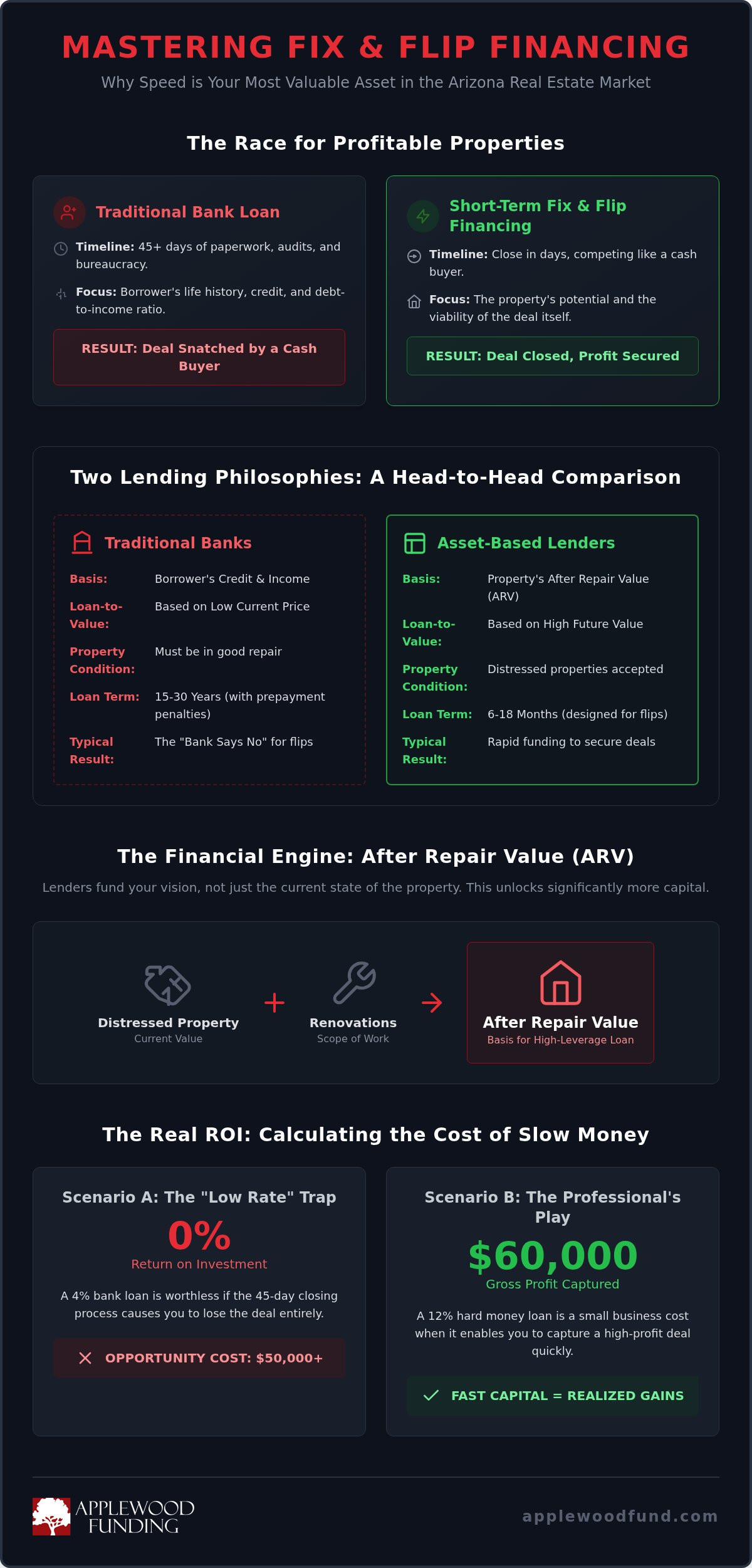
The core mechanism of this financing is the After Repair Value (ARV). Conventional mortgages focus on the current purchase price. If you’re buying a distressed home in Mesa, that price is low, and your loan will be even lower. Short-term lenders look at what the property will be worth after you’ve worked your magic. This allows for much higher leverage. It often covers up to 100% of renovation costs, providing the liquidity you need to keep your projects moving without draining your personal cash reserves.
The Role of Hard Money in Your Flip
Hard money is the engine behind the most successful Arizona flips. It represents a fundamental shift from borrower-based to asset-based underwriting. While a bank obsesses over your debt-to-income ratio, a private lender like Applewood Funding focuses on the deal itself. Does the property make sense? Are the neighborhood comps in Scottsdale strong? If the asset is solid, the capital follows. This speed allows you to compete directly with all-cash institutional buyers. In a market where the best deals in Peoria or Tempe disappear in 48 hours, having an agile partner is the difference between a closed deal and a missed opportunity.
Short-Term vs. Long-Term Debt
Don’t use a 30-year tool for a 6-month job. Using long-term debt for a quick flip is a rookie mistake that leads to heavy prepayment penalties. These fees can gut your profit margins the moment you try to sell. Short-term structures keep your capital recyclable. You aren’t tied down by long-term interest commitments or rigid bank schedules. Instead, you match your loan term to your realistic exit strategy. This flexibility keeps your balance sheet clean and your capital ready for the next acquisition. It’s about maintaining velocity. You get in, you renovate, you sell, and you move on to the next Phoenix project with your profits intact.
The Strategic Advantage: Why Speed Beats Interest Rates
In the high-stakes world of Arizona real estate, amateur investors obsess over interest rates. Professionals obsess over deal capture. You might find a bank offering a 4% loan, but if that bank takes 45 days to close, it’s the most expensive money you’ll ever use. While you’re filling out paperwork, a cash-ready competitor just secured a deal with a $50,000 profit margin. This is the opportunity cost of slow capital. In Scottsdale and Phoenix, the best inventory disappears in hours. Short term fix and flip financing gives you the agility to strike when the iron is hot.
Leverage is your greatest tool for scaling. By using private capital to fund your acquisition and renovation, you keep your personal cash in the bank. This liquidity isn’t just a safety net; it’s your growth engine. Instead of sinking all your capital into one single project in Mesa, you can use high-leverage financing to run three flips simultaneously. This velocity is how you dominate the local market. For a deeper dive into how these structures work, check out this Forbes guide to fix and flip financing. It highlights why speed is the ultimate currency for flippers.
The ‘Bank Says No’ Scenario
Traditional banks are designed to avoid risk, not fund opportunities. They often reject flip projects because the property is in poor condition, or because the investor is self-employed. If the roof is leaking or the copper pipes are missing, a conventional lender won’t touch it. Applewood Funding looks past the red tape. We focus on the deal’s After Repair Value and your vision for the property. We turn a bank’s ‘no’ into a funded project in a fraction of the time, focusing on the asset’s potential rather than just your credit score. If you’ve been hit with a rejection, it’s time to discuss your project with a local expert who understands the Arizona market.
Calculating the Real ROI of Fast Funding
Let’s look at the math. A 12% hard money loan might look expensive compared to a standard mortgage. But if that loan allows you to capture a deal with a $60,000 gross profit that you would have otherwise lost, the interest is just a small cost of doing business. Missing the deal entirely results in a $0 return. In this context, “expensive” money is often the most profitable tool in your kit. Short-Term ROI is defined by the speed of deal capture and the ability to recycle capital quickly to maximize annual profit volume. It’s about how many times you can turn your money in a calendar year, not the percentage on the loan document.
Comparing Short-Term Financing Structures
Choosing the right tool for the job is essential. Not all short term fix and flip financing is created equal. You need to know when to swing the heavy hammer of hard money and when a bridge loan is the smarter surgical strike. Hard money is your go-to for distressed properties in Peoria or Glendale that need a complete overhaul. It’s built for speed and handles the “ugly” houses banks won’t touch. Bridge loans, however, act as the connective tissue between your current assets and your next acquisition. They solve the timing problem that kills so many deals.
For a deep dive into specific product numbers and requirements, check out our Fix and Flip Loans Pillar. Understanding these nuances is how you keep your capital recyclable and your portfolio growing.
Bridge Loans for Flippers
Think of a bridge loan as your portfolio’s accelerator. It’s the perfect solution when you’ve found a killer deal in Tempe but your cash is still tied up in a property waiting to close in Mesa. This “buy before you sell” strategy allows you to scale without waiting for the slow turn of the residential sales market. Typical terms in Arizona range from 3 months up to 5 years, providing a flexible window to stabilize an asset or finish a light renovation. It’s about maintaining momentum. You don’t let a great property slip away just because your liquidity is temporarily locked. You bridge the gap, secure the asset, and move forward.
Loan to Cost (LTC) Explained
LTC is the metric that actually matters to your bank account. While Loan-to-Value (LTV) looks at the property’s current worth, LTC focuses on the total project cost. This includes both the purchase price and the renovation budget. At Applewood Funding, we prioritize LTC because we want to maximize your leverage. We often fund up to 90% or more of the purchase price and 100% of your renovation costs through structured rehab draws. This is a game changer for cash-conscious investors.
Why does this matter? It reduces your initial capital injection. You keep more cash in your pocket to handle unexpected project hurdles or to secure your next earnest money deposit. We release funds as you hit specific milestones in your Scope of Work. It’s a partnership. We provide the capital; you provide the execution. By maximizing your LTC, you can do more deals with less of your own money on the line. That’s how you dominate the 2026 Arizona market. You use our capital to build your wealth.
Qualifying for Rapid Funding: The Arizona Roadmap
Getting approved for short term fix and flip financing shouldn’t feel like an interrogation. While banks bury you in paperwork, private lenders follow a roadmap focused on the deal’s potential. Step one is the deal analysis. We look at the After Repair Value (ARV) using active neighborhood comps in Phoenix and Mesa. Don’t rely on data from six months ago. In the balanced 2026 market, inventory moves fast, and your comps must reflect current buyer demand. Step two is your Scope of Work (SOW). A clear, line-item rehab budget is your real ‘credit score’. It proves you have a concrete plan to create value and manage the project’s lifecycle.
Step three involves your business structure. Most rapid funding requires an LLC or corporate entity. This keeps the transaction professional and protects your personal assets. Finally, step four is your exit strategy. Whether you plan to sell for a profit or refinance into a long-term rental, we need to see the finish line. Clear exit plans reduce risk for everyone involved. Review our Fix and Flip Loan Requirements Checklist to ensure your package is ready for a fast ‘yes’.
Arizona Market Nuances
Scottsdale and Phoenix are different worlds. A ‘comp’ in North Scottsdale doesn’t translate to a project in Central Phoenix. You need to understand local buyer expectations for finishes and layout. Navigating local inspection and permit timelines in Glendale or Peoria is also critical to keeping your short-term loan on track. Working with a local lender who knows Sedona from Tucson gives you a massive edge. We understand the neighborhood dynamics that national algorithms miss. This local expertise ensures your ARV is realistic and your funding arrives when you need it most.
Hard Money for the Self-Employed
Traditional lenders treat tax returns like a barrier. If you’re an entrepreneur or independent contractor, your legal deductions often make you look ‘unqualified’ to a bank. We don’t think that way. Applewood Funding supports entrepreneurs by using bank statement programs to verify liquidity. We care about your actual cash flow and your ability to execute the flip. Your self-employment status shouldn’t stop you from building a real estate empire. We focus on your bank balance and the deal’s merit rather than a W-2. Ready to bypass the red tape? Get your deal analyzed by a local Arizona expert today.
Scaling with Applewood Funding’s Fix and Flip Solutions
Successful flipping isn’t just about finishing one house. It’s about building a pipeline. To scale your business in the 2026 Arizona market, you need a partner who understands that short term fix and flip financing is a tool for growth, not just a loan. Applewood Funding provides the infrastructure for that growth. Led by Joel McDaniel, our team doesn’t rely on the cold, detached algorithms used by national lenders. We know the Phoenix metro area. We know which streets in Scottsdale are seeing the highest demand and which neighborhoods in Mesa are primed for a shift. This local expertise allows us to move at a pace that traditional banks simply can’t match.
We also offer a rare strategic advantage: owner-occupied hard money options. Most private lenders strictly avoid primary residences due to regulatory complexity. We don’t. If you’re living in your project while you renovate, we provide the capital to make it happen. This flexibility is a game changer for investors who want to maximize their personal equity while improving their own living space. We prioritize speed and asset-based underwriting to move you from ‘searching’ to ‘funded’ in as little as a few days. Our goal is to remove the financial friction that stops most investors before they even begin. For a comprehensive look at how rehab loans for real estate investors work in the 2026 Arizona market, including Maricopa County loan limits and how local foreclosure laws impact your strategy, our dedicated guide covers everything you need to scale your portfolio.
Customized Funding for Every Experience Level
Experience shouldn’t be a barrier to entry. If you’re a first-time flipper in Glendale or Peoria, you’ve likely already heard “no” from conventional lenders. We use common-sense underwriting. We look at the deal’s merit and your renovation plan rather than just your years in the business. For the seasoned pro investor scaling a high-volume portfolio in Scottsdale or Tempe, we provide the deep capital reserves needed to run multiple flips simultaneously. Our short term fix and flip financing structures are designed to be recyclable. We want you to finish your project, realize your profit, and immediately move into the next acquisition with a lender you already trust.
Ready to Fund Your Next Win?
Stop letting bureaucratic red tape kill your momentum. Our application process is built for speed and clarity. It starts with a simple, no-obligation deal review where we look at your project’s potential. We don’t hide behind fine print or surprise fees. You get a clear term sheet so you can make informed decisions. Whether you’re tackling a distressed single-family residence or a high-end Scottsdale remodel, we’re ready to act as your financial ally. Take the first step toward your next successful exit today. Get Your Fix and Flip Financing Quote Today and see how fast your capital can move.
Dominate the Arizona Market with Rapid Capital
We’ve shown you why speed is the ultimate currency in the 2026 real estate landscape. Whether you’re targeting distressed properties in Phoenix or high-end remodels in Scottsdale; short term fix and flip financing is your strategic advantage for growth. You now understand how to leverage LTC to keep your cash liquid and why a local expert’s neighborhood knowledge beats a national bank’s algorithm every single time. The mechanics are clear; it’s time to put them into action.
Don’t let a low credit score or your self-employment status keep you on the sidelines. Managed by Joel McDaniel (NMLS 175371), the team at Applewood Funding specializes in finding the value that traditional institutions miss. We provide the deep local Arizona expertise you need to fund your vision in days, not weeks. It’s time to stop chasing deals and start building a real estate empire with a partner who values your results over your paperwork.
Apply for Fast Fix and Flip Financing Now and turn your next potential deal into a funded win. The Arizona market moves fast. Make sure you’re moving faster. Your next successful exit is just a few days away.
Frequently Asked Questions
What is the typical term for a fix and flip loan?
Typical terms for short term fix and flip financing usually range from 6 to 18 months. This window aligns with the standard renovation and resale timeline in the Arizona market. While some products extend up to five years for more complex projects, most investors prefer the 12 month sweet spot. This keeps capital moving and minimizes interest carry costs. You get the funds you need to renovate and exit without being tied down by long term bank commitments.
Can I get fix and flip financing with bad credit?
Yes, you can secure financing even with a low credit score or past financial hurdles. Because we use asset-based underwriting, the property’s After Repair Value (ARV) and your Scope of Work are more important than your FICO score. We focus on the deal’s potential rather than your credit history. This allows entrepreneurs in Phoenix and Scottsdale to bypass traditional banking barriers and close on profitable distressed properties that banks won’t touch.
How fast can Applewood Funding close a short-term loan?
Applewood Funding can move from initial contact to a funded project in as little as a few days. Unlike traditional banks that require 45 days for an audit, our local Arizona team prioritizes speed. We understand that in markets like Mesa or Tempe, the best deals disappear in hours. Our streamlined process ensures you have the capital ready to compete with all-cash buyers, allowing you to secure inventory before your competitors even finish their paperwork.
Does short-term financing cover the cost of renovations?
Yes, a major advantage of short term fix and flip financing is that it often covers 100% of your renovation costs. We structure these as rehab draws based on your specific milestones. This high leverage, often calculated as Loan to Cost (LTC), reduces your initial capital injection. You keep your personal cash in the bank for emergencies or to secure your next earnest money deposit while we fund the heavy lifting of the remodel.
What is the difference between a bridge loan and a fix and flip loan?
A bridge loan is a gap solution used for quick acquisitions or moving between properties when your cash is temporarily tied up. It focuses on timing. A fix and flip loan is more comprehensive, specifically designed to include both the purchase price and the renovation budget. While both are short-term tools, the fix and flip product is the heavy hitter for projects requiring a full remodel and a quick exit strategy in the Arizona market.
Are fix and flip loans available for owner-occupied properties in Arizona?
Yes, Applewood Funding offers rare owner-occupied hard money options across Arizona. While most private lenders only fund non-owner-occupied investment properties, we support investors who want to live in their primary residence while they renovate. Whether you’re remodeling a home in Glendale or Peoria, we provide the capital you need. This unique flexibility allows you to maximize your personal equity without the rigid restrictions of conventional residential mortgage products.
What documents do I need to qualify for short-term financing?
You’ll need a clear Scope of Work (SOW) with a line-item budget and neighborhood comps that support your projected ARV. We also require your entity documents, such as LLC or corporate filings, as most short-term loans are structured for businesses. To prove liquidity, we look at bank statements rather than traditional tax returns. This process is designed to be fast and transparent, focusing on your ability to execute the project successfully.
Is there a prepayment penalty on short-term hard money loans?
Most short-term hard money loans do not have prepayment penalties because they are designed for rapid exits. We want you to finish your project and sell the property as quickly as possible. This allows you to recycle your capital and move on to your next Phoenix flip without being penalized for your efficiency. Always review your specific term sheet, but our goal is to keep your business agile and your profits accessible for future growth.