

Short Term Fix and Flip Financing: The 2026 Investor’s Guide to Rapid Capital
September 8, 2026
Hard Money Loan Pros and Cons: 2026 Strategic Guide
September 10, 20262026 Arizona Rehab Loan Guide for Real Estate Investors

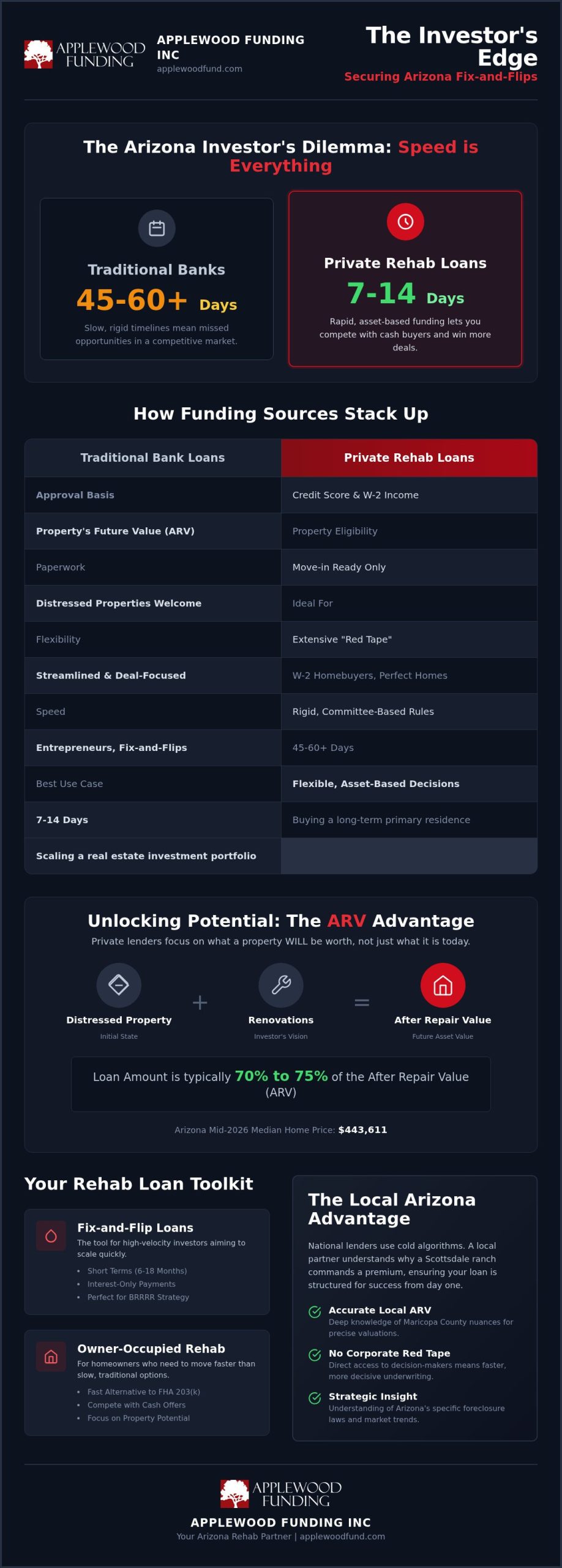
Why are you still losing Phoenix fix-and-flips to cash buyers when the capital you need is right in front of you? It’s a common story in the 2026 Arizona market. You find a distressed gem in Mesa. A traditional bank’s appraisal timeline stalls. The deal dies before it starts. You don’t have weeks to wait for a committee. That’s why smart rehab loans for real estate investors have become the ultimate power tool to close deals in days, not months.
At Applewood Funding Inc, we understand the frustration of losing out to institutional buyers while you’re stuck managing complex renovation draws and fighting strict credit requirements. This guide reveals how to secure fast, flexible renovation capital to maximize your fix-and-flip or rental property ROI. We’ll preview the 2026 Maricopa County loan limits, explain how Arizona’s specific foreclosure laws impact your strategy, and show you how to leverage asset-based funding to scale your portfolio with confidence. It’s time to stop waiting on banks and start winning more deals.
Key Takeaways
- Understand why traditional bank timelines fail and how private capital bridges the speed gap to secure competitive Arizona deals.
- Compare specialized rehab loans for real estate investors, including standard fix-and-flip options and rare owner-occupied hard money solutions.
- Master the difference between LTV and LTC to ensure your renovation budget is lender-ready and your profit margins are protected.
- Follow a step-by-step funding roadmap from your initial ARV analysis to the final pre-funding checklist for a seamless closing.
- Learn how working with a local Arizona direct lender eliminates corporate red tape and puts you ahead of institutional competition.
What Are Rehab Loans and Why Do Investors Need Them?
Rehab loans function as strategic profit amplifiers for your portfolio. They aren’t merely debt; they’re the essential fuel for any serious fix-and-flip operation. At their core, these short-term financing tools provide the capital needed to cover both the initial acquisition and the intensive renovation of distressed properties. In the high-velocity 2026 Arizona market, speed serves as your most valuable asset. Traditional mortgages often fail because they’re designed for move-in-ready homes and W-2 employees with months to spare. Savvy professionals need a solution that closes in days.
This is where rehab loans for real estate investors change the competitive landscape. This model relies on asset-based lending. We evaluate the property’s future potential rather than just your current credit score or tax returns. With Arizona median home prices reaching $443,611 by mid-2026, the battle for distressed inventory has never been more intense. Private capital allows you to act with the authority of a cash buyer, securing properties that would otherwise be swallowed by institutional giants. It’s about bridging the “speed gap” that keeps most part-time investors on the sidelines.
Hard Money vs. Traditional Bank Loans
Banks prioritize red tape and rigid criteria. They want perfect houses and perfect borrowers. If a property in Mesa has a stripped kitchen or a cracked foundation, a traditional lender won’t touch it. While a standard FHA insured loan provides a path for primary residents, it’s frequently a dead end for investors targeting “un-inhabitable” gems. Rehab loans provide funding in days, not months. This flexibility is vital for self-employed entrepreneurs who possess the vision but don’t fit into a corporate lending box. We prioritize the deal, not the paperwork.
The Role of ARV (After Repair Value) in Lending
ARV is the heartbeat of your project. It’s the estimated value of the property after all renovations are complete. Lenders use this figure to calculate your maximum loan amount, typically capping the total loan at 70% to 75% of the ARV. Getting this number right is the difference between a massive ROI and a break-even headache. National lenders often rely on cold algorithms that miss local nuances. An Arizona-based lender understands why a renovated ranch in Scottsdale commands a premium over a similar square footage in a different zip code. Accurate, local data ensures your rehab loans for real estate investors are structured for success from day one.
Ready to move faster? At Applewood Funding Inc, we provide the local expertise and rapid capital you need to dominate the Arizona market. We don’t do committees. We do deals.
Types of Rehab Loans for Arizona Real Estate
Choosing the right rehab loans for real estate investors depends entirely on your exit strategy. Arizona’s 2026 market doesn’t wait for indecisive funding. Whether you’re targeting a quick flip in Scottsdale or building a rental portfolio in Tucson, your capital structure must match your timeline. Different projects require different “power tools” in your financial kit. We don’t believe in one-size-fits-all lending. We believe in speed and precision.
Fix-and-Flip Loans for Rapid Scaling
Fix-and-flip loans are the gold standard for high-velocity investors. These are short-term solutions, typically ranging from 6 to 18 months, designed to get you in and out of a project fast. To maximize your monthly cash flow during the renovation phase, these loans often feature interest-only payments. This keeps your overhead low while you’re focused on the heavy lifting. If you’re ready to scale your operations, check out our deep dive: Fix and Flip Loans: The Investor’s Guide to Arizona Real Estate Funding in 2026.
For those building long-term wealth, the BRRRR strategy (Buy, Rehab, Rent, Refinance, Repeat) is the go-to move. You start with a hard money rehab loan to secure and fix the property. Once the asset is stabilized and a tenant is in place, you transition into long-term debt. This allows you to pull your initial capital back out and move to the next deal. It’s a proven cycle for Arizona investors who want to scale without getting their cash stuck in a single roof.
Owner-Occupied Rehab Solutions
Most lenders ignore homeowners who want to renovate their primary residence but don’t have massive equity. Traditional banks might point you toward a FHA 203(k) loan, but those programs are notoriously slow. In a competitive environment, waiting 60 days for a government-backed loan to clear means someone else will buy your dream home. We offer specialized owner-occupied hard money that focuses on the property’s potential. You can find more details here: Owner Occupied Hard Money Loans: Fast Funding for Your Primary Residence.
Finally, ground-up construction loans are seeing massive demand in growing Phoenix suburbs like Buckeye and Queen Creek. These aren’t just for massive developers anymore. Individual investors are using private capital to fund new builds on vacant lots where inventory is tight. If you have a specific project in mind and need to move now, you should talk to a local Arizona expert today to see which structure fits your goals.
Evaluating the Rehab Budget and Loan-to-Cost (LTC)
Knowing your numbers is the difference between a payday and a pitfall. While Loan-to-Value (LTV) looks at the final After Repair Value, Loan-to-Cost (LTC) focuses on the hard dollars you’re spending right now. Most rehab loans for real estate investors in Arizona are structured around LTC; often covering up to 80-90% of the purchase price and 100% of the renovation costs. You need a lender-ready budget to secure these terms. This isn’t a back-of-the-napkin sketch. It’s a line-itemized breakdown of every nail, board, and permit required to bring your vision to life.
Don’t forget the 10-15% contingency buffer. In the 2026 Arizona market, material costs and labor availability can shift mid-project. If you don’t build this safety net into your projections, a single plumbing surprise in a Central Phoenix bungalow can eat your entire profit margin. Lenders want to see that you’ve planned for the unexpected. It proves you’re a professional who understands the reality of the dirt, not just the math on the screen.
The Mechanics of Construction Draws
Lenders don’t just hand over the full renovation budget at the closing table. Instead, they use a draw schedule. A draw schedule is the roadmap for project liquidity, ensuring funds are released as specific milestones are met. Typically, you complete a phase of work, request an inspection, and then receive the reimbursement for that phase. To avoid draw lag, keep your documentation tight and your receipts organized. Happy contractors stay on site when they’re paid on time. While some government programs like FHA Section 203(k) mortgage insurance involve heavy oversight and slower timelines, private capital moves at the speed of your project.
Closing Costs and Points: The Cost of Speed
Speed has a price. In the world of private lending, that price is measured in origination points. One point equals 1% of the loan amount. While these costs are higher than a 30-year fixed bank loan, they’re the premium you pay to bypass months of red tape. Think of it as an investment in opportunity. If paying two points allows you to close in five days and beat out five other buyers for a $50,000 profit, the math is simple. Arizona investors choose Applewood Funding Inc because we prioritize transparency. No surprises. No hidden fees. Just the fast capital you need to dominate the market.
The Arizona Investor’s Roadmap to Funding
Success in the Grand Canyon State requires more than just finding a house. You need a process that beats the clock. When you’re looking for rehab loans for real estate investors, the roadmap starts with your own due diligence. Don’t just find a property; analyze the potential. Identify the asset and run a preliminary ARV analysis before you even pick up the phone. Once the numbers make sense, the speed of your funding depends on the clarity of your plan.
- Step 1: Property Identification and Preliminary ARV Analysis. Verify the neighborhood comps. Know your exit.
- Step 2: Gathering Documentation. This is the ‘Pre-Funding Checklist’ phase. Get your entity docs and rehab budget ready.
- Step 3: The Rapid Appraisal and Inspection Process. We use local experts who understand street-level value in the Valley.
- Step 4: Underwriting and Clearing Title. We handle this in-house to avoid corporate delays and committee bottlenecks.
- Step 5: Closing and Initial Funding. Sign the docs, get your keys, and start the demo immediately.
Local Market Secrets: Phoenix, Scottsdale, and Mesa
The 2026 market is diverse. A mid-century modern rehab in the Phoenix Biltmore area requires a different budget and finish level than a luxury flip in North Scottsdale. Scottsdale buyers expect high-end smart home integration and designer kitchens. Phoenix buyers often prioritize energy efficiency and historic charm. Mesa is seeing a surge in demand for family-sized rentals near the light rail. Leveraging this local knowledge allows you to tailor your rehab budget, which helps us provide better loan terms. We see the value because we know these streets.
Streamlining Your Approval
Traditional banks demand two years of tax returns and a mountain of red tape. We don’t. For self-employed investors, bank statement loans are the ultimate shortcut. We look at your actual cash flow, not just what your accountant says you owe. While your credit score matters, equity is king in the hard money world. If the deal is strong and you have skin in the game, we’ll find a way to fund it. Start your journey by reviewing our Fix and Flip Loan Requirements: The 2026 Investor’s Pre-Funding Checklist. Don’t let a missing document kill your next deal. If you’re ready to move on a property right now, apply for Arizona funding today and get a decision fast.
Why Applewood Funding is Your Arizona Rehab Partner
Speed is the ultimate currency. In the 2026 Arizona market, a 24-hour delay can cost you a six-figure profit. You don’t need a lender who treats you like a number in a spreadsheet. You need a partner who knows the difference between a Scottsdale luxury remodel and a Mesa rental refresh. Applewood Funding provides rehab loans for real estate investors who value agility over corporate polish. We’ve built our reputation on moving faster than the competition.
We offer direct access to decision-makers. There are no corporate committees here. You talk to the people who control the capital. This eliminates the “black hole” of traditional underwriting. Our local expertise spans from the Valley to the high country of Flagstaff and the red rocks of Sedona. We know these markets because we live in them. We don’t rely on national algorithms. We rely on street-level reality.
The ‘Applewood’ Difference in 2026
Managed by Joel McDaniel, Applewood Funding brings decades of Arizona lending experience to your table. We handle the complex deals that make traditional banks flinch. This includes our specialty in owner-occupied hard money; a tool most lenders won’t even discuss. We believe every property has potential. Our commitment to your success shows in our transparent communication. No hidden fees. No last-minute surprises at the closing table. We’re your ally in every draw and every milestone.
Ready to Fund Your Next Project?
You can get a quote in minutes. We don’t start with a hard credit pull that lowers your score. Our first conversation is simple and focused on the deal. We want to know about the property, your vision for the renovation, and your estimated ARV. If the asset is strong, the funding follows. Don’t let another distressed property slip away while you wait for a bank’s approval. Get Your Fast Rehab Loan Quote Now and take control of your next Arizona investment.
Scale Your Arizona Portfolio with Confidence
The 2026 Arizona market moves fast. You’ve seen how the right capital structure turns a distressed property into a high-ROI asset. By mastering the LTC ratio and preparing a lender-ready budget, you position yourself to win. Speed and local knowledge are your best defense against institutional competition. Don’t let a slow bank committee be the reason you miss out on your next Scottsdale or Phoenix gem.
Our specialized rehab loans for real estate investors provide the leverage you need to close deals in days. We focus on the property’s potential; not just your tax returns. Our Arizona local experts provide fast asset-based approvals and specialized owner-occupied options that most lenders avoid. We’re here to help you navigate the draw process and clear title without the corporate headaches.
Stop waiting and start making moves. Your next successful project is just one conversation away. Secure Your Rehab Funding with Applewood Funding today and get the capital you need to dominate the market. Let’s get to work.
Frequently Asked Questions
Can I get a rehab loan with bad credit in Arizona?
Yes, you can secure funding even with credit challenges. Asset-based rehab loans for real estate investors prioritize the property’s potential and your equity stake rather than a FICO score. We look at the strength of the deal in Phoenix or Scottsdale. If the numbers work and you have skin in the game, we can move forward. This allows you to skip the red tape of traditional banks.
How much of the renovation cost will a rehab loan cover?
Most specialized lenders cover 100% of your renovation costs and up to 80-90% of the property’s purchase price. This is based on the Loan-to-Cost (LTC) ratio. We release the renovation funds through a structured draw schedule as you hit specific project milestones. This structure keeps your out-of-pocket expenses low while ensuring the project has the liquidity needed to reach its maximum market value in the Valley.
What is the typical interest rate for a hard money rehab loan in 2026?
As of September 2026, interest rates for hard money rehab loans typically range from 8.99% to 13.5%. These rates reflect the speed, flexibility, and higher risk associated with asset-based lending compared to a standard 30-year mortgage. While the cost of capital is higher, the ability to close a deal in days often outweighs the interest expense. This is especially true when competing against cash buyers in high-demand markets like Mesa or Tempe.
Do I need a licensed contractor for a rehab loan?
Yes, we generally require a licensed and bonded contractor for major structural work. This protects the property’s value and ensures the renovation meets local Arizona building codes. For cosmetic updates, we may offer more flexibility depending on your experience level. Providing a detailed, professional budget from a licensed pro helps streamline your approval. It gives us the confidence that the project will be completed on time and within the projected ARV.
How fast can Applewood Funding close a fix-and-flip loan?
Applewood Funding can close a fix-and-flip loan in a matter of days. We eliminate the corporate committees and institutional bureaucracy that slow down traditional banks. Because we are local Arizona experts, we handle underwriting and title clearing in-house. This rapid process allows you to act like a cash buyer. You can secure distressed properties in competitive neighborhoods before other investors even get their first appraisal back.
Are rehab loans available for primary residences?
Yes, we offer specialized owner-occupied hard money loans for primary residences. This is a rare product that most traditional lenders and hard money firms avoid. If you’re buying a home that needs significant work or want to renovate your current Arizona residence where equity is low, this tool provides the capital you need. It’s a fast alternative to the slow timelines of government-backed rehabilitation programs like the FHA 203(k).
What documents do I need for a bank statement rehab loan?
You’ll need 12 to 24 months of personal or business bank statements to prove cash flow. We also require your entity documents, a government-issued ID, and a detailed, line-itemized rehab budget. The beauty of this program is that it skips the tax return headache. It’s perfect for self-employed investors in Phoenix who have strong revenue but use legal deductions that make traditional bank qualification difficult.
What happens if my renovation goes over budget?
If your project exceeds the initial budget, you’ll typically need to cover the difference with your 10-15% contingency fund. We strongly recommend building this buffer into your original rehab loans for real estate investors request. If costs spiral beyond that, communication is key. We can discuss loan modifications or secondary funding options. Being proactive helps avoid project stalls and keeps your contractors on-site to finish the job.