

Arizona private loans for borrowers with bad credit
November 7, 2026Glendale Hard Money Loans for Bad Credit and LTV Limits
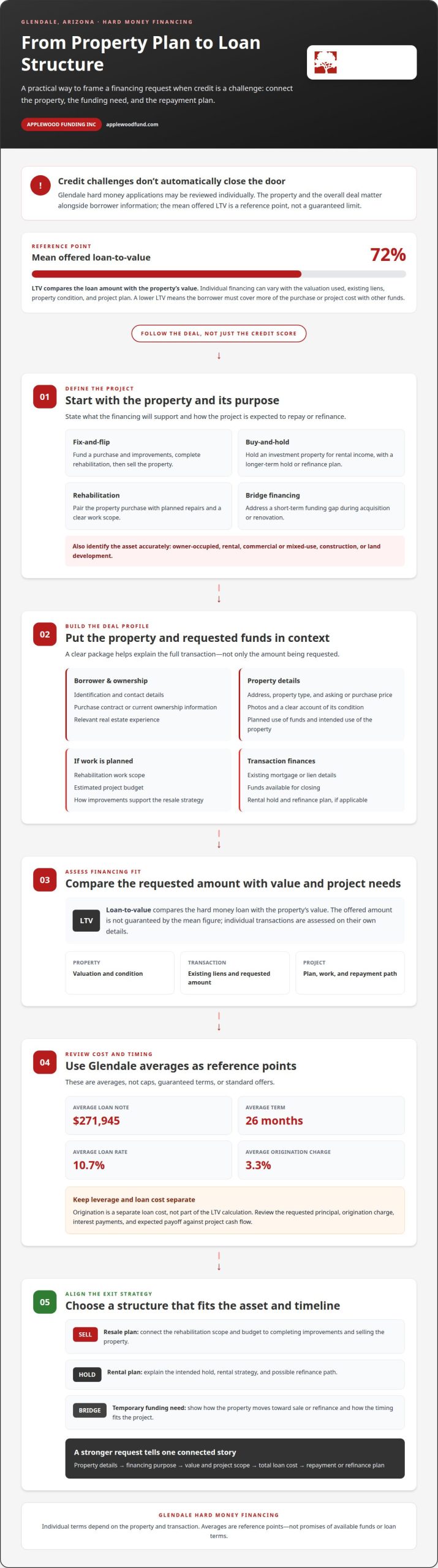
Bad credit doesn’t automatically close the door on a Glendale real estate loan. Glendale hard money lenders for bad credit may review applications individually, weighing the property and the deal rather than relying on a single standard outcome. The mean loan-to-value ratio offered in Glendale, Arizona, is 72%, but that average isn’t a guaranteed limit for every project.
If traditional financing feels out of reach, it’s natural to focus on your credit score and wonder how much you could borrow. With Glendale hard money lenders for bad credit, the key is understanding how the property, requested financing, and repayment plan fit together.
This guide explains how hard money loans work, what loan-to-value (LTV) means, and how credit challenges fit into the process. You’ll also see how the property and project shape financing options, so you can identify a practical next step in Arizona.
Key Takeaways
- Match the financing structure to your plan, whether you’re renovating for resale or holding a rental property.
- Understand how a property’s value and the requested loan amount shape its loan-to-value ratio and borrowing capacity.
- See which residential and mixed-use property types may fit private financing and what lenders consider in a deal.
- Learn how private money can support different Glendale real estate projects, including construction and land development.
- Use the lender directory to identify potential financing paths, then focus on the lender and loan type that fit your project.
Need a Glendale Hard Money Loan?
In Glendale, hard money lending can support a property purchase, renovation, or rental strategy when conventional mortgage financing doesn’t fit. The right structure depends on the property, its value, the work planned, and the repayment or refinance path.
Fix-and-Flip and Buy-and-Hold Financing
A fix-and-flip loan can help fund a Glendale purchase and improvements before resale. A buy-and-hold loan instead supports an investment property intended to generate rental income over time. For either plan, define the property, budget, work scope, and exit strategy. A resale plan centers on completing rehabilitation and selling; a rental plan centers on holding the property or refinancing later.
Rehabilitation and Bridge Loan Options
Rehabilitation financing can pair the property purchase with planned repairs, while bridge financing can cover a short-term funding gap during acquisition or renovation. For a Glendale fix-and-flip, organize the project in stages: identify needed work, estimate its scope, and connect the planned improvements to the resale strategy. This makes the lending request easier to assess than a purchase figure alone.
Example Fix-and-Flip Loan Terms
These figures describe an example, not a quote or promised result.
Compare the financing amount with the purchase, renovation plan, and expected exit before choosing a structure.
Application Documents and Property Information
To apply for a Glendale hard money loan, prepare borrower identification and contact details, plus the purchase contract or current ownership information. Include the property address, type, asking or purchase price, photos, and a clear account of its condition. For rehabilitation, add a work scope and estimated budget; for a rental, outline the hold and refinance plan.
Also organize any existing mortgage or lien details, available funds for closing, and relevant real estate experience. These items help explain the full transaction, not just the requested loan. Glendale lenders may review applications individually, so present the property, financing need, and repayment plan together. A clear package lets the lender assess the deal’s practical fit.
Loan-to-value limits
Loan-to-value, or LTV, compares a hard money loan with the property’s value. Glendale’s mean offered LTV is 72%, but individual financing depends on the property and transaction.
That calculation is not an approval or a promise of available funds. The valuation used, existing liens, property condition, and project plan can all affect the amount. A lower LTV means the borrower must cover more of the purchase or project cost with other funds.
Average Loan Size and Term
The average hard-money loan note in Glendale is $271,945, with an average term of 26 months. These averages are reference points, not caps or standard offers. A real estate investor should compare the amount needed with the property value and intended use. A shorter timeline may fit a flip or bridge loan, while a longer hold may require a different repayment or refinance plan.
The average origination charge is 3.3%. Treat it as a separate loan cost, not as part of the LTV calculation. Before accepting a money loan, map the requested principal, origination charge, interest payments, and expected payoff against the project’s cash flow. This step shows how much capital the transaction needs beyond the down payment.
Rates, Fees, and Loan Programs
Glendale’s average hard-money loan rate is 10.7%. A private money lender may assess the property, requested amount, borrower’s plan, and repayment path when structuring financing. Rate and fees affect the total cost, while LTV affects how much of the property value the loan covers. Review both together, rather than treating the largest available loan as the best fit.
Investors can evaluate hard money loans for purchases, renovations, rentals, or construction. Fix-and-flip financing prioritizes the improvement and resale plan; buy-and-hold financing centers on rental operations and a longer exit strategy. Bridge loans can address a temporary funding need while a project moves toward sale or refinance. Match the loan program to the asset and timeline.
California licensing and disclosure rules aren’t automatically the framework for a loan secured by Glendale, Arizona property. The property’s location and transaction structure determine which state requirements are relevant, so consider Arizona’s framework for an Arizona property.
To review how the requested amount fits a Glendale project, use the hard money loan contact page as a next step.
How Do Hard Money Loans Work?
A Glendale hard money loan starts with a specific property and a defined financing purpose. Applewood Funding offers owner-occupied hard money loans and financing for real estate projects in Arizona. The property and planned repayment are important parts of framing the request, alongside borrower information.
Residential and Commercial Property Types
Property type and intended use shape a financing request. For an owner-occupied home, explain how the property will be used and what the loan will finance. For a rental or development project, describe the property, planned use of funds, and repayment strategy. Applewood Funding offers owner-occupied, rental, construction, and land financing.
Classify the asset accurately before requesting financing. A mixed-use building, for example, combines residential and business functions, so describe both uses clearly. Property type helps explain the purpose of the funds and repayment plan. Connect the address, use of funds, and proposed repayment in a concise request.
Commercial, Bridge, and Construction Loans
Commercial hard money loans can support acquisitions or improvements when a property’s value and project plan drive the request. A commercial bridge loan can provide temporary financing during a transition, such as acquiring an asset before a longer-term loan or sale. Construction financing addresses a different need: funding development work on land or an existing property.
For a Glendale construction request, describe the site, intended build, project stages, and funding purpose. For a bridge loan, explain what event ends the temporary financing, such as a sale or refinance. Those details help distinguish a short-term gap from a full construction project. Land loans likewise depend on the parcel and proposed use, rather than residential features.
From Property Review to Funding
The process begins when the borrower identifies the property and requests a loan for a defined purpose. The lender reviews the application case by case, considering the asset, its condition, the requested financing, and the proposed repayment path. That review helps establish whether the request suits a residential, commercial, bridge, or construction structure.
Next, align the loan type with the project. A Glendale townhome renovation differs from financing a multi-use property or undeveloped land. The lender’s review then moves toward valuation and final terms. Before funds are released, the borrower needs to understand the loan amount, payment structure, costs, and payoff plan. A practical exit strategy matters for both a resale and a refinance.
Residential, Commercial, and Land Financing
Residential loans can fit homes and eligible multifamily properties; commercial financing serves business-use or mixed-use assets. Land financing centers on the parcel and its planned development. State the property category, intended use, project scope, and exit strategy together. That gives the lender a coherent basis for assessing the request and determining whether the proposed loan structure matches the real estate.
Private money loans for Glendale real estate projects
Private hard money financing can address a Glendale real estate project when the request is tied to a specific property and purpose. Start by defining the purchase, the asset’s current condition, and the planned repayment. A fix-and-flip investor may plan to sell after rehabilitation, while an investment property buyer may hold and rent. Explain the project clearly alongside your borrower information.
Credit, Income, and Property Review
Don’t assume “no income or credit-score requirements” means every private money lender ignores those factors. Review criteria can differ, and a lender may assess the property, requested loan, borrower information, and repayment plan together. Prepare a concise project summary: identify the Glendale address, explain how funds will be used, and show how the loan is expected to be repaid. Strong collateral alone doesn’t explain the exit.
Foreclosure and Multifamily Projects
A foreclosure purchase can involve a tight acquisition timeline, so align the financing plan with the sale process and required closing steps. For a multifamily property, describe the units, current condition, occupancy, and intended use. A loan request for a vacant building needs a different project explanation from one for an operating rental. Make the property’s role in the investment plan clear before seeking funds.
Before signing, examine the note and security documents for the maturity date, default triggers, late charges, cure provisions, and foreclosure remedies. Check whether early payoff carries a prepayment penalty, how it is calculated, and whether other charges affect the payoff. These terms shape the risk if a sale or refinance takes longer than planned.
Trust, Probate, and Estate Transactions
A trust, probate, or estate transaction can add ownership and signing questions to a Glendale purchase. Identify who holds title, who has authority to sign, and whether the property is being transferred or sold. For example, an estate selling a house may need to clarify the transaction’s status and intended use of loan proceeds. Match the financing request to the actual ownership structure.
Bridge Loans for Home Purchases
When planning a home purchase alongside a later sale or refinance, map the sequence: identify the property being purchased, the event that will repay the loan, and the funds available if that event is delayed. For an investment property, include its planned use and the intended repayment strategy. Make sure the loan structure fits the purchase and your plan to repay it.
Across these Glendale scenarios, compare the total repayment obligation, maturity date, early-payoff terms, and default provisions before committing. A private money loan should fit the property and the transaction’s real exit plan, whether the deal centers on a home purchase, multifamily asset, or estate property.
Hard money lender directory in Glendale
A useful Glendale financing search starts with the property and funding purpose, not a generic list of names. Glendale is in Arizona, so focus on financing for Arizona real estate. Then identify the project category: owner-occupied, fix-and-flip, rental, construction, land, or cash-out. Each points to a different financing need and repayment plan.
Use this project map to narrow the directory:
- Fix and flip: Match the request to the purchase, renovation scope, and resale plan.
- Rental property: Center the request on the asset, rental strategy, and intended hold.
- Owner-occupied property: Identify the occupancy plan and property details.
- Construction or land: Explain the site, development purpose, and funding stages.
- Cash-out: Describe the property equity and how proceeds support the project.
Those categories help distinguish a lender program from a loan that fits the actual deal. For example, a Glendale investor buying a property to renovate needs a clear project scope and resale exit. A buyer holding an investment property needs a plan for ongoing ownership. A land request should explain the parcel’s intended use. Private lenders review applications individually, so align the property, requested financing, and exit strategy in one concise summary.
Compare the Financing Fit
For each potential funding path, compare the same deal details: property type, purchase or current value, requested amount, project use, and repayment plan. Then review the proposed LTV, interest rate, origination charge, term, payment structure, and payoff conditions. A lower requested amount may reduce the financing gap, while a larger amount may require more equity or a stronger project rationale. Judge the full structure, not one attractive feature.
Glendale borrowers with credit challenges can organize options around collateral and project purpose without assuming that every program ignores credit or income. A well-defined asset and exit plan make the request easier to assess. Keep the directory focused on relevant programs, not broad claims about guaranteed approval. If a lender’s stated focus doesn’t match the property or intended use, that option does not belong near the top of the list.
Turn the Directory Into a Shortlist
Build a short list by grouping financing paths, then eliminate any that don’t fit the property or timeline. For a fix-and-flip, confirm the proposed structure covers the acquisition and planned work. For a rental, match the financing purpose to the hold strategy. For construction or land, make the development plan central. This process gives Glendale investors a practical way to sort capital options without confusing California markets or unrelated loan programs.
Have a Glendale property project in mind? Discuss your real estate financing needs and outline the property, project purpose, and repayment plan.
Applewood Funding Inc
Applewood Funding Inc offers hard money financing for owner-occupied homes and real estate projects in Arizona, including Glendale. If credit challenges complicate a conventional application, bring the property details, intended use, and repayment plan into the conversation. Applewood Funding states “No Credit Required.”
Options include Owner Occupied Hard Money Loans, Fix and Flip Loans, Rental Property Loans, and Construction and Land Loans. Each supports a different purpose, from purchasing a home to funding an investment or development project. Share what you plan to finance and how you expect to repay it. Contact Applewood Funding Inc to discuss your Glendale real estate financing needs.
Move From Loan Research to a Clear Plan
Your next move is to test the financing against the project’s real-world outcome. Before pursuing a Glendale property, map the purchase, planned work, carrying costs, and exit strategy in one working budget. Then consider what changes if renovation takes longer or a sale or refinance brings in less than expected. That stress test can reveal whether the loan structure leaves enough room to complete the plan.
For borrowers considering Glendale hard money lenders for bad credit, the strongest next step is a focused conversation about the property and its purpose. Applewood Funding Inc offers financing for owner-occupied properties, fix-and-flip projects, and rental investments. Bring your project goals and questions about the proposed structure into the discussion.
Contact Applewood Funding Inc to discuss your loan. A clear plan can help you approach your next real estate decision with confidence.
Frequently Asked Questions
How long does it take to close the loan?
There isn’t one closing timeline for every Glendale hard money loan. The file must move through property review, title work, document preparation, and signing. Delays can arise if ownership records need clarification, a lien payoff is pending, or required documents arrive incomplete. Applewood Funding Inc describes its process as “Quick Application – Quick Closing,” but borrowers should plan around the steps their specific transaction requires.
What if I have a bad credit score?
A bad credit score doesn’t automatically rule out asset-based financing. Glendale borrowers comparing glendale hard money lenders for bad credit can focus on how the property and repayment plan fit the loan request. Applewood Funding Inc states “No Credit Required.” That does not mean every lender uses the same criteria. For a fix-and-flip, explain how the requested funds support renovations and how the planned sale relates to repayment.
What’s the difference between private money lenders and traditional banks in Glendale?
Private money lenders generally review real estate requests individually, while traditional banks typically use established mortgage underwriting processes. For a Glendale investment property, a private lender may focus closely on the collateral, project, and repayment plan. A bank application often gives greater weight to borrower qualifications and conventional documentation. Compare each lender’s review approach and proposed loan structure, including how the terms fit your project timeline.
Which hard money lenders serve Glendale, Arizona, and work with borrowers with bad credit?
Applewood Funding Inc serves Arizona, including Glendale, and states “No Credit Required.” That makes it relevant for borrowers seeking financing despite credit challenges. Keep the property’s location clear in the loan inquiry, then describe the property, intended use, and repayment plan. Lender criteria vary, so distinguish a lender’s stated credit approach from the terms and requirements of a specific transaction.
What credit score do Glendale hard money lenders require, if any?
There isn’t one credit-score threshold that applies to every Glendale hard money lender. Applewood Funding Inc states “No Credit Required,” so a stated minimum score isn’t a prerequisite for its hard money options. Other lenders may use different review criteria. Prepare to explain the property, requested financing, and repayment plan. These details help present the transaction beyond the credit score alone.
What loan-to-value ratios and property types do Glendale hard money lenders accept?
Glendale’s mean offered loan-to-value ratio is 72%, but that figure isn’t a universal cap or an individual approval. Eligible property categories can include single-family homes, condos, townhomes, multifamily buildings, and multi-use properties. LTV compares the loan amount with the value used in the review. Property condition, existing liens, and intended use can affect how much financing fits the transaction.
What are current hard money loan rates, points, and fees in Glendale?
There isn’t one rate or points schedule for every Glendale transaction. Applewood Funding Inc states “Lowest Rates GUARANTEED” and “No Up-Front Fees – No Cost to Apply.” Those statements describe its advertised rate position and application costs. They don’t provide a universal points figure or itemize every possible transaction expense. Review the written loan terms to understand the specific structure before proceeding.
How much down payment or equity do bad-credit borrowers need for a Glendale hard money loan?
The required cash or equity depends on the loan amount, property valuation, and any existing liens. For borrowers evaluating glendale hard money lenders for bad credit, the LTV calculation can show the relationship between the loan and property value. That difference isn’t automatically the required down payment. Purchase costs, liens, and the valuation basis also affect the cash needed to complete a Glendale transaction.