

Self-employed mortgage lender Phoenix: Documents and loan options
November 10, 2026Cash Out Refinance Rates in Scottsdale, AZ: Compare Loan Costs
The interest rate on a cash-out refinance applies to the full new mortgage, not just the cash you withdraw. So when comparing cash-out refinance rates in Scottsdale, AZ, look beyond the rate to the new loan balance, term, and total borrowing cost.
It makes sense to weigh the monthly payment against the cash you could access. A lower rate may still cost more if refinancing replaces a favorable existing mortgage or increases the balance.
This guide explains how rates, equity, loan terms, and closing costs shape your options, and when a HELOC or private financing may be worth considering instead. You’ll get a practical framework for comparing the trade-offs before choosing a path.
Key Takeaways
- Estimate usable cash by accounting for the new loan, existing mortgage payoff, and closing costs, not just home equity.
- Compare the full loan cost, including the rate, term, loan-to-value ratio, and any discount points.
- Review closing costs and any program-specific fees before deciding how much cash to take out.
- Consider how property taxes, homeowners insurance, and current home value affect affordability and loan eligibility.
- Explore a cash-out hard money loan when conventional refinance options don’t fit your financing needs.
What is a Cash-Out Refinance?
A cash-out refinance replaces your current mortgage with a new, larger one. The new loan pays off the existing balance, and you receive the remaining proceeds as cash. The available amount depends on the appraised value, the loan-to-value limit, the mortgage payoff, and transaction costs. The new interest rate applies to the entire refinanced balance, not only the cash you take out.
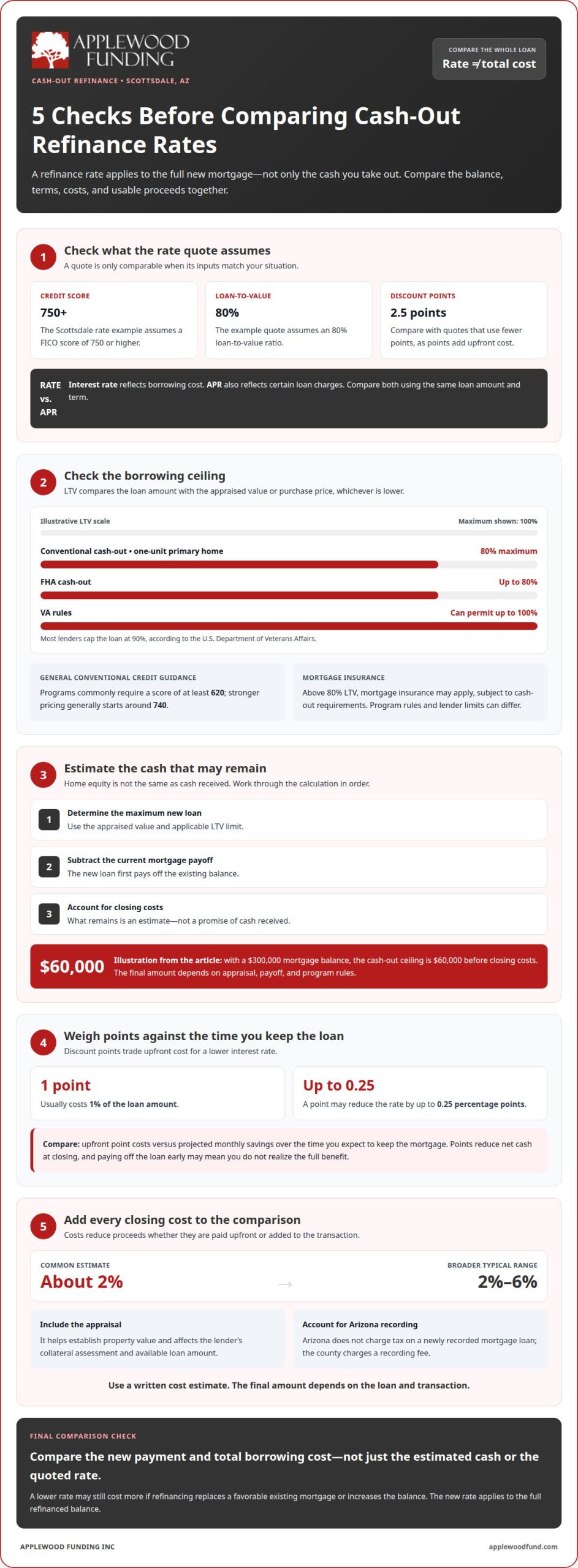
Estimate the amount in three steps: determine the maximum new loan, subtract the current mortgage payoff, then account for closing costs. That figure is a ceiling, not a promise of cash received.
The result depends on the appraisal, final payoff, loan limits, and costs. When comparing cash-out refinance rates in Scottsdale, AZ, weigh the new payment and total loan cost, not just the estimated cash.
Current mortgage rates can change the decision. A refinance applies its rate to the whole new balance, including the amount replacing your existing mortgage. If your current mortgage has a lower rate, refinancing could increase the cost of that existing debt. In November 2026, the listed Scottsdale 30-year fixed mortgage APR was 7.599% for a 30-day rate lock. Use rate quotes and loan terms to compare the complete borrowing cost.
Timing and payment history also matter. Arizona cash-out refinance programs commonly require about six to twelve months since purchase. Lenders also review mortgage payment history during lending qualification. Before estimating proceeds, identify the purchase date, current payoff, and any missed or late payments. These details help establish whether a refinance timeline and application are practical.
Mortgage interest may have tax implications depending on your circumstances and how you use the proceeds. Don’t treat a possible deduction as guaranteed savings. Consider the interest cost and monthly payment first, and don’t let a potential tax benefit determine whether the loan fits your budget.
Arizona does not charge tax on a newly recorded mortgage loan. Instead, the county charges a recording fee. Include it with other closing costs when estimating net proceeds. Cash available is what remains after the new mortgage pays off the existing balance and applicable costs, not the home’s full equity.
Rate assumptions, loan amount, loan-to-value, and discount points
A quoted rate is meaningful only when you understand its assumptions. Compare the loan amount, loan-to-value ratio, credit score, and points before assessing the monthly cost.
Rate and Loan Amount Assumptions
A Scottsdale refinance rate example assumes a FICO score of 750 or higher, an 80% loan-to-value ratio, and two and a half discount points. A listed 30-year fixed refinance quote includes an interest rate and APR, which can vary with the loan terms and assumptions. The interest rate shows borrowing cost; APR also reflects certain loan charges. Compare both figures using the same term and loan amount.
The loan amount affects both the monthly payment and total interest. Estimate the proposed balance using the home’s appraised value and applicable loan-to-value limit, then subtract the existing mortgage payoff and closing costs to estimate net proceeds. A quote based on different credit, equity, or points assumptions may not reflect your actual terms.
General Eligibility and Loan-to-Value Limits
Loan-to-value, or LTV, compares the loan amount with the home’s appraised value or purchase price, whichever is lower. For a conventional cash-out refinance on a one-unit primary home, the general maximum is 80% LTV. That limit means the home’s equity sets a ceiling on borrowing, even when income or credit supports a larger payment.
Conventional cash-out programs commonly require a credit score of at least 620, while stronger pricing generally starts around 740. FHA cash-out refinances allow up to 80% LTV, and VA rules can permit borrowing up to 100% of a home’s value, though most lenders cap the loan at 90%, according to the U.S. Department of Veterans Affairs. Program rules and lender limits can differ. Above 80% LTV, mortgage insurance may apply, subject to cash-out requirements.
With a $300,000 mortgage balance, the cash-out ceiling is $60,000 before closing costs. The final amount depends on the appraisal, payoff, and program rules.
Discount Points
Discount points are upfront charges used to reduce an interest rate. One point usually costs 1% of the loan amount and may reduce the rate by up to 0.25 percentage points. The Scottsdale rate assumptions include two and a half points, so compare that quote with options carrying fewer points.
To assess the trade-off, compare the upfront cost of points with projected monthly savings over the time you expect to keep the mortgage. Points increase the amount due at closing and reduce net cash from a refinance. If you pay off the loan early, you may not realize the full benefit of a lower rate.
Arizona homeowners weighing property-secured financing can discuss an owner-occupied hard money loan with Applewood Funding as another path when conventional assumptions do not fit.
Cash-out refinance closing costs
Closing costs reduce the cash you receive, whether they’re added to the transaction or paid upfront. Compare the estimated total with your loan amount and intended use, such as education, renovation, or other improvements.
Closing Costs and Appraisal
Refinance closing costs are commonly estimated at about 2% of the new loan amount, with a broader typical range of 2% to 6%. The appraisal helps establish the property’s value, which affects the lender’s collateral assessment and available loan amount. Include appraisal charges in the written cost estimate, alongside other transaction charges. A higher appraisal doesn’t remove fees, but it can affect the equity calculation.
These figures illustrate how the percentage range changes the amount, not a quote for a specific refinance. The final estimate depends on the loan and transaction. Subtract expected costs from the projected cash-out amount to see what may remain for tuition, renovation work, or other planned expenses.
Costs also affect the loan’s effective size. Adding eligible closing costs to the balance increases the amount secured by the home; paying them at closing reduces the cash available immediately. Review an itemized estimate to see which charges are paid upfront and which are included in the loan. That distinction makes comparisons clearer.
Lender Offers and Upfront Costs
Compare offers by reviewing the interest rate, APR, points, loan amount, and total costs together. A lower advertised rate may involve more points or other upfront charges. Check whether costs are paid at closing or financed, since this changes both net proceeds and the balance used to calculate future payments.
A VA cash-out refinance funding fee is 3.3% after first use, according to the U.S. Department of Veterans Affairs. Include that fee when estimating proceeds and compare it with other costs in the loan estimate. The fee is separate from general closing-cost estimates, so avoid treating a broad percentage as an all-inclusive figure for every loan program.
For each offer, note the new loan amount, cash received after costs, monthly payment, and total upfront charges. Then match the proceeds to a specific goal. Education expenses may follow a schedule, while renovation work can involve staged spending. Borrowing more than you need increases the secured balance and the interest paid over time.
Before closing, compare the latest payoff amount with the lender’s final figures. The payoff may differ from the balance on a recent statement because interest accrues between payments and closing. Confirm how the estimate accounts for the payoff, appraisal, and any financed charges. This review connects the offer to the cash expected at settlement.
Cash-out refinance hard money loans
A cash-out hard money loan offers another route when a conventional refinance doesn’t fit. It is private financing secured by real estate. Depending on the transaction, it can replace existing debt or provide funds against property equity. The key question is whether the property and repayment plan support the financing.
Start with the property, not a rate estimate. The lender may assess its value, condition, existing liens, intended use, and available equity. Credit and income may also matter, but private financing can place more weight on the property and transaction than a conventional mortgage process. This may be relevant when conventional qualification or documentation is a barrier.
Consider a Scottsdale homeowner whose conventional 80% loan-to-value limit does not provide enough proceeds for a planned project. A hard money option may be worth evaluating, but the property’s equity alone does not determine approval or affordability. Review the proposed loan amount, lien payoff, costs, payment structure, and repayment source together. The result should fit the borrower’s cash-flow plan, not just the immediate funding need.
Compare the full obligation by entering the proposed loan amount, interest rate, payment schedule, and expected payoff timing into a calculator. Then weigh the result against the project’s cash needs and income. For a renovation, map expected spending and project milestones against payment obligations. Avoid relying on a projected sale or refinance as the only repayment plan.
Before comparing private financing with a standard mortgage refinance, identify whether proceeds will pay off the current mortgage, whether any liens will remain, and how the new debt is secured. Review how the interest rate, fees, payment schedule, and payoff terms affect total borrowing cost. Compare written proposals using the same requested amount and purpose.
Hard money financing is not automatically the best choice for every homeowner. A borrower with strong conventional eligibility and a suitable mortgage rate may prefer a traditional refinance or another equity option. Private financing may fit better when conventional lending criteria, documentation, or timing conflict with a property-backed funding need. The clear takeaway: evaluate the repayment path and total cost before choosing this route.
How do Arizona property taxes, homeowners insurance, and local home values affect cash-out refinance eligibility?
Arizona property taxes and homeowners insurance affect the monthly housing expense considered in a loan review. Local home values influence the equity calculation through the appraisal. These factors help shape affordability and potential borrowing capacity, but they affect different parts of the application.
An Arizona property tax estimate used in November 2026 is 0.49% of home value per year. This example illustrates how taxes can add to the payment burden alongside principal, interest, and insurance. A higher monthly housing expense can leave less room in a borrower’s budget for mortgage payments.
Add the annual insurance premium to property taxes when reviewing housing costs. For a Scottsdale property, the actual premium and tax bill depend on the home and its circumstances. Use current bills or estimates rather than relying only on statewide averages.
Home value affects the potential loan through the appraisal and the program’s loan-to-value limit. Arizona home prices rose 27.5% over the five years through the second quarter of 2026, but rose 0.6% over the year preceding that quarter. These statewide figures offer context, not a substitute for a current appraisal of a specific Scottsdale property.
Price growth alone added an estimated $107,400 in equity to an Arizona home valued at $498,700 over five years through the second quarter of 2026. That estimate shows how market appreciation can build equity, but it doesn’t establish the value of a particular home. The appraised value, current mortgage payoff, other liens, and applicable loan limit determine how much equity may support refinancing.
Keep the calculations separate. First, estimate the loan amount allowed by the appraised value and program limit. Then assess whether the projected payment, property taxes, and insurance fit your finances. A home may have substantial equity while recurring housing costs still affect affordability. Manageable monthly expenses don’t create additional equity if the appraisal is lower than expected.
For a practical review, gather the latest property tax bill, insurance premium, mortgage statement, and property details used for valuation. Compare them with the proposed payment and cash proceeds. This helps show whether property value, housing expenses, or existing debt is the main constraint. An owner-occupied home and a rental property may have different financing needs.
If property equity and housing costs are shaping your decision, discuss property-backed financing options for your situation.
Applewood Funding: Cash Out Hard Money Loans
Applewood Funding Inc. offers Cash Out Hard Money Loans for property owners seeking equity-based funding when a conventional refinance doesn’t fit. The right option depends on the property, existing debt, and financing goal.
For an owner-occupied property, an Owner Occupied Hard Money Loan may suit a financing need tied to the home. Fix and Flip Loans and Rental Property Loans serve different property plans. Consider the loan purpose and repayment approach alongside the property’s value and current obligations.
Compare the proposed financing with the costs and monthly obligations of refinancing before deciding. If you’d like to discuss your property financing needs, contact Applewood Funding Inc..
Make Your Next Financing Decision With Clarity
Before choosing a loan, write down what the funds will accomplish, how the new payment fits your budget, and what repayment path supports the plan. This gives you a practical way to assess cash-out refinance rates in Scottsdale, AZ alongside alternatives, rather than letting a headline rate decide for you.
Applewood Funding offers property-backed financing options for homeowners and real estate investors. The right conversation starts with your property, financing goal, and current obligations. Share those details to explore whether a cash-out hard money loan aligns with your next move. If another financing path fits better, that distinction matters too.
Contact Applewood Funding about your options and take the next step with a clearer plan.
Frequently Asked Questions
How much cash could you take out in Arizona?
Available cash is the new loan amount minus existing mortgage payoffs and transaction costs. That is an illustrative limit, not a guaranteed payout. The appraisal, loan program, liens, and closing costs all affect what remains for the homeowner.
How Do I Determine the Home Equity Amount?
Subtract the total debt secured by the property from its current market value. Include the mortgage payoff and any other property liens to estimate equity. Equity isn’t the same as available cash, because program limits and transaction costs affect proceeds.
How can I avoid paying so much more in total interest?
Borrow only what you need, then compare the full repayment schedule rather than focusing only on the monthly payment. Extending repayment over a longer term can increase total interest, even if the payment falls. Compare the proposed term with the time remaining on your current mortgage. Review points and upfront costs too, since a lower rate may require more cash at closing.
If I refinance, what will my new monthly payment be?
Your payment depends on the new loan amount, interest rate, and term. This example excludes property taxes and homeowners insurance, which add to housing costs. Use the final loan amount and proposed terms to compare payments, not just the cash you expect to receive.
What are current cash-out refinance rates in Scottsdale, AZ?
The listed Scottsdale 30-year fixed mortgage APR was 7.599% on November 10, 2026. It reflects a 30-day rate lock and stated assumptions, so it’s a market reference rather than a guaranteed cash-out refinance offer. Cash-out pricing also reflects factors such as credit profile, equity, loan amount, and points. Compare the APR and upfront costs with the interest rate to understand the overall offer.
How do cash-out refinance rates compare with standard refinance and HELOC rates in Scottsdale?
A cash-out refinance replaces the current mortgage, applying the new rate to the full refinanced balance. A HELOC leaves the first mortgage in place and provides a separate credit line, often with a variable rate. A typical HELOC rate range was 7.00% to 9.00% in November 2026. Compare rates alongside payment structure, costs, and how much debt each option puts on the property.
Which Scottsdale, AZ lenders offer cash-out refinancing, and what rates and fees do they charge?
Applewood Funding offers Cash Out Hard Money Loans for property-backed financing. This example doesn’t establish terms for a Scottsdale property. The loan structure, property, and transaction determine the relevant financing details. Applewood Funding also offers Owner Occupied Hard Money Loans, Fix and Flip Loans, and Rental Property Loans.
What credit score, income, and debt-to-income requirements apply to cash-out refinancing in Arizona?
Requirements depend on the loan program and its underwriting criteria. Conventional and government-backed options assess credit, income, existing debts, and the proposed housing payment together. Debt-to-income review compares monthly debt obligations with qualifying income, while documentation supports the income calculation. Applewood Funding’s private hard money lending states “No Credit Required.” This option differs from conventional refinance qualification standards.