

How to Refinance Hard Money Debt Into a DSCR Loan in Arizona
November 9, 2026Self-employed mortgage lender Phoenix: Documents and loan options

A self-employed mortgage lender in Phoenix may ask for personal and business tax returns, bank statements, and financial records. Arizona bank statement mortgage programs typically review 12-24 months of statements. The right option depends on how your income is documented and the property you plan to finance.
It’s understandable to worry that business deductions or uneven deposits could affect qualifying income. A self-employed mortgage lender in Phoenix may assess income through tax returns or account deposits, depending on the loan program. The IRS identifies Form 1040 as the U.S. personal income tax return, with Schedule C used by sole proprietors to report business profit or loss.
This guide explains which documents lenders may request, how self-employment income can affect eligibility, and what mortgage options are available in Arizona. If you’re looking for a self-employed mortgage lender in Phoenix, compare conventional and government-backed loans with bank statement and other alternative options to find a documentation path that suits your circumstances.
Key Takeaways
- Prepare for lenders to review personal and business records, with the exact documents depending on your business structure and loan type.
- Understand why tax-return income and bank-deposit income can lead to different assessments of your borrowing capacity.
- See how credit, self-employment history, cash reserves, and documented income can shape mortgage eligibility.
- Explore Arizona mortgage paths, including conventional, government-backed, and bank statement options.
- Learn when a bank statement loan may be worth considering if tax returns don’t reflect your cash flow clearly.
What employment documentation is needed?
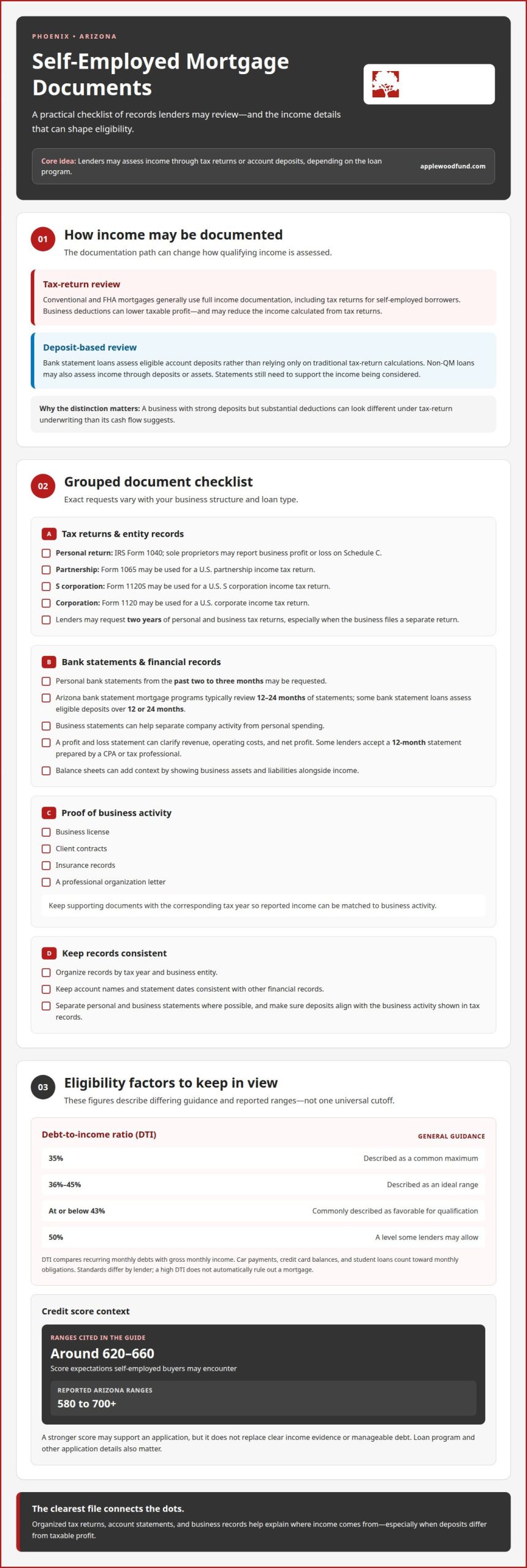
Self-employed applicants need records showing how their work generates income and how consistently it continues. A lender may review personal and business tax returns, bank statements, profit and loss statements, and proof that the business operates. The right documents depend partly on your business structure. Sole proprietors, partnerships, S corporations, and corporations report business income differently, so organize records by tax year and entity.
Match the tax documents to the entity. According to the Internal Revenue Service, U.S. partnerships can use Form 1065 to file a partnership income tax return. U.S. S corporations can use Form 1120S to file an income tax return, and U.S. corporations can use Form 1120 to file a corporate income tax return, also according to the Internal Revenue Service. If your business files a separate return, lenders may request business returns alongside your personal returns.
Income is only part of the review. Lenders also compare recurring monthly debts with gross monthly income to calculate your debt-to-income ratio, or DTI. General guidance describes 35% as a common maximum, 36% to 45% as an ideal range, and 50% as a level some lenders may allow. These figures reflect differing lender standards, not one universal cutoff. A DTI at or below 43% is also commonly described as favorable for qualification.
A high DTI doesn’t automatically rule out a mortgage, but it can leave less room for a new payment. Car payments, credit card balances, and student loans all count toward monthly obligations. Review which debts are included in the calculation and how they compare with documented income. Lower balances or clearer income records can strengthen the overall picture, though the loan program and other application details also matter.
Credit and income records work together. Self-employed buyers may encounter credit score expectations around 620 to 660, while reported Arizona ranges span 580 to 700+. A stronger score may support an application, but it doesn’t replace clear income evidence or manageable debt. Keep personal and business statements easy to distinguish, and make sure deposits align with the business activity shown in tax records.
Business deductions can lower taxable profit, which may reduce the income a lender calculates from tax returns. A business with strong deposits but substantial deductions can therefore look different under tax-return underwriting than its cash flow suggests. A bank statement loan may assess eligible deposits over 12 or 24 months instead. A business license can help document business activity, while organized statements and financial records help explain where income comes from.
Income and business documentation lenders may require
Mortgage documents link reported income to business activity and personal finances. Phoenix lenders may review tax returns, financial statements, or account deposits, depending on the loan program.
Income and Business Financial Records
Income and business records show how your company earns money and manages expenses. Lenders use them to assess whether documented income supports a mortgage payment. Personal bank statements from the past two to three months may be requested, while business statements help separate company activity from personal spending. A profit and loss statement can clarify revenue, operating costs, and net profit over a selected period.
Some lenders accept a 12-month profit and loss statement prepared by a CPA or tax professional. Balance sheets can add context by showing business assets and liabilities alongside income. Keep the statement dates and account names consistent with your other records. Clear financial documentation helps explain deposits that differ from the profit shown on a tax return.
Tax and Business Documentation
Tax and business documentation ties your reported earnings to the legal structure and activity of your business. According to the Internal Revenue Service, U.S. personal income tax returns are filed using IRS Form 1040, which includes schedules used to report income. Sole proprietors can report business profit or loss on Schedule C of Form 1040, according to the Internal Revenue Service.
Lenders may request two years of personal and business tax returns, particularly when an entity files a separate business return. They may also request business licenses, client contracts, insurance records, or a professional organization letter to verify self-employment. Keep supporting documents with the corresponding tax year so reported income can be matched to business activity.
Bank Statement and Alternative Loans
A bank statement loan assesses eligible account deposits rather than relying only on traditional tax-return calculations. Phoenix applicants can compare this approach with conventional and FHA mortgages, which generally use full income documentation, including tax returns for self-employed borrowers. Non-QM loans may also assess income through deposits or assets instead of traditional tax returns.
The main difference is how each program documents income. Tax-return underwriting may show lower qualifying income when business deductions reduce taxable profit. Deposit-based review offers another way to assess cash flow, but statements still need to support the income being considered. Choose a documentation path that accurately reflects your records and fits the property and loan purpose.
Preparing Finances and Documents
Prepare records that give a consistent picture of income, expenses, and ownership. Separate business and personal accounts where possible, then gather tax returns, bank statements, profit and loss statements, and balance sheets. Include a business license or client contracts if they help demonstrate ongoing activity. Make sure the records identify the relevant accounts and business entity.
Before applying, review recurring debts and upcoming payments against the income shown in your documents. Resolve unexplained gaps between deposits and reported revenue by organizing the records that explain them. For an application where tax returns don’t reflect cash flow clearly, discuss a bank statement loan with Applewood Funding.
Mortgage application challenges for self-employed workers
Self-employed borrowers often face a documentation challenge: business cash flow and qualifying income are not always the same. Tax deductions can reduce reported profit, while seasonal work can make deposits vary from month to month. Lenders review application records together, looking for a consistent explanation of income, expenses, and ongoing business activity.
Start by separating business and personal finances. When client payments, household purchases, and company expenses share one account, it can be harder to identify business income. Organize statements by account and tax year, and match major deposits to invoices or client contracts. A CPA can help present records clearly, especially when business income varies between tax periods.
Credit is another pressure point. Credit utilization under 30% of total revolving balances is a useful target described in the available guidance. For example, paying down a card balance before applying can reduce utilization, though the full application still includes income, debts, and other factors. Avoid taking on new recurring payments without considering how they may affect the mortgage budget.
Build a cash reserve that can support mortgage payments if business income drops. Lenders may look for reserves covering 6 to 12 months of payments, particularly when income fluctuates. A separate savings or investment account makes those funds easier to identify. A down payment also matters: guidance advises self-employed applicants to aim to save at least 20%, while the amount required depends on the loan option.
The application process is easier to manage when records are ready before submission. Organize documents by purpose, then respond to underwriting requests with records that directly answer each question. If a deposit looks unusual, provide its supporting invoice or contract. If expenses changed, show the relevant business records rather than relying on a verbal explanation. This helps the lender build a clearer financial picture.
- Before applying: separate business and personal accounts, and organize statements with matching invoices or contracts.
- Review credit: check revolving balances and work toward keeping utilization under 30%.
- Plan reserves: set aside funds that can cover 6 to 12 months of mortgage payments.
- Explain changes: pair unusual deposits or expense shifts with records that show their source.
Independent workers with a shorter business history may have fewer conventional documentation paths. Arizona applicants typically need 1-2 years of self-employment work history, while alternative mortgage programs may assess income differently. The strongest preparation is a consistent record set: business activity, personal finances, and the income method all tell the same story.
Self-employed mortgage eligibility
Mortgage eligibility in Phoenix depends on documented income, work history, credit, debts, available funds, and property use. Lenders assess independent contractors and business owners by reviewing how long their work has continued and whether the financial records support the income used to qualify.
For a Phoenix mortgage, self-employed borrowers typically need 1-2 years of self-employment work history. Lenders often look for a two-year history in the same line of work, while an established business and consistent earnings can strengthen the application. A borrower with less than 2 years of self-employment may qualify using tax returns rather than bank statements.
Ownership matters, too. Mortgage lenders generally consider a borrower self-employed when they own at least 25% of a business. That includes some LLC owners, but forming an LLC alone doesn’t establish qualifying income. Lenders still assess the borrower’s share of income, business financials, personal debts, and verification records. Keep ownership information consistent across tax filings and business documents.
Work history can include related employment. Freddie Mac loan guidance says borrowers with 2 years of experience in the same field may qualify using their full self-employment income. Fannie Mae borrowers may combine W-2 and self-employment income when they show a 12-month history of receiving both at the same time. For example, a contractor who moved from employee work into independent work in the same trade can document both income sources.
Credit and reserves affect the wider eligibility picture. A minimum FICO score of 660 is a useful target for self-employed applicants, and lenders may look for cash reserves covering 6 to 12 months of mortgage payments. These factors sit alongside income verification, monthly debts, and the down payment. Eligible borrowers may also qualify for FHA or VA programs when they meet those programs’ requirements.
LLC and Property Eligibility
For an LLC borrower, eligibility depends on ownership, income documentation, and the loan’s intended use. A lender evaluates whether the applicant’s personal income supports the proposed payment, even if business records show substantial company revenue. Keep personal and business statements distinct, and make the LLC’s ownership and financial activity clear.
Property use helps determine the right financing path. A primary residence and a rental property are different cases, so identify the intended use early. Owner-occupied financing is for a home the borrower will live in; rental-property financing is for an investment property. Property condition and project purpose also matter, particularly when the plan involves renovation or construction instead of a standard purchase.
Before applying, organize your work-history timeline, ownership records, income documents, credit profile, reserves, and property purpose. This gives the lender a consistent basis for assessing the application and identifying a financing structure that fits the borrower and property.
Arizona self-employed mortgage options
Arizona business owners can consider traditional, government-backed, and alternative mortgage loans. A self-employed mortgage lender in Phoenix can help match income documentation and property purpose with an appropriate loan path.
Available Mortgage Options
Arizona’s options include conventional, FHA, VA, USDA, bank statement, and other Non-QM mortgages. Down payment requirements vary by loan type and borrower, so comparing programs can help identify a suitable option. Comparing documentation rules, down payment, and interest helps owners identify a practical home loan for their situation.
Arizona’s HOME Plus program offers eligible borrowers a forgivable second mortgage of roughly 4 to 5 percent of the loan amount. Self-employed status alone doesn’t establish eligibility; income and other program requirements still matter.
Lenders Serving Self-Employed Borrowers
Banks, credit unions, mortgage lenders, and alternative lenders in Phoenix offer loans to self-employed borrowers. Programs differ in how they verify income: conventional and FHA lenders generally rely on full documentation, while bank statement and Non-QM programs can assess deposits or assets. A self-employed mortgage lender in Phoenix can help business owners identify an income documentation method that fits their records and property plans.
Compare the loan structure, not just the lender category. An owner whose tax deductions reduce reported income may need a different documentation path than one with stable taxable earnings. Bank statement programs typically assess deposits over a 12-24-month period, making the income method a key factor in choosing a mortgage loan.
Self-Employed Loan Programs
Bank statement loans use account deposits to assess income, while conventional and FHA loans typically use tax returns and other standard documentation. Non-QM loans can use alternative income assessments, and Arizona programs typically require 10%-25% down, with interest potentially higher than traditional loans. These options may suit borrowers whose returns don’t clearly show cash flow.
VA loans may offer eligible borrowers no-down-payment financing and no monthly mortgage insurance. USDA loans are designed for low- to moderate-income buyers seeking rural or suburban homes. For investment property, Arizona DSCR loans typically require a 20%-25% down payment. Match the program to the property’s intended use.
To discuss which mortgage structure fits your income records and property plans, explore your Phoenix mortgage options.
Applewood Funding: Bank Statement Loans for Self-Employed
Applewood Funding Inc offers Bank Statement Loans for Self-Employed borrowers whose tax returns don’t clearly reflect business cash flow. These loans assess account deposits over a 12- or 24-month period, providing an alternative income documentation path for eligible applicants. They may suit independent business owners with substantial deductions or variable reported profit.
Property purpose matters, too. Owner Occupied Hard Money Loans are for borrowers financing a home they’ll live in. Rental Property Loans and Fix and Flip Loans are for investment property plans. Choose the option that matches both your income documentation and the property’s intended use.
Have questions about which option fits your situation? Contact Applewood Funding Inc to discuss your financing needs as a self-employed mortgage lender phoenix seeker.
Choose a financing path that fits your next move
Next, match the loan structure to the property and the way your income is documented. A self-employed mortgage lender in Phoenix can help you consider whether a bank statement loan or another financing route suits your circumstances. Be ready to explain what you’re buying, how you plan to use it, and how your business generates income.
Applewood Funding offers options for different property goals: Owner Occupied Hard Money Loans for a home you’ll occupy, Fix and Flip Loans for renovation projects, and Rental Property Loans for investment properties. Start with the option that matches your actual plan, not just a familiar-sounding loan name.
Take the next step with a clear picture of your financing goal and income documentation. Connect with Applewood Funding to discuss a path that fits. A focused conversation can help you move forward with greater clarity.
Frequently Asked Questions
What documents do you need to provide?
Prepare personal income records, business financials, and documents that explain your work. A Phoenix applicant might organize statements by account and pair business deposits with invoices or client contracts. Include a profit and loss statement or balance sheet if available, along with relevant business licenses or insurance records. Grouping files by tax year and business entity makes it easier to connect income, expenses, and ownership.
What tax return requirements are needed?
Self-employed mortgage applicants commonly provide two years of personal tax returns, with business returns when the company files separately. The Internal Revenue Service identifies Form 1040 as the U.S. personal income tax return, including schedules for reporting income. For example, a partnership return and an owner’s personal return document different parts of the financial picture. Include every schedule filed with the personal return, not just its first page.
What tips can help me prepare to get a loan?
Make your financial records easy to follow before applying. Separate personal and business transactions, organize documents by tax year, and explain unusual deposits or major expense changes. Avoid opening new credit accounts or taking on recurring payments while preparing your application. If a CPA maintains your books, ask them to keep current financial statements consistent with the returns and bank records you’ll submit.
How do lenders calculate qualifying income for self-employed borrowers?
Lenders calculate qualifying income by reviewing documented earnings, business expenses, and the income method allowed by the loan program. Tax-return underwriting can show less income when deductions reduce taxable profit. A bank statement program may instead assess eligible deposits over the review period. For example, a contractor with fluctuating client payments needs records that distinguish business revenue from transfers, loans, or personal deposits.
What credit score, down payment, and debt-to-income requirements apply to self-employed mortgages in Phoenix?
Phoenix self-employed applicants commonly see credit expectations ranging from 580 to 700+, while reported debt-to-income guidance includes a favorable level of 43% and some programs allowing up to 50%. Down payment expectations depend on the program: conventional or FHA options commonly range from 3.5%-20%, while bank statement programs typically use 10%-20%. Compare the full requirements, not one threshold alone.
What risks or reasons for denial should self-employed Phoenix homebuyers know about?
An application can be weakened by declining income across tax records, unexplained deposits, rising monthly debts, or inconsistencies between business and personal records. A short self-employment history can also limit available loan paths. Property use matters: a primary home and a rental investment may require different financing. Before submitting, resolve discrepancies between statements and returns, and document ownership and intended property use consistently.