

Phoenix Ground Up Construction Financing Costs and Terms
October 29, 2026Emergency Cash-Out Refinance in Scottsdale: How to Access Equity

Your home equity can help meet an urgent cash need, but an emergency cash-out refinance in Scottsdale means replacing your existing mortgage, not simply withdrawing savings. The new loan pays off the current mortgage, and you receive the approved amount left over as cash after closing costs. Lenders generally allow borrowing up to 80% of a home’s value, leaving at least 20% equity.
It’s understandable to focus on how much money you could access. But a new loan also changes your mortgage balance, payment, and total interest costs, so weigh the immediate need against the longer-term impact.
This guide explains how cash-out refinancing works, what to expect during application and closing, and how homeowners may use proceeds, including to build an emergency fund. You’ll also see how it compares with other ways to access home equity and what can shape eligibility. Start with the essentials, then decide whether this option fits your situation.
Key Takeaways
- Compare a cash-out refinance with other ways to access home equity, focusing on how each affects your mortgage and available cash.
- Estimate usable equity by considering your home’s value, mortgage balance, closing costs, and the equity you’ll retain.
- Prepare income, mortgage, insurance, and identification documents to help move the application process forward.
- Match the proceeds to a clear purpose, such as consolidating debt, funding home improvements, or building an emergency reserve.
- Review your credit, debt, income, and payment history to understand the factors that shape eligibility.
What Is a Cash-Out Refinance?
Scottsdale mortgage lenders and brokers that offer cash-out refinancing can provide access to home equity; compare their stated closing timelines before choosing. An emergency cash-out refinance in Scottsdale replaces your current mortgage with a larger loan and pays you the remaining approved funds after the old balance and closing costs.
Benefits and Risks of Home Equity Borrowing
Borrowing against home equity can provide funds for debt repayment, a major purchase, or home improvements without selling your Scottsdale home. For example, proceeds could help consolidate balances or repair essential systems. The trade-off is that the home secures the debt, and refinancing may increase the total interest paid over the mortgage’s life. Compare the immediate need with the added obligation and long-term cost.
Turning Home Equity Into Cash
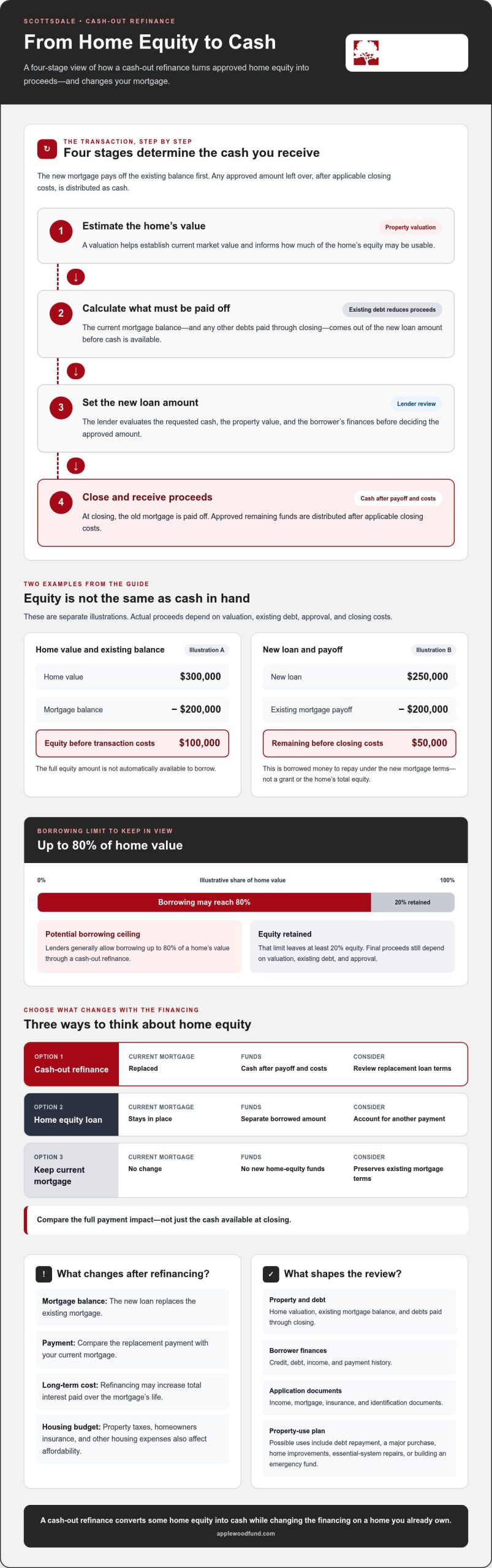
Consider a home valued at $300,000 with a $200,000 mortgage balance. The homeowner has $100,000 in equity before transaction costs, but that doesn’t mean the full amount is available to borrow. The lender evaluates the property and application, then approves a new mortgage amount. After the old loan is paid off, the remaining approved funds, less closing costs, become cash for the homeowner.
Cash-Out Refinancing and Home Equity Loans
A cash-out refinance replaces your existing mortgage; a home equity loan typically adds separate debt while leaving the first mortgage in place. That distinction matters if you want to retain your current mortgage terms. Compare the new loan’s payment with the added payment from a second loan. For an emergency cash-out refinance in Scottsdale, consider whether replacing the mortgage fits better than taking on another obligation.
| Option | Effect on current mortgage | How funds are accessed | Key consideration |
|---|---|---|---|
| Cash-out refinance | Replaces it | Cash after payoff and costs | Review replacement loan terms |
| Home equity loan | Leaves it in place | Separate borrowed amount | Account for another payment |
| Keep current mortgage | No change | No new home-equity funds | Preserves existing mortgage terms |
Compare the full payment impact, not just the cash available at closing.
Available Home Equity to Borrow
Lenders generally allow borrowing up to 80% of a home’s value through a cash-out refinance, leaving at least 20% equity. The final amount depends on valuation, existing debt, and approval. Keep the retained equity and your intended cash need in view as you compare terms.
Cash-out refinance lenders set limits on withdrawals and the equity you must retain. The refinance converts some home equity into cash while changing the financing on a home you own. You don’t need to buy a property or negotiate a purchase contract.
Cash-out refinance definition and how it works
A cash-out refinance replaces an existing mortgage with a new, larger mortgage secured by the same home. The new loan first pays off the old balance; the remaining approved amount goes to the homeowner as cash, less closing costs. Unlike a home purchase, this changes financing on a property you already own.
For example, a new $250,000 loan could pay off a $200,000 mortgage and leave $50,000 before closing costs. That $50,000 is not the home’s full equity or a separate grant. It is borrowed money, and repayment is required under the new mortgage terms. The lender assesses the property and borrower before deciding the loan amount.
Think through the transaction in four steps. Each one affects the amount available and the mortgage that remains afterward:
- Estimate value. A property valuation helps establish the home’s current market value.
- Calculate the payoff. The existing mortgage balance and any other debts paid through closing reduce the new loan proceeds.
- Set the new loan amount. The lender evaluates the requested cash, property value, and borrower’s finances.
- Close and receive proceeds. The old mortgage is paid off, and approved remaining funds are distributed after applicable closing costs.
Compare the replacement loan’s payment with your current mortgage before moving forward. One example assumes an existing first mortgage balance of $300,000 at 3.25% interest, with $75,000 in cash requested. This illustrates how accessing cash can also replace a lower-rate mortgage with a larger loan at a different rate.
Principal and interest are only part of the household budget. Property taxes, homeowners insurance, and other housing expenses also affect monthly affordability. The new mortgage changes the total interest paid over time. Compare the cash you need with the replacement payment and longer-term cost, not just the amount deposited at closing.
For a Scottsdale homeowner, the practical decision is whether the refinance solves a specific need strongly enough to justify changing the existing mortgage. List the planned use, estimate the funds needed, then compare loan terms and proceeds. To discuss financing options for your situation, review mortgage options with a lending specialist.
Refinance application and closing process
A cash-out refinance involves document review, property valuation, underwriting, and closing. In Arizona, the timeline and final terms depend on completing these steps and meeting the lender’s requirements.
Application and Closing Steps
The application starts with a requested loan amount and details about the Scottsdale home, existing mortgage, income, and debts. The lender reviews the application, assesses the property, and evaluates whether the new loan can support the requested cash. After approval, closing documents finalize the replacement mortgage and direct payoff of the existing loan.
- Submit the application. Provide borrower, property, mortgage, and loan-request information.
- Gather documents. Prepare recent income records, mortgage statements, identification, insurance details, and applicable tax returns.
- Complete review and valuation. The lender checks finances and property value before determining terms.
- Review and close. Read the final loan documents, sign them, and complete the mortgage payoff and funds disbursement.
Cash-out refinance closings typically take four to six weeks. Arizona closing costs typically range from 2% to 5% of the loan amount. Cash proceeds aren’t taxable income; IRS rules generally allow interest deductions only when proceeds buy, build, or substantially improve the home securing the loan. Arizona’s anti-deficiency protections apply to qualifying single-family homes or duplexes on 2.5 acres or less under A.R.S. § 33-814.
Cash-Out Refinance Eligibility
Eligibility combines ownership, payment history, property value, and borrower finances. General requirements include owning the home for at least 12 months and having no late mortgage payments during the preceding 12 months. Lenders also assess whether the home’s value supports the new loan and whether the borrower can manage its payments. These criteria differ from the application steps because they determine approval, not document completion.
Credit, Income, and Debt-to-Income Requirements
General cash-out refinance guidance lists a minimum credit score of 620, while standard qualification for cash-out refinances generally requires 680. A score of 700 or higher may help borrowers qualify for better interest rates. General guidance also lists a maximum debt-to-income ratio of 43% and at least 2 years of consistent employment.
Prepare records that clearly show your income and existing obligations. Recent income documents, mortgage statements, employment information, identification, and homeowners insurance details support the review. Tax returns may also be needed when applicable. Organize these records before applying, then compare the proposed payment with your monthly budget and existing debts.
Uses for cash-out refinance proceeds
An emergency cash-out refinance in Scottsdale can turn approved home equity into funds for a defined financial need. Before applying, write down the purpose, the amount required, and the expense it will address. For an unexpected repair, for example, identify the necessary work and estimate its cost before deciding how much cash to request.
Build an emergency fund. Setting aside proceeds can create a reserve for unexpected expenses, such as a home repair or temporary income disruption. Decide which costs the reserve should cover and keep the money separate from everyday spending. An emergency cash-out refinance in Scottsdale may provide access to funds for this purpose, but the reserve is still borrowed money tied to mortgage debt.
Repay debt. Proceeds may help pay down existing balances. First, list each debt’s balance, required payment, and interest terms. Then identify which obligations the planned payoff would address. Consolidation may simplify repayment, but it shifts borrowing onto a mortgage secured by your home. Compare the new mortgage obligation with the payments being replaced, rather than focusing only on having fewer bills.
Fund a purchase or home improvement. Cash may support a major purchase or a project such as repairing a roof, updating a kitchen, or improving essential systems. For renovation work, define the scope before borrowing. Separate necessary repairs from optional upgrades, then match the requested funds to a written project plan. This clarifies whether the borrowing serves a specific home need.
Use this practical sequence before committing the proceeds:
- Name the need. Write one clear purpose, such as a reserve, debt payoff, or home repair.
- Set the required amount. Use bills, payoff statements, or project estimates to establish a target.
- Prioritize competing uses. Rank urgent obligations ahead of optional purchases or upgrades.
- Plan for repayment. Compare the new mortgage payment with your household budget after spending the funds.
Keep the intended use and long-term obligation in view. Paying off debt may simplify payments, but the mortgage balance and repayment period change. A home improvement may address a practical need, while still requiring a defined scope. An emergency reserve can offer flexibility, but should remain available for urgent costs. Before closing, make a written allocation plan and assign each portion of the proceeds to its intended purpose.
What are the eligibility requirements for a cash-out refinance in Scottsdale, Arizona?
Eligibility can depend on ownership history, credit profile, income, debts, payment record, and property. Use these criteria to prepare before submitting a Scottsdale refinance application.
Start with ownership and mortgage history. General guidance says applicants should have owned their home for at least 12 months and made mortgage payments without late payments during the preceding 12 months. These checks help show the lender how long you’ve held the property and whether your recent payment record supports a new mortgage.
Credit score thresholds vary by the guidance used. A general cash-out refinance requirement lists a minimum score of 620, while standard qualification for cash-out refinancing generally calls for 680. A score of 700 or higher may help borrowers qualify for better interest rates. Treat these as separate reference points, not a promise that one score alone determines approval.
Income and debt also matter. General guidance lists at least 2 years of consistent employment and a maximum debt-to-income ratio of 43%. Debt-to-income compares monthly debt obligations with gross monthly income. For example, a borrower with substantial monthly debt may have less room for a new mortgage payment, even with steady earnings. Lenders also evaluate the requested loan against the property and application details.
- Ownership and payment history: Prepare details showing at least 12 months of ownership and the preceding 12 months of mortgage payments.
- Credit: Review your score against the 620, 680, and 700-point reference levels.
- Income and employment: Gather records that show consistent employment and documented income.
- Debt load: List monthly obligations to understand how they compare with gross income and the 43% general DTI limit.
- Property and current mortgage: Organize mortgage statements and property information for the lender’s review.
Organized documents can make your application easier to assess. Gather recent income documents, mortgage statements, homeowners insurance information, identification, and employment information. Tax returns may also be needed when applicable. If you’re self-employed, organize income records that explain how your earnings are documented. Lenders need a clear view of income alongside existing obligations.
VA, USDA, FHA, and conventional loans can be refinanced with cash out. The existing loan type is therefore one part of the review, alongside credit, income, debt, ownership history, and property details. Compare your documents against those criteria, then discuss your refinance eligibility and mortgage options.
Applewood Funding: Owner Occupied Hard Money Loans
Applewood Funding Inc offers Owner Occupied Hard Money Loans for homeowners seeking financing secured by a home they live in. Owner Occupied Home OK. This private hard-money option may suit borrowers whose needs don’t fit a conventional refinance. Compare the loan structure with the impact of replacing your current mortgage.
A hard-money loan differs from a standard cash-out refinance. Review the purpose of the funds, the property securing the loan, repayment terms, and how the obligation fits your budget before deciding. Applewood Funding Inc also offers Fix and Flip Loans, Rental Property Loans, and Construction and Land Loans for other property financing needs.
Contact Applewood Funding Inc or visit applewoodfund.com to discuss your financing needs.
Make Your Next Move With a Clear Plan
Before pursuing an emergency cash-out refinance in Scottsdale, turn the need into a short decision brief: what the funds must accomplish, the minimum amount that solves the problem, and the mortgage impact you can manage. Separate urgent essentials from optional spending. This gives each financing discussion a practical standard, not just a target cash figure.
Then compare the option with your current financial priorities. Consider whether replacing your mortgage aligns with how long you expect to keep the home, your planned use for the proceeds, and your comfort with the new obligation. Ground your plan in actual bills, payoff details, or project scope. A clear brief keeps the discussion focused on the right financing structure and its trade-offs.
Applewood Funding can discuss financing options for your situation. Bring your planned use and key questions, then contact Applewood Funding to start the conversation. Take the next step with a clear purpose and confidence in the decision ahead.
Frequently Asked Questions
What is the maximum loan-to-value ratio for a cash-out refinance in Arizona?
Cash-out refinance lenders generally allow borrowing up to 80% of a home’s value, leaving at least 20% equity. That’s general lending guidance, not a single Arizona-wide legal cap. The lender calculates loan-to-value by comparing the proposed mortgage balance with the property’s appraised value. Existing mortgage debt affects how much cash remains available, so a homeowner’s usable proceeds can be lower than the maximum loan amount.
How quickly can a Scottsdale cash-out refinance close, and are emergency or expedited options available?
A cash-out refinance typically takes four to six weeks to close. The timeline includes property valuation, financial review, underwriting, and closing, so an urgent cash need doesn’t remove those steps. Treat the expected closing window as part of your decision: if a bill or repair has an earlier deadline, compare that date with the refinance process before relying on its proceeds.
How much cash can homeowners in Scottsdale typically access through a cash-out refinance?
There’s no set cash amount for every Scottsdale homeowner. Estimate potential proceeds by taking the approved new mortgage, subtracting the existing mortgage payoff and closing costs, then accounting for lender limits and required retained equity. The home’s valuation and current debt are key inputs. Use payoff information and a property value estimate to frame a request, then budget around net proceeds rather than the gross loan amount.
What documents are needed to apply for a cash-out refinance in Scottsdale?
Prepare recent income documents, mortgage statements, identification, homeowners insurance information, and employment information. Tax returns may be needed when applicable. Keep files current and consistent: income records support the lender’s review, while mortgage statements show the balance being paid off. If you’re self-employed, organize income documents that reflect your earnings and are easy to match against the application.
How do Scottsdale cash-out refinance lenders compare with HELOCs and home equity loans?
A cash-out refinance replaces the current mortgage, while a home equity loan adds separate debt and a HELOC provides access through a credit line. Arizona HELOC closings typically take two to four weeks, compared with four to six weeks for a cash-out refinance. Compare the total payments, access structure, and effect on your existing mortgage. A HELOC can preserve that first mortgage, but adds another obligation.
What are the risks and costs of refinancing a mortgage to get emergency cash?
Cash-out refinance closing costs typically range from 2% to 5% of the loan amount, reducing net proceeds. The new mortgage can also increase total interest over its life. Replacing a mortgage rate below 4% with a current-rate loan may substantially raise monthly housing costs. Because the home secures the debt, weigh the urgent expense against the new payment and long-term borrowing cost before committing.