


Sedona Vacation Rental Loan Financing and Qualification
October 26, 2026Private Mortgage Lenders in Phoenix, AZ and How to Contact Them

The practical way to contact private mortgage lenders in Phoenix, AZ is to start with a matched local list, then use each company’s published phone number, email, or inquiry form. A directory can help you find options, but you still need to check licensing and compare how each lender approaches your project. Make those checks before you move forward.
Finding a lender is only the first step. You want clear contact details, financing that fits your property or investment plan, and confidence in the people handling your request. This guide explains how to locate lender contacts, review licensing, and compare matched Phoenix options. You’ll also learn what to look for when choosing a lender you trust, so you can take the next step with a sharper plan.
Key Takeaways
- Use matched Phoenix lender listings to find company contact details and narrow your search by financing needs.
- Compare interest rates and origination points together to understand the overall loan terms.
- Review licensing information and lender communication before deciding who to trust with your request.
- Compare written loan estimates from multiple lenders so fees and terms are easier to assess side by side.
- Match the loan type to your plan, whether you’re buying an owner-occupied property, flipping, renting, or building.
How many private mortgage lenders are there based in Phoenix, United States?
There isn’t one useful count for every Phoenix borrower. Some lenders are based in Phoenix, while others serve Phoenix-area properties from elsewhere in Arizona. Start with matched local listings, then use each company’s published phone number, email, or inquiry form to reach the right lending team. A Phoenix lender list averages 13.9 contacts per company, as of Sep 17, 2026. That’s a useful clue for finding people to contact, not a count of lenders.
The Arizona Private Lender Association is another way to find private money lending contacts. It represents Arizona private money lenders making real-estate-secured loans with private funds. Its stated mission is to promote private capital for Arizona real estate projects. The association accepts loan requests for distribution to its members, and its directory can help borrowers identify participating lenders and their contact details.
The Arizona Private Lender Association is a nonprofit corporation classified as 501 (c) 3 and states that it complies with Arizona law. The median employee-size range for companies on the Phoenix private mortgage lender list is 1-10 employees, as of Sep 17, 2026. These details offer context, not a measure of a lender’s reliability or ability to fund a particular deal. Check the company’s exact legal name and relevant licensing records before applying. Match names carefully; similar business names can create confusion.
Arizona private mortgage rates and origination points depend on the property, loan purpose, equity, repayment plan, and lender’s terms. Origination points are upfront charges expressed as a share of the loan principal, so include them when comparing the total amount due at closing. Ask for the rate, points, payment schedule, and other charges in writing. Compare complete terms, not just the advertised rate.
Private lenders typically assess a property and repayment plan more directly than banks or credit unions, which commonly use broader borrower and income underwriting. Hard-money lending is a form of asset-focused private lending, not always a separate lender category. Compare the proposed terms and underwriting approach before choosing.
There is no single credit score, income, down payment, or equity threshold for every Phoenix private lender. Qualification can depend on the property value, available equity, borrower credit, income documentation, and repayment strategy.
Prepare identification, asset and income records, property details, a purchase contract or refinance information, and a project budget when relevant. Then submit the request, provide supporting documents, review the proposed terms, and proceed to closing steps.
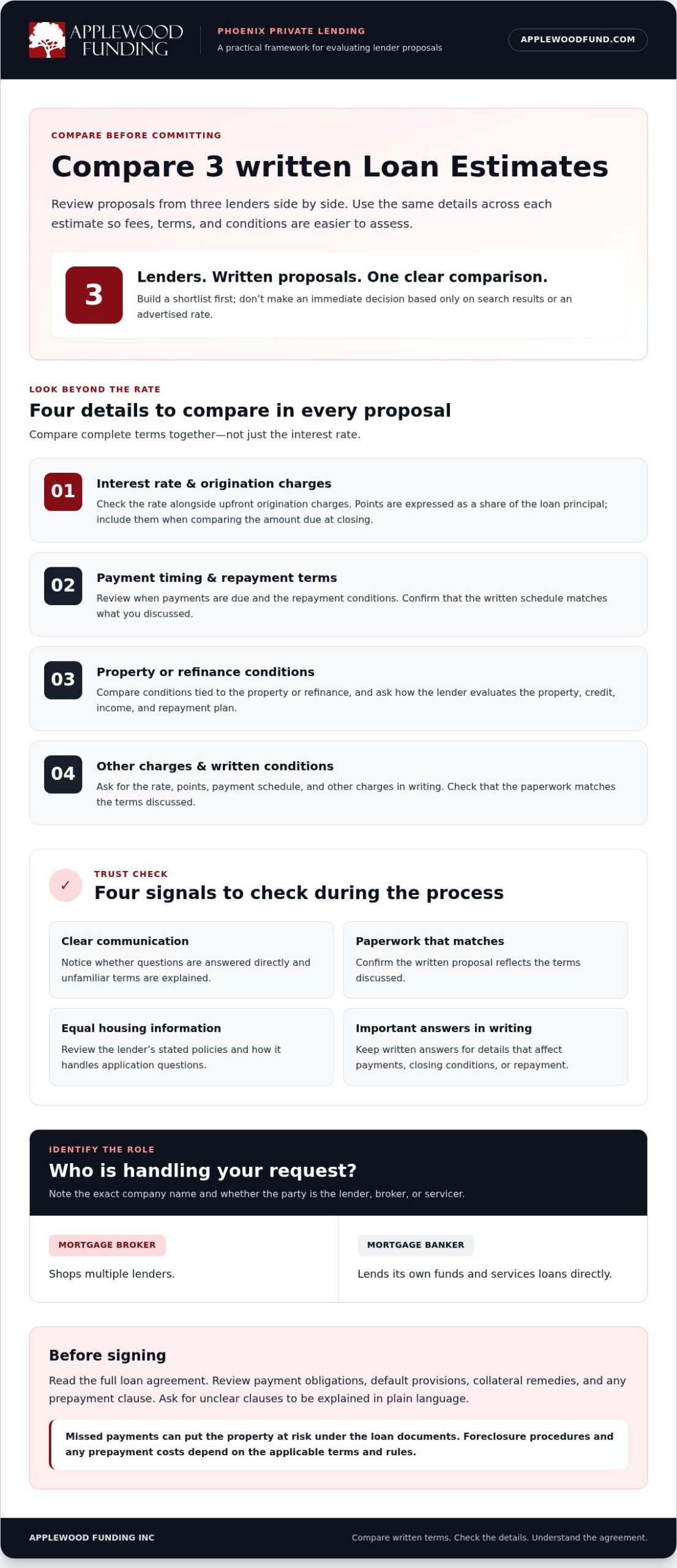
Before signing, review the loan agreement’s payment terms, default provisions, collateral remedies, and prepayment clause. Missed payments can put the property at risk under the loan documents. Foreclosure procedures and any prepayment costs depend on the applicable terms and rules.
Phoenix private lenders may finance investment properties, home purchases, and refinances. Borrowers with damaged credit may still be assessed on the complete application, including property equity and repayment capacity, rather than a score alone.
Choosing a lender you trust
Start with written terms, clear communication, and a lender whose process fits your real estate plan. Compare Loan Estimates from three lenders, then review the same details across each proposal. Look beyond the interest rate. Compare fees, payment timing, repayment terms, and conditions tied to the property or refinance. A side-by-side review makes differences easier to spot.
If you searched “private mortgage lenders phoenix az,” use the results to build a shortlist, not make an immediate decision. Compare private mortgage lenders in Phoenix, AZ by their written terms and how clearly they explain the process. Note the exact company name, such as Applewood Funding Inc, the contact handling your request, and whether that party is the lender, broker, or servicer. A mortgage broker shops multiple lenders, while a mortgage banker lends its own funds and services loans directly.
Use a short checklist during your first conversation. Ask how the lender evaluates the property, credit, income, and repayment plan. Request a written explanation of the proposed loan structure and the documents needed next. For example, a rental-property borrower can ask how projected rent and property condition factor into the review. Clear answers help you assess whether the lender’s approach fits your needs.
- Compare complete terms. Review the interest rate, origination charges, payment schedule, and repayment conditions together.
- Check communication. Notice whether the lender answers questions directly and explains unfamiliar terms.
- Review the paperwork. Confirm the written proposal matches the terms discussed.
- Look for equal housing information. Review the lender’s stated policies and how it handles application questions.
Credit can influence a lender’s review, but it’s only one part of the application. Ask which credit details matter for your loan purpose and how property value or equity factors into the decision. Get important answers in writing, especially if they affect payments, closing conditions, or repayment.
Before committing, read the full loan agreement and identify every payment obligation and default condition. Ask for a plain-language explanation of unclear clauses before signing. Keep copies of the proposal, disclosures, and messages together. When you work with a trusted team like Applewood Funding Inc, you can easily compare Phoenix mortgage financing options.
Finding licensed mortgage lenders in Phoenix
Before sharing financial records, identify the company handling your request and its role in the transaction. Applewood Funding Inc is a private hard-money lender serving Arizona. Its offerings include Owner Occupied Home Loans, Fix & Flip Loans, Rental Property Loans, and Construction and Land Loans.
Next, search official Arizona licensing records using the legal name. Compare the result with the name on the lender’s website, application, and proposed paperwork. Check that the listed business and contact details match. If a search returns similar names, ask the representative which record applies to the company involved in your purchase or refinance.
Licensing checks depend on the lender’s role and the transaction. A broker arranging a loan may be a different business from the company funding it. Ask each party to identify its role in writing. For an Arizona property, ask which Arizona record applies to the company handling the loan. A Phoenix office address alone doesn’t identify the legal entity responsible for your financing.
Use a practical review sequence:
- Collect the lender’s exact legal name and any trade name.
- Identify whether the contact is a lender, broker, or servicer.
- Search official Arizona records using the legal name.
- Compare the record with the application and proposed loan documents.
- Save the search result and written answers with your loan records.
The Arizona Private Lender Association is a nonprofit corporation classified as 501 (c) 3 and states that it complies with Arizona law. Its member directory can help identify participating private lenders, but a directory entry isn’t a substitute for reviewing the specific company’s licensing record. Confirm that the legal entity in the record matches the one named in your loan paperwork, especially when a broker introduces another funding company.
Pay attention to mismatches. A Phoenix office address paired with a different company name, or loan documents naming an unfamiliar entity, deserves a clear written explanation before you proceed. Ask who will receive payments, who holds the loan documents, and whom to contact about account questions. Keep the answers, licensing search, and final agreement together. This creates a focused record of the lender’s identity and role before you move ahead with an Arizona mortgage request.
Largest matched private mortgage lenders in Phoenix
“Largest” can mean the broadest contact network, a larger staff, or a strong fit for your financing request. A Phoenix private mortgage lender list averages 13.9 contacts per company, as of Sep 17, 2026. That figure describes contacts per company, not the total number of lenders or a ranking of loan capacity. The median employee-size range for listed companies is 1-10 employees, also as of Sep 17, 2026. Treat these figures as directory context, not proof of funding ability.
A search for private mortgage lenders in Phoenix, AZ can help you identify financing that fits your plans. Applewood Funding is an Arizona private hard-money lender offering Owner Occupied Home Loans, Rental Property Loans, Fix & Flip Loans, and Construction and Land Loans. Match the loan purpose to your property and plans before applying.
The Arizona Private Lender Association provides another contact route. It was founded to serve Arizona private money lenders making real-estate-secured loans with private funds. Its mission is to represent, promote, and foster private capital for Arizona real-estate projects. The association accepts loan requests that can be sent to all members. Use that route to reach participating lenders, then clarify who reviews applications and who funds each loan.
Build a comparison sheet before making calls. Include these fields:
- Contact route: note the published phone, email, or inquiry form.
- Loan fit: describe the property type and intended use.
- Decision-maker: record whether you spoke with a lender, broker, or loan officer.
- Next step: track requested documents and follow-up details.
For example, an investor seeking a Phoenix rental-property loan can contact matched lenders, explain the property and repayment plan, and ask which team handles that request. Keep every answer tied to the specific company. A contact count or employee range doesn’t establish an individual lender’s services, lending capacity, or closing process.
Before sending personal financial records, match the contact’s company name with its application and loan paperwork. Save written financing terms and contact names together. The largest matched lender isn’t automatically the best choice. For private mortgage lenders in Phoenix, AZ, a direct contact, a clear fit, and comparable terms make your shortlist more useful.
What types of private mortgage loans are available in Phoenix, AZ?
Private mortgage financing in Phoenix can serve different property plans. The right category depends on whether you’ll live in the property, renovate it, rent it, build on it, or use existing equity. Start by defining the property’s purpose and your repayment plan. Then identify loan types designed around that use. A home purchase and a renovation project need different underwriting details, even when both involve real estate.
For an owner-occupied purchase, hard money financing can address a home used as the borrower’s residence. This is distinct from financing an investment property. Clarify how the lender treats occupancy, property condition, and your intended use. For a fix-and-flip project, explain the acquisition and renovation plan, including the work needed before resale. The property and the project plan both matter.
Rental property loans focus on real estate held to generate rental income. A borrower can organize property details, expected use, and a repayment strategy before contacting lenders. Construction and land financing serves a different purpose: it relates to building plans or land development rather than simply buying a finished home. Prepare a clear project outline so the lender can understand the intended use of funds.
- Owner-occupied hard money loans: For a borrower financing a property intended as a primary residence.
- Fix-and-flip loans: For purchasing and improving a property before resale.
- Rental property loans: For acquiring or financing real estate held as a rental investment.
- Construction and land loans: For land purchases or construction and development plans.
- Bank statement loans for self-employed borrowers: For self-employed applicants whose income documentation relies on bank statements.
- Cash-out hard money loans: For accessing equity in a property through a new loan.
Self-employed borrowers can ask how bank statements will be reviewed and which account records support the application. For a cash-out request, gather current property information and explain how the proceeds will be used. In either case, compare the repayment terms and payment schedule against your financial plan. Don’t assume one loan category works the same way across every property or borrower.
Before applying, write down the property address, intended use, project scope, income documentation, and repayment source. That concise summary helps a lender route your request to the relevant loan type. Discuss your Phoenix property financing needs and identify a loan category that fits your plan.
Applewood Funding: Owner Occupied Hard Money Loans
Applewood Funding offers Owner Occupied Hard Money Loans for borrowers financing a home they plan to occupy. It also provides Fix and Flip Loans, Rental Property Loans, and Construction and Land Loans. Match the loan purpose to your property and plan before starting an application. For example, a primary residence calls for a different financing conversation than a renovation project or rental investment. Prepare the property details and intended use so you can discuss the relevant option clearly. If your Phoenix financing needs fit one of these loan types, contact Applewood Funding to discuss your situation. You can also visit applewoodfund.com.
Put Your Phoenix Financing Plan Into Motion
Turn your property goal into a clear loan request. Note whether you’re buying a home to occupy, renovating for resale, or financing a rental. Include the property details, intended use, and repayment plan. Then contact Applewood Funding to discuss the loan option that fits.
For borrowers comparing private mortgage lenders in Phoenix, AZ, the right fit starts with matching the loan purpose to the project. Applewood Funding offers Owner Occupied Hard Money Loans, Fix and Flip Loans, and Rental Property Loans. Bring your financing priorities into the conversation and focus on the option that aligns with your property plans.
Contact Applewood Funding to discuss your financing needs. A clear plan helps you move into the next conversation with confidence.
Frequently Asked Questions
How do I get contact information for these companies?
Use matched Phoenix lender listings and the Arizona Private Lender Association member directory to identify company contact channels. Look for a published phone number, email, or inquiry form, then note the company’s legal name and the person handling your request. To reach Applewood Funding, just text or call 602-497-4444 to get started. Its loan process has no up-front fees, no junk fees, and no cost to apply.
How long does it take to close on a home loan in Phoenix?
Arizona purchase mortgages typically close 21-30 days after a home goes under contract. A private loan’s timeline depends on the application, property review, title work, and how quickly requested documents are provided. For example, an incomplete project budget can hold up a renovation loan review. Ask for the expected steps and timing for your transaction, then plan around the purchase contract’s closing date.
What private mortgage lenders operate in Phoenix, Arizona?
Private lenders serving Phoenix include participating members of the Arizona Private Lender Association and lenders shown in matched local listings. Applewood Funding is an Arizona private hard-money lender. Its financing includes owner-occupied, fix-and-flip, and rental property loans. Phoenix-area borrowers can also compare options serving Scottsdale, Glendale, Peoria, Tempe, and Mesa, as well as Sedona, Flagstaff, and Tucson. Match the lender’s loan focus to your property and purpose.
What are typical rates, fees, and loan terms from Phoenix private mortgage lenders?
Arizona private money loan averages vary by reporting period: the average interest rate was 10.41% in the third quarter of 2026, and 7.49% in the first quarter of 2026. The average origination fee was 3.4% in the first quarter of 2026. These are statewide averages, not a quote for an individual loan. Compare the written rate, points, payment schedule, term, and prepayment provisions.
Are private mortgage loans in Arizona regulated, and what licensing rules apply to lenders?
Arizona private lending involves state-law considerations, and a lender’s role affects which licensing records to review. The Arizona Private Lender Association states that it complies with Arizona law; that statement does not establish the licensing status of every member. Identify whether a company is the lender, broker, or servicer, then search official Arizona records using its exact legal business name before proceeding.
How can borrowers verify a Phoenix private mortgage lender is legitimate and licensed?
Match the lender’s legal name across its public contact information, application, and proposed loan documents. Search the relevant Arizona licensing records under that name, and confirm whether the business acts as lender or broker. Applewood Funding Inc identifies itself as Licensed AZ Mortgage Broker and Licensed Loan Originator NMLS-175371 AZ MB-0903207. Keep the record and written loan terms with your application documents.
How quickly can private mortgage lenders in Phoenix approve and fund a loan?
Approval and funding depend on the lender’s review of the borrower, property, loan purpose, and submitted documents. A purchase, refinance, and construction request may require different information, so prepare property records and a clear repayment plan early. Applewood Funding describes its process as “Quick Application – Quick Closing.” That phrase sets no specific funding date; ask for the steps and timing that apply to your transaction.