

Private Mortgage Lenders in Phoenix, AZ and How to Contact Them
October 27, 2026Hard Money Loan Closing Costs in Phoenix: Fees and Points

The interest rate is only one part of borrowing costs. Hard money loan closing costs in Phoenix can include origination points, appraisal, title and escrow, document preparation, underwriting, and property insurance. The exact mix depends on the property and loan structure, so account for closing costs alongside monthly payments when planning your budget.
It’s easy to focus on the rate and overlook how points and closing expenses affect the total cost of a deal. This guide explains which charges to review, how origination points work, and what can shape your overall borrowing cost.
You’ll also see how approval and funding timelines can compare with traditional mortgages. Hard money loans can be approved and funded in a matter of days, while traditional mortgages can take 40 to 50 days. Use the comparison to understand the trade-offs and assess which financing approach fits your project and timeline.
Key Takeaways
- Separate origination points from other closing charges so you can see what each cost covers and how it affects cash to close.
- Arizona’s average hard money loan origination fee was 3.4% in the first quarter of 2026, a useful benchmark for understanding the market.
- Compare interest, upfront fees, loan term, and repayment structure together to assess the full cost of financing.
- Property details and loan complexity can shape expenses such as appraisal, title, insurance, and document preparation.
- Use the article’s comparison and decision guide to weigh financing costs against your project needs and timeline.
What Are Typical Hard Money Loan Fees?
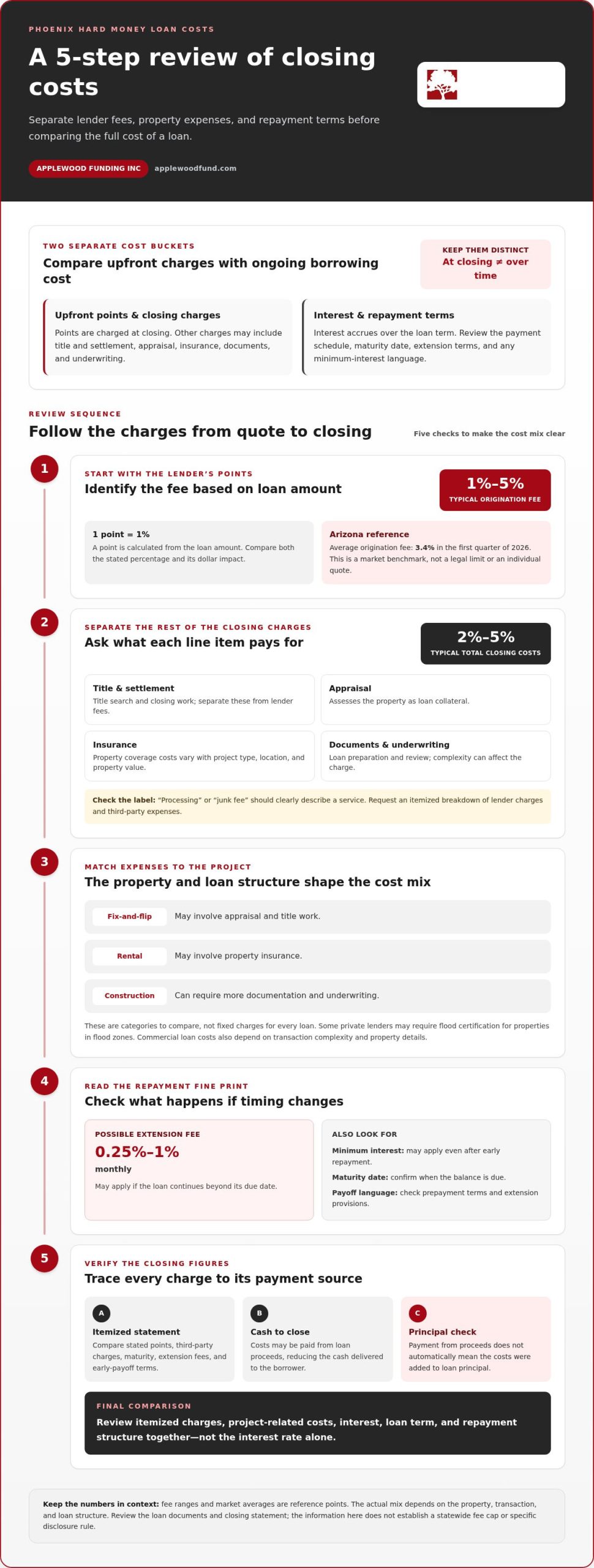
Hard money loan origination fees typically range from 1% to 5% of the loan amount, while total closing costs usually run 2% to 5%. Review points, third-party charges, and payoff terms separately before comparing loan offers.
A 1% point equals 1% of the loan amount.
Origination Points, Closing Costs, and Junk Fees
Origination points compensate a lender for arranging a hard money loan, while title search and settlement fees cover separate closing services. Ask for an itemized breakdown that distinguishes lender charges from third-party expenses. A label such as “processing” or “junk fee” should clearly describe a service. Applewood Funding offers No Up-Front Fees – No Cost to Apply, with no junk fees.
Extension fees can apply if a borrower keeps the loan beyond its due date. They may be 0.25-1% monthly. Some lenders also require minimum interest even after early repayment, so compare prepayment language and maturity terms before signing.
Closing Costs by Loan Type
Fix-and-flip, rental, and construction loans can have different cost categories because the property and financing structure differ. A fix-and-flip deal may involve appraisal and title work; a rental loan may involve property insurance; construction financing can require more documentation and underwriting. These are categories to compare, not fixed charges for every loan type.
For Phoenix projects, property insurance costs vary with project type, location, and property value. An appraisal assesses the property as loan collateral, and some private lenders may require flood certification for properties in flood zones. Commercial hard money loans also depend on transaction complexity and property details, so review itemized charges rather than assuming a residential loan’s cost mix applies.
Arizona Disclosures and Closing Cost Options
For the question of Arizona disclosures and lending rules, focus on the loan documents and closing statement: compare the stated points, third-party charges, maturity date, extension fees, and early-payoff terms. The facts here don’t establish a statewide cap or a specific disclosure rule, so don’t treat a market fee range as a legal limit.
Hard money loan closing costs may be paid from the loan proceeds when the transaction closes, reducing the cash delivered to the borrower. That does not automatically mean the costs were added to the loan principal. Review how each charge is paid and shown in the closing figures. Applewood Funding offers No Up-Front Fees – No Cost to Apply, with no junk fees.
| Cost option | What it covers | Key comparison |
|---|---|---|
| Origination points | Lender fee based on loan amount | Compare percentage and dollar impact |
| Title and settlement | Title search and closing work | Separate from lender fees |
| Appraisal and insurance | Collateral valuation and property coverage | Depends on property and project |
| Documents and underwriting | Loan processing and review | Complexity affects the charge |
| Extension or minimum interest | Term and repayment provisions | Review maturity and payoff language |
Compare itemized charges, project-related costs, and repayment terms together.
Hard money loan interest rates and upfront points
Interest and upfront points affect different parts of a real estate investor’s budget. Interest accrues over the loan term, while points are charged at closing. Compare both with the repayment schedule rather than treating them as competing versions of the same cost.
How rates and points shape borrowing costs
Hard money loan interest is generally 8-18% annually, often with interest-only payments. Another common market range is 8% to 15%. These are broad ranges, not a quote for a particular Phoenix property. The rate can change the carrying cost each month, while upfront points affect funds available at closing.
Arizona hard money loans had an average interest rate of 7.49% in the first quarter of 2026. Treat that figure as a market reference, not a prediction for an individual loan. Property value, loan structure, project plan, and the lender’s assessment all influence the offer. A flexible structure may help match financing to a project, but it doesn’t remove the cost of interest.
Interest-only payments and balloon repayment
Some hard money loans use monthly interest-only payments followed by a balloon payment at maturity. During the term, payments cover interest rather than reducing principal. The borrower needs a separate plan to repay the outstanding balance, such as selling or refinancing the property.
Before accepting terms, map the payment schedule against project milestones. For a renovation, consider when work will finish and when the property could be sold or refinanced. For a rental investment, consider the expected timing of income and permanent financing. This helps show whether the maturity date fits the plan.
Loan term and total interest
Hard money loan terms commonly range from 3-6 months to 2 years. Phoenix real estate investors typically see terms of 12-24 months. A shorter term may limit the time interest accrues, but it can leave less room for construction delays, a slower sale, or refinancing complications.
Compare the stated interest rate with the expected time you’ll carry the loan. For an interest-only structure, estimate interest over the planned term, then consider a longer hold using the loan’s actual extension terms. Don’t treat the balloon balance as a small final installment. It is the principal still owed at maturity.
Use this review sequence: identify the annual interest rate, list every upfront point, confirm monthly payment treatment, then note the maturity date and balloon balance. If you’re assessing Phoenix mortgage and hard money financing, bring those terms together so you can compare the cost against your project timeline.
Should I partner with a hard money lender in Arizona?
Compare the full financing cost, not just the lender’s interest rate. For an Arizona real estate deal, weigh fees, title and escrow work, repayment terms, and the cost of waiting for funding.
Total Financing Costs
Total financing cost combines lender charges, third-party closing expenses, interest over the expected hold, and any payoff or extension costs. Compare that total with the project timeline and exit plan, whether you intend to sell, refinance, or keep a rental property.
Hard money loans generally cost more than conventional financing because private lenders use their own capital, offer shorter terms, and take on greater risk with minimal underwriting. The trade-off can be speed: hard money closings are described as taking 10-21 days, compared with 45-60 days for conventional financing. Include the value of timing in your comparison, but don’t treat a faster close as a lower borrowing cost.
Hard Money Lender Comparisons
Compare Arizona private hard-money lenders using the same deal assumptions. Put each offer’s interest rate, points, third-party fees, payment structure, maturity date, and extension terms side by side. Then estimate the cost through your planned payoff date instead of comparing only the first payment.
Credit can matter to a lending decision, but property value, project details, and repayment strategy also shape the loan offer. For example, a real estate investor planning a rental refinance should compare the maturity date with the expected refinance timeline. A loan with a different rate may still cost more if its fees or payoff terms don’t fit the exit plan.
Title and Escrow Company Roles
Title and escrow companies handle work separate from a lender’s underwriting. Title and escrow fees are based on the loan amount and help ensure the property has a clear title. Their role relates to the transaction and property records, while lender fees compensate a lender for arranging and reviewing financing.
Review the settlement statement by payee and service. Separate title search and settlement charges from lender origination fees, then match each charge to its stated purpose. This helps identify which expenses relate to closing services and which relate to the loan itself.
Mortgage and Transfer Taxes
Don’t assume a mortgage tax or transfer tax is a standard hard money lender fee in Arizona. A loan and a property conveyance are different parts of a transaction, so the documents and applicable tax treatment matter. The available market facts don’t establish a statewide tax rule for every hard money loan.
For a Phoenix purchase, distinguish loan charges from any tax shown in the closing documents. Identify which transaction event a listed tax relates to and how it was calculated. This keeps tax entries separate from lender fees when comparing total financing costs.
Choose financing by comparing the full cost through your planned exit, title and escrow charges, and the timing your project needs.
Average hard money loan origination points in Arizona
An Arizona average can help investors frame an offer, but it isn’t a borrower-specific quote. Origination points are an upfront charge tied to the loan amount, so compare the percentage, how it is calculated, and the services it covers. Keep that charge separate from underwriting, title, escrow, and other closing expenses. Applewood Funding Inc offers No Up-Front Fees – No Cost to Apply, with no junk fees.
Use an average as a starting reference, then evaluate the actual financing structure. A lender’s underwriting approach, property details, project plan, and repayment strategy can all affect proposed terms. A statewide benchmark may not describe every Arizona borrower or real estate transaction.
How to compare an origination offer
Start with the written loan terms. Identify the origination fee, confirm its calculation basis, and distinguish it from any separate lender charge. Then compare offers using the same loan amount, property, and planned payoff date. Without consistent assumptions, a lower-looking points charge can hide other costs or terms that affect total financing expenses.
Next, match the fee to the loan program and transaction. A purchase, refinance, or cash-out transaction may involve different underwriting needs. Construction funding can require project review that differs from financing an existing property. These details help explain why a market average is a reference point, not a universal price.
What can affect the case-specific figure?
Your origination cost depends on the loan amount, property, project complexity, repayment plan, and program. Review the quoted figure alongside the other loan terms rather than judging affordability from points alone. Applewood Funding Inc offers No Up-Front Fees – No Cost to Apply, with no junk fees.
- Loan structure: Compare the amount financed and how the origination charge is calculated.
- Property and project: Note whether the transaction involves an existing property, renovation, or construction plan.
- Underwriting: Separate origination compensation from review and documentation charges.
- Repayment strategy: Consider the planned sale, refinance, or other payoff route when assessing total cost.
For a practical Arizona comparison, place each offer’s origination fee beside its interest rate, maturity terms, and other closing charges. Check whether the fee is paid at closing or from loan proceeds, and account for its effect on available project capital. Don’t compare points in isolation from the rest of the financing.
Investors can use this process to assess financing options and lending programs without treating an average as a promised term. The useful takeaway is simple: benchmark the offer, normalize the assumptions, and judge the full financing package against the property and exit plan.
What are typical hard money loan closing costs in Phoenix, Arizona?
Build a property-specific closing estimate rather than relying on a single flat figure. For a Phoenix hard money loan, separate lender charges from appraisal, title, escrow, insurance, and any flood certification. This shows which costs relate to the property and which relate to arranging financing.
Start with the appraisal, which assesses the property’s value as collateral. The property and loan request shape its role in the transaction. Next, account for title search and settlement work, which helps establish clear title and complete closing. Keep those charges distinct from origination points and underwriting costs.
Insurance is another project-specific line item. Property insurance costs vary by project type, location, and property value. A Phoenix rental, a property being renovated, and a construction project may therefore have different insurance needs. Some private lenders may also require flood certification for properties in flood zones.
Build a clear closing-cost worksheet
Use the property address and loan structure to organize the estimate. List each charge by category, then note the service, payee, and whether the cost relates to the lender or the property. This makes it easier to spot a repeated charge, unclear description, or expense that needs clarification in the closing figures.
- Lender charges: Record origination points, document preparation, and underwriting separately.
- Property review: Include the appraisal used to assess collateral value.
- Title and settlement: Track title search and closing services as transaction costs.
- Coverage and location: Include property insurance, plus flood certification where required for a flood-zone property.
Then review how each line affects the funds available at closing. Hard money closing costs are typically paid from loan proceeds when the transaction closes. That means the loan’s stated amount and the net proceeds available for the purchase or project are not necessarily the same figure. Keep those amounts distinct in your budget.
For a Phoenix project, the main cost drivers include loan structure, property value and location, insurance needs, and transaction complexity. Compare the itemized estimate with the work the property requires. A construction plan, for example, can involve different documentation and property review than financing an existing rental.
Before moving ahead, compare the complete cost breakdown with your project budget and planned exit. Discuss Phoenix hard money financing for your property to understand how the loan structure and property details shape the financing estimate.
Applewood Funding: Owner Occupied Hard Money Loans
Applewood Funding Inc offers Owner Occupied Hard Money Loans for borrowers financing a property they’ll occupy. Owner Occupied Home OK. Match the loan type to the property and project: Fix and Flip Loans address renovation projects, Rental Property Loans support rental investments, and Construction and Land Loans serve construction or land financing needs.
Bring your property details, intended use, project plan, and repayment strategy into the financing conversation. Those details help frame the loan structure and clarify which costs to compare against your budget. If you’re assessing owner-occupied financing or another real estate project, contact Applewood Funding Inc to discuss your financing needs, or visit applewoodfund.com.
Turn Your Financing Review Into a Clear Next Step
Your next move is to connect the financing structure to the property’s business plan. Before committing, map expected purchase or project milestones against the loan’s repayment date and intended exit. That gives you a practical way to judge whether the financing supports the deal, rather than forcing the deal to fit the loan. Keep your assumptions visible, especially the planned hold period and how you expect to repay the balance.
Use that project picture when discussing the hard money loan closing costs in Phoenix. A focused conversation can help you consider which financing path fits your property, whether it’s owner-occupied, a fix-and-flip, or a rental investment. Applewood Funding Inc offers options for these needs, and the right starting point is the plan for your property. Discuss your options with Applewood Funding Inc. Take the next step with a clear project plan and move forward with confidence.
Frequently Asked Questions
What are the closing costs of a hard money loan?
Phoenix hard money loan closing costs can include origination charges, appraisal, title and escrow services, document preparation, underwriting, and property insurance. The combination depends on the property and financing structure. For example, a construction project may involve different documentation needs than purchasing an existing rental. Review settlement figures by service and payee so lender charges stay distinct from property-related and closing-service expenses. Applewood Funding offers No Up-Front Fees – No Cost to Apply, with no junk fees.
How much do appraisal, inspection, title, escrow, and recording fees cost in Phoenix?
These charges depend on the property, loan amount, and work required for the transaction. Title and escrow fees are based on the loan amount, while an appraisal assesses the property as collateral. In Phoenix, use an itemized estimate to distinguish appraisal and inspection work from title, escrow, and recording entries. Compare the stated service for each charge rather than combining them into one unexplained closing-cost figure.
How do Phoenix hard money closing costs compare with conventional investment property loans?
Hard money financing generally carries higher costs than conventional financing, so compare the full cost against the project timeline and exit plan. For a Phoenix investment property, consider whether a shorter-term loan supports a time-sensitive purchase or renovation, then weigh that against the longer financing horizon you may need. Compare total charges, payment structure, and payoff timing using the same property assumptions, not just initial fees.
What hidden fees and prepayment penalties should Phoenix hard money borrowers watch for?
Review the loan documents for charges triggered by an extension, early payoff, or added processing work. Some hard money lenders require minimum interest even when a borrower repays early, and an extension fee may apply after maturity. Before signing, mark the maturity date, identify what triggers each charge, and check whether any lender fee duplicates a listed service. That review helps Phoenix borrowers plan a payoff without overlooking contract terms.