


Self Employed Home Loan No W2: Your 2026 Guide to Alternative Financing
September 15, 2026Mortgage for Self Employed Borrowers: How to Secure Funding in 2026

Why should a tax return designed to save you money at the IRS stop you from buying a home in Phoenix? If you’re a business owner, you know that your bottom line on paper rarely reflects the actual cash flowing through your accounts. Securing a mortgage for self employed borrowers shouldn’t feel like a battle against your own accountant. Traditional lenders look at your qualified income after every deduction, essentially punishing you for being a smart entrepreneur. It’s frustrating to watch the Scottsdale market move while a big bank ignores your success.
We know that your business finances are complex. You need a lender who speaks your language and values speed over bureaucracy. You’ve built a successful business; you shouldn’t have to wait months for a lender to catch up. You need a partner who looks at your bank statements and real-world cash flow, not just your tax returns. We believe your hard work deserves a clear path to homeownership.
This guide reveals how to bypass the red tape and use bank statement loans to secure funding in 2026. We’ll show you how Joel McDaniel (NMLS 175371) and the Applewood Funding team help Arizona professionals close fast using real revenue instead of outdated tax forms. Get ready to move from “denied” to “delivered” in record time.
Key Takeaways
- See how the “Tax Return Trap” sabotages your debt-to-income ratio and why conventional underwriting software isn’t built for entrepreneurs.
- Master the process of qualifying for a mortgage for self employed borrowers using deposits rather than IRS filings to reflect your true buying power.
- Compare conventional, bank statement, and hard money options to find the right balance of speed and documentation for your specific situation.
- Follow a step-by-step plan to organize your consecutive business bank statements and prepare a winning application that lenders can’t ignore.
- Unlock the advantage of working with a local Arizona lender who understands the competitive Scottsdale and Phoenix markets better than any national bank.
Why Traditional Banks Reject Self-Employed Borrowers
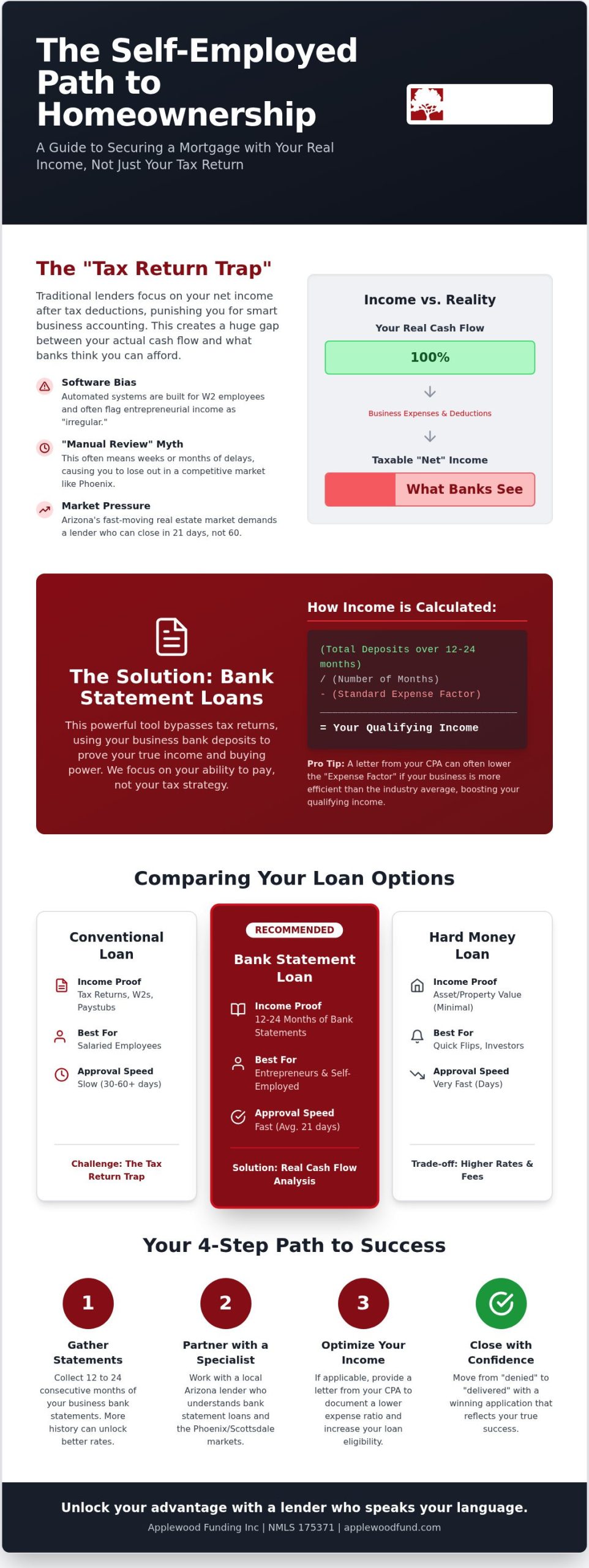
Traditional banks crave predictability. They want a clean W2 and a steady paystub. If you run your own business, you don’t fit their rigid boxes. You use legal deductions to grow your company. You write off expenses to lower your tax liability. While your accountant cheers, your bank underwriter cringes. This is the “Tax Return Trap.” It’s the primary reason many entrepreneurs struggle to secure a mortgage for self employed borrowers through conventional channels. They see your tax strategy as a lack of income.
The Problem with Net Income
Underwriters focus on your net profit. They look at what’s left after every deduction, including non-cash expenses like depreciation. This creates a massive gap between your taxable income and your actual spendable cash flow. Your gross receipts might be soaring, but on paper, you look like you barely make a living. Big banks essentially penalize self-employed borrowers for practicing sound financial management. They ignore the cold, hard cash in your accounts and focus solely on a document designed to minimize what you owe the government. It’s an unfair system that ignores the reality of business ownership.
Big Bank Red Tape in 2026
As we move through 2026, national lenders are tightening their grip. They rely on automated software that instantly flags “irregular” income. They might promise manual underwriting, but that’s often a black hole of endless paperwork and 60-day delays. In a competitive Arizona market, that’s a death sentence for your offer. Whether you’re eyeing a property in Scottsdale or a new build in Mesa, you can’t afford to wait on a corporate committee in another state. The local market moves fast. Your lender should too.
- Software bias: Algorithmic systems are built for salaried employees, not business owners.
- The manual review myth: “Manual review” often means your file sits on a desk for weeks while you lose out on your dream home.
- Market pressure: Phoenix real estate moves faster than bank bureaucracy. If you can’t close in 21 days, someone else will.
You need a partner who understands the local landscape. Joel McDaniel (NMLS 175371) and the team at Applewood Funding see the person behind the business. We don’t get hung up on the red tape that stops big banks in their tracks. We focus on your success and your ability to pay, not just what the IRS sees. If you’re ready to stop apologizing for your tax strategy, it’s time for a different approach. We look at your actual cash flow to get the deal done.
What is a Bank Statement Loan for Self-Employed Borrowers?
A bank statement loan is a powerful financial tool designed for the modern entrepreneur. It bypasses the traditional requirement for tax returns and W2s. Instead, lenders verify your income by looking at the actual cash flowing into your business accounts. This is the gold standard mortgage for self employed borrowers who have high revenue but use legal deductions to reduce their taxable income. We focus on your ability to pay, not how much you decide to give the IRS at the end of the year.
While many national lenders only offer a basic 12-month review, the 2026 market favors those who show more depth. A 24-month bank statement program provides a clearer picture of your business’s health and resilience. This longer history often unlocks better interest rates and higher loan amounts. It proves your income isn’t just a one-year fluke. For Arizona freelancers and business owners, this transparency is the key to winning in a competitive housing market.
How the Income Calculation Works
Lenders calculate your qualifying income by averaging your total business deposits over the selected period. They apply an “expense factor” to account for the costs of running your business. A consultant might see a low 20% expense factor, while a restaurant owner might face a 50% ratio. However, we can often add back non-cash expenses like depreciation to boost your total qualifying income. If your business operates more efficiently than the industry average, a simple letter from your CPA can often lower that expense factor further. You can find a full breakdown of these calculations in our Bank Statement Loans 2026: The Ultimate Guide.
Who Qualifies for This Program?
Qualification is simpler than you might think. Generally, you need to show at least two years of self-employment history in the same industry. It doesn’t matter if you operate as a sole proprietorship, an LLC, or an S-Corp. In 2026, credit score requirements for these specialized loans have remained flexible. Most programs look for a score of 620 or higher, though a higher score will always secure the most aggressive terms. This program is specifically built for the “outsiders” who the big banks ignore. If you’re ready to see what your real cash flow can buy, talk to an Arizona lending expert today to get started. We move at the speed of your business, not the speed of a bank committee.
Comparing Your Options: Bank Statement vs. Hard Money vs. Conventional
Choosing a mortgage for self employed borrowers isn’t just about hunting for the lowest interest rate. It’s about finding a lender who will actually cross the finish line. Conventional loans offer the lowest rates but demand a mountain of tax returns. These documents often show zero “qualified” income due to your smart deductions. Bank statement loans provide a middle ground. They offer moderate rates and flexible verification based on your actual business deposits. Then there’s hard money. It’s built for extreme speed when the big banks fail you. In 2026, the right choice depends on your timeline and your tax strategy.
The Owner-Occupied Hard Money Advantage
Most lenders won’t touch owner-occupied hard money for a primary residence. We do. In Arizona’s fast-moving markets, you sometimes need to close in days to beat out a cash offer. This is where Owner Occupied Hard Money Loans: Fast Funding comes into play. It’s the ultimate bridge. You secure the property now with minimal documentation and refinance into a bank statement loan later once the dust settles. It’s a strategic move for the bold entrepreneur who refuses to lose a deal to bank bureaucracy. We prioritize the asset and your equity over a stack of IRS forms.
Self-Employed Home Loan No W2 Comparison
If you’re a 1099 contractor in Scottsdale or a business owner in Mesa, you need a different playbook. Our Self Employed Home Loan No W2 Guide breaks down how down payments vary across these programs. Conventional loans might ask for 3 percent down but reject you on income. Bank statement loans typically require 10 to 20 percent down. Hard money often starts at 20 to 25 percent down. You’re trading a larger down payment for the certainty that your loan will actually fund. It’s about buying power and leverage, not just the monthly payment.
How do you decide which path to take? Use this simple decision framework to evaluate your situation. If you have 60 days and high taxable income, go conventional. If your tax returns are “optimized” but your cash flow is strong, choose a bank statement loan. If you found a “must-have” property in Phoenix and need to close before next Friday, hard money is your only real option. Speed is a currency in the current market. Don’t let a slow bank cost you a great investment.
- Conventional: Best for those with high taxable income and no deadline pressure.
- Bank Statement: Best for successful business owners with high deductions.
- Hard Money: Best for competitive bidding wars or properties needing quick closings.
Step-by-Step: Preparing Your Application for Success
Don’t wait until you find your dream home in Scottsdale to start digging through your files. A successful mortgage for self employed borrowers requires a proactive strategy that starts months before you submit an application. You need to present a narrative of stability and growth that an underwriter can’t ignore. While traditional banks look for reasons to say no, we look for the proof that says yes. It starts with your data.
Organization is your greatest leverage. Gather 12 to 24 months of consecutive business bank statements immediately. Consistency is the goal. Lenders look for steady deposit patterns, not just one or two “hero” months. If your business is seasonal, the 24-month option is often better as it shows the full cycle of your success. At the same time, you must clean up your spending habits. If you’re still paying for personal vacations or daily groceries out of your business account, stop now. Underwriters want to see a clear, professional line between your business revenue and your personal life.
The Bank Statement Audit
Large, unexplained deposits are the fastest way to kill a deal. If you moved $50,000 from a personal savings account into your business, you must document the source. Every dollar needs a story. Additionally, ensure your business is registered with a physical Arizona address. In 2026, lenders are increasingly wary of virtual offices or PO Boxes for self-employed professionals. Your ending balance also matters more than you think. If you consistently end the month with a low balance, an underwriter will question your “cushion” for a mortgage payment. Aim to keep a healthy reserve to prove your business has staying power.
CPA Collaboration
Your CPA is your secret weapon in this process. A professional letter from them can often override generic industry “expense factors” that would otherwise lower your qualifying income. If your business operates with lower overhead than the industry average, your CPA needs to certify that. In 2026, a clean, professionally prepared Profit & Loss (P&L) statement is the baseline for speed. It bridges the gap between your bank deposits and the underwriter’s comfort zone. Joel McDaniel (NMLS 175371) and the Applewood Funding team work directly with your financial professionals to ensure the numbers tell the right story.
Ready to see if your statements are mortgage-ready? Don’t leave it to chance. Contact our Arizona lending experts today for a pre-submission review. We’ll identify the red flags before the bank does, ensuring your path to homeownership is fast and certain.
Arizona’s Solution for Self-Employed Borrowers: Applewood Funding
National banks see a file. We see a neighbor. When you’re searching for a mortgage for self employed borrowers, you need more than an algorithm. You need a partner who understands the specific heat of the Phoenix market and the unique value of a Scottsdale hillside estate. Applewood Funding isn’t a distant corporate office. We’re on the ground in Arizona, making decisions based on real-world business success, not just a credit score on a screen. We value your hustle and your results.
Speed is our greatest asset. While big banks shuffle your paperwork through multiple states and committees, we keep everything local. We close loans in days, not months. In a competitive 2026 market where sellers expect quick action, our agility gives you the winning edge. You shouldn’t lose your dream home because a bank in another time zone is slow to respond. We move fast because your business moves fast.
Why Local Arizona Knowledge Matters
A property in Sedona isn’t the same as a property in Chicago. National appraisers often miss the nuances of unique Arizona homes, leading to “maybe” answers that kill your deal. We understand the 2026 Arizona real estate cycle. We know which neighborhoods are surging in Mesa and where the opportunities lie in Tempe. This local insight allows us to provide a firm “yes” when national lenders are still stuck in committee. We don’t guess. We know the territory.
Our expertise extends to complex appraisals. Whether it’s a luxury short-term rental or a custom desert build, we ensure the valuation reflects the true market potential. Big banks fear the “unique.” We embrace it. We use local data to support your vision and secure your funding without the typical institutional hesitation. We understand the value of Arizona land and the entrepreneurs who build on it.
Get Started with Applewood Funding
Stop fighting the red tape. You deserve a lender who moves at the speed of your business. Working with Applewood Funding means direct access to decision-makers like Joel McDaniel (NMLS 175371). No gatekeepers. No endless hold music. Just direct answers and aggressive solutions tailored to your specific cash flow. We offer specialized Bank Statement Loans and Owner-Occupied Hard Money solutions that big banks simply don’t provide.
Our process is built for entrepreneurs. We offer a consultation-focused approach to find the right fit for your finances. Most importantly, we start with a conversation, not a hard credit pull. We want to understand your business first. We look at your deposits, your growth, and your goals. Then, we build the path to your new front door. Secure your Arizona mortgage with Applewood Funding today and experience the difference of a local ally who values your success.
Take Control of Your Arizona Homeownership Goals
Stop letting traditional banks dictate your future based on a tax return. Your business success deserves better than a “maybe” from an automated system. We’ve shown you that a mortgage for self employed borrowers is entirely possible when you use the right tools. Whether you leverage bank statements or need the extreme speed of owner-occupied hard money, the path is clear. You have the cash flow. You have the equity. Now, you just need a lender who understands your hustle.
Joel McDaniel (NMLS 175371) and the Applewood Funding team specialize in fast, equity-based approvals that national lenders simply can’t match. We prioritize your results over red tape. Don’t let another Scottsdale or Phoenix property slip away while you wait for a bank committee to catch up. Take the first step toward your new front door today. Our local expertise ensures you get the funding you need without the institutional headache.
Apply for a Self-Employed Mortgage in Arizona Now. Your success has built your business; let it build your home too. We’re ready to fund your future.
Frequently Asked Questions
Can I get a mortgage if I am self-employed with no W2?
Yes. You don’t need a traditional paystub to prove your worth. Bank statement loans allow you to use your business deposits as proof of income. This is a game changer for entrepreneurs who pay themselves through their company rather than a standard salary. We look at the actual cash moving through your accounts. It’s about your real world buying power, not a piece of paper from a payroll company.
How many months of bank statements do I need for a self-employed mortgage?
Most programs require 12 to 24 months of consecutive business bank statements. Providing 24 months often unlocks better interest rates and higher loan amounts because it shows long term stability to underwriters. This documentation completely replaces the tax returns that traditional banks demand. Make sure your statements are complete and show a clear history of deposits. Consistency is what wins over a lender in the 2026 Arizona market.
Is the interest rate higher for bank statement loans in 2026?
Generally, yes. Bank statement loans are considered Non-QM products, which carry slightly higher rates than conventional loans due to the increased flexibility. However, the gap is often smaller than you’d expect. You’re trading a marginally higher rate for the ability to actually get approved without showing tax returns. For many Arizona business owners, this is a fair trade for securing a home in a competitive Scottsdale or Phoenix neighborhood.
Do I need tax returns for a self-employed home loan?
Not with a bank statement program. These loans are specifically designed to bypass the “Tax Return Trap” where legal write-offs lower your qualified income. We verify your ability to pay using your gross deposits instead. This allows you to keep your smart tax strategy while still qualifying for a competitive mortgage for self employed borrowers. It’s the most efficient way to secure funding without IRS interference or big bank red tape.
Can I use a hard money loan for my primary residence in Arizona?
Yes. Applewood Funding specializes in owner-occupied hard money loans across Arizona. While most private lenders only fund investment properties, we provide solutions for your primary home when speed is critical. This is a rare and powerful tool for entrepreneurs who need to close a deal in days. You can use this as a bridge and refinance into a long-term bank statement loan once you have secured the property and settled in.
What is the minimum credit score for a self-employed mortgage borrower?
We typically look for a credit score of 620 or higher for our specialized programs. While a higher score will always secure more aggressive terms and lower down payments, we have flexibility that national banks lack. We prioritize your business cash flow and equity over a single number on a credit report. If your business is thriving and you have a solid down payment, we’ll find a way to make the numbers work.
How long does it take to close a bank statement loan with Applewood Funding?
We close loans in days, not months. While a traditional bank might take 45 to 60 days to process a complex self-employed file, our team moves at the speed of your business. We eliminate the corporate red tape and provide direct access to decision-makers like Joel McDaniel (NMLS 175371). In the fast-paced Phoenix and Scottsdale markets, this speed is often the difference between a winning offer and a missed opportunity.
Can I get a mortgage as a 1099 contractor in Phoenix?
Absolutely. 1099 contractors are the backbone of the Arizona economy. Whether you’re in tech, consulting, or the trades, we use your 1099 income and bank deposits to qualify you for a home loan. You don’t need to be a W2 employee to own property in Phoenix. We understand your income structure and provide the same specialized mortgage for self employed borrowers that we offer to larger business owners and seasoned entrepreneurs.