

Sedona luxury property private loans for second homes
November 22, 2026Arizona Hard Money Interest Rates for Phoenix Real Estate
The rate matters, but the deal behind it matters more. Arizona hard money interest rates in 2026 typically range from 10% to 14% per year, and they’re usually higher than regular mortgage rates. Your property, financing needs, and loan structure all shape the terms you’ll weigh against the project’s potential.
That’s why a Phoenix fix-and-flip, rental purchase, commercial property, or vacant-land project shouldn’t be judged by the interest rate alone. Points and repayment terms also affect the financing picture, while a rate that looks attractive may not suit the timing or plan for your investment.
Here, you’ll get a clear view of typical Phoenix rates and loan points, what can influence financing terms, and how options differ across investment, residential, commercial, and vacant-land properties. Use the details to assess the full cost and fit of a loan, then move forward with a clearer picture of what your project needs.
Key Takeaways
- Compare the full borrowing structure, not just the interest rate: origination points, payment schedule, and loan term all affect the deal.
- Phoenix hard money loans commonly involve 2 to 4 origination points; understand how points are calculated before weighing financing options.
- Match the loan structure to your project and exit plan, whether you’re renovating for resale, holding a rental, or financing land or another property type.
- Evaluate leverage alongside the property and project costs. A lower loan-to-value ratio can influence the lender’s risk assessment and the terms offered.
- Use the article’s property-specific comparisons to identify which financing path best fits your investment, residential, commercial, or vacant-land plans.
What is the average hard money interest rate in Phoenix for 2026?
For 2026, hard money loan rates typically range from 10% to 14% per year, and generally exceed regular mortgage rates. Arizona’s average was 10.41% in the third quarter, based on 166 short-term loans funded between July 1 and September 30, 2026. The first-quarter average was 7.49%, so the period and loan sample matter when comparing rates.
Loan size also shifts the context. The average Arizona hard money loan amount was $1,250,318 in the third quarter of 2026, compared with $511,600 in the first quarter. These figures describe different quarterly samples, not a standard loan amount for every Phoenix borrower. A lender’s offer reflects the property, requested leverage, repayment plan, and overall deal risk.
Terms commonly include interest-only periods of 6, 12, 18, or 24 months. With interest-only payments, the scheduled payment covers interest rather than reducing principal, so the borrower needs a plan for repaying or refinancing the balance. A short bridge loan may fit a purchase or renovation with a defined exit; a longer hold calls for careful attention to maturity and balloon-payment terms.
An advertised hard money interest rate is a starting point, not the entire financing picture. Compare the stated rate with points, payment structure, loan term, and payoff provisions. Phoenix hard money and bridge loan rates can vary with the property’s condition and location, including street-level value differences. Commercial properties may also involve different underwriting considerations than residential investment properties.
Leverage affects both the amount borrowed and the lender’s exposure. Many hard money lenders seek loan-to-value ratios between 65% and 75%; lower LTV ratios usually support better rates because they reduce lender risk. Some Arizona hard money loans may offer up to 85%-90% loan-to-cost and up to 75% of after-repair value. LTC measures financing against project costs, while ARV estimates value after planned improvements.
Arizona’s Consumer Lender Act caps finance charges on covered consumer loans at 36% on the first $3,000 and 24% above that amount. Arizona’s private-lender exemption under 6-942(A)(2) requires lending one’s own money for one’s own investment, no intent to resell, and not being engaged in the mortgage-lending business.
What can help borrowers qualify for favorable terms? Lower requested leverage, support for the property’s value, and a clear repayment or exit plan can help show how the loan fits the project. Hard money financing focuses on the property and transaction, not only the borrower’s credit profile.
Closing speed depends on the transaction and documentation. Arizona hard money loans may close in as little as 5 to 10 business days, while lenders can typically close in only a few days. Build time for property valuation, title work, and loan documents into the purchase schedule rather than relying solely on an advertised timeline.
Fix-and-flip, rental, and investment property financing
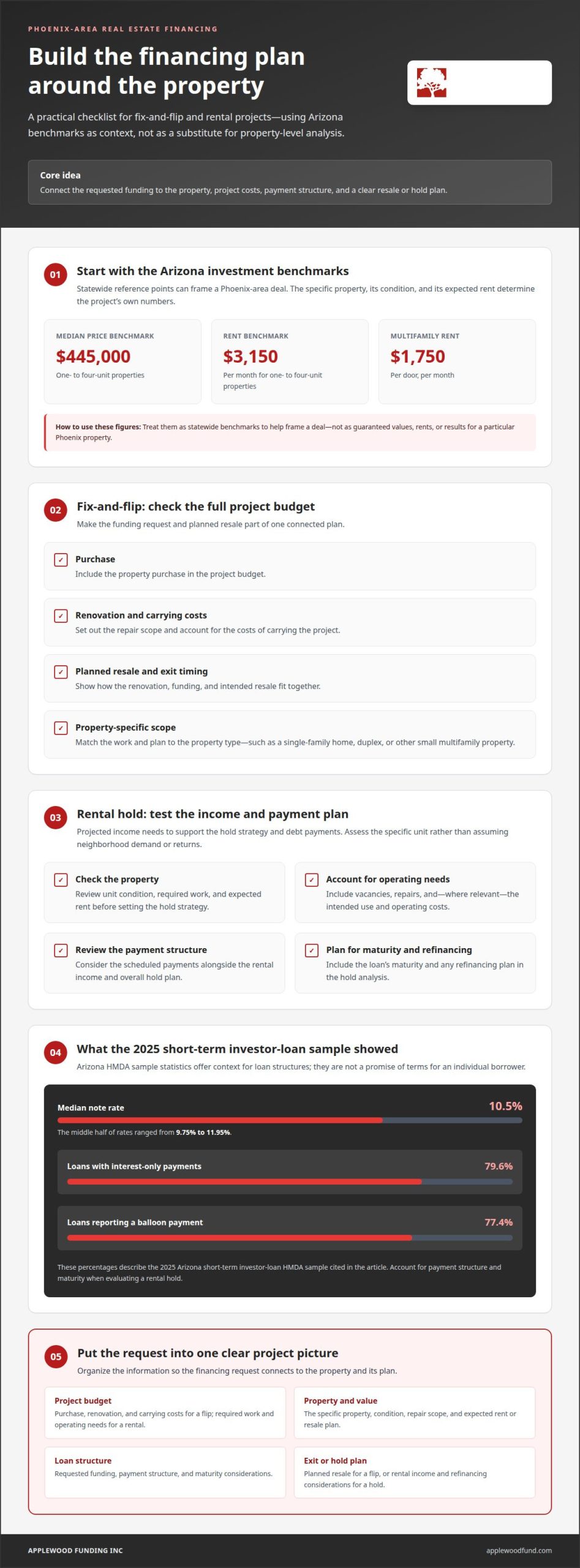
Arizona’s investment benchmarks give borrowers a starting point for sizing a project. The median price benchmark for one- to four-unit properties is $445,000. The rent benchmark for those properties is $3,150 per month, while multifamily rent is $1,750 per door per month. These statewide figures help frame a Phoenix-area deal, but the specific property, condition, and expected rent drive its numbers.
For a fix-and-flip, budget for the purchase, renovation, and carrying costs, then set out the planned resale. Assessing these items together shows how the funding, repair work, and exit timing fit into one plan.
Rental investors use a different test: projected income must support the hold strategy and debt payments. In the 2025 Arizona short-term investor-loan HMDA sample, the median note rate was 10.5%, and the middle half of rates ranged from 9.75% to 11.95%. Interest-only payments applied to 79.6% of those loans, while 77.4% reported a balloon payment. Borrowers should account for the payment structure and maturity alongside rent, vacancies, repairs, and refinancing plans.
Phoenix-area rehab projects can involve single-family homes, duplexes, and other small multifamily properties. Each property type calls for a specific repair scope and rent or resale plan. Organize the project budget, scope of work, property value, and exit plan so the financing request clearly shows how the funds support the transaction.
For an Arizona rental, assess the unit’s condition, expected rent, and required work before setting the hold strategy. In Scottsdale, a property intended for short-term rental needs a plan for its intended use and operating costs. Underwrite the specific property rather than assuming its neighborhood guarantees demand or a particular return. A property-level analysis connects the financing request to the actual income or resale plan.
For a rental hold, discuss rental property financing around the property’s income plan and financing needs. For a flip, keep the renovation budget and planned exit central to the lending request.
Residential, commercial, and vacant-land financing
Phoenix financing comparisons work best when each option is measured against the property and transaction. Compare the requested loan amount, collateral, repayment plan, and expected hold or exit. A typical hard money review centers on the real estate and project structure, while bank underwriting can involve broader documentation. The interest rate matters, but a useful comparison also considers timing, payment structure, and whether the property fits the lender’s criteria.
Residential financing may be for an owner-occupied home or an investment property, and those purposes are not interchangeable. State who will occupy the property, how the funds will be used, and how you plan to repay the loan. For a Phoenix home purchase or cash-out transaction, the property’s value and existing financing help frame the request. Compare terms that match your transaction rather than treating every residential loan as the same product.
For an investment property, describe the asset and its intended use. Explain the project, income plan, and repayment source so the financing request reflects how the property will support the loan. Hard money financing considers the property as collateral along with the transaction structure. Organize these details before comparing proposals, since differences in loan amounts or assumptions can make terms difficult to evaluate fairly.
Land financing starts with a different set of questions than a loan secured by an improved building. Explain whether you plan to hold the parcel, prepare it for construction, or pursue development. Include the land’s location, intended use, and project steps in the financing request. For a construction plan, connect the land to the proposed build and repayment path so the request presents a complete project.
Bank financing may take weeks or even months to approve. Hard money can suit a time-sensitive transaction or a property that needs work, but borrowers should weigh speed against the loan’s full terms. A $400,000 fix-and-flip loan is one example of a deal local private lenders may approve without a committee process. Approval still depends on the property and transaction; the example is not a standard loan amount.
To compare Phoenix lenders, put each proposal beside the same project assumptions. Record the property type, requested financing, intended use, repayment plan, and expected exit. Then compare the interest rate with payment timing and the conditions for paying off the balance. For a fix-and-flip, include the renovation plan and resale strategy. For commercial property or vacant land, spell out the use and development path. Clear inputs make competing structures easier to assess and help borrowers decide which financing approach fits the deal.
How many points do Phoenix hard money lenders charge?
Phoenix hard money loans commonly charge 2 to 4 origination points upfront, with one point equal to one percent of the loan amount. Arizona borrowers should weigh those upfront costs alongside interest, repayment timing, and the risks of carrying debt longer than planned.
Origination Points and Fees
Points are calculated as a percentage of the loan amount and typically paid at closing. For example, a 2-point charge equals 2% of principal, while 4 points equals 4%. Arizona hard money lenders charged an average origination fee of 3.4% in the first quarter of 2026. That market average offers context, not a quote for an individual mortgage or investment property.
Term-Sheet Costs
A term sheet puts the financing structure in writing. Review the interest rate, points, payment schedule, loan term, and listed charges. Note which costs are due at closing and how the payment terms affect the loan over time. This helps Arizona borrowers understand the funds needed at closing and the ongoing effect on a rental or resale plan.
Points and interest affect borrowing costs in different ways. Points are based on the loan amount and paid upfront; interest accrues according to the balance and payment terms. With a shorter hold, upfront points can make up a larger share of the total borrowing cost. With a longer hold, ongoing interest has more time to accrue. Compare both with the project’s expected timeline.
What should Arizona borrowers consider when comparing loan costs? Review the points, interest payments, maturity date, and principal repayment plan. If a Phoenix-area renovation or rental takes longer than expected, the financing may remain in place beyond the original timeline. Build the repayment plan around realistic project milestones and available income.
Before accepting terms, match the term sheet to the transaction. Confirm the loan amount and calculate the points based on it, then map each payment to the project calendar. For a fix-and-flip, compare the expected resale timing with the loan term. For a rental, assess whether expected income can support scheduled payments during the hold.
Don’t compare offers by interest rate alone. One proposal may have a lower rate but more upfront points; another may use a different payment structure. Compare the same principal, planned holding period, and exit strategy across proposals. This gives you a clearer view of total cost and whether the financing fits your project’s return plan.
Hard money loans for Phoenix-area real estate
Phoenix real estate investors use hard money loans to pursue purchases, renovations, and other time-sensitive projects. Arizona short-term investment real estate lending totaled approximately $866 million across 472 loans in the second quarter of 2026. That activity shows a substantial market, but a statewide total doesn’t establish whether one property or loan structure makes sense.
Quarterly figures can vary sharply. Arizona lending totaled approximately $4.4 billion across 580 loans in the first quarter of 2026, compared with approximately $1.2 billion across 587 loans in the fourth quarter of 2025. These totals describe different quarters, not a consistent monthly pace. For a Phoenix borrower, the practical question is how the financing supports the property’s purchase, improvement, or planned exit.
Start with the asset and the plan. A residential fix-and-flip request should connect the purchase, renovation scope, and resale strategy. A rental-property request should explain the intended hold and how payments fit the operating plan. For commercial real estate, describe the property’s use and the project’s repayment source. Private money financing depends on the transaction details, so a clear request helps lenders assess the collateral and structure.
Timing matters, but speed alone isn’t a sound selection method. Arizona hard money loans may close in as little as 5 to 10 business days. A Phoenix investor pursuing a competitive purchase should account for valuation, title work, closing documents, and the seller’s timeline. Keep a backup plan for delays, especially when renovation work or occupancy affects the expected exit.
Build a simple deal review before committing. List the purchase price or current property value, planned work, expected holding period, and repayment source. Compare the proposed loan amount and structure with the project’s cash needs. A property needing repairs may call for a different plan from a rental that is ready to lease. Use the same assumptions to compare each proposal.
General lending trends do not forecast Phoenix property values or future loan availability. Focus on the specific asset, required work, and planned repayment point. If the exit depends on a sale, test the resale plan against renovation timing. If it depends on rental income, account for operating needs before relying on that income.
Ready to discuss financing for a Phoenix-area real estate project? Talk through your real estate financing options with the property type, project plan, and intended exit in view.
Applewood Funding Inc
Applewood Funding Inc, a private hard money lender in Arizona, offers Owner Occupied Hard Money Loans, Fix and Flip Loans, Rental Property Loans, and Construction and Land Loans. Consider these options for an owner-occupied home, property renovation, rental investment, or land project. No Credit Required, No Up-Front Fees, and No Cost to Apply. You Will Get the Lowest Rates GUARANTEED.
Bring the property type, intended use, project scope, and repayment approach into the conversation. Those details help frame the financing request and clarify which loan category may fit. Review the proposed rate alongside points, payment structure, and loan term to weigh the full borrowing picture.
Contact Applewood Funding Inc to discuss your real estate financing needs.
Make your next financing move with a clear plan
Use Arizona hard money interest rates in 2026 as one part of your decision, not the whole decision. Before moving ahead, connect the financing to the property’s purpose, your operating plan, and a realistic exit. That keeps the loan choice grounded in what you’re building, rather than a rate viewed on its own.
Applewood Funding Inc offers Owner Occupied Hard Money Loans, Fix and Flip Loans, and Rental Property Loans for borrowers evaluating different real estate plans. Bring your property goals and financing questions into the conversation, then explore which direction fits your next move.
Contact Applewood Funding Inc to discuss financing. Take the next step with a clear plan and confidence in the path ahead.
Frequently Asked Questions
Can I use a hard money loan for a rental property or Airbnb in Scottsdale?
A hard money loan can support a rental-property investment in Scottsdale, including a property intended for Airbnb use. Explain the rental model, expected income, property condition, and repayment plan in your financing request. Financing does not determine whether a property may operate as a rental, so account for applicable local requirements when planning its use.
Do hard money lenders in Arizona require a minimum credit score?
Arizona hard money lenders may set different credit criteria; an applicant benchmark cited for these loans is a 600 to 640+ FICO score. Applewood Funding states “No Credit Required” for its lending. Credit isn’t the only factor in a property-backed loan: the collateral, requested leverage, project plan, and repayment strategy also shape how a loan request is assessed.
Can I finance a duplex or fourplex rehab?
A duplex or fourplex renovation can be structured as an investment-property project. Applewood Funding offers Fix and Flip Loans. Connect the purchase or current property with the renovation scope, expected after-repair value, and exit plan. For a fourplex, include the work for each unit and the rental or resale strategy to present the complete investment.
Do you lend on rental properties or BRRRR deals?
Applewood Funding offers Rental Property Loans for rental investments. A BRRRR plan combines buying, renovating, renting, and later refinancing, so set out the acquisition and renovation financing separately from the intended long-term loan. A rental-property loan is for the rental investment; it does not establish that future refinancing will be available or fit the project.
What are typical Arizona hard money loan interest rates in 2026?
Arizona hard money interest rates in 2026 typically range from 10% to 14% per year. The Arizona average was 10.41% in the third quarter of 2026, based on 166 short-term loans. Rates vary with the property, loan structure, and requested leverage. Compare the stated rate with upfront points and payment terms to understand the borrowing cost.
What are current Arizona hard money loan terms, including duration and payment structure?
Arizona hard money loan terms can include 6-, 12-, 18-, and 24-month interest-only periods. Interest-only payments cover interest during the scheduled period, leaving principal to be repaid under the loan’s terms. Before committing, map the maturity date against the project’s sale, rental, or other repayment plan. The schedule should fit the property’s intended use and exit.
Which Arizona hard money lenders publish 2026 rates and fees?
Applewood Funding’s published Arizona loan examples show product-specific terms, not one rate for every borrower. Its Scottsdale rental-purchase example lists 8.0% interest and a 60-month term. Applewood Funding also states “No Up-Front Fees” and “No Cost to Apply.” Its site says, “You Will Get the Lowest Rates GUARANTEED.” Compare any published example with the terms for your own transaction.
How do Arizona hard money loan rates compare with bank, DSCR, and private-money loans?
Hard money rates are usually higher than regular mortgage rates. Arizona hard money loans typically range from 10% to 14% per year, while the median rate for Arizona 30-year DSCR-type loans was 7.25% in 2025. Private money often describes the funding source behind a hard money loan, so compare the loan’s structure, points, payment schedule, and term, not just its label.