

Hard Money Second Mortgage Pricing in Glendale
November 19, 2026Private Lender for Small Apartment Buildings in Peoria
A small apartment building doesn’t automatically fit a conventional loan. A private lender for a small apartment building in Peoria, Arizona, may offer another financing route, with the property and investment plan central to the application.
Before moving forward, get clear on which loan programs may fit, what shapes private-money rates, and how an application is reviewed. This guide explains the financing process and the factors that influence a lending decision.
You’ll learn how private lending can support a small multifamily purchase or rental investment, what information lenders review, and what to expect as an application moves ahead. Use these points to assess whether this financing path fits your building and next step.
Key Takeaways
- Match the loan program to the property plan, whether you’re buying a rental, renovating a building, or funding construction.
- Understand how interest rates, loan structure, and property details can shape the financing terms.
- See what the application review considers and how complete materials can affect the process.
- Learn how bridge financing may fit a renovation strategy and what to consider when planning the exit.
- Explore when Applewood Funding’s rental property or hard money loan options may align with your investment.
Loan programs for small multifamily properties
Small multifamily financing can support a purchase, renovation, or rental investment. In Peoria, Arizona, compare programs by how they assess the building, borrower, and intended repayment plan.
Loan-to-Value and Origination Points
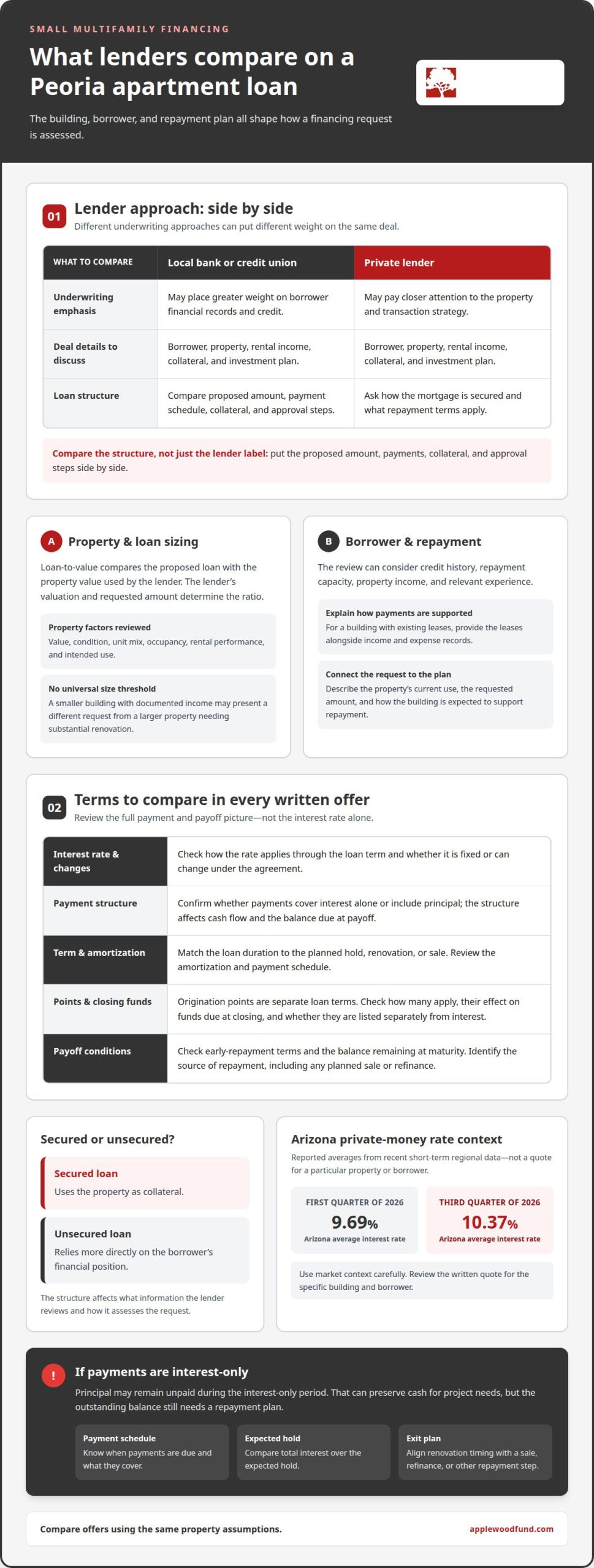
Loan-to-value compares the proposed loan with the property value used by the lender. The lender’s valuation and requested amount determine the ratio. Origination points are separate loan terms. Review how many points apply, how they affect funds due at closing, and whether the written offer lists them separately from interest. To compare offers, review loan-to-value, points, payment structure, and repayment terms together.
Lender Options for Multifamily Financing
Local banks, credit unions, and private lenders may assess a small apartment building through different underwriting approaches. Compare what each considers about the borrower, property, rental income, collateral, and investment plan. A bank or credit union may place greater weight on borrower financial records and credit, while a private lender may place closer attention on the property and transaction strategy. Ask how the proposed mortgage is secured and what repayment terms apply.
For a Peoria purchase, the useful comparison is not just the lender type. Put the proposed amount, payment schedule, collateral, and approval steps side by side to see how the loan structures differ.
Borrower Requirements and Down Payments
Down-payment needs depend on the lender’s valuation, loan-to-value calculation, and requested financing. Credit history, repayment capacity, property income, and relevant experience can also shape the review. A secured loan uses the property as collateral; an unsecured loan relies more directly on the borrower’s financial position. These structures affect what information the lender reviews and how it assesses the request.
For example, a borrower purchasing a building with existing leases can provide those leases alongside income and expense records. This helps explain the property’s performance and the plan for making payments.
Accepted Loan Amounts and Property Sizes
There is no single amount or building size that defines every private lender’s fit. The lender assesses the property’s value, condition, unit mix, occupancy, rental performance, requested financing, and intended use. A smaller building with documented income may present a different request from a larger property that needs substantial renovation.
Describe the specific Peoria property, its current use, and the planned transaction. Include the amount requested and explain how the building is expected to support repayment. These details give the lender a basis to evaluate the request and consider an appropriate loan structure.
Illinois private-money interest rates
For a Peoria, Arizona apartment investment, the interest rate is only one part of the financing decision. A lender’s quote reflects the property, requested loan structure, collateral, borrower profile, and repayment plan. Review written terms for the specific building instead of using a rate from another market as a local benchmark.
How to assess a rate quote
Ask how the interest rate applies throughout the loan term and whether payments cover interest alone or include principal. The payment structure affects current cash flow and the balance due at payoff. Note whether the quoted rate is fixed or changes under the agreement, and match its duration to the planned hold, renovation, or sale.
For a Peoria purchase, compare the proposed payment with expected rental income and property expenses. A rate that looks manageable on paper may strain cash flow if the building needs work or takes time to lease. Review the operating plan alongside the loan terms.
Interest-only payments and cash flow
An interest-only structure can leave principal unpaid during the interest-only period. That may preserve cash for project needs, but the borrower still needs a plan for the outstanding balance. Compare the payment schedule, total interest over the expected hold, and source of repayment.
For example, an investor planning renovations should align the financing period with the work schedule and next repayment step. If the plan depends on a sale or refinance, consider how the building’s condition and rental performance support that transition.
Compare financing terms, not just rates
Compare each offer’s interest rate, payment amount, term, amortization, and payoff conditions together. Review how the loan handles early repayment and what balance remains at maturity. These details show how financing affects monthly operations and the eventual exit.
Build a side-by-side comparison using the same property assumptions for each proposal. Include expected rent, operating expenses, planned repairs, and intended hold period. This helps show whether the payment structure supports the investment, rather than relying on the rate alone.
Bring the building details and repayment strategy together before choosing a structure. A focused review of your financing scenario can connect the rate discussion to the property’s investment plan with Applewood Funding Inc.
The average interest rate for Arizona private-money loans was 10.37% in the third quarter of 2026, compared with 9.69% in the first quarter of 2026. The third-quarter 2026 private-money interest-rate and loan-amount averages were calculated from recent short-term regional data. These figures provide market context, but they are not a rate quote for a particular property or borrower.
This example shows how a quoted rate translates into a monthly obligation, but it does not establish what an Arizona borrower will receive. Compare the payment basis, repayment term, and payoff balance with the property’s operating plan, and verify the actual written quote before assessing affordability.
Application review process
An application for a small apartment building brings the borrower, property, and repayment plan into one review. The lender assesses how the requested loan relates to the building’s condition, value, income, and intended use.
Organize the application around the property
The first step is submitting a complete file. Include the purchase or refinance details, requested loan amount, property address, and a clear description of the plan. Property records, current leases, rent information, operating expenses, and repair estimates help explain how the building performs and what work it needs. Borrower financial documents and credit information help the lender assess repayment capacity alongside the real estate.
Consistency matters. If a rent schedule differs from the lease documents, or repair estimates don’t match the stated scope, the lender needs to resolve the gap before assessing the request. A complete, consistent application gives the reviewer a clearer view of the deal and can reduce avoidable follow-up.
Review the borrower and repayment plan
The lender evaluates how the proposed payment fits the borrower’s financial picture and property strategy. For a rental building, the review connects current or projected rental income with expenses and debt obligations. For a purchase that requires repairs, the work plan and intended repayment path explain how the borrower expects the property to support the loan.
Present the exit strategy plainly. A sale, refinance, or ongoing rental operation leads to different repayment assumptions. The lender can then assess whether the requested structure aligns with the building’s use and the borrower’s plan. If a document changes, provide the updated version so the application reflects one consistent set of facts.
Understand timing and follow-up
Peoria County’s loan application process can take 6-8 weeks when all application materials are properly submitted. That timeline applies to the county process, not every private lender’s review. Private financing timelines depend on the lender’s process and the completeness of the file, so avoid treating the county estimate as a private-loan commitment.
During review, respond to requests with the specific document or explanation needed. For example, if a reviewer asks about a lease discrepancy, provide the relevant lease information and clarify the rent figures. A focused response addresses the issue without introducing unrelated material.
Prepare for a clear lending decision
Before submitting, make sure the requested amount, property details, income records, and repayment plan tell the same story. Identify known repairs or occupancy changes directly. Clear materials help the lender evaluate the asset, borrower capacity, and expected payment together instead of relying on incomplete assumptions.
Commercial real estate
A small apartment building is a real estate investment when financing centers on its income and investment purpose. In Peoria, structure the loan around the plan: acquire, renovate, hold, or sell. That purpose affects the payment strategy, equity tied up in the property, and exit plan.
Bridge financing for renovation
An interest-only bridge loan can provide temporary financing while an apartment building is renovated. These loans usually have terms from one to two years. During the interest-only period, scheduled payments cover interest, so they don’t reduce the principal balance. This can leave more cash available for project work, but the outstanding balance still needs a clear payoff plan.
For example, a borrower renovating a Peoria apartment building might plan to repay through a sale or refinance after completing the work. The lender’s review connects the requested financing with the property’s condition, renovation scope, and intended exit. Present these elements together, not as separate assumptions.
Principal-and-interest payments and equity
A principal-and-interest mortgage payment reduces the outstanding balance over time. One example shows apartment mortgage payments reducing the balance by $250,000 over 10 years. That reduction can build equity, although the actual result depends on the loan’s terms and payment history. Compare this structure with interest-only financing by considering both current cash flow and the remaining balance at payoff.
For a rental property, compare expected rent with the scheduled payment and operating needs. Then consider how much principal the payment reduces under the proposed terms. A payment that leaves more cash in the short term may also leave more debt to repay later.
Connect the loan to the investment purpose
Let the property’s purpose guide the financing structure. A renovation plan calls for a defined work scope and a realistic route from temporary financing to repayment. A long-term rental plan requires attention to continuing income, expenses, and mortgage payments. In either case, explain how the building is expected to support the loan.
Equity also matters. The amount invested in the property affects how much capital remains available for repairs, reserves, or other project needs. Lay out the purchase, renovation, and hold strategy so the financing request reflects the full investment, not just the initial transaction.
Build a workable exit plan
Before accepting temporary financing, identify the expected payoff source and the conditions needed to reach it. For a sale, connect the renovation scope with the planned sale. For a refinance, show how the property’s expected performance supports the transition. A clear exit plan helps align the loan term, work schedule, and repayment strategy.
Private lenders serving Peoria real estate investors
For a Peoria apartment investment, assess the financing against the property, borrower, and repayment plan. Illinois lending and foreclosure requirements depend on the transaction; review the loan and security documents carefully before signing.
Prepayment and Balloon-Payment Terms
Before accepting an offer, identify whether the note permits early repayment and whether prepayment charges apply. Check when any charge ends, how it is calculated, and whether partial principal payments are treated differently. These terms matter if a sale or refinance could repay the debt ahead of schedule.
A balloon payment requires a larger payoff at a stated point than regular payments alone would cover. Confirm the maturity date, expected balance, and planned repayment source. For example, a strategy relying on refinancing needs a backup plan if the property’s income or condition changes before maturity.
Also review late-payment provisions, default terms, and any personal repayment obligations in the documents. A clear comparison brings scheduled payments, early-payoff conditions, final payoff amount, and the borrower’s exit strategy together.
Neighborhood and Property-Type Coverage
Neighborhood names alone don’t establish whether a specific Peoria building fits a loan. The exact address, property condition, occupancy, rental income, and investment purpose provide a more useful basis for review. A lender evaluates the asset and proposed financing together, rather than relying only on a broad location label.
For a small apartment property, organize the application around its unit mix, leases, income, expenses, and repair needs. If the building needs work, connect the scope to the intended use and repayment plan. If it operates as a rental, show how current performance supports the proposed debt.
Private lending decisions also involve how the loan is structured. A secured loan uses identified collateral, while an unsecured loan relies on a different repayment basis. The documents should make the parties, collateral, payment obligations, and default provisions clear. Have Illinois counsel review transaction-specific legal questions before execution.
For Peoria investors, the practical takeaway is to evaluate the specific deal rather than assume every lender uses the same criteria. Present the address, property records, income details, financing purpose, and exit plan as one complete picture. This helps show whether the proposed structure matches the building’s actual investment role.
Prepare the key deal details and discuss your Peoria property financing to connect the lending approach with your investment plan.
Peoria County requires one full-time-equivalent job to be created or retained for every $15,000 of loan fund investment under its loan programs. Investors should include this requirement in early eligibility and project planning, and confirm that the proposed staffing outcome meets the program’s terms before relying on county loan funds. Compare this condition with the property’s financing needs and repayment plan so the funding choice fits the project.
Applewood Funding
Applewood Funding helps real estate investors match a property’s purpose with a suitable financing approach. For a small apartment building, that may mean Rental Property Loans or financing for renovation work. The right direction depends on the building, its condition, and your investment plan.
Bring the property details, intended use, and repayment strategy into the conversation. That gives the financing review a clear starting point and keeps the discussion focused on options relevant to your project.
Contact Applewood Funding to discuss financing for your apartment building.
Take the Next Step With a Clear Financing Plan
Turn your apartment investment plan into a focused financing conversation. Before moving ahead, identify the property’s purpose, the capital it needs, and how repayment fits your broader goals. A private lender for a small apartment building in Peoria can support that plan when the financing structure aligns with the property and your next move.
Applewood Funding offers Owner Occupied Hard Money Loans, Fix and Flip Loans, and Rental Property Loans. These options serve different property plans, from occupying a property to renovating or holding it as a rental. Share the building details and intended use to start a practical discussion about the financing approach.
Discuss your apartment financing with Applewood Funding. Take the next step with a plan that fits your investment.
Frequently Asked Questions
Which private lenders finance small apartment buildings in Peoria, Illinois?
Look for a private real estate lender that finances investment properties in Illinois and evaluates multifamily buildings. Applewood Funding is a private hard money lender serving Arizona, including Peoria, Arizona. That geographic distinction matters: an Illinois property requires financing applicable to its location. For any prospective loan, focus on whether the lender’s program fits the building’s use, condition, ownership structure, and planned repayment.
Do private lenders in Peoria offer bridge, hard-money, or rental-property loans for multifamily buildings?
Private real estate financing can include short-term bridge loans, hard-money loans, and rental-property loans, depending on the lender and property. A bridge structure may suit a building undergoing renovations, while rental financing addresses an investment held for income. These terms describe different financing purposes, not interchangeable products. Applewood Funding offers hard-money and rental-property financing for Arizona properties; loan fit depends on the property plan and location.
What documents and property details are needed to apply for a private apartment-building loan?
Prepare records that establish ownership, property condition, and operating performance. A useful package can include the purchase contract, entity ownership documents, insurance information, current leases, rent records, and recent operating statements. For planned work, include estimates or a defined scope. Keep names, addresses, occupancy details, and income figures consistent across records so the reviewer can connect each document to the same property.
How long does private loan approval and funding take in Peoria?
Private approval and funding timing depends on the lender’s review, property documentation, title work, and closing coordination. Peoria County’s loan application process can take 6-8 weeks when all application materials are properly submitted, but that is a county-program timeline, not a private-loan funding estimate. Ask how underwriting and closing steps fit your purchase schedule, and build flexibility into transaction dates until the financing and closing requirements are clear.