

Flagstaff Cabin Renovation Financing for Project Costs
November 21, 2026Sedona luxury property private loans for second homes

A Sedona luxury property private loan may help finance a high-value home when a private lending structure suits the purchase. Applewood Funding Inc is a private hard money lender offering Owner Occupied Home Loans and Rental Property Loans in Arizona. The right financing depends on whether you plan to live in the home, use it as a second residence, or rent it out.
With a high-value property, the financing details matter as much as the offer itself. You’ll want to understand how interest accrues, what lenders review during approval, and what needs to happen before closing.
This guide explains how private financing can work for Sedona luxury homes, how occupancy and investment plans affect the loan, and what to review before closing. Applewood Funding Inc offers owner-occupied and investment-property financing in Arizona, with a direct application process and no hoops to jump through.
Key Takeaways
- How you’ll use a Sedona property, as a second home or an investment, can shape the financing options to consider.
- Understand how interest accrues and how repayment terms affect the loan’s overall cost before moving forward.
- Approval and closing involve property and borrower review; standard jumbo or DSCR loans typically close in 30 to 45 days.
- Occupancy plans matter. Learn how primary-residence requirements differ from financing a second home or rental property.
- Down payment and loan-to-value terms depend on the property and financing structure, so know which factors can affect the amount you need to bring to closing.
Financing for second homes and investment properties
Sedona buyers may compare conventional or jumbo financing with private hard money loans and investment-focused options. First, define how you will use the property. A personal retreat and an income-producing home call for different financing discussions.
Private Loan Comparisons
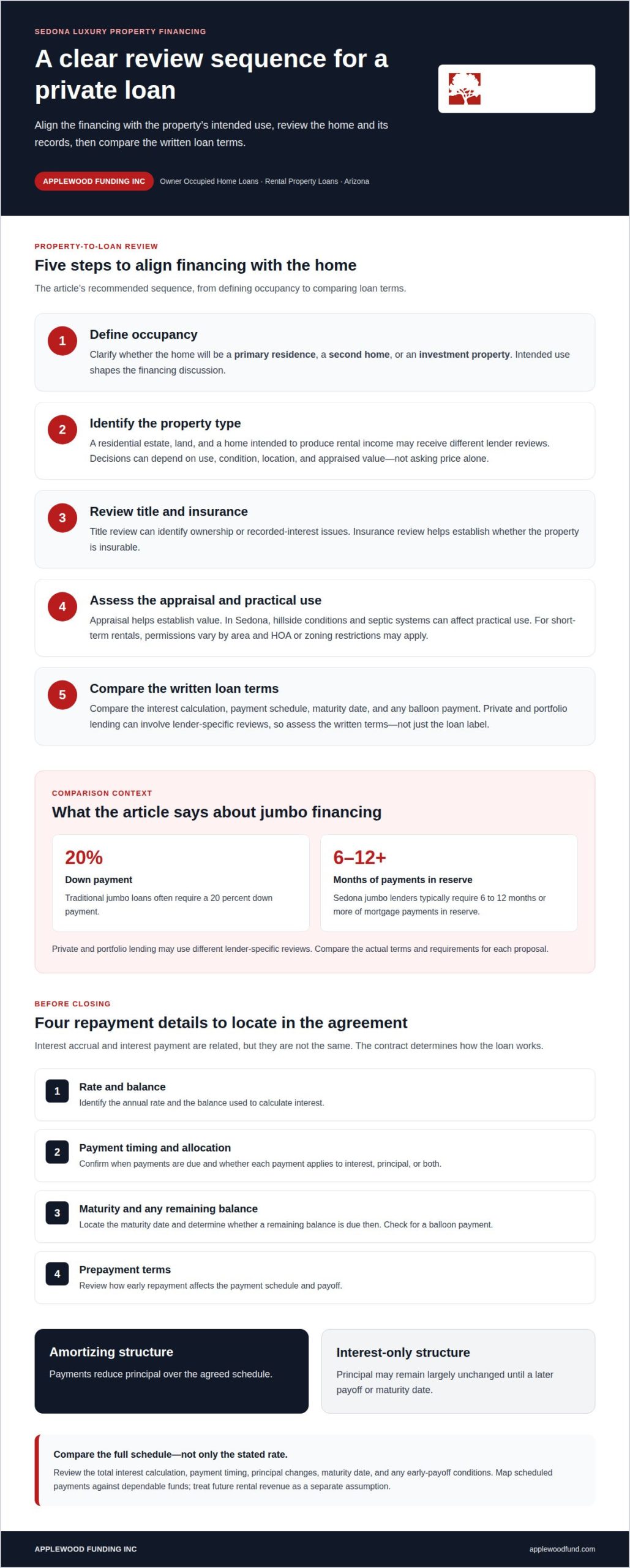
For a Sedona second home, compare a private loan with a jumbo mortgage and a portfolio loan by examining qualification criteria, down payment, reserves, and repayment structure. Traditional jumbo loans often require a 20 percent down payment, and Sedona jumbo lenders typically require 6 to 12 months or more of mortgage payments in reserve. Private and portfolio lending can involve different lender-specific reviews, so compare the written terms rather than relying on the loan label.
A portfolio loan is held by the lender rather than sold like many conventional mortgages. Private loan terms depend on the agreement and the property securing the loan. Compare the interest calculation, payment schedule, maturity date, and any balloon payment before choosing a structure.
Local Lender Options
Sedona buyers can consider private hard money financing for luxury residential purchases. Applewood Funding Inc is a private hard money lender offering Owner Occupied Home Loans and Rental Property Loans in Arizona. Identify whether the property will be a primary residence, second home, or investment, then compare the financing structure with that intended use.
Arizona licensing and compliance requirements depend on the transaction and the parties involved. A lender’s licensing status and role can depend on the transaction and the parties involved. Review the loan documents and the lender’s role together, since a residential purchase and an investment transaction can raise different compliance questions.
Eligible Property Types and Price Ranges
Sedona’s luxury market includes second homes and investment properties, with homes often priced above Arizona’s average. A lender’s decision can depend on the home’s use, condition, location, and appraised value, not its asking price alone.
For nearby-area searches, define the property type before comparing financing. A private lender may assess a residential estate differently from land or a home intended to produce rental income. The available market information gives Sedona figures, not a separate price range for every nearby community, so evaluate each property on its own characteristics.
Local Financing Considerations
Appraisal, title, and insurance reviews help establish a property’s value, ownership status, and insurability. In Sedona, hillside conditions and septic systems can affect practical use, while title review identifies ownership or recorded-interest issues relevant to the transaction.
Short-term rental plans need particular attention: vacation-rental permissions vary by area, and HOA or zoning restrictions may apply. Review those factors before relying on projected rental income. Red-rock views, downtown access, and resort-area locations can also shape property demand and appraisal context.
Use a clear sequence: define occupancy, identify the property type, review title and insurance, assess appraisal findings, then compare loan terms. For a Sedona luxury property private loan, this helps align financing with the home’s actual use and the closing requirements.
Loan repayment and accruing interest
For a Sedona real estate purchase, the interest clause explains how borrowing costs build over time. It should state the rate, whether interest accrues on outstanding principal, how often payments are due, and when repayment ends. Review these terms alongside your purchase plan. A desirable property can still strain cash flow if its payment schedule conflicts with your income or rental plans.
Interest accrual and interest payment are related, but they are not the same. Accrued interest is calculated over time under the loan agreement; a scheduled payment may cover interest, principal, or both. With an amortizing structure, payments reduce principal over the agreed schedule. With interest-only payments, principal may remain largely unchanged until a later payoff or maturity date. The contract determines which structure applies.
Use this sequence to understand the repayment obligation before closing:
- Identify the annual rate and the balance used to calculate interest.
- Confirm when each payment is due and how the agreement applies it.
- Locate the maturity date and determine whether a remaining balance is due then.
- Review prepayment language to understand how early repayment affects the schedule.
For example, a buyer using a Sedona home as a second residence may rely on income from elsewhere. An investor may expect rental income, which can vary with occupancy and permitted use. Map scheduled payments against dependable funds, and treat future rental revenue as a separate assumption. If the agreement includes a balloon payment, plan for that final obligation, not only the earlier monthly payments.
Compare written terms across financing proposals. A lower stated rate alone doesn’t show how much interest will accrue if the principal balance, payment timing, or loan duration differs. Look at the full schedule, total interest calculation, payment allocation, maturity date, and any early-payoff conditions. Ask for unclear calculations to be explained using the proposed loan’s actual balance and dates, not a generic illustration.
Keep the signed agreement and payment schedule together. Track due dates, principal changes, and any payoff amount provided during the loan term. For a Sedona investment property, update the cash-flow plan when rental assumptions change; for a second home, account for payments without relying on rental income. To discuss a structure for your purchase, review financing options for your property.
Sedona buyers interested in investment properties should review local regulations before purchasing. Make that review part of the purchase decision alongside the repayment schedule. If the plan depends on rental income, confirm that the intended use fits local requirements before relying on those assumptions in a cash-flow estimate.
Compare the intended property use with the obligations in the loan agreement, and revisit the financing plan if that use changes. Reviewing the terms before purchase can help align repayment expectations with your investment plan. Keep the relevant terms and assumptions together when assessing the full commitment.
Mortgage approval and closing timelines
A standard jumbo or DSCR loan in Sedona typically closes in 30 to 45 days. That estimate gives buyers a planning window, not a universal deadline for every private loan. The actual sequence depends on the lender’s review, the property file, and how quickly each closing item is completed.
Approval starts with the proposed loan and the property’s intended use. A second home and an income-producing property may require different information because their repayment plans differ. The lender reviews the borrower’s financial profile alongside the property and identifies outstanding items before final approval. A clear purchase contract and consistent application details help keep the review organized.
For a Sedona home with red-rock views, the property review involves more than confirming its address and asking price. The appraisal supports the lender’s collateral assessment, while title work helps establish ownership and identify recorded interests. Insurance information also needs to fit the property and proposed use. Resolve questions about documents early to help prevent delays in later closing steps.
Keep the process moving with a simple sequence:
- Submit the application. Provide complete borrower, occupancy, and purchase details so the lender can open its review.
- Respond to requests. Send requested financial or property records promptly, with matching names and figures.
- Complete property review. Coordinate appraisal, title, and insurance items as the lender requires.
- Review final terms. Compare the approved loan amount, payment structure, interest terms, and closing figures with the agreement.
- Sign and fund. Complete the closing documents and funding steps according to the transaction schedule.
Each step can cause a different delay. Missing borrower records can pause underwriting; property questions can extend appraisal or title review; changes to purchase terms can require updated calculations. For a DSCR loan, the lender also considers the investment property’s income profile. Keep contract dates visible and send requested materials to the appropriate closing contact promptly.
Before setting a move-in or rental start date, distinguish approval from funding. Approval means the lender has accepted the application under stated conditions; closing completes the required documents and transaction steps. A Sedona private loan may follow its own agreed timeline, so use the written schedule for that transaction rather than assuming the 30 to 45-day standard-loan estimate applies. This distinction helps buyers coordinate access, insurance, and planned use without confusing a lending decision with a completed closing.
Primary residence requirements
A primary residence is the home a borrower occupies as their main home; a second home or rental serves a different purpose. For a Sedona private property loan, the lender evaluates the stated occupancy plan alongside the borrower’s finances and property details. Borrowers generally provide financial records, property information, and purchase documents. The review depends on the loan structure.
Keep the occupancy description consistent throughout the application. A buyer purchasing a Sedona home for regular personal use should describe that plan accurately. A buyer planning to rent the property should explain the intended rental use. This distinction matters because occupancy affects how the lender assesses repayment, property use, and financing.
Borrower qualifications center on the ability to support the loan and the property’s role as collateral. A lender reviews income or other repayment resources, existing obligations, available assets, and the home’s value and condition. Credit history may also inform the review. No single document proves qualification by itself; the lender considers the full application and how its pieces fit together.
Organize the file around these practical records:
- Income documentation that reflects how you earn, such as employment records or self-employment income records.
- Personal or business bank statements that show account activity and available funds.
- Information about recurring debts and other financial obligations.
- The purchase contract, property address, and details describing intended occupancy.
- Property records and insurance information requested for the Sedona home.
Self-employed borrowers may use a bank statement loan that analyzes 12 to 24 months of personal or business bank statements. That review gives the lender a view of deposits and cash flow over time. Keep statements complete and consistent with the income figures in the application. If income changes seasonally or varies by project, supporting records can help explain the pattern.
For an owner-occupied application, explain how the home fits your living plans. A buyer relocating to Sedona may describe the move and expected occupancy. A buyer who will use the property only during visits should identify it as a second home, not a primary residence. Describe a rental plan as an investment use, including whether projected rent supports repayment.
Before submission, align the occupancy choice, purchase contract, financial records, and repayment plan. If plans change during approval, update the lender before closing rather than leaving conflicting details in the file. A clear, consistent application helps the lender assess the Sedona property and borrower profile against the requested loan structure.
Sedona Private Lender LTV and Down Payment Requirements
Loan-to-value, or LTV, compares the proposed loan with the property value used in underwriting. For a Sedona purchase, the lender’s appraisal and loan structure help determine the maximum financing considered. The down payment is the portion of the purchase price not covered by loan proceeds, plus any other closing funds required by the transaction.
There isn’t one LTV or down payment amount that applies to every Sedona private loan. Lenders weigh the property’s appraised value, condition, intended use, borrower profile, and repayment plan. A luxury home with distinctive features may require careful valuation because its asking price and appraised value can differ. The lender bases its calculation on the value and terms it accepts, not simply the buyer’s preferred number.
Use this sequence to understand the figures in a proposed loan:
- Identify the value used. Confirm whether the lender’s calculation uses the purchase price, appraised value, or another stated valuation.
- Review the proposed loan amount. Compare it with that value to understand the stated LTV.
- Calculate the cash gap. Subtract loan proceeds from the purchase price, then account for other transaction funds.
- Read the conditions. Note whether property condition, occupancy, or loan purpose changes the terms.
For example, if a Sedona property appraises below its contract price, the difference can affect the buyer’s cash requirement. The lender may calculate its loan against the lower accepted value, while the purchase contract remains at its agreed price. That gap can change the funds needed to complete the transaction. Ask for the valuation basis and proposed loan amount to be shown clearly in the written terms.
Down payment planning also depends on whether the home is a second residence or an investment. Projected rental income may inform the lender’s review, but it does not replace the collateral analysis. Property condition, title findings, and the borrower’s available funds can also affect the loan structure. Keep purchase funds separate from assumptions about future rental income.
Compare proposals by looking beyond the LTV percentage. Review the loan amount, valuation basis, cash contribution, payment terms, and any conditions tied to the property. For a Sedona luxury purchase, a clear side-by-side review can show whether each proposal fits the transaction and your available funds. To discuss a property’s financing structure, request a loan review.
Applewood Funding: Rental Property Loans
Applewood Funding Inc offers Rental Property Loans for buyers financing long-term rental investments. If your Sedona purchase is intended to generate rental income, this may fit better than financing structured around a personal second home. The property’s use and your investment plan help shape the financing discussion.
For a home you will occupy, Applewood Funding offers Owner Occupied Hard Money Loans. Fix and Flip Loans and Construction and Land Loans serve different project purposes. Match the financing discussion to the property and your plan, then review how the loan terms align with the intended use.
Have a Sedona rental property in mind? Contact Applewood Funding Inc to discuss your financing needs.
Put Your Sedona Financing Plan in Motion
Your next step is to align the property’s intended use with a financing plan you can manage beyond closing. Consider how long you expect to hold the home, how you will fund payments, and what may change if your plans shift. Those decisions help focus a conversation about a Sedona luxury property private loan with Applewood Funding Inc.
Bring the purchase details and your intended use into that conversation. A clear starting point makes it easier to discuss the property, your goals, and the loan structure you’re considering. If the home is an investment, be ready to explain its role in your broader real estate plans. If it’s a personal retreat, center the discussion on that use.
Take the next step when you’re ready. Contact Applewood Funding Inc about your loan to discuss your plans and financing needs. A clear plan starts with a focused conversation, and you can move forward with confidence.
Frequently Asked Questions
What private loan options are available for buying luxury property in Sedona, Arizona?
Options include private hard-money financing, jumbo loans, and DSCR financing for income-producing properties. Applewood Funding Inc offers Owner Occupied Hard Money Loans and Rental Property Loans for different occupancy plans, alongside Fix and Flip Loans and Construction and Land Loans for project-based purchases. Self-employed borrowers may also consider Bank Statement Loans for Self-Employed. Identifying whether the home is for personal use, rental income, or a project helps narrow the appropriate financing path.
What are typical loan terms and repayment structures for private loans on luxury homes?
Private loan terms and repayment schedules are set by the agreement, not by one standard structure for every Sedona home. Review how regular payments apply to principal and interest, how accrued interest is handled, and what balance is due at maturity. If a sale or another planned payoff is part of your strategy, compare the maturity date with that timeline. Read prepayment and default provisions before signing.
How long does private loan approval and closing take for a Sedona luxury property?
Standard jumbo or DSCR loans typically close in 30 to 45 days. That estimate is not a universal timeline for private loans. For a private loan, use the transaction’s written schedule and approval conditions to understand the remaining steps. A Sedona buyer can keep the process organized by coordinating requested borrower and property documents with the purchase contract’s key dates.