

Fast Closing Real Estate Loans in Mesa, AZ
November 13, 2026Tucson Private Money Lenders for Real Estate Investors
The property and the deal can matter more than a borrower’s credit history. Tucson private money lenders for real estate provide property-backed financing, making hard money loans an option when an investor’s project needs an alternative to traditional financing. The property and its value are central to the loan request.
That flexibility can help with a time-sensitive purchase, a fix-and-flip, a rental investment, or a construction project. But the right financing depends on what you’re buying, what work the property needs, and how the loan will be repaid. This guide explains how hard money loans work, which Tucson property types they can finance, what lenders assess during approval, and how to find private lending options. You’ll also see where fix-and-flip, rental, construction, and land financing fit, so you can identify the next step for your project.
Key Takeaways
- Understand how hard money and private money loans use real estate as key collateral, and how that differs from traditional lending.
- Match short-term financing to your investment plan, whether you’re acquiring a property, renovating it, or preparing it for rental.
- Learn which details about a property and project shape a lender’s approval decision.
- See how residential, commercial, and industrial projects can call for different financing approaches.
- Explore how Applewood Funding’s hard money, fix-and-flip, rental, construction, and land loan offerings may fit your project.
What are Hard Money Loans?
In Tucson, private money and hard money loans are property-backed financing, while banks generally use broader borrower and income reviews. Arizona rules depend on the loan structure, purpose, occupancy, and lender’s role, so “private money” alone doesn’t identify a specific licensing requirement.
Hard Money and Private Money Definitions
Hard money loans are short-term loans secured primarily by real estate collateral. Private money describes financing from nonbank lenders, including specialized lending companies and private investors. The terms often overlap, but they don’t guarantee identical underwriting. A borrower should focus on the property, repayment plan, loan term, and written agreement. Those details show whether financing fits a purchase, renovation, or rental strategy.
Qualification commonly centers on the property and the transaction’s assets, rather than credit history alone. A lender may review the purchase contract, property details, renovation scope and budget, borrower financial information, and exit plan. For a fix-and-flip, the plan should explain how improvements support resale or refinancing. Organize the project details early so the lender can assess the same deal the borrower intends to complete.
Deferred Terms and Interest Rates
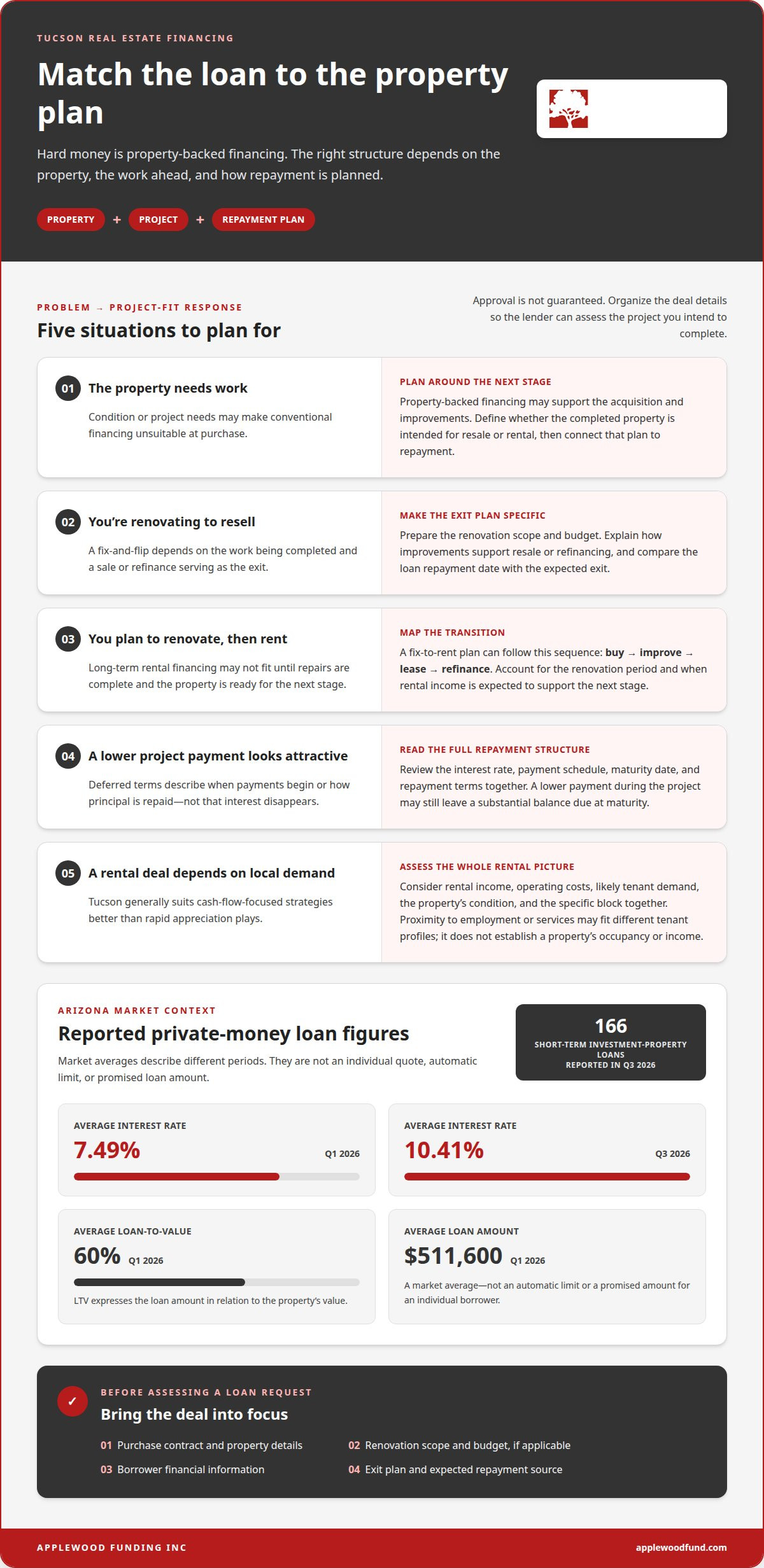
“Deferred terms” can refer to when payments begin or how principal is repaid, not a promise that interest disappears. The agreement sets the interest rate, payment schedule, maturity date, and repayment terms. Read these together. A lower payment during the project may still leave a substantial balance due at maturity.
Arizona private money loans averaged an interest rate of 7.49% in the first quarter of 2026. In the third quarter of 2026, they averaged 10.41% across 166 short-term investment-property loans. These market averages describe different periods, not a quote for an individual borrower. The property, leverage, project risk, and repayment plan influence the terms offered.
Loan Amounts and Loan-to-Value Limits
Loan-to-value, or LTV, expresses the loan amount in relation to the property’s value. Arizona private money loans had an average LTV of 60% in the first quarter of 2026, with an average loan amount of $511,600. These are market averages, not automatic limits or promised amounts. A lender also considers collateral quality, project costs, and the funds needed to complete the plan.
Loan-count rankings need context. Compare the same geography and reporting period, and distinguish funded loans from applications. A ranking without those details can mislead Tucson borrowers. Instead, focus on how the lender evaluates the property, what documents support the requested amount, and when repayment is due.
Hard money loan benefits for Tucson real estate investors
For Tucson buyers, hard money financing can support a purchase when the property’s condition or project needs make conventional financing unsuitable. The key is matching the loan structure to the investment plan.
Investor Loan Benefits
For real estate investors, a property-focused review can be useful when income documentation or borrowing history doesn’t reflect a project’s potential. Financing is structured around the acquisition or improvement plan, but approval is not guaranteed. Compare the repayment date with the expected sale or refinance. A clear exit plan keeps the loan connected to the project’s economics.
Tucson generally suits cash-flow-focused strategies better than rapid appreciation plays. That makes rental income, operating costs, and the property’s likely tenant demand central to neighborhood selection. A property near employment or services may fit a different tenant profile than one chosen mainly for resale potential. Assess the block, property condition, and rental plan together, not as separate decisions.
Property Financing and Purchase Funding
Investment property financing can support an acquisition that needs repairs before long-term rental financing becomes suitable. Tucson investors may also use a fix-to-rent strategy: buy a property, improve it, lease it, then refinance into a long-term rental loan. Plan for each transition, including the renovation period and when rental income is expected to support the next stage.
Hard money can also fund a purchase while an investor prepares a property for resale or rental. For example, a buyer may finance a home that needs work, then plan to sell it after renovation or keep it as a rental. Each route has a different repayment source. A sale depends on the completed property and buyer demand; a refinance depends on the stabilized rental and its financing fit.
Tucson’s rental market includes tenants connected to six major active-duty military installations in Arizona. That context may help investors assess potential demand, but it doesn’t establish a specific property’s occupancy or income. Evaluate the location and intended tenant before relying on rental projections. A sound plan links purchase price, improvement scope, lease strategy, and repayment path.
Arizona’s estimated funded private money loan volume was approximately $12.9 billion in the second quarter of 2026. That statewide activity offers market context, not a forecast for a Tucson investment or an individual loan. For rental acquisition or refinancing, discuss your investment financing options in light of the property and exit plan.
Residential, commercial, and industrial property financing
In Tucson, financing needs vary with a property’s use, condition, and income plan. Match the loan structure to the asset and the project’s next stage.
Property Type Financing
A residential rental, apartment building, storefront, and industrial property each raise different financing questions. For a Tucson rental home, consider occupancy plans, property condition, and expected rent. For commercial or industrial real estate, explain the intended use, current operations, and improvement needs. The property type shapes the financing request.
Start with the asset’s role. Is it a stabilized rental, a vacant building, or a property that needs substantial work? A clear answer connects the requested financing to the property’s use and helps distinguish a purchase loan from construction, renovation, or longer-term ownership financing.
Bridge and Construction Financing
Commercial bridge financing can address a temporary funding need while a property moves toward sale, lease-up, or longer-term financing. Construction financing instead supports a building or development project. A Tucson investor planning new construction should present the property, project scope, budget, and intended completion strategy as one connected plan.
For either approach, the project timeline and repayment route matter. A bridge loan may depend on a sale or refinance; construction financing must account for work completed and the property’s intended use. Lay out those milestones clearly. Lenders can then assess how the requested funds relate to each stage.
Apartment financing differs from a single-property rental loan. The number and mix of units, existing leases, occupancy, and operating income can all inform the loan request. A building with signed leases differs from one requiring repairs and tenant placement. In Tucson, explain whether the plan is to maintain current operations, improve the units, or reposition the property.
Cash flow is central to rental underwriting. Debt service coverage ratio, or DSCR, compares property income with debt obligations. Investors can use DSCR loans for stabilized rental properties in Tucson. That makes the property’s income performance especially relevant. A vacant building or a property undergoing major repairs may need a different financing approach before it reaches stabilized operation.
Fix-and-flip financing addresses another stage: acquiring and improving a property for resale. The lender’s review can consider the purchase, planned work, and exit strategy together. For example, a Tucson home needing renovation has a different financing profile from a leased apartment building. The interest rate and other terms depend on the deal’s risk, collateral, and repayment plan, rather than the label attached to the property.
Industrial property also needs project-specific analysis. A warehouse purchased for continued use differs from one requiring construction or a change in operations. Identify its current condition, intended use, and repayment source to connect the opportunity with financing suited to the asset.
Mortgage application and approval process
A Tucson mortgage application turns a property opportunity into a documented loan request. The lender reviews the asset, planned use, requested funding, and repayment strategy before approval and closing.
For a residential purchase, prepare the purchase contract, property address, requested loan amount, and borrower details. A renovation project also needs a scope of work and budget. A rental request can include lease information and income projections. These documents connect the financing request to the property’s condition and intended use.
The process usually moves through these practical stages:
- Initial review: The lender collects the property details, transaction purpose, and borrower information.
- Project assessment: The lender reviews the purchase terms, renovation plan, rental strategy, or construction scope.
- Collateral review: Property value and condition inform the proposed loan structure.
- Terms and approval: The lender sets out the amount, interest rate, payment terms, and maturity date for review.
- Closing preparation: The parties coordinate the documents needed to complete the transaction and fund the loan.
Keep the application clear and consistent. For example, a Tucson fix-and-flip file should connect the purchase contract, repair budget, and planned sale or refinance. If the requested amount changes, update the figures to match the project plan. This gives the lender a coherent basis for evaluating the transaction.
A mortgage broker can help organize an application and coordinate communication between borrowers and lenders. The lender makes its own underwriting decision, while a title or escrow professional may coordinate closing documents and funds. These roles are distinct. Identify who is assessing the loan, preparing the closing, and answering borrower questions.
Funding speed follows the work required to review the file, property, and transaction. A complete purchase contract and renovation budget give the lender clearer information than an application with missing project details. Property condition, appraisal or valuation needs, title work, and the closing schedule can also affect timing. No timeline should be assumed from the word “hard money” alone.
Before signing, review the written terms carefully. Confirm the interest rate, payment schedule, maturity date, and any balance due at payoff. For a residential rental, align those terms with the lease-up and income plan. For construction, connect expected funding needs to project milestones. This final review ties the loan to the needs of the Tucson property.
Tucson private money lender listings
Evaluate Tucson lenders by matching the program to your property, project, and repayment plan. Compare written terms side by side, including the interest rate, payment structure, maturity date, and collateral requirements. When considering Tucson private money lenders for real estate, use the same deal details for each comparison.
A listing is a starting point, not a quality ranking. Directory order doesn’t show whether a lender handles residential purchases, commercial projects, construction, or rental properties. For each name, identify the loan types offered and the property types financed. A lender focused on fix-and-flip projects may not fit a stabilized apartment purchase.
Use one consistent project description for every comparison. For a Tucson renovation, describe the property, planned work, purchase terms, and intended exit. Consistent details make it easier to compare programs using the same assumptions. Include the requested amount and repayment plan.
- Program fit: Identify whether the lender considers residential, rental, commercial, or construction projects.
- Loan structure: Compare the interest rate, payment timing, maturity date, and payoff terms.
- Collateral review: Note how the property’s condition and value affect the proposed amount.
- Borrower review: Understand how credit score, experience, assets, and income enter the assessment.
- Execution: Compare the application materials and closing steps required for each offer.
Look beyond the advertised rate. A shorter repayment period or payment structure may not fit the project. Compare the full written offer and identify the total amount due at payoff. For a renovation and resale, align the maturity date with the project schedule and expected sale.
For Tucson rental loans, distinguish a property with established income from one still being renovated or leased. A stabilized rental and a property needing substantial work have different financing needs. Commercial borrowers should also distinguish acquisition, construction, and other project requirements. Broad listing descriptions may not explain these differences.
Credit score is one part of the borrower picture, not a substitute for reviewing the property and repayment plan. Ask how the lender weighs collateral, project details, income, and assets. When comparing tucson private money lenders for real estate, check that every discussed term appears in the written proposal before deciding.
To compare offers for a Tucson purchase or renovation, discuss your loan options with a lending professional.
Applewood Funding
Applewood Funding Inc helps Tucson investors connect real estate projects with financing suited to their purpose. Its options include Owner Occupied Hard Money Loans, Fix and Flip Loans, Rental Property Loans, and Construction and Land Loans.
Consider Applewood Funding Inc when a property purchase, renovation, rental plan, or construction project needs financing beyond conventional lending. Share the property details, intended use, and repayment plan so the conversation can focus on the factors that shape the loan.
Contact Applewood Funding Inc to discuss your real estate financing needs.
Move Your Tucson Project Forward
The key decision is whether the loan structure supports the property’s intended use and repayment plan. Assess Tucson private money lenders for real estate based on the deal’s purpose, property condition, and exit path. If a project depends on stable, long-term payments, short-term financing may be a poor fit. Match the loan timeline to the investment plan.
Before getting started, clarify what needs funding, the property’s current stage, and how the debt will be repaid. A clear project brief helps focus the discussion on relevant terms and financing options. Keep the decision grounded in the property and its financial plan, whether the goal is to acquire, improve, hold, or develop real estate.
Ready to discuss a financing path for your Tucson property? Connect with Applewood Funding to talk through your project and next steps. Start with a clear plan, then move forward with purpose.
Frequently Asked Questions
Can I Qualify With a Lower Credit Score?
Yes, a lower credit score doesn’t automatically rule out a hard money application. Applewood Funding Inc states, “No Credit Required.” A lender can still assess the property, the requested financing, and the project’s repayment plan. For example, a borrower purchasing a property for renovation can explain the work and intended exit strategy alongside the property details. Credit isn’t the only factor in the lending decision.
How Do They Work?
Private real estate loans center the property and transaction in the financing review. Provide details about the property, planned use, and repayment strategy. The lender evaluates the request and presents proposed terms for review. For a rental purchase, connect the property with the plan to operate it as a rental. Review the written agreement and payment obligations before proceeding.
How Long Does the Approval Process Usually Take?
Approval timing depends on how quickly the lender can review the property, project, and closing details. A complete application with a purchase contract, property information, and a clear project plan gives the lender a more coherent file to assess. Appraisal or valuation work, title preparation, and closing coordination can also affect timing. Applewood Funding Inc describes its process as “Quick Application – Quick Closing,” without specifying a standard number of days.
What Documents Do I Need to Get Started?
Start with the purchase contract, property address, requested loan amount, and a description of the planned use. A renovation project also needs its work scope and budget; a rental request can include lease details and income information. Provide the financial and asset details requested for the application. For a Tucson purchase that needs repairs, make sure the property plan and repair budget describe the same project.
Where Can You Apply?
You can apply for Arizona real estate financing through Applewood Funding Inc. The company serves Arizona borrowers, including those pursuing projects in Tucson, Phoenix, Scottsdale, Glendale, Peoria, Mesa, and Sedona. Submit your property and project details through the application process to focus the discussion on your financing purpose and loan structure.
Which Private Money Lenders Offer Real Estate Loans in Tucson, Arizona?
Applewood Funding Inc offers real estate financing for Arizona borrowers, including Tucson investors and property owners. Its loan options include owner-occupied hard money, fix-and-flip, rental property, and construction and land loans. The right fit depends on the property’s intended use and the project. A buyer renovating a home for resale has a different financing need from an owner seeking financing for an occupied property.
What Types of Tucson Real Estate Deals Do Private Lenders Finance?
Private real estate lending can support property acquisition, renovation, rental investment, and construction. Applewood Funding Inc offers financing for owner-occupied properties, fix-and-flip projects, rental properties, and construction or land. A Tucson investor planning to renovate and resell should describe the purchase and work plan; a rental borrower should explain the intended rental use. Match the request to the deal.
What Are Typical Tucson Private Money Loan Rates, Fees, and Points?
Rates and points depend on the loan’s written terms, while application costs should be distinguished from other charges. Applewood Funding Inc states, “No Up-Front Fees – No Cost to Apply.” Review the proposed interest rate, payment schedule, maturity date, and any points or closing charges in the loan documents. Ask for the full repayment terms in writing so you understand the obligations attached to your specific Tucson property financing.