

Cash Out Refinance Rates in Scottsdale, AZ: Compare Loan Costs
November 11, 2026Hard money lenders that fund 100% of rehab: cash needed
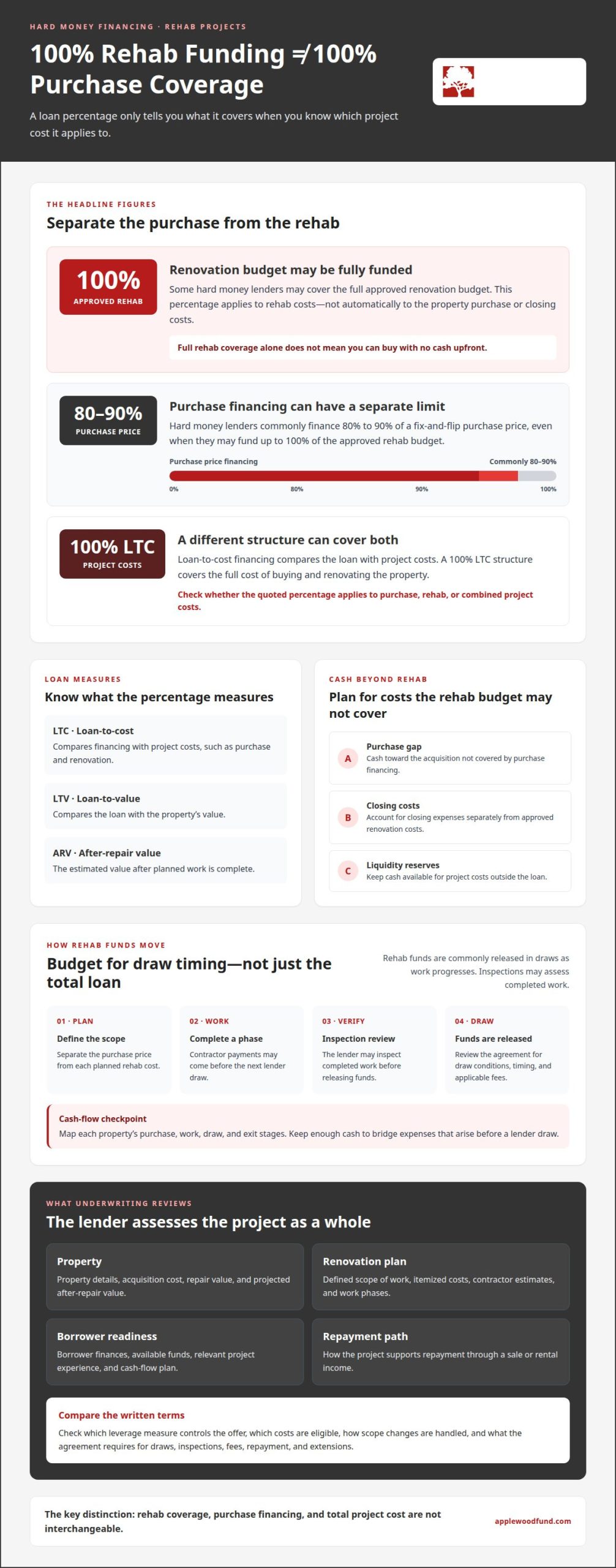
Funding 100% of the rehab doesn’t automatically mean you can buy a property with no cash upfront. Some hard money lenders that fund 100% of rehab may cover the approved renovation budget while financing 80% to 90% of a fix-and-flip property’s purchase price. A 100% loan-to-cost structure, by contrast, covers the full cost of buying and renovating the property.
Focusing on the rehab percentage makes sense when renovation costs are the main hurdle. But that figure is only part of the cash picture. Depending on the loan and project, you may also need funds for the purchase gap, closing costs, or reserves.
This guide explains hard money financing, how lenders assess a property, renovation budget, and borrower, and what cash you may need beyond rehab funds. It also covers how credit and project experience factor into financing decisions, so you can assess a deal before moving forward.
Key Takeaways
- Understand how a lender evaluates the property, renovation plan, budget, and projected value before deciding what a loan can cover.
- Build a cash-flow plan around closing expenses and the timing of renovation work, not just the approved loan amount.
- See how credit history and prior project experience can shape underwriting, and which parts of your application help show you’re prepared.
- Focus on the lender’s process for reviewing project details and managing rehab funds, not just the headline financing percentage.
- Match the financing approach to your project, whether you’re renovating a property to sell, hold as a rental, or develop.
What is hard money?
A hard money loan is property-focused financing often used for a fix-and-flip, rental, or renovation project. Whether it covers the full rehab budget depends on the lender’s program and how the loan separates purchase funds from approved renovation costs.
Full Rehab Versus Purchase Financing
Rehab financing pays approved renovation costs, while purchase financing pays toward acquiring the subject property. A loan covering 100% of rehab does not automatically cover the purchase price or closing costs. Hard money lenders commonly finance 80% to 90% of a fix-and-flip purchase price and may fund up to 100% of its approved rehab budget.
By contrast, 100% loan-to-cost financing covers the full cost of buying and renovating the property. So, when evaluating a “100%” offer, identify which cost category reaches that percentage. The distinction determines how much cash you must bring toward the acquisition.
Understanding Financing, LTC, LTV, and ARV
“100% financing” describes the share of a defined cost or value that the loan covers. Loan-to-cost, or LTC, compares financing with project costs, such as purchase and renovation. Loan-to-value, or LTV, compares the loan with the property’s value. After-repair value, or ARV, is the estimated value after planned work is complete.
These measures answer different questions. LTC shows how much project spending the loan may cover, while LTV and ARV help frame the property’s value after improvements. Ask which measure sets the financing limit and whether the calculation includes the purchase, rehab, or both.
How are rehab funds disbursed, and what inspections or draw fees apply? Rehab funds are commonly released in draws as work progresses, with inspections used to assess completed work. The loan agreement outlines the draw process, inspection conditions, and applicable fees. Include those terms in your project cash plan.
That timing matters when you’re managing multiple projects. If one fix-and-flip requires contractor payments before the next lender draw, you’ll need cash to bridge the gap. A rental renovation may follow a different schedule from a resale project. Map each property’s purchase, work, draw, and exit stages before committing cash across deals.
To qualify for high-leverage financing, prepare a clear path from acquisition to repayment:
- Identify the subject property and explain whether it will become a rental or a fix and flip.
- Separate the purchase price from each planned rehab cost, then support the requested budget with a defined scope of work.
- Show how the completed project supports repayment, using the property’s expected condition and value.
- Organize relevant project experience, available funds, and a cash-flow plan for costs outside the loan.
- Compare the lender’s LTC, LTV, ARV, draw, and inspection terms against the project plan.
Each step helps the lender assess the property and your ability to complete the work. Clear project details also show whether rehab-only financing meets your needs or whether purchase financing matters more.
Hard money loan underwriting
Underwriting evaluates the property, renovation plan, borrower, and repayment path as one deal. With a hard money loan, the available financing depends on the lender’s program and the project’s strength.
Loan Programs and Leverage Limits
Private lenders with rehab programs may fund the approved renovation budget in full, while setting separate limits for purchase financing. Investors comparing hard money lenders that fund 100% of rehab should check how each lender calculates leverage. The loan’s limit can depend on acquisition cost, repair value, projected after-repair value, and the borrower’s cash contribution. Ask which measure controls the offer and whether it applies to purchase, rehab, or combined project costs.
Loan program terms also shape what qualifies. A bridge loan may support a short renovation and resale plan, while rental financing considers a hold strategy. Review the written terms for eligible costs, required borrower funds, and how changes to the approved scope are handled.
Application and Approval Process
Prepare a complete file before underwriting begins. Include the purchase agreement, property details, itemized renovation scope, contractor estimates, and exit plan. The lender uses these materials to assess the property, repair value, and whether the proposed work supports repayment through a sale or rental income.
Then the lender reviews borrower finances and project experience alongside the property. Respond promptly to requests for missing documents, and keep the scope and budget consistent across submissions. For a project with several repair phases, organize the work in sequence so the lender can assess costs and funding milestones clearly.
Loan Terms and Extension Options
The promissory note and loan agreement set the repayment schedule, interest calculation, payment structure, maturity date, and any extension process. Read those terms together. Delays can affect the payoff plan, so identify what the documents require if work or a sale takes longer than expected.
An extension option applies only if the agreement provides for one, and its conditions may include lender approval or additional charges. Confirm how and when to request an extension, and what happens if the loan reaches maturity before repayment. Add the relevant dates to your project calendar.
Eligible Property Types and Investment Strategies
Full rehab financing depends on the lender’s program and the project’s use, not a universal property list. A residential property planned for a fix-and-flip may be assessed differently from one intended as a rental. Describe the property, renovation plan, and exit strategy clearly to show how each fits the financing request.
Which hard money lenders fund 100% of rehab costs? Private lenders offering rehab-specific programs may cover the full approved renovation budget, subject to their underwriting and loan terms. For first-time investors, hard money lenders that fund 100% of rehab evaluate the project and borrower against their program criteria. The property and strategy must fit the program.
What property types and investment strategies qualify for full rehab financing? Properties accepted by the lender’s program may qualify when the proposed renovations and repayment plan meet its criteria. For a project-specific financing discussion, review your hard money loan options alongside the property’s intended use and scope.
Cash required at closing and liquidity reserves
A rehab loan may cover approved renovation work without covering all the cash needed to close or carry the project. Before committing to the purchase, estimate acquisition funds, closing charges, prepaid interest, and post-closing liquidity separately.
Start with the gap between the purchase price and loan proceeds. If financing covers the rehab budget but only part of the acquisition, you’ll need cash for the remaining purchase balance. Closing costs and prepaid interest may also be due at settlement. The final amounts depend on the loan documents, transaction, and closing statement, not the rehab percentage alone.
Review the lender’s estimate alongside the purchase agreement. Identify each amount due at closing, who receives it, and whether it’s paid separately or deducted from proceeds. Prepaid interest is interest collected in advance under the loan terms. Its timing affects the cash required at settlement, even when renovation funds are fully approved.
Closing through an LLC adds an entity to the documentation and funding process. The lender and closing agent need consistent information about the borrower, ownership, and intended property use. A business-purpose loan involving an LLC may raise questions about coverage under the Truth in Lending Act. The legal classification depends on the transaction’s facts; an LLC name alone doesn’t settle it. Review the loan documents and required disclosures for the specific deal.
Keep the application and closing sequence organized:
- Submit the purchase details, borrower information, renovation scope, and requested financing structure.
- Resolve lender questions about the subject property, intended use, and entity documents.
- Review the approved loan terms, closing costs, prepaid interest, and any conditions to funding.
- Compare the closing statement with the approved terms before funds are transferred.
This sequence helps uncover a cash gap before closing day. A revised repair budget or delayed document, for example, can change what’s approved or when proceeds are available. Keep funds accessible until the closing agent confirms the final amount due and the settlement is complete.
Plan reserves for the period after closing, too. Contractors may need payment before a lender releases a renovation draw, and the property may not produce rental income during repairs. Set aside liquidity for carrying costs and unplanned work based on the project schedule and your other obligations. A rental strategy also needs a plan for expenses between renovation completion and the start of expected rent.
Keep closing cash and project reserves separate in your records. Label funds for acquisition, settlement charges, interest, scheduled work, and unexpected delays. This makes it easier to see whether one real estate purchase could strain cash needed for another project. Treat the approved loan amount as one part of the funding plan, not a substitute for available liquidity.
Credit score and investor experience requirements
A borrower’s credit profile and real estate experience help underwriters assess execution risk, but neither tells the whole story. A strong appraisal and clear renovation plan support the property case, while credit history and completed projects show how the borrower has handled financial obligations and project work.
Credit-score requirements vary by lender and program, so don’t treat one score as a universal cutoff. A lender may group applicants into credit tiers and weigh each score alongside payment history, outstanding obligations, and recent credit events. Ask how the program uses credit information and whether the rest of your file can strengthen the review.
Credit is more than a single number. A borrower with a lower score and documented property experience presents a different file from a first-time investor with the same score and no completed projects. Underwriters may consider the reasons for credit issues, when they occurred, and whether accounts show a pattern. Provide accurate context and supporting records rather than relying on a score alone.
Experience also has several dimensions. A completed fix-and-flip can demonstrate familiarity with budgeting, contractors, inspections, and resale. Managing a rental shows a different set of responsibilities, including property upkeep and operating costs. Investors without direct renovation experience can clarify their role by documenting relevant project partners, the planned scope, and who will coordinate each phase.
For a 100% rehab request, the lender still evaluates whether the borrower can carry the project beyond the approved work budget. Credit history, available liquidity, project experience, and the appraisal each address a different risk. The appraisal informs the property’s value; it doesn’t replace evidence that the borrower can manage the renovation and meet loan obligations.
Prepare a concise borrower file before submitting the application:
- Provide complete credit information and explain any material credit events with relevant records.
- Summarize completed real estate projects, including the property’s use and your role.
- For each renovation, organize the scope, budget, timeline, and outcome.
- Identify how contractors or partners will support work you haven’t managed before.
- Connect your available cash to project needs that financing does not cover.
Use consistent project details across your application, renovation budget, and borrower summary. If the application describes a rental but the exit plan describes a resale, clarify the strategy before underwriting proceeds. Consistency helps the lender assess the borrower, property, and intended repayment path together.
Credit challenges don’t determine an application’s outcome on their own. Their effect depends on the lender’s criteria and the full file. Present your credit history alongside relevant experience, the appraisal, and a credible project plan. Clear details give underwriters something concrete to evaluate.
Choosing a private lender
Choose financing by matching its funding process to your project, not by focusing on headline leverage alone. Compare how the lender defines approved rehab costs, releases funds, handles delays, and evaluates your repayment plan.
Private lenders with rehab-specific programs may fund the full approved renovation budget. First-time real estate investors can apply, but financing depends on the lender’s criteria and the complete deal, including property condition, scope, borrower finances, and exit strategy. Ask how the program assesses limited experience rather than assuming every lender uses the same standard.
Which lenders offer 100% rehab financing to first-time real estate investors? Private lenders with rehab loan programs may consider first-time borrowers when the project and application meet their underwriting criteria. Compare how each lender evaluates the property, renovation plan, available cash, and borrower readiness.
Which hard money lenders offer full rehab financing in my state or city? Look for private lenders whose programs cover the property’s location and offer rehab financing. In Arizona, Applewood Funding offers hard money financing for real estate projects, including Fix and Flip Loans. Assess the specific property and loan structure rather than relying on a nationwide label.
Use a consistent scorecard for each funding proposal:
- Coverage: Identify whether the loan funds rehab only or also covers part of the purchase.
- Draw process: Understand what documentation, completed work, or inspection triggers each release.
- Budget changes: Find out how the lender reviews revisions when hidden damage changes the scope.
- Repayment plan: Match the loan’s maturity and payoff requirements to a sale or rental strategy.
- Borrower criteria: Understand how credit, experience, liquidity, and project partners affect approval.
Read the term sheet and final loan documents together. A proposal may describe full rehab funding, for example, while the final documents limit eligible work or set conditions for releasing funds. Confirm how the approved budget, draw process, extension terms, and charges fit your schedule. A straightforward offer may still be a poor fit if its repayment deadline conflicts with the expected completion date.
Ask for a written explanation of how the lender calculates leverage. A percentage without its base can mislead: it may refer to purchase cost, rehab cost, combined project cost, or projected value. Compare like with like. If one offer bases funding on approved renovation costs and another includes acquisition, their headline percentages describe different levels of financing.
Also assess communication during the lending process. Renovation work can involve contractor changes, delayed materials, and updated documents. Know who handles draw requests, how decisions are communicated, and what happens when the project plan changes. These details affect cash flow after funding, not just the application stage.
Bring your property, budget, and intended exit strategy into a financing discussion. Discuss your rehab financing options with the project details ready.
Private lenders with rehab-specific programs may fund 100% of the approved renovation budget. Confirm which costs qualify and what conditions apply to releasing the funds.
Applewood Funding Inc
Applewood Funding Inc helps real estate borrowers explore financing for renovation, rental, and development projects in Arizona. If you’re comparing rehab coverage with purchase financing, bring the property details, planned work, and repayment strategy into the discussion. That keeps the focus on how the project fits the loan structure.
Available options include Owner Occupied Hard Money Loans, Fix and Flip Loans, Rental Property Loans, and Construction and Land Loans. The right fit depends on the property and how you plan to use it. Review the proposed financing alongside your cash needs, renovation timeline, and exit plan before moving ahead.
Ready to discuss your project? Contact Applewood Funding Inc to talk through your financing needs.
Move Your Next Deal Forward
Before pursuing financing, decide what a successful project needs to achieve. Are you looking to preserve capital for another acquisition, complete a renovation, or turn a vacant property into a rental? That priority can help determine which loan structure deserves a closer look.
Choosing among hard money lenders that fund 100% of rehab starts with matching the financing to your investment plan, not chasing a headline percentage. Bring the project’s goals and proposed timeline into a conversation about the right path. If your plans change, revisit the financing strategy before committing to a new deal.
Applewood Funding Inc can help you explore financing options suited to your real estate goals. Reach out to discuss your next project and take a clear next step toward putting your plan in motion.
Frequently Asked Questions
What is loan-to-cost (LTC)?
Loan-to-cost (LTC) compares the loan amount with the costs used to calculate the project budget. For a rehab purchase, that calculation may include acquisition and approved renovation costs. Check the lender’s definition of “cost,” because excluded expenses can affect how much cash you need. A project worksheet that separates purchase, repairs, and other expenses makes the calculation easier to follow.
Final Thoughts: Is 100% Rehab Financing Right for You?
It may fit if covering approved renovation work helps preserve capital for other project needs. It may be less useful if the remaining purchase balance, closing expenses, or cash reserves strain your budget. Before proceeding, map the expected project costs against the loan’s covered expenses and your available funds. The key decision is whether the complete financing structure supports your plan, not just whether rehab reaches 100%.
What happens to rehab funds that are never drawn?
Undrawn rehab funds are handled according to the loan agreement; they aren’t automatically paid to the borrower as cash. The documents should explain whether unused proceeds reduce the final amount advanced, affect the payoff calculation, or require another step at closing. Before work begins, compare the approved scope with the draw schedule. This helps you avoid planning around funds that won’t be released for completed work.
What is after repair value (ARV)?
After repair value (ARV) is the estimated value of a property after the planned renovation is complete. For example, an Arizona investor might use ARV to assess whether a renovated home’s projected value supports a resale or rental plan. ARV is an estimate based on the finished condition, not the property’s current value. The appraisal and proposed work help frame that projection for underwriting.
What is loan-to-value (LTV)?
Loan-to-value (LTV) compares a loan amount with a property’s value. It differs from LTC, which uses project costs as its reference point. For a rehab loan, confirm which property value the lender uses, such as the current or post-renovation value. The distinction matters because the same loan amount can produce different LTV calculations depending on the valuation.
What are typical loan-to-cost and after-repair-value limits for hard money rehab loans?
Hard money lenders commonly finance 80% to 90% of a fix-and-flip purchase price and may finance up to 100% of its approved rehab budget. A 100% loan-to-cost structure covers the full cost of buying and renovating the property. These measures describe different limits. Ask how a proposed loan applies LTC and ARV to your project, rather than treating full rehab coverage as full purchase financing.
What credit score, experience, and down payment do lenders require?
There isn’t one universal credit score, experience level, or down payment requirement across hard money programs. Underwriters assess the borrower’s credit profile and project background alongside the property, budget, and repayment plan. The required cash contribution also depends on what the loan covers. Rehab-only financing can leave an acquisition gap, while purchase financing may cover part of the price.
What are typical hard money interest rates, points, fees, and loan terms?
There isn’t one standard set of terms for every hard money rehab loan. Interest, points, other charges, repayment schedule, maturity, and extension conditions are set by the specific loan agreement. Review the full written terms, including how interest is calculated and when payments are due. Compare the financing structure with your renovation timeline and exit plan rather than judging an offer by a single term.