

Glendale Hard Money Loans for Bad Credit and LTV Limits
November 8, 2026How to Refinance Hard Money Debt Into a DSCR Loan in Arizona
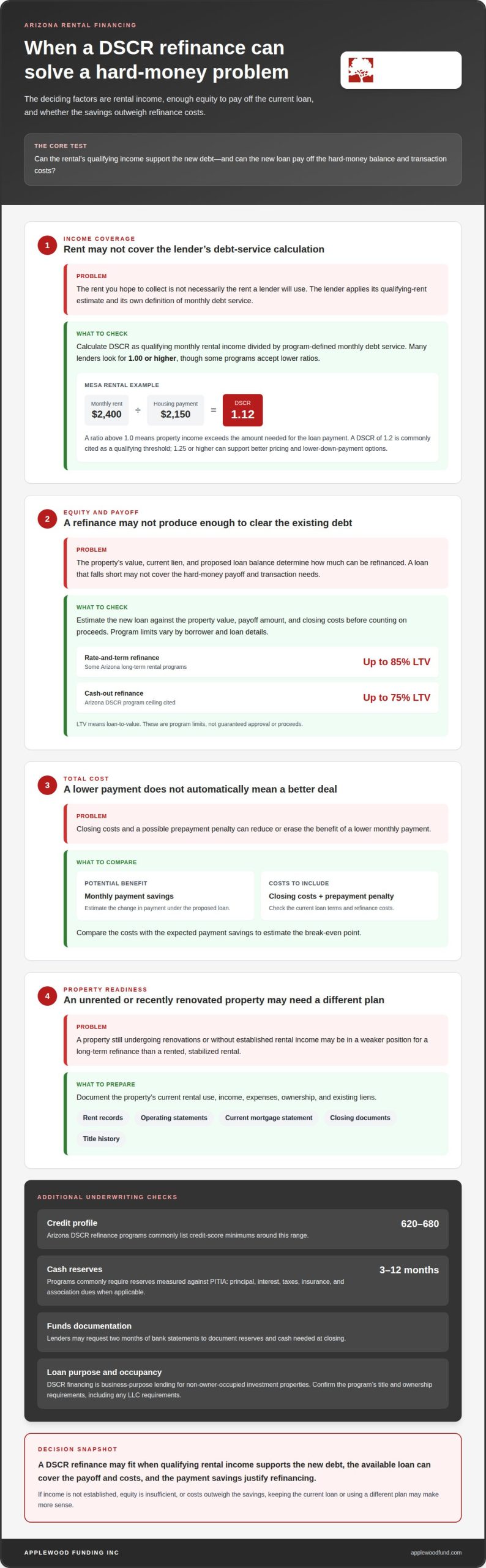
High hard money payments don’t automatically make refinancing the right move. You can refinance a hard money loan into a DSCR loan in Arizona if the property is a rental and its income meets the program’s requirements. Many DSCR lenders look for a ratio of 1.00 or higher, though some programs accept lower ratios.
The key is whether the property’s rental income can support the new debt and whether the refinance leaves enough equity to pay off the hard money loan. A lower payment may improve cash flow, but closing costs and any prepayment penalty can change the math. Timing matters, too: a newly renovated or unrented property may need a different plan than a stabilized rental.
Learn how DSCR is calculated, what lenders may review, and how to weigh costs against potential payment savings. Then use the refinancing steps to decide when moving from hard money may make sense for your Arizona rental, and when keeping the current loan may be the better move.
Key Takeaways
- A DSCR refinance can replace hard money debt on an Arizona rental when the property’s qualifying income supports the new loan.
- Loan-to-value, credit, and cash reserves can affect how much you can refinance and what terms may be available.
- Rent records and operating statements help show the property’s income and expenses during underwriting.
- Compare potential monthly payment savings with refinance costs and any prepayment penalty to estimate your break-even point.
- Timing matters: a rented, stabilized property may be in a stronger position for a long-term refinance than one still undergoing renovations.
DSCR Loans in Arizona: Best Cash-Flow Locations
- Confirm the property and occupancy fit. DSCR financing is for business-purpose, non-owner-occupied investment properties. Under the cited federal business-purpose context, the rule does not apply if the borrower expects to stay in the home more than 14 days in the coming year, according to the Electronic Code of Federal Regulations. Treat the rental as an investment, not a home you plan to occupy. If you’re refinancing hard money, the property’s rental use and income are central to whether it can qualify.
- Calculate coverage using the rent and debt service. A common residential-investor calculation divides qualifying monthly rental income by program-defined monthly debt service. For example, a Mesa rental bringing in $2,400 monthly against a $2,150 housing payment has a DSCR of 1.12. A ratio above 1.0 means the property’s income exceeds the amount needed for the loan payment. Use the lender’s debt-service definition and qualifying rent estimate, not just the rent you hope to receive.
- Compare local rents with the proposed loan. Phoenix’s median rent was $1,255 in October 2026, down 2.9% from a year earlier. That citywide figure is context, not a rent estimate for every property or submarket. Compare the subject rental’s supported income with its projected monthly debt service, then test how taxes, insurance, vacancies, and operating costs affect cash flow. A Phoenix portfolio property and a Mesa rental may need separate estimates.
- Check refinance leverage before counting on proceeds. Some Arizona long-term rental DSCR purchase and rate-and-term refinance programs allow a maximum loan-to-value ratio of 85%, depending on borrower and loan details. Cash-out refinancing can have a lower ceiling, with Arizona DSCR programs allowing up to 75% of property value. Estimate the new loan against the value and payoff amount. The available proceeds must cover the hard-money balance and transaction needs.
- Review short-term rental rules and tax obligations. Arizona cities may regulate short-term rentals, even though state law prevents cities from banning them outright. Scottsdale requires short-term rentals to carry $500,000 in liability coverage. Arizona short-term rental owners may need a state Transaction Privilege Tax license through the Arizona Department of Revenue. Arizona has a flat state income tax rate of 2.5%, according to the Arizona Department of Revenue. Review local rules and HOA documents before basing refinance income on short-term bookings.
Down payment, credit score, and reserve requirements
- Separate purchase requirements from refinance equity. A purchase requires a down payment; refinancing focuses on the property’s value, existing lien, and proposed loan balance. Arizona DSCR purchase programs commonly require 20% to 25% down, while some allow a wider range. For a refinance, the lender compares the requested amount with the property’s value and calculates loan-to-value. That calculation affects whether the proceeds can pay off the hard money debt, cover closing costs, or provide cash out.
- Check the credit and coverage thresholds together. Arizona DSCR refinance programs commonly list credit score minimums around 620-680, while program minimums more broadly range from 620 to 660. The property’s cash flow matters too. A DSCR of 1.2 is typically cited as a qualifying threshold, and a ratio of 1.25 or higher can support better pricing and lower down-payment options. Compare your credit profile and rent-supported coverage before choosing a loan structure.
- Set aside reserves for the property’s full payment. DSCR programs commonly require 3 to 12 months of PITIA in cash reserves. PITIA includes principal, interest, taxes, insurance, and association dues when applicable. For a refinance, reserves help show the property can carry its obligations through a vacancy or repair period. Lenders may also request two months of bank statements documenting funds for reserves and any cash needed at closing.
- Review seasoning and title history before applying. Seasoning refers to how long you have owned the property or held the current loan. A lender may review ownership and lien records to determine whether the transaction qualifies as rate-and-term or cash-out refinancing. Gather the current mortgage statement, closing documents, and title history. These records can explain recent transfers, renovation financing, and liens that must be cleared at closing.
- Match the ownership structure to the loan purpose. DSCR loans are business-purpose financing for non-owner-occupied investment properties. Many Arizona DSCR programs allow ownership through an LLC, and LLC members typically provide personal guarantees. Keep the entity’s ownership records consistent with the property title and application. If the rental is held personally, compare that structure with the program’s title requirements before preparing closing documents.
Use these requirements to identify what may affect your refinance amount, cash needed, and approval path. For help assessing an Arizona rental financing scenario, discuss your property financing options.
Refinancing hard money and private money loans
Map the debt you’re replacing, the property’s current use, and the refinance structure before choosing a path. These steps help investors move from short-term lending toward rental cash flow and longer-term financing.
-
Compare Available Refinance Loan Types
First compare rate-and-term and cash-out DSCR refinancing. A rate-and-term refinance replaces existing debt, while a cash-out refinance may also release equity, subject to the property’s value and program limits. DSCR loans qualify using rental income rather than tax returns, which can suit investors managing rental properties. Conventional refinancing follows a different underwriting route, so compare its documentation requirements with property-income qualification.
Then match the loan structure to the next investment move. If preserving equity matters most, focus on replacing the current balance and maintaining cash flow. If you need proceeds for another project, assess whether a cash-out structure fits. Arizona DSCR loans can have 30-year fixed terms, giving eligible rental owners a longer-term alternative to short-term debt.
-
Refinance Hard or Private Money Debt
List the current payoff amount, maturity date, monthly payment, and any prepayment terms. Hard money loans frequently carry interest rates between 9 percent and 15 percent, depending on risk and property condition. Investors often use this financing to act on a purchase or renovation before the property is ready for long-term lending. The tradeoff is that short-term debt can pressure cash flow if the rental transition takes longer.
Next, compare the payoff with the DSCR loan amount supported by the property’s value and qualifying rent. Account for any remaining renovation work, occupancy status, and the timing of lease income. Many DSCR loans include a prepayment penalty during the first 1 to 5 years, so review the existing loan terms and proposed replacement structure. Don’t treat available equity as spendable proceeds until the new loan’s limits and payoff needs are clear.
-
Move a Bridge Loan to DSCR
Plan the transition from bridge financing around the property’s readiness. Arizona bridge loans can run for up to 24 months, while investors may refinance a bridge loan into a 30-year DSCR loan after leasing up a small apartment building. A new-construction project may also move to DSCR financing once rented. The key shift is from funding a temporary project to qualifying the completed rental through its income.
Build a clear handoff: finish the work, establish rental income, and organize ownership records before the bridge term ends. If an LLC owns the property, Arizona DSCR programs commonly allow LLC vesting, with members typically providing personal guarantees. Match the LLC’s title and ownership records to the refinance application. For a property-specific financing discussion, review Arizona rental financing options.
Can I use a DSCR Loan to refinance an existing rental property?
Yes. A DSCR loan can refinance an existing rental property, with underwriting focused on rental income and property expenses. Organize the records clearly so the lender can assess coverage and the loan’s purpose.
-
Gather Application Documents
Start with a current rent roll and operating statement. A rent roll lists rental income by unit, while an operating statement organizes the property’s income and expenses. Make sure the figures match. For example, if a unit is vacant, show that clearly rather than counting its expected rent as collected income.
Next, assemble property and loan records that explain the refinance request. Include the existing mortgage statement, current payoff information, ownership details, and leases supporting the rent roll. Keep the property address and ownership names consistent across documents. For an LLC-owned rental, include records linking the entity to the property and identifying its members. Clear records help underwriting assess the application’s purpose and repayment picture.
Use the documents to tell one consistent story about the property, its current debt, and its rental income. Correct mismatched dates or amounts before submitting the file. An outdated rent roll paired with a newer operating statement can raise questions about actual income and occupancy.
-
Document Operating Expenses
Build an operating statement from the rental’s actual expense records. Separate recurring costs, such as taxes, insurance, maintenance, and management, from unusual repair expenses. Label each item and its time period. This helps the lender distinguish ordinary property costs from a one-time project expense.
Then reconcile totals against invoices, account statements, or property records. If a repair appears in the operating statement, keep its supporting invoice. If expenses changed after renovation or a new management arrangement, show when the change took effect. Don’t present projected savings as expenses already reduced.
Keep the expense picture aligned with the rent roll. For example, explain whether a management charge covers the entire rental or only selected units. Consistent records give underwriting a clearer view of net operating income and the property’s ability to support debt service.
-
Prepare DSCR Loan Documentation
Arrange income and expense records so the lender can calculate coverage using its program’s method. A common residential-investor calculation divides qualifying monthly rental income by program-defined monthly debt service. The lender uses the resulting DSCR to evaluate whether property income supports the proposed loan payment.
Review each figure before submission. Confirm that rent shown in leases matches the rent roll and that operating expenses appear in the statement for the correct period. Keep the proposed loan amount and existing payoff details together so the refinance can be assessed against both property income and current debt.
Finally, answer underwriting requests with the specific record that resolves each question. If an income figure differs between documents, provide the corrected record and explain the change. A complete, consistent file helps the lender evaluate rental income, expenses, and coverage without muddying the property’s financial picture.
When refinancing hard money debt into a DSCR loan makes sense
Judge the refinance by its effect on cash flow, payoff timing, and rental plans. A lower monthly payment matters only if the full transaction supports your investment goals.
- Compare the complete monthly payment, not just the interest rate. Set the hard money payment beside the proposed DSCR mortgage payment, including taxes, insurance, and other property obligations. Then compare expected rent with the full payment and operating costs. For example, a lower mortgage payment may still leave little cash flow if rental expenses rise or occupancy falls. Focus on actual property income, not an optimistic rent estimate.
- Calculate how long payment savings take to recover refinance costs. Divide total refinance costs by expected monthly payment savings. In one example, $9,000 in total costs divided by $750 in monthly savings produces a 12-month break-even period. If you expect to hold the rental beyond that point, the savings can have time to offset the costs. If you plan to sell or refinance again sooner, the transaction may not recover its expense.
- Match the refinance to the property’s stage. A completed, income-producing Arizona rental is different from a vacant property still undergoing renovation. DSCR programs assess rental income, so an unfinished project without established rent may be poorly timed for this transition. Investors using bridge debt for construction or rehabilitation should plan around completion, leasing, and the current loan’s maturity date. The goal is to move from temporary project financing to debt supported by rental operations.
- Choose the financing path that fits your next move. A long-term DSCR loan can suit borrowers who plan to keep the rental and prioritize predictable financing. A sale, continued renovation, or return to owner occupancy points to a different decision. DSCR loans are business-purpose financing for non-owner-occupied investment properties, and qualification relies on rental income rather than tax returns. If the property is intended as your home, a DSCR refinance is not the right fit.
Apply the break-even calculation to your own payment estimate and holding plan before committing. Discuss your Arizona rental refinance scenario and identify which financing path fits the property.
Applewood Funding
Applewood Funding Inc helps Arizona property investors think through the next financing step when a hard money loan no longer fits their rental plan. The right path depends on the property’s income, current debt, and whether it is ready to operate as a rental or still needs work. Applewood Funding Inc offers financing for rental properties, fix-and-flip projects, owner-occupied properties, and construction and land projects. That range can help frame financing needs across different stages of an investment, without treating every property as a DSCR refinance candidate. Bring the property plan and current loan details into the conversation, including whether the rental is occupied, producing income, or still under renovation. Contact Applewood Funding Inc to discuss your Arizona property financing needs.
Choose the Next Financing Move With a Clear Plan
Make the refinance decision part of your rental’s wider investment plan. Consider what you want the property to do next: produce steady income, release equity for another project, or remain flexible for a future sale. The right financing choice should support that goal, not just replace the current mortgage.
If you’re weighing whether to refinance a hard money loan into a DSCR loan in Arizona, organize the property’s current debt, rental records, and intended holding plan. That gives the next conversation a practical starting point and helps clarify which questions still need answers. A refinance should fit both the property’s performance and your plans as an investor.
Talk with Applewood Funding about your refinance and map out the financing path for your rental. A well-planned next step can help you move forward with greater clarity and confidence.
Frequently Asked Questions
What is a Debt Service Coverage Ratio (DSCR) loan in Arizona?
A DSCR loan is investment-property financing that evaluates whether rental income supports the property’s loan payments. In Arizona, these loans are for business-purpose, non-owner-occupied properties. That makes property income central to qualification rather than the borrower’s personal tax returns. For example, an investor with several rentals can have each property’s income assessed as part of its own financing request.
How is the DSCR calculated?
For a common residential-investor calculation, divide qualifying monthly rent by program-defined monthly debt service. If qualifying rent is $2,500 and monthly debt service is $2,000, the DSCR is 1.25. That means qualifying rent is 1.25 times the amount used for debt service. The lender’s program determines which rent and payment components count, so use the same definitions for both sides of the calculation.
What is the minimum DSCR required to qualify?
There isn’t one universal minimum across Arizona DSCR programs. Some lenders look for a DSCR of 1.00 or higher, while some programs accept ratios as low as 0.75. Other programs may consider lower coverage with compensating factors, such as more equity. A ratio above 1.0 means income exceeds the amount needed for the loan payment, but the program’s threshold and other eligibility factors still matter.
Are there any restrictions on property types for DSCR Loans?
Arizona DSCR financing commonly covers residential investment properties with 1 to 4 units, including eligible condominiums. Properties may be vacant or tenant-occupied under some programs, but the loan’s business-purpose, non-owner-occupied requirement still applies. A property used as the borrower’s residence doesn’t fit that purpose. Short-term rentals may also be eligible, with rental-income documentation and program terms affecting how the property qualifies.
Can you refinance a hard money loan into a DSCR loan in Arizona?
Yes, you can refinance a hard money loan into a DSCR loan in Arizona when the property is an eligible rental and its income supports the proposed debt. The transition often makes sense after renovation is complete and rental operations are established. For example, a recently finished property can move from project financing to a loan assessed using rental income. Compare the payoff, property value, and refinance expenses before deciding.
What are Arizona DSCR loan requirements for refinancing an investment property?
Requirements commonly include sufficient property income, eligible investment use, acceptable loan-to-value, credit, and cash reserves. DSCR refinance programs commonly cite credit scores in the 620-680 range and reserves of 3-6 months of PITIA. Long-term rental rate-and-term refinancing may allow up to 85% loan-to-value under some programs; cash-out limits can be lower. Rent records, operating statements, and current loan details help document the request.
What minimum DSCR do Arizona lenders require for a cash-out or rate-and-term refinance?
There is no single minimum DSCR that applies to every cash-out or rate-and-term program. Some Arizona programs look for 1.00 or higher; others may accept 0.75 or lower when compensating factors support the application. A stronger ratio can improve the overall loan profile, but DSCR is only one consideration. The refinance type also affects loan-to-value limits and available proceeds, so assess coverage alongside equity.
How long must you own a property before refinancing a hard money loan with a DSCR loan?
The required ownership period depends on the refinance program and its seasoning rules. There is no single ownership timeline that applies to every Arizona DSCR loan. Keep closing and title records showing when ownership began, and document later transfers or improvements. The lender can use that history when assessing the transaction and its value. Also plan around the hard money loan’s maturity date and the property’s rental readiness.