

Hard Money Loan Closing Costs in Phoenix: Fees and Points
October 28, 2026Phoenix Ground Up Construction Financing Costs and Terms
A ground-up loan follows construction progress, not a single lump-sum payout. Phoenix ground-up construction financing typically offers loan-to-cost ratios of 70-80% in Arizona, with funds released in stages as work progresses. Inspections and title updates are required at each phase, so the draw process is part of the project plan from the start.
It’s reasonable to focus on the down payment and timeline, but they are only part of the decision. Project costs, the property, the builder, and the construction plan all affect how financing may fit. In Arizona, ground-up financing may cover land acquisition and vertical construction when the land is under contract.
This guide explains how new construction loans work, what down payments may involve, how draws and inspections fit together, and which property types may qualify. You’ll also see how commercial ground-up financing differs from a standard long-term mortgage, so you can map the funding approach to the build before moving ahead.
Key Takeaways
- Arizona ground-up loans typically cover 70-80% of project costs, so plan how you’ll fund the remaining share.
- Construction funds are released in stages as work progresses, with inspections and title updates tied to each phase.
- Typical down payments range from 10% to 20% of total project cost; your project budget is central to planning the cash contribution.
- Assess the property and development plan together to understand whether the proposed build fits the loan’s criteria.
- Commercial financing may cover both land acquisition and vertical construction when the land is under contract.
What is a New Construction Loan?
A new construction loan funds a build in stages rather than as one lump sum. In Arizona, lenders assess project cost, expected completed value, borrower strength, and the plan for completing the work.
Arizona Ground-Up Loan Basics
An Arizona ground-up construction loan can cover the costs of building on a site, with funds released as construction advances. New investors may qualify with a strong plan, a licensed builder, and a realistic projected after-repair value. Most construction lenders prefer a credit score of 620 or higher; some banks view scores below 740 as risky for builders. Show how the team, budget, and finished property support the project.
Prepare a clear project package with the budget, construction plans, builder details, land information, and work schedule. Include financial statements and relevant project experience where available. Keep figures consistent across the budget, plans, and builder agreement so the project costs and scope are easy to follow.
Loan-to-Value and Loan-to-Cost Limits
Loan-to-cost measures the loan against eligible project costs. Ground-up construction lenders typically offer loan-to-cost ratios of 70-80% for projects in Arizona. Loan-to-after-repair value compares the requested loan with the estimated value after construction. Both measures matter: a project can fit the cost limit but exceed what its completed value supports.
For example, a detailed budget may include land, labor, and materials, while an appraisal considers the completed property. The lower lending ceiling can shape the final loan amount. Review the assumptions behind the projected value, including the planned use and finished scope. Avoid treating a maximum ratio as a promise of approval or as a substitute for a complete funding plan.
Local Decisions and Draw Approvals
For a Phoenix project, bring the budget, plans, builder information, and projected value together in one clear package. Organize documents so each major cost connects to a budget line and construction phase. A licensed builder and realistic projected after-repair value can help make the project plan clear, including for a first-time investor.
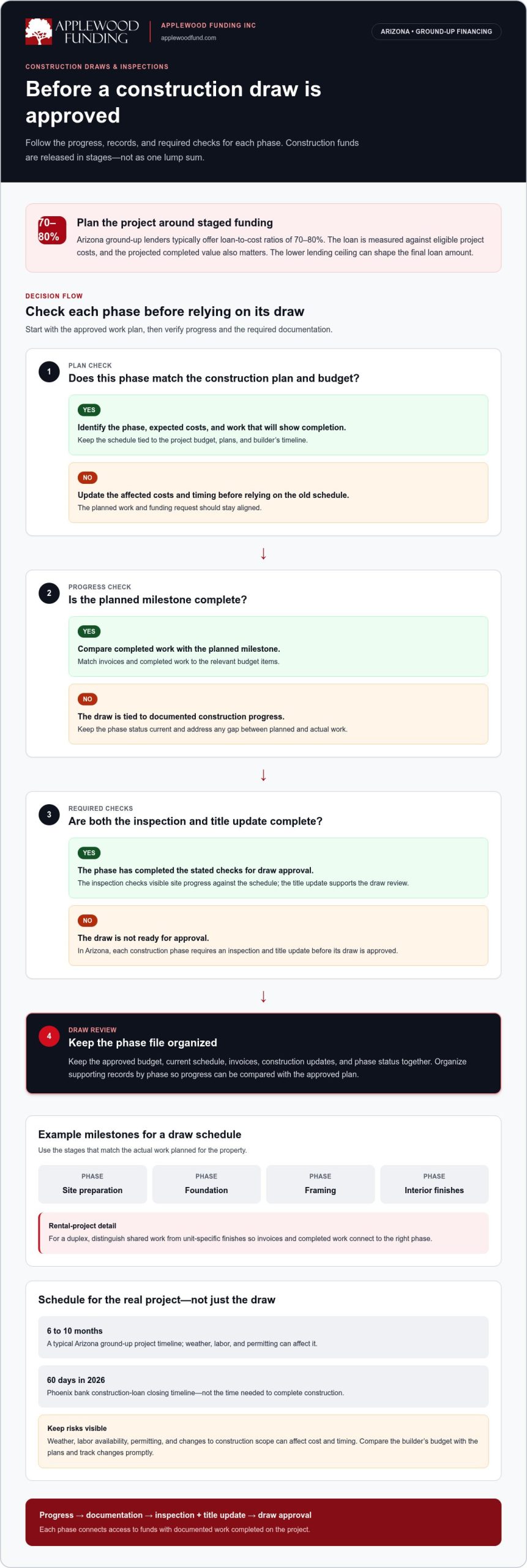
Construction funds are released in stages as work progresses. In Arizona, each phase requires an inspection and title update before its draw is approved. Match invoices and completed work to the relevant budget items, then keep records for the next phase organized. This ties access to funds to documented progress.
Permits, Zoning, and Project Risks
Zoning and permit approvals depend on the Phoenix parcel, proposed use, and building plans. Build the applicable City of Phoenix review and approval steps into the project schedule, since the parcel and design determine the process. Include how approvals fit the timeline alongside the plans, budget, and builder information.
How long does approval and funding take? Phoenix bank construction-loan closing timelines take 60 days in 2026. That is a bank closing timeline, not the time needed to complete construction. A typical Arizona ground-up project takes 6 to 10 months, depending on weather, labor, and permitting.
Plan for risks that can affect cost and timing, including weather, labor availability, permitting, and changes to the construction scope. Compare the builder’s budget with the plans, track changes promptly, and keep the draw schedule aligned with completed work. Differences between estimates and actual progress can leave later phases short of funds.
Construction draw schedules and inspections
Draws connect construction progress with access to loan funds. Draws are generally released as construction progresses, and lenders may require checks before releasing funds.
Construction Draw Schedules
A draw schedule maps planned construction work to funding requests. Build it from the project budget, construction plans, and builder’s timeline. For example, it might cover site preparation, foundation, framing, and interior finishes. The actual stages should match the work planned for the property.
For each stage, identify the work, expected costs, and records that show completion. This gives the borrower a clear path from project activity to a draw request. Keep the budget and schedule aligned. If the plans change, update the affected costs and timing before relying on the old schedule.
Rental projects need the same practical discipline. For example, a duplex schedule should distinguish shared work from unit-specific finishes. That detail helps connect invoices and completed work to the right phase and makes it easier to spot budget gaps before they affect later construction.
Use a tracking file with the approved budget, current schedule, invoices, and status for each phase. Before submitting a draw request, compare completed work with the planned milestone and organize supporting records by phase. Keeping these items current makes the request easier to review and helps identify missing documentation.
Inspections During Construction
Inspections provide a progress check before funds are released for a phase. In Arizona, each construction phase requires an inspection and title update. The inspection connects the site’s visible work with the schedule, while the title update supports the draw review. Both steps matter: a finished task alone does not complete the full approval process.
Prepare the site and records for the planned inspection. Make completed work accessible and keep relevant invoices and construction updates together. If framing is the milestone, for example, be ready to show how the scheduled framing work has progressed. Clear records help reviewers compare actual progress with the approved plan.
After an inspection, address any documented difference between the site and scheduled work. Update the timeline or budget if the project changes, and keep the next phase’s records separate. Follow a clear sequence: complete work, document progress, complete the inspection and title update, then submit the draw request.
Construction delays can shift later milestones, so track schedule changes as they happen. A missed delivery or change in work sequence can affect when a phase is ready for inspection. Keep builder updates, invoices, and the revised schedule together. For Phoenix projects, these records connect each draw request to completed work on site.
To discuss how a construction funding plan can align with project phases, explore Phoenix construction financing options.
Down payments for Arizona ground-up construction
Plan the down payment using the full project budget, not just construction invoices. For an Arizona build, map your cash contribution against land, planned work, and the funds available throughout development.
Typical down payments for ground-up builds range from 10% to 20% of total project cost. Treat this as the starting range for planning, then organize the budget so the contribution and requested loan can be compared clearly.
Calculate total project costs before setting aside a down payment. Gather land costs, construction estimates, plans, and the builder’s schedule in one budget. Then identify the amount you can contribute and the amount you expect to finance. This helps show whether the proposed residential development has a workable funding structure.
Land ownership can also affect the cash plan. If you already own the parcel, include its value and any debt tied to it in the project budget. If you’re acquiring land, show its cost alongside the build budget. In either case, keep the proposed scope consistent with the total project cost estimate.
Arizona construction market conditions can influence the budget as work advances. Weather, labor, and permitting can affect the schedule of a ground-up project. A typical Arizona build takes 6 to 10 months, depending on those factors. Build your cash plan around the project schedule, not only the first construction phase. This helps you see when funds may be needed and how changes could affect the remaining budget.
What options are available for ground-up construction financing in Phoenix, Arizona? Applewood Funding is an Arizona private hard-money lender offering Construction and Land Loans. Its Arizona ground-up financing can cover land acquisition and vertical construction when the land is under contract.
Which Phoenix-area banks, credit unions, and private lenders finance ground-up construction? The relevant lender groups are banks, credit unions, and private lenders. Their project reviews can differ, so focus on how each proposed loan accounts for land and construction together. Arizona ground-up financing may cover land acquisition and vertical construction when the land is under contract.
Prepare a consistent project package with land details, construction budget, plans, builder information, and timeline. Show how your contribution fits the total project cost, and explain any land equity included in the funding plan. Clear records make the project’s financial structure easier to review.
Stress-test the budget against practical changes. If labor, weather, or permitting shifts the schedule, note how that affects planned cash needs. Track your contribution separately from expected project expenses. An organized plan helps reveal funding gaps before construction moves into its next phase.
Eligible and ineligible property types
Property type matters because the planned use shapes how a Phoenix project is reviewed. Start by identifying the finished property, its intended occupancy, and the construction plan.
Eligible Property Types
Ground-up proposals may involve a home, a spec home, or a multifamily building. Those labels alone don’t describe the full project. Present the site, plans, builder, budget, and projected after-repair value together. Investors should make the intended use clear from the first project summary.
A Phoenix duplex offers a concrete example of a multifamily build: it has two residential units and approximately 2,156 square feet total. Each unit is approximately 1,078 square feet, with two bedrooms and 1.5 bathrooms. These details show how a property’s unit count, layout, and completed scope can be described clearly.
Eligible Project Types
Project type is about the work and finished property, not only its label. A ground-up residential development has a new construction plan, a builder, a budget, and an intended use. New investors can present those details together, along with a licensed builder and realistic projected after-repair value.
Present those elements together. For a spec home, explain the planned finished property and how its projected value relates to the scope. For a two-unit build, include both units in the plans and budget. Consistent documents help show the whole project rather than relying on a broad label.
Occupancy and Project Use
How do Phoenix construction financing needs differ for owner-occupied homes, spec homes, and multifamily projects? The key distinction is the planned use: a home for the borrower, a spec home intended for sale, or a building with multiple residential units. That use should match the plans, budget, and value assumptions. Owner Occupied Home OK.
For multifamily, state the unit count and show the full building scope. The Phoenix duplex, completed in 2026, demonstrates this approach with two units and covered carport parking. For a spec home, describe the finished design and sale plan. For an owner-occupied home, make the borrower’s intended occupancy clear.
Ineligible projects are those that don’t fit the lender’s criteria or present a coherent build plan. A property description alone won’t resolve that mismatch. Before applying, match the site details, intended use, construction plans, builder, budget, and projected completed value. If one element changes, update the other documents too.
Use this quick review before presenting a Phoenix project:
- State whether the plan is owner-occupied, for sale, or multifamily.
- Show the unit count and completed layout.
- Align the construction budget with the plans and builder.
- Explain how the projected after-repair value reflects the proposed scope.
Commercial ground-up construction loans
Commercial projects need financing that connects land, construction, and intended property use. Arizona ground-up financing can cover land acquisition and vertical construction when the land is under contract. This lets developers plan the site purchase and building work together.
Start with the site and the proposed commercial use. Describe what the completed property will do, how the plans support that use, and which construction phases the budget covers. For example, a developer planning a commercial building should present the land agreement, project plans, builder details, budget, and work schedule as one connected package. The documents should tell the same story.
Include permits and zoning approvals in the project plan. Their timing can affect when construction begins and how the work schedule is arranged. Show how approval steps relate to site preparation and vertical construction. If the plans change, update the schedule and budget together to clarify the proposed build and its funding needs.
Term length is another key decision. Arizona ground-up construction loans commonly have terms of 6 to 18 months. Phoenix new-construction hard-money loans typically last 12 to 24 months. Both are short-term compared with a standard 30-year loan term. Match the proposed term to the construction schedule and the project’s planned next step, such as selling or refinancing the completed property.
A typical ground-up construction project in Arizona takes 6 to 10 months, depending on weather, labor, and permitting. Compare that timeline with the loan term before work starts. Leave room in the project plan for approval steps, inspections, and changes to construction sequencing. The goal is a realistic path from land acquisition through completed construction, not just a projected start date.
Commercial construction needs a clear draw plan. Divide the work into phases that align with the budget and builder’s schedule. For each phase, identify the completed work, supporting records, and inspection needs. In Arizona, an inspection and title update are required for each phase before funds are released. Tie draw documents to specific work so progress and requested funding stay aligned.
Before applying, assemble the land contract, plans, budget, builder information, permit schedule, and projected completed value. Review them together for mismatched costs or timing. A commercial up build works best as a coordinated plan: land acquisition, approvals, construction, and funding each need a defined place. To discuss financing for a Phoenix construction project, talk through your ground-up project financing.
Applewood Funding: Owner Occupied Hard Money Loans
Applewood Funding offers Owner Occupied Hard Money Loans for borrowers financing a home they plan to occupy. For a new build involving land and construction, its Construction and Land Loans are the relevant offering to explore. The right fit depends on the project’s purpose: an owner-occupied home, a rental property, or a fix-and-flip investment each calls for a financing approach aligned with that use.
Bring together the property plan, construction budget, builder information, and intended use. These details provide a clear starting point for discussing financing, whether you’re preparing to build or evaluating a property investment. Applewood Funding offers Construction and Land Loans in Arizona.
Contact Applewood Funding to discuss your Phoenix construction financing needs.
Turn your project plan into a financing conversation
A ground-up project benefits from financing suited to its purpose. Before moving ahead, outline the property’s intended use, construction scope, timeline, and plan for the completed asset. Note which decisions are settled and which still depend on the project design. This gives your financing discussion a clear focus and connects the funding plan to the work ahead.
For Phoenix ground-up construction financing, start with the project itself, not just the amount you hope to borrow. Applewood Funding offers Construction and Land Loans, as well as Fix & Flip Loans and Rental Property Loans for those investment strategies. Consider whether you intend to sell, rent, or occupy the completed property. The goal can help shape your next planning steps.
Bring your site details, build plan, and intended use to the discussion. When you’re ready to talk through your project, contact Applewood Funding about your Phoenix project. A clear plan is a practical place to start.
Frequently Asked Questions
How Do You Qualify for New Construction Financing?
Start with a strong construction plan, licensed builder, realistic projected after-repair value, and clear project budget. Arizona lenders assess how those elements fit together, along with the borrower and property. Applewood Funding is a private hard-money lender offering Construction and Land Loans. Owner Occupied Home OK. Its stated terms include “No Up-Front Fees – No Cost to Apply,” 3 to 360 months, and “You Will Get the Lowest Rates GUARANTEED.”
What credit score do I need?
Most construction lenders prefer a credit score of 620 or higher for Arizona ground-up loans. Some banks view scores below 740 as risky for builders, but those are general market preferences, not a universal threshold. Applewood Funding states “No Credit Required.” Keep your project plan, builder information, budget, and completed-value estimate organized, since those details help explain the project beyond a credit score alone.
Where do you start?
Start by defining the parcel, intended use, construction scope, and project budget. Then gather your plans and builder details. For Phoenix ground-up construction financing, align the land status with the proposed build before discussing loan structure. To reach Applewood Funding, text or call 602-497-4444. Applewood Funding Inc Licensed AZ Mortgage Broker and Licensed Loan Originator NMLS-175371 AZ MB-0903207 serves Arizona markets including Phoenix, Scottsdale, Glendale, Peoria, Tempe, Mesa, Sedona, Flagstaff, and Tucson.
What down payment or equity do Phoenix construction lenders require?
Typical down payments for Arizona ground-up builds range from 10% to 20% of total project cost. Work from the complete project budget, including land and construction, rather than estimating from building costs alone. If you own the land, list its value and any debt separately so your equity contribution is clear. Keep that breakdown consistent with the requested loan and project plan.
What loan-to-cost and loan-to-value limits apply to ground-up construction loans?
Arizona ground-up lenders typically offer loan-to-cost ratios of 70-80%. Loan-to-cost compares the proposed loan with eligible project costs; loan-to-value compares it with the property’s estimated value. These measures answer different questions, so review both against the same scope and valuation assumptions. A detailed budget and realistic completed-value estimate help reveal whether project costs or projected value set the tighter financing limit.
What borrower qualifications and documents are required for a Phoenix construction loan?
Prepare a project budget, construction plans, land details, builder information, and work schedule. A licensed builder, clear plan, and realistic projected after-repair value can support an application, including for new investors. Keep the figures consistent: the budget and value estimate should reflect the finished scope shown in the plans. Organize records so the project plan is easy to follow from site to completion.
How do construction loan draws, inspections, and interest-only payments work?
Construction draws release funds as work progresses. In Arizona, each phase requires an inspection and title update before its draw is approved. Keep invoices, completed-work records, and schedule updates organized by phase. Interest-only payments generally cover accrued interest during the stated interest-only period, without reducing principal. Review the loan’s payment terms alongside the draw schedule so you can understand how payment obligations relate to construction progress.