

Hard Money for Renovation: Understand Costs, Fees and Funding Gaps
October 21, 2026Hard money for fix and flip: costs and down payment needs

In Arizona, hard money for fix and flip projects can fund a property purchase and renovations, with underwriting commonly based on projected after-repair value. A renovation reserve may also be included. A typical fix-and-flip down payment is 15% to 25% of the amount borrowed.
That’s the starting point, not the full cash picture. You’ll also need to understand how the loan amount, renovation funds, and closing costs affect the money you bring to the deal.
This guide explains what hard money can fund, how down payments work, and which costs to account for as you evaluate a flip. You’ll also learn what lenders assess and how an application moves toward closing, helping you compare financing with your project plan before committing.
Key Takeaways
- Compare loan-to-value, loan-to-cost, and after-repair value to understand how a lender may size financing for your project.
- See how borrowed capital can support cash-only and auction purchases, and why project experience and property details matter.
- Estimate the cash you may need to bring by looking beyond the down payment to the full purchase and renovation plan.
- Prepare for the application by organizing property, project, and financial details that help lenders assess the deal.
- Understand how short-term financing fits a flip, including the need for a clear sale or refinance plan.
What are Hard Money Loans Used For In New York?
In Arizona, investors use hard money loans to buy properties that need repairs, fund renovations, and prepare for resale or refinancing. For a flip, lenders commonly assess projected after-repair value, or ARV, alongside purchase and renovation costs. The property and work plan are therefore central to the financing decision.
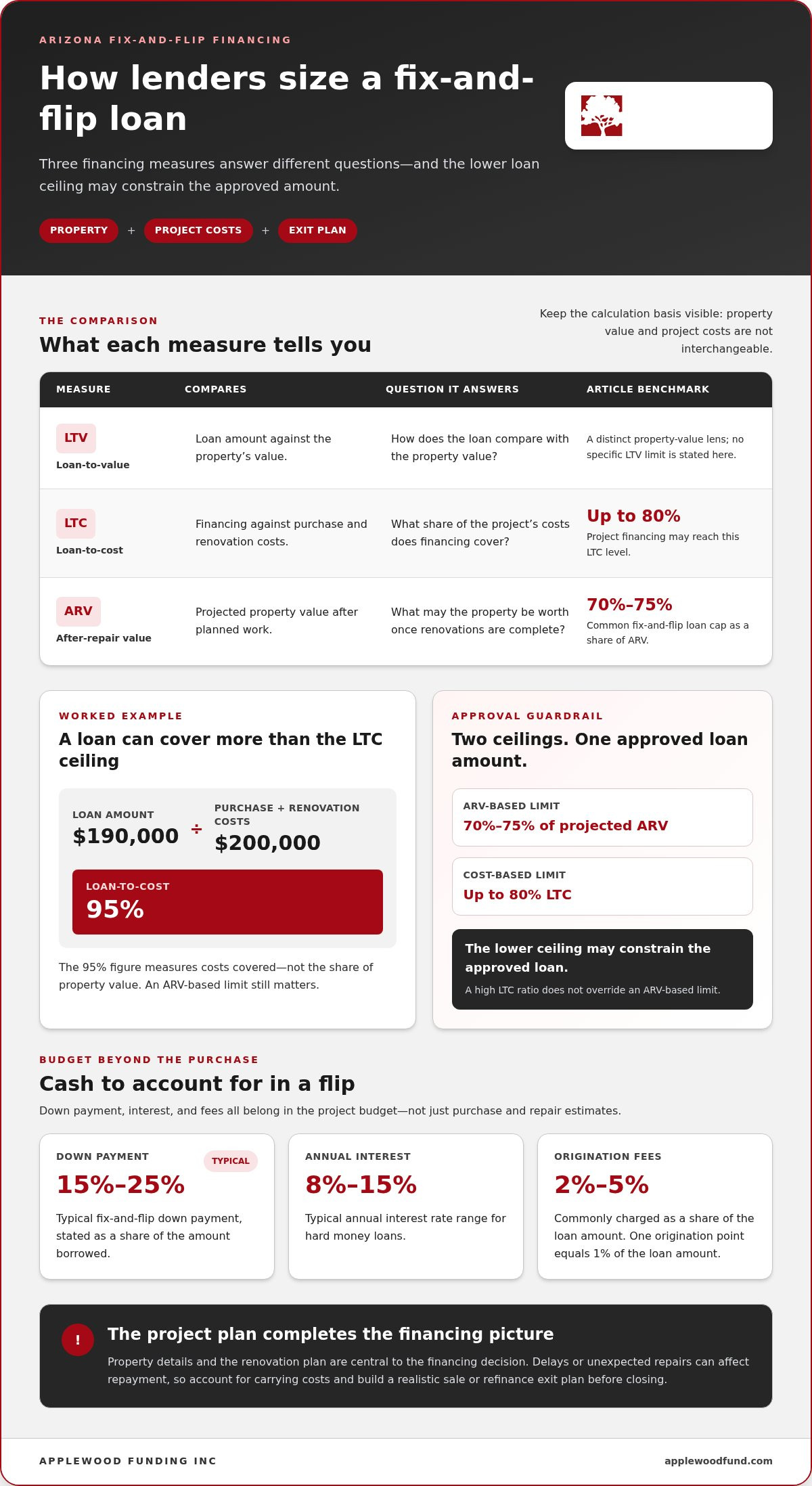
Three measures help show how financing may fit the deal. Loan-to-value compares the loan amount with property value. Loan-to-cost compares financing with purchase and renovation costs. ARV estimates value after planned work. Lenders commonly cap fix-and-flip loans at 70% to 75% of ARV, while project financing may reach up to 80% loan-to-cost. Each measure answers a different question.
For example, a $190,000 loan on a project with $200,000 in purchase and renovation costs equals 95% loan-to-cost. That figure measures the share of costs covered, not the share of property value. Keep both calculations in view. A high loan-to-cost ratio doesn’t override an ARV-based limit, so the approved loan amount may be constrained by whichever ceiling is lower.
A typical fix-and-flip down payment is 15% to 25% of the amount borrowed. Hard money loan annual interest rates typically range from 8% to 15%, and origination fees commonly run 2% to 5% of the loan amount. One origination point equals 1% of the loan amount. Include interest and fees in the project budget, not just the purchase and repair estimates.
How do hard money loans compare with private money, bridge loans, and conventional financing for flips? Hard money is a type of private, property-backed financing, while bridge loans also provide short-term funding. Conventional financing generally follows a longer underwriting and closing process; traditional bank loans for fix-and-flip projects generally take 30 to 60 days to close.
What state-specific laws and licensing rules apply to hard money fix-and-flip loans? For an Arizona deal, requirements depend on the transaction structure, property occupancy, borrower, and lender. Identify the loan type and occupancy status when reviewing transaction documents, as these factors shape the applicable licensing and disclosure rules.
Hard money can move quickly, but project delays and unexpected repairs can affect repayment. What are the risks, including extensions and default? A slower sale or refinance can extend carrying costs; lenders like Applewood Funding Inc offer qualified borrowers extensions of 3 to 6 months. Default can put the property securing the loan at risk, so build a realistic exit plan before closing.
Using borrowed capital to pursue cash-only and auction deals
Private financing can help investors pursue auction properties when conventional underwriting does not fit the deal’s pace or condition. The lender still evaluates the borrower and property before approving financing.
What credit score, experience, and income requirements do hard money fix-and-flip lenders have? A listed credit benchmark is 550+, though requirements vary by lender. Lenders commonly look for 2-3 successful fix-and-flip projects, while income review may focus more on the property than personal pay stubs.
Borrower and Deal Qualifications
Qualifications depend on the investor’s credit, experience, financial records, ownership structure, and project plan. These factors help underwriting assess whether the borrower can complete the work and repay the loan through a credible exit.
A lender may request a list of real estate experience from the last 3 years. It may also request 2 months of personal and business bank statements. Organize records showing completed projects, available capital, and the proposed purchase and renovation plan. Some borrowers may not need tax returns or pay stubs because underwriting can focus on the property’s cash flow.
An entity can clarify who owns the property and signs the loan documents, but its structure does not replace project analysis. For an auction deal, provide the property details, repair scope, purchase terms, and intended resale or refinance. This gives the lender a clearer basis for assessing the collateral and repayment plan.
Collateral and Exit Strategies
Collateral is the property securing the loan, while an exit strategy explains how the borrower expects to repay it. The lender assesses both the real estate and the plan to turn the project into repayment.
For an auction property, its condition and resale potential shape the collateral assessment. Share the available property information and a realistic renovation plan. Gaps in the scope can weaken the deal’s financial case. The exit should suit the project, such as selling after repairs or refinancing into longer-term financing.
Borrowed capital can make an auction offer possible without using all your available cash for the purchase. But the financing must align with the auction’s payment terms and closing schedule. Before bidding, map out the purchase funds, renovation budget, and repayment plan together. A funding gap at closing can put the transaction at risk.
Keep the deal flexible, not vague. If repairs expand or a sale takes longer, you’ll need a workable alternative exit. Compare expected sale proceeds with the loan payoff, or assess whether refinancing could repay the short-term debt. A clear plan connects the property’s value with your ability to repay.
To discuss how property-backed financing may fit your investment plans, explore real estate financing options.
Down payment requirements
A fix-and-flip down payment depends on the lender’s leverage limits and the property’s value. Before deciding how much cash to reserve, compare the loan with project costs and projected after-repair value.
Down Payments and Leverage
Leverage describes how much of a property or project cost the lender will finance; it matters because the remaining share must come from the borrower. A typical fix-and-flip down payment is 15% to 25% of the amount borrowed. Borrowers should also be prepared for a 20% to 40% down payment on a hard money loan, reflecting different loan structures and calculation bases.
Don’t treat those percentages as interchangeable. Ask what figure the lender uses: purchase price, total project cost, current value, or the amount borrowed. Hard money lenders may finance 50% to 70% of a property’s purchase price, while fix-and-flip loans may allow up to 80% loan-to-cost. The difference between the lender’s advance and your full project budget shapes the cash you need.
Down Payments and ARV Caps
An after-repair-value cap limits the loan against the property’s projected value after renovations. Even a high loan-to-cost figure cannot override a lower ARV-based ceiling.
Hard money lenders commonly cap fix-and-flip loans at 70% to 75% of ARV. Other stated program limits include 70% of ARV, while listed maximum leverage can be up to 65% to 70% of ARV. These ranges reflect different lender programs, not one universal rule. A lower cap can increase the borrower’s required cash contribution.
Loan-to-value uses the property’s fair market value or projected ARV as its reference point. Hard money lenders typically limit loans to 60% to 80% of either value, while hard money loans are also commonly capped at a 65% to 75% loan-to-value ratio. These ranges describe different lending approaches. Confirm which valuation and ratio govern the specific program.
To estimate your cash contribution, compare the lender’s maximum loan amount with the purchase-and-repair budget and the applicable value cap. Plan around the lower permitted loan amount. If the lender approves less than the project requires, you’ll need additional capital or a revised deal structure.
Down payment funds aren’t the only cash to consider. Renovation timing, reserves, and your planned refinance or sale can affect how much working capital you need to keep available. Set aside project funds separately from the money needed for your contribution. This helps prevent a promising real estate deal from becoming underfunded mid-project.
Application and closing timelines
A fix-and-flip loan can move faster than a conventional mortgage, but speed depends on a complete file and a financeable property. Hard money loans for fix-and-flip projects can be approved and funded in 5 to 10 days. Hard money loans can often close in 5 to 15 business days, while traditional bank loans for these projects generally take 30 to 60 days.
Start by presenting the deal clearly. The lender needs to understand the property, purchase, renovation plan, and financing purpose. Organize the purchase agreement, scope of work, project budget, and expected exit strategy. Clear, consistent figures help underwriting assess the property and requested loan amount without chasing missing details.
Borrower documents matter too. Lenders may request 2 months of personal and business bank statements, along with a list of real estate experience from the last 3 years. A credit score can also be part of underwriting; a listed benchmark for hard money fix-and-flip loans is 550+, though requirements vary. Keep entity and ownership details consistent across the application and property documents.
Expect underwriting to examine the collateral and project together. The lender reviews the property’s value, proposed repairs, and likely post-renovation value. A clear renovation scope connects the requested funding to the work. Resolve conflicting purchase figures or gaps in the budget before they slow approval.
Closing involves more than a lending decision. The transaction must go through property review, title work, and final loan documents before funds can be released. Respond promptly to document requests and coordinate with the parties handling the purchase. These steps help keep a short closing window from being lost to avoidable delays.
Renovation funding may be released through draws rather than all at once. The lender can disburse funds over the course of the project, tying access to renovation capital to completed work. Build the draw process into your contractor schedule and cash-flow plan. A delayed draw can affect the project timeline even after the purchase closes.
Treat a fast timeline as a planning tool, not a substitute for preparation. Before applying for a flip loan, organize the purchase terms, renovation details, financial records, and repayment strategy. This gives underwriting a coherent view of the deal and helps reveal whether the funding plan and project schedule fit together.
Use the closing window to keep decisions moving. Return requested documents promptly, review the loan terms carefully, and coordinate closing details as soon as they’re ready. A well-prepared file can support a faster path from application to funding. A conventional mortgage may require more time for a fix-and-flip purchase.
Using hard money for fix-and-flip projects
A hard money loan for a fix-and-flip is short-term, property-secured financing for acquiring and renovating real estate. Hard money for fix and flip projects may also include renovation funds released as work progresses, rather than all at once. The key question is whether the purchase, repairs, and exit plan fit together.
Start with the project’s full lifecycle. A common loan term runs from 6 months to two years, with monthly interest-only payments. That structure can preserve cash for repairs, but it leaves the principal to repay at the end. Build a timeline from purchase through renovation, listing, and sale, then compare it with the loan maturity.
Renovation financing may be disbursed over the course of a project, so the draw schedule matters. Capital needs to arrive in time for planned work and contractor payments. Tie each expected draw to a defined renovation stage. If the work stalls, funding delays can affect the schedule and the property’s readiness for resale.
Estimate potential profit after accounting for the project’s full costs, not just the difference between the purchase price and expected resale value. Include renovation spending, loan interest, holding costs, and selling expenses. Then test what happens if the sale takes longer or repairs run over budget. A deal that works only under the best-case timeline leaves little room to protect your exit.
The exit usually involves selling the renovated property or refinancing after repairs. Refinancing may suit a property intended for rental when the numbers support a longer-term plan. But a rental strategy changes the goal: assess expected rental income, ongoing property costs, and the new financing needed to repay the short-term loan.
Plan for timing pressure before work begins. Some hard money lenders offer qualified borrowers extensions of 3 to 6 months. An extension can provide additional time, but it is not a substitute for a realistic schedule or repayment plan. Hard money fix-and-flip loans typically have no prepayment penalties, which can help borrowers repay early after a successful sale.
Before committing, review the project: confirm the repair scope, map the draw schedule, stress-test resale timing, and identify a backup exit. This helps you assess whether financing supports the renovation and the final value can support repayment. If the project’s profit depends on every step going perfectly, revisit the budget or deal structure.
Have a property and renovation plan ready? Discuss your fix-and-flip financing and how the proposed project could be structured.
Applewood Funding: Owner Occupied Hard Money Loans
Applewood Funding Inc offers Owner Occupied Hard Money Loans for borrowers financing a property they plan to occupy. For an investment flip, its Fix and Flip Loans are designed for the purchase-and-renovation purpose discussed in this guide. The right loan type depends on how you’ll use the property.
Consider Rental Property Loans if you plan to hold a completed property as a rental instead of selling it after repairs. For new construction or land development, Construction and Land Loans may be a closer fit. Matching financing to the intended use keeps the application focused on the project.
Bring your property details, renovation scope, budget, and repayment plan into the conversation. Those details help frame what you’re financing and how you expect the project to reach its next stage. If you’re weighing options for a flip, contact Applewood Funding Inc to discuss your project, or visit applewoodfund.com.
Turn Your Project Plan Into a Clear Next Move
Start by deciding what a successful project means to you. Is your goal to sell, keep the property as a rental, or finance a property you’ll occupy? That choice shapes how you evaluate the deal and the financing path. A hard money for fix and flip strategy should serve the project’s purpose, not drive it.
Before moving forward, make sure your assumptions about the property, repairs, and planned outcome work together. Use that clarity to discuss your financing needs and identify the loan type that fits. Applewood Funding offers Owner Occupied Hard Money Loans, Fix and Flip Loans, and Rental Property Loans for different property plans.
Bring your project goals to the conversation and explore the next step with Applewood Funding. Contact Applewood Funding to discuss your project. A well-defined plan puts you in a stronger position to move forward with purpose.
Frequently Asked Questions
What Kind of Loan is Best for a House Flip?
A short-term fix-and-flip loan can suit a project that needs purchase and renovation capital before resale. Conventional financing may fit better when the property qualifies and its longer underwriting process works with your purchase timeline. Compare repayment terms with your renovation schedule and planned exit. For example, a project intended for long-term rental may need financing designed around holding the property.
Do you need good credit for a hard money loan?
Not always, but credit can still affect a lender’s decision and loan terms. Hard money underwriting may also weigh the property, available equity, real estate experience, and whether the project has a clear repayment plan. A borrower with a weaker credit profile can strengthen an application by documenting prior projects, available funds, and a detailed renovation scope. Requirements differ by lender and deal structure.
How to Choose the Right Financing Option?
Choose financing by matching the loan’s purpose, repayment plan, and property use. Review how the lender evaluates the property, the costs and payment schedule, and whether repayment depends on a sale or refinance. Test the plan against slower renovations or a delayed sale. For a property you’ll occupy in Arizona, Applewood Funding offers Owner Occupied Hard Money Loans; investment projects need financing suited to their use.
Should Real Estate Investors Use Loans for House Flipping?
Loans can help investors preserve cash or pursue a project beyond their available funds, but borrowed capital adds repayment pressure. Before borrowing, estimate the full project budget and sale proceeds, including holding and selling costs. Check whether the expected margin remains workable if repairs take longer or the sale price falls short. If repayment depends on one optimistic assumption, reconsider the deal.
What is after repair value (ARV)?
After-repair value, or ARV, estimates what a property may be worth after planned renovations. Investors use it to assess potential resale value, and lenders may consider it when evaluating collateral. Base your estimate on comparable properties and the specific work planned. A polished renovation budget cannot support a sound ARV if the finished property does not match those comparisons.
What is loan-to-cost (LTC)?
Loan-to-cost, or LTC, compares the loan amount with eligible project costs, such as purchase and renovation expenses. It shows investors what portion of the project financing covers and what capital they must provide. A loan may cover a large share of costs yet still fall short of the lender’s separate limit based on projected property value.
What is loan-to-value (LTV)?
Loan-to-value, or LTV, compares the loan amount with a property’s value. Depending on the financing structure, the lender may consider current value or projected value after repairs. A lower LTV means the loan represents a smaller share of that value. Review the valuation assumptions alongside the proposed loan amount to understand how the lender calculated its leverage.
What are typical hard money loan rates, points, fees, and loan terms for fix-and-flip investors?
Rates, origination points, other fees, and repayment terms vary by lender, property, leverage, borrower experience, and project plan. Origination points are calculated as a percentage of the loan amount, while interest adds to the cost of carrying financing. Fix-and-flip loans commonly have short repayment windows, so compare the full written terms with your planned sale or refinance, not just the interest rate.