


Private Lender vs. Big Bank: Which Home Financing Path Fits in Arizona?
October 18, 2026Private Mortgage for Business Owners: How to Find the Right Fit

Can a private mortgage for business owners work when tax returns show less income than the business brings in? It may be worth exploring, but lenders still need a clear picture of your finances. Different loan options assess that picture in different ways.
If you’re self-employed, business deductions may lower taxable income without showing the full story of your cash flow. That can make a traditional application harder to document, especially if you’re unsure whether tax returns, bank statements, or profit-and-loss records will carry the most weight. The right path depends on more than income: property use and timing matter, too.
This guide explains how bank statement loans and owner-occupied hard money loans differ, when each may fit, and what costs, repayment terms, and risks to weigh. You’ll also learn which financial and property details to organize before discussing financing in Arizona. Start with a clear view of your business income and plans for the property. Then compare options using the full picture, not just one line on a tax return.
Key Takeaways
- A private mortgage for business owners may be worth exploring when tax returns don’t capture the full business picture, but the right fit depends on the complete application.
- Compare conventional, bank statement, and private hard money pathways by income documentation, property use, timing, and repayment trade-offs.
- Clarify whether the property will be your primary residence or an investment before weighing loan options.
- Organize financial records and property details to explain your business income and support a clearer lending discussion.
- Arizona borrowers can distinguish bank statement loans from owner-occupied hard money without confusing home financing with investment-property loans.
Private Mortgage for Business Owners: What It Means and Who It May Help
A private mortgage for business owners can provide another way to finance a property when a conventional lender’s income review doesn’t fit how a business earns and reports money. “Private” describes the lender, often a non-bank source of financing. It doesn’t, by itself, explain how income is verified, what the property can be used for, or how repayment works. Those details depend on the loan structure and terms.
Quotable definition: “A private mortgage is financing provided by a non-bank lender; the loan’s documentation, property-use rules, and repayment structure depend on the specific program.” For a general foundation on how mortgage loans work, see Understanding Mortgage Loans. Separate who lends the money from how the loan assesses your application.
Why business income can look different on a mortgage application
Business revenue is not the same as personal qualifying income. Revenue is money coming into the business; expenses cover the costs of operating it. Net income is what remains after expenses, while cash flow describes money moving in and out over time. Tax deductions may reduce the income shown on a return, even when the business has regular deposits and ongoing activity.
That difference can make conventional underwriting challenging. A lender may review tax returns alongside other records to understand whether income is stable and available to support the mortgage. Strong deposits or cash flow can add context, but neither guarantees approval. The lender still assesses the full application, including obligations, assets, credit, and the property.
Private mortgage, bank statement loan, or hard money?
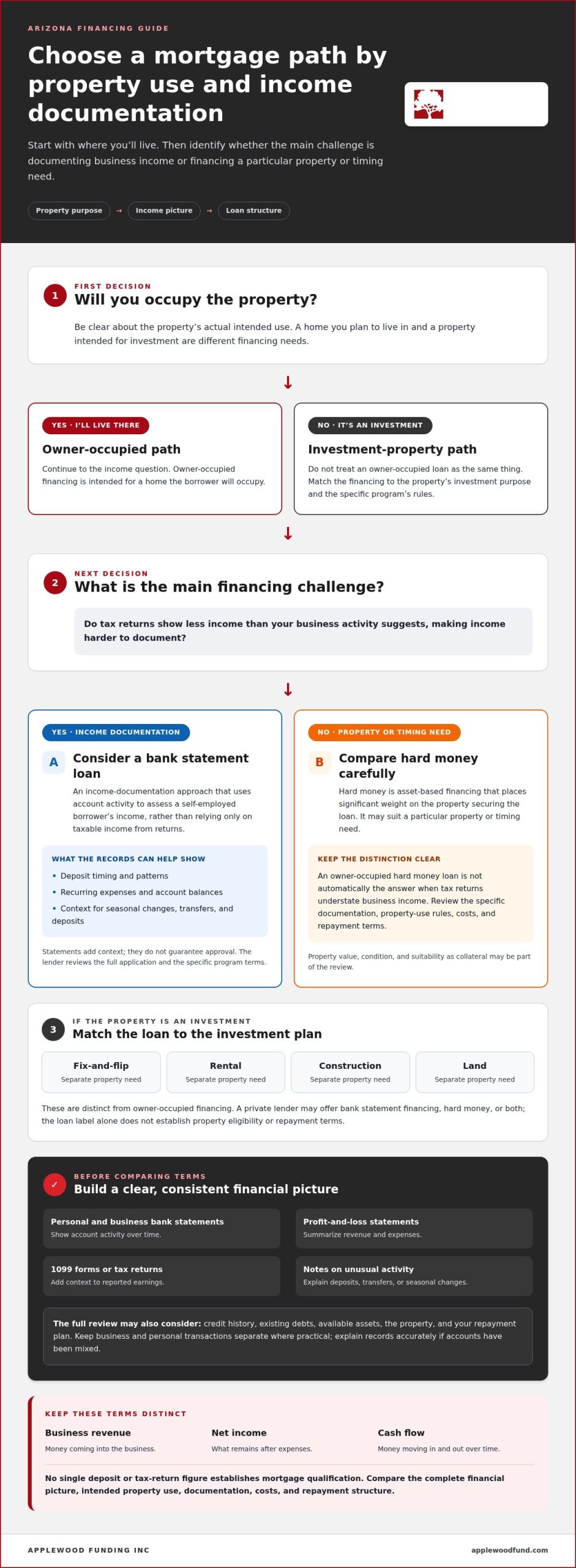
These terms are related, but they aren’t interchangeable. A bank statement loan is an income-documentation approach: account activity helps assess a self-employed borrower’s income, rather than relying only on taxable income from returns. The lender may need context for transfers, business expenses, and deposits so the statements tell a clear story.
Hard money describes a form of asset-based financing that places significant weight on the property securing the loan. It may suit a particular property or timing need, but it isn’t automatically the right answer when tax returns understate business income. A private lender may offer bank statement financing, hard money, or both. Compare the specific repayment terms, costs, documentation, and intended use, not just the label.
Property use changes the financing conversation
Be clear about whether you’ll live in the property or use it as an investment. Owner-occupied financing is intended for a home the borrower will occupy; investment-property financing serves a different purpose and may have different underwriting and loan terms. Applewood Funding Inc offers bank statement loans for self-employed borrowers and owner-occupied hard money loans. Its fix-and-flip, rental, construction, and land financing serves separate property needs. Match the loan path to the property’s actual use before comparing terms.
How Private Mortgage Lenders Assess a Business Owner’s Income
A lender looks for a credible picture of repayment, not one impressive deposit or a single tax-return figure. Review may include income records, credit history, existing debts, available assets, the property securing the loan, and your repayment plan. The weight given to each factor varies by lender and loan structure. For a private mortgage for business owners, records that fit together can help explain how the business earns and how its finances support the application.
“Taxable income is the amount reported after applicable deductions; documented cash flow is the recorded movement of money through accounts, and neither one alone establishes mortgage qualification.” Keep that distinction in mind. Account activity can add context to tax records, but a lender still evaluates the full financial and property picture.
What bank statements and business records can demonstrate
Statements can show the timing and pattern of deposits, recurring expenses, and changes in account balances. For example, a seasonal business may have uneven monthly deposits; a longer-term record can help explain that pattern. Statements don’t automatically identify which deposits are revenue, transfers, or borrowed funds, so clear records matter.
Depending on the loan and lender, useful supporting documents may include:
- Personal and business bank statements that show account activity over time
- Profit-and-loss statements that summarize revenue and expenses
- 1099 forms or tax returns that add context to reported earnings
- Records or notes that explain unusual deposits, transfers, or seasonal changes
Where practical, keep business and personal transactions separate. If accounts have been mixed, don’t try to make the history look cleaner after the fact. Organize the records accurately and explain legitimate transfers or shared expenses. A clear paper trail helps a reviewer understand what the numbers represent instead of guessing.
How property, credit, and available equity can affect the review
Property purpose matters. A home you intend to occupy and a property you plan to rent or use for another investment serve different financing needs. State the intended use clearly and keep it consistent across your application. The property itself may also be reviewed for its value, condition, and suitability as loan collateral.
Credit history and existing obligations help show how you’ve managed debt and what payments you already carry. Assets may provide context about reserves or available funds. In asset-based lending, property value is important, but it doesn’t replace a careful review of the borrower and repayment plan. Consider how payments will be made, from what income or proceeds, and what happens if your expected timing changes.
Before discussing options, group records by account and date, note unusual transactions, and prepare a short explanation of how the business earns. That makes it easier to connect deposits, expenses, and income records. Arizona business owners who want to discuss how their records and property plans fit a financing path can use Applewood Funding Inc’s Phoenix mortgage contact page as a starting point.
Compare Mortgage Paths for Business Owners in Arizona
Start with two questions: What will the property be used for, and which records best show your income? A conventional mortgage may fit when tax returns support the required income review. A bank statement loan may offer another way to assess self-employed income. Private hard money can address a specific property or timing situation, but it isn’t a like-for-like substitute for every home loan.
Rule of thumb: “Choose by property purpose and income evidence, not by the loan label alone.” Use this comparison to frame the conversation, not to assume approval. Eligibility, underwriting, timing, and repayment terms depend on the specific loan and borrower.
| Path | Income documentation | Property use | Timing and repayment trade-offs |
|---|---|---|---|
| Conventional mortgage | Typically centers on documented income, including tax records for business owners. | May finance an eligible primary residence or investment property, subject to the program. | Follow the lender’s underwriting process and compare the proposed payment and term with your budget. |
| Bank statement loan | Uses account activity to help assess self-employed income; statements are evidence, not approval. | Program rules and property eligibility determine whether the intended use fits. | Documentation and review needs vary. Compare the full repayment terms with your expected cash flow. |
| Private hard money | May put greater weight on the property and overall transaction than a conventional income review. | Owner-occupied and investment financing are distinct; confirm the loan’s intended-use fit. | May be considered for a specific timing or documentation obstacle. Review costs, repayment schedule, and exit plan carefully. |
When a bank statement mortgage may fit better
If business deductions make tax-return income look lower than the deposits and activity in your accounts suggest, a bank statement loan may give the lender another income record to evaluate. Organize statements so recurring business revenue is distinguishable from transfers, one-time deposits, and borrowed funds. That context supports review; it doesn’t guarantee qualification. For more detail on this pathway, see Bank Statement Loans 2026: The Ultimate Guide for Self-Employed Borrowers.
When owner-occupied hard money may be worth exploring
This is a specialized option for a property you intend to occupy as your primary residence, not the default first choice for every business owner. It may be worth examining if a specific timing need or conventional documentation issue makes another route difficult. Before proceeding, understand the payment structure, total costs, and how you’ll repay or transition from the loan. Keep this separate from financing meant for rentals, flips, construction, or land. Applewood Funding offers owner-occupied hard money loans; its article Owner Occupied Hard Money Loans: Fast Funding for Your Primary Residence provides further context on this distinct path.
Prepare a Strong Private Mortgage Application in Phoenix and Across Arizona
A focused financing conversation starts with a clear project, not a loan label. Whether you’re considering a home in Phoenix, a property in Scottsdale, an investment in Mesa, or a purchase in Tucson, explain the property’s intended use and how the financing fits your business and personal finances. A private mortgage for business owners still requires a careful look at the borrower, property, and repayment plan. Preparation helps make that discussion more productive, but it can’t guarantee approval or particular terms.
Five steps to make your financing conversation more useful
- Define the property goal. State whether it will be your primary residence or an investment property. Describe the purpose of the funds, such as purchasing a home or financing an investment, and be consistent about occupancy.
- Gather income and business records. Organize relevant personal and business bank statements, tax returns, 1099 forms, and current profit-and-loss statements. Include records that help explain seasonal income, large deposits, or changes in business activity.
- Summarize obligations and assets. Prepare an accurate list of current debts and recurring payments, along with a clear picture of assets that may be relevant to the application. Keep explanations and figures consistent with your supporting records.
- Set out the timeline. Share key dates tied to the purchase or project, and identify what drives them. A target date is useful context, not a promise that financing will be completed by then.
- Test the repayment plan. Compare the expected payments with realistic household and business cash flow. Consider quieter business periods and existing commitments, not just your strongest revenue months.
Trade-offs to understand before choosing private financing
Review the complete proposed structure before deciding. Understand the payment schedule, fees, repayment period, and any planned exit, such as selling or refinancing the property. Ask yourself whether the plan still works if business income falls, a purchase is delayed, or your intended property use changes. Private financing may address a specific documentation or timing challenge, but compare it with conventional or bank statement options that may fit your income evidence and goals.
Keep the property purpose central. A primary residence in Phoenix and a rental property in Mesa are different financing scenarios, even if the same business owner is applying. Clearly identify occupancy, expected use, and the source of repayment before weighing terms. Then compare the actual loan structure with your alternatives, rather than assuming “private” automatically means faster, simpler, or better suited to your situation.
Ready to organize your property purpose, business records, and repayment plan for a financing discussion? Discuss your Arizona mortgage options with Applewood Funding Inc.
Explore Applewood Funding’s Private Mortgage Options for Arizona Business Owners
A business owner’s financing conversation should start with the property and income records, not an assumption that one loan type fits every situation. Applewood Funding Inc works with Arizona borrowers through bank statement loans for self-employed applicants and owner-occupied hard money loans for primary-residence scenarios. These are distinct paths. Which one makes sense to discuss depends on your documented finances, intended occupancy, property, and goals. Neither option guarantees qualification.
Match the financing discussion to the property and business
If business deductions make tax returns an incomplete picture of your income, bank statement financing may provide another way to present account activity for review. Statements still need context, and the lender evaluates the overall application. Organize your records and be ready to explain recurring deposits, seasonal patterns, and business expenses.
Owner-occupied hard money is a specialized option for a property you intend to use as your primary residence. It isn’t a universal substitute for a conventional mortgage or a bank statement loan. Be direct about whether you’ll live in the home. A primary residence in Phoenix, for example, has a different financing purpose from a rental investment in Scottsdale or a property project in Mesa.
Applewood Funding Inc’s other real estate financing options serve separate purposes. Fix-and-flip loans relate to renovation and resale projects; rental property loans are for investment properties; construction and land loans address development-related needs. Keep those uses distinct from owner-occupied home financing. Describing the property accurately helps focus the conversation on relevant options rather than a mismatched loan label.
Applewood Funding Inc serves borrowers across Arizona, including Phoenix, Scottsdale, Mesa, Tempe, Glendale, Peoria, Sedona, Flagstaff, and Tucson. Location is useful context, but it doesn’t mean every property or borrower receives identical terms. The property, its intended use, and the borrower’s financial profile all matter.
Take the next step with an Arizona mortgage conversation
Before reaching out, bring a short summary of your business income, the records you can provide, current obligations, property location, occupancy plans, and funding purpose. If timing matters, explain the key dates and why. This gives the discussion a practical starting point and helps distinguish whether bank statement or owner-occupied hard money financing is more relevant to explore.
Business owners looking for a private mortgage for business owners in Phoenix or elsewhere in Arizona can describe their situation directly. Share the property goal and the income evidence that best reflects your business. Applewood Funding Inc offers bank statement loans for self-employed borrowers and owner-occupied hard money loans, with the relevant path depending on your details.
Discuss your private mortgage options.
Turn Your Financing Plan Into a Clear Next Step
The next move isn’t choosing a loan based on its name. It’s turning your business and property plans into a clear financing conversation. Before you move forward, decide what you need the loan to accomplish, what repayment approach feels workable, and which records best support your financial picture. That clarity can help you assess whether a private mortgage for business owners fits your priorities.
Applewood Funding is managed by Joel McDaniel, NMLS 175371. Bring your property details, intended use, income records, and questions about repayment to the discussion. You don’t need every answer before you start. A focused conversation can help identify which financing path is relevant to explore, without assuming approval or predetermined terms.
Discuss your private mortgage options and take the next step with a clearer plan. Your business income may need context, not guesswork. Start with the facts you have and move forward with confidence.
Frequently Asked Questions
Can I get a private mortgage if I own a business?
Yes, business ownership doesn’t automatically prevent you from pursuing a mortgage. The lender will assess your financial records, credit, obligations, the property, and the proposed repayment plan. A business owner buying a home in Phoenix, for example, can explain how business income supports personal finances and mortgage payments. Approval depends on the specific loan and borrower, so ownership alone doesn’t determine the outcome.
Can a business owner qualify for a mortgage using bank statements instead of tax returns?
Possibly. Some bank statement loan programs use account records to assess income, but that doesn’t mean tax returns or other documentation will never be needed. Prepare statements that show the business’s financial activity and be ready to explain deposits that aren’t income, such as transfers between accounts. Applewood Funding offers bank statement loans for self-employed borrowers, though qualification depends on the full application.
Is a private mortgage the same as a hard money loan?
No. “Private mortgage” refers broadly to financing from a non-bank lender, while “hard money” describes a particular asset-based lending approach. A private lender may offer different types of loans, each with its own qualification and repayment structure. Look beyond the label: review the loan documents, the property’s role as collateral, payment schedule, fees, and how the balance will be repaid.
Can I use a private mortgage to buy a primary residence in Arizona?
It may be possible. Applewood Funding offers owner-occupied hard money loans for primary-residence situations in Arizona. Be clear that you intend to live in the property, whether it’s in Scottsdale, Mesa, Tempe, or Tucson. Owner-occupied financing is different from a loan for a rental or renovation project, and the borrower, property, and loan terms determine whether a particular option fits.
How do private mortgage lenders review self-employed income?
They assess the records available under the specific loan program and consider whether the overall finances support repayment. That may involve comparing deposits with business records, reviewing existing debt payments, and understanding fluctuations such as seasonal revenue or a recent change in business activity. A concise explanation of unusual income patterns can help make records easier to interpret, but it doesn’t replace underwriting or guarantee approval.
Are private mortgages more expensive than conventional mortgages?
They can be, but costs depend on the loan structure and borrower’s circumstances. Compare more than the interest rate: review fees, payment amount, repayment period, and any costs associated with paying off or replacing the loan. A shorter-term structure may create different budget pressures than a longer-term mortgage. Compare the complete written terms with a conventional option before deciding which trade-offs make sense.
How long does it take to get a private mortgage as a business owner?
Timing varies with the property, loan structure, and how quickly required records are complete. Missing statements, unclear ownership details, or changes to the transaction can affect progress. Share your target date early, especially if a purchase contract or other commitment sets a deadline.
What documents should a business owner prepare before discussing a private mortgage?
Start with recent personal and business bank statements, tax returns, profit-and-loss statements, and any 1099 forms that help explain income. Also gather a summary of current debts, available assets, the property address, intended occupancy, and key purchase or project dates. If you’re in Glendale, Peoria, Sedona, or Flagstaff, organize records by account and date so the financing conversation can focus on your property and plans.