

What Is ARV? How to Estimate After-Repair Value in 2026
October 15, 2026Rental Property Investment Loans in 2026: Compare Options and Choose

The most familiar loan option isn’t automatically the right one for a rental property. The best fit depends on what you plan to do with the property, how its income supports your strategy, and how financing fits your timeline. Comparing rental property investment loans means looking beyond the loan label and weighing the details of the deal.
Before pursuing a property, it’s reasonable to want clear answers about qualification, payments, and timing. Financing options may assess borrower finances and property details differently, so start with your investment plan. This guide explains how to compare the main options, including how to consider your intended hold, expected rental income, available funds, and closing timeline.
You’ll also learn what information to organize before discussing financing, so you can focus on the property and your goals. For Arizona investors, Applewood Funding Inc offers rental property loans and alternative, asset-based real estate financing. Start with the strategy, then match the financing path to the deal.
Key Takeaways
- Match financing to the property’s intended use and investment plan, not just the loan label.
- Compare rental property investment loans by what each financing path evaluates, what documentation may be involved, and how repayment fits your strategy.
- Use rental income and property expenses to pressure-test your assumptions. A DSCR is one way to consider how income relates to debt payments.
- For Arizona properties, base rental assumptions on the specific property and market rather than statewide generalizations.
- Organize your plan, property details, and borrower information before discussing financing with Applewood Funding.
Rental Property Investment Loans: Start With the Property Plan
Start with the property, not the loan label. A rental property investment loan is financing used to buy or refinance real estate intended to produce rental income. That purpose distinguishes it from owner-occupied home financing, which is tied to a home the borrower plans to live in. The broader practice of real estate investing includes using financing to acquire property, but the right approach depends on the deal and how you plan to operate it.
Before comparing rental property investment loans, write down the property’s intended use, your operating plan, and how long you expect to hold it. Add the expected rent, major expenses, and any work the property needs. These details keep the financing discussion focused on the investment you’re actually considering.
Rental property or second home: why intended use matters
A second home is generally intended for the owner’s personal use, while a rental property is acquired with an income-producing plan. Think through who will occupy the property, whether you intend to rent it, and how it will operate day to day. Describe your actual plan clearly. Occupancy and documentation requirements vary by financing program, so don’t assume one program’s rules apply to every option.
Build a property-level view before comparing loans
Assess the asset as its own investment. A property-level review helps identify what needs investigation and which assumptions deserve closer scrutiny before you compare financing paths.
- Condition: Note the property’s current state and the repairs or preparation needed before renting it.
- Expected use: Define your rental plan and intended type of occupancy.
- Hold period: Estimate how long you plan to own the property and what could prompt a sale or refinance.
- Income and expenses: Record anticipated rent alongside operating costs such as maintenance, insurance, taxes, and management. Treat these figures as estimates, not guaranteed results.
Make your assumptions local and property-specific. For a Phoenix property, consider the neighborhood, condition, and rental plan instead of applying a broad citywide expectation. For a home in Scottsdale or Tucson, build a separate estimate based on that property and its surrounding area. Nearby properties can provide points of comparison, but they don’t guarantee your rental income or expenses.
Then test the plan: how would lower rent, an unexpected repair, or a longer vacancy affect your numbers? You don’t need perfect forecasts. You need transparent assumptions that show the risks and help explain your investment strategy. With that foundation, compare how financing categories assess the property, borrower, documentation, and repayment plan.
How Rental Property Loans Work: Property, Borrower, and Repayment
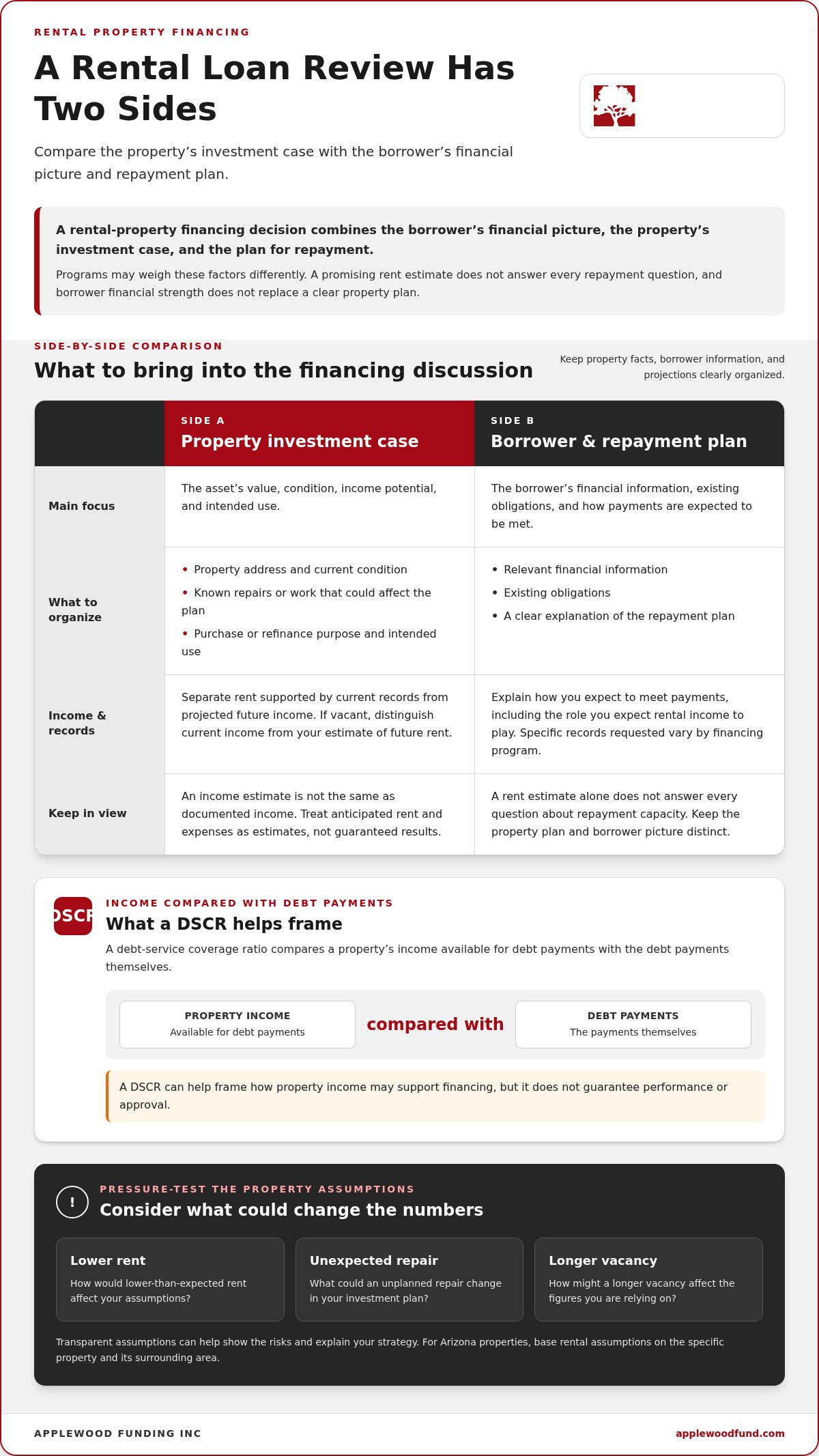
A rental-property financing decision combines the borrower’s financial picture, the property’s investment case, and the plan for repayment. That’s the central idea behind rental property investment loans. A financing program may consider the property’s value, condition, and income potential alongside the borrower’s financial information. The weight given to each factor depends on the program.
Property and borrower details work together. A promising rent estimate doesn’t answer every question about repayment capacity. Likewise, a borrower’s financial strength doesn’t replace a clear explanation of the property’s intended use. StudentAid.gov’s discussion of rental property as an investment offers another perspective on how these assets may fit into a broader financial picture.
What investors may need to organize
Prepare a clear snapshot of the deal, then organize financial records that explain your proposed repayment plan. A consistent account of the property, transaction, and finances gives the financing discussion a stronger starting point. Requirements vary by structure, so there isn’t one document list for every investor or property.
- Property details: Identify the address, current condition, and any known work that could affect the investment plan.
- Transaction purpose: Clarify whether you’re looking to purchase or refinance, and explain how you intend to use the property.
- Financial records: Gather relevant information about your finances and existing obligations. The specific records requested depend on the financing program.
- Repayment plan: Explain how you expect to meet payments, including the role you expect rental income to play.
Keep current facts separate from projections. If the property is vacant, distinguish its current income from your estimate of future rent. If it’s already rented, separate rent supported by records from any changes you’re projecting.
How rental income can enter the financing discussion
Existing rent or projected income may be relevant when evaluating an investment property, but an estimate isn’t the same as documented income. Label each clearly. This makes it easier to see which parts of your plan are supported by current records and which depend on future leasing or operating assumptions.
One concept you may encounter is the debt-service coverage ratio (DSCR). In plain language, it compares a property’s income available for debt payments with the debt payments themselves. It can help frame how well the property’s income may support its financing, but it doesn’t guarantee performance or approval. The calculation of income and expenses, and whether a program uses this measure, can vary.
For a deeper look at the calculation, consult a dedicated DSCR explainer. To discuss how a specific property plan and repayment approach fit together, talk through your rental financing plans with Applewood Funding.
Compare Rental Property Investment Loan Options by Fit
Loan labels are a starting point, not a decision. Compare how each financing category approaches the property, your documentation, and repayment plan. Details vary by program and lender, so use this table to identify questions that matter for your deal, not to assume a specific outcome.
| Financing category | Typical decision focus | Documentation themes | Intended use and questions to resolve |
|---|---|---|---|
| Conventional investment-property mortgage | May consider the borrower’s financial profile alongside the property and its intended rental use. | Borrower finances and property information may be reviewed. Exact requirements depend on the program. | Often considered for an acquisition or refinance of a rental. How do the program’s qualification approach, repayment structure, and timing fit your hold plan? |
| DSCR-style financing | May emphasize the property’s income relative to its debt obligations, using a debt-service coverage ratio or related analysis. | Property, rental-income, and expense information may be important. How income is documented or projected varies. | Can be relevant when the property’s ability to support debt is central to the financing discussion. Which rent and expense assumptions are used, and how are they evaluated? |
| Private asset-based lending | May give substantial attention to the property as collateral and the specifics of the transaction. | Property value, condition, purpose, and exit or repayment plan may be part of the review. Requirements vary by financing arrangement. | Investors may compare it for a property or timeline that doesn’t align with their preferred conventional route. What are the repayment structure, costs, and plan for the end of the loan? |
Conventional financing versus alternative lending
Conventional mortgages and alternative financing are different routes to assess, not automatic winners and losers. Underwriting methods, paperwork, repayment terms, and processing timelines depend on the specific program and transaction. Compare the full structure, not just the application process or one headline term. For a closer look at potential trade-offs in hard money financing, read this hard money loan pros and cons guide.
Match the financing path to the investment scenario
For a stabilized rental, compare the hold period, rent assumptions, and preferred repayment structure with the options under consideration. For a property needing substantial work, separate the funds needed to acquire it from the renovation plan and how you’ll use the finished property. If your goal is to renovate and resell rather than hold as a rental, that’s a distinct strategy. Explore this fix-and-flip financing guide for that scenario.
Use the same deal assumptions in every comparison. Ask how the structure handles your intended use, what documentation it calls for, how payments are arranged, and what happens at your planned exit. This makes rental property investment loans easier to compare by fit rather than by label alone.
Arizona Rental Property Loan Checklist: Test the Deal Before Applying
A strong financing conversation starts with a tested plan, not a guess about what a property might earn. Use this sequence to make assumptions visible, compare options with a clear purpose, and prepare the information needed to discuss rental property investment loans.
- Define the plan. State whether you’re buying or refinancing, how the property will be used, your intended hold period, and your likely exit strategy. A long-term rental and a renovation followed by resale call for different questions.
- Review the property assumptions. Separate what you know, such as current condition or an existing lease, from estimates about future rent, repairs, vacancy, and expenses. For a Phoenix, Mesa, or Flagstaff property, base your assumptions on that property and its local context. An Arizona-wide average isn’t a substitute for property-specific research.
- Organize the information. Gather available property details, relevant borrower financial records, and information about the purchase or refinance. Note what’s documented and what remains an estimate so the financing discussion starts with a clear picture.
- Compare structures against the plan. Consider how each option approaches the property, documentation, repayment, and your intended timeline. Compare the full structure rather than assuming one category is universally faster, easier, or less costly.
- Discuss the financing. Bring your summary, assumptions, and questions together. Explain what the property needs, how you expect repayment to work, and when you need to make decisions.
Stress-test the rental property’s assumptions
Run a conservative scenario before relying on projected numbers. List expected rent, recurring operating expenses, maintenance needs, and potential vacancy periods. Then consider how the plan changes if rent is lower than expected, repairs cost more, or the property takes longer to lease. These are planning estimates, not guaranteed rental income or investment returns.
Prepare a focused financing conversation
Summarize the property, transaction purpose, target timeline, and planned hold or exit strategy. Bring relevant borrower and property information, and flag assumptions that still need research. Keep Arizona legal, tax, and program-specific questions grounded in current professional guidance, since details can depend on the situation.
With your deal assumptions organized, you can have a more focused conversation about rental-property financing. Discuss your Arizona rental-property financing needs with Applewood Funding.
Explore Rental Property Financing With Applewood Funding
You’ve mapped the property, clarified its intended use, tested your rental assumptions, and compared financing categories. Now bring those pieces into one focused conversation. Applewood Funding offers rental property loans and alternative real estate financing, including asset-based lending. As an Arizona-serving alternative lender, Applewood Funding can discuss your project in the context of its property details, financing purpose, and intended timeline.
You don’t need every estimate finalized before starting. Bring a clear summary, mark what’s documented, and identify what still needs investigation. That gives the discussion a practical starting point without treating projected rent, eligibility, or financing outcomes as certain.
What to clarify before moving forward
Before discussing rental property investment loans, be ready to explain what you want the property to become and how financing supports that goal. A purchase, refinance, or plan involving a property that needs work may raise different questions. Your intended hold period and exit plan also help put the financing discussion in context.
- Property outcome: Describe the rental or other intended use and the condition of the property.
- Financing purpose: Explain whether you’re purchasing or refinancing, and what the financing needs to accomplish.
- Investment timeline: Share your target timing, expected hold period, and likely exit strategy.
- Open assumptions: Flag estimates about rent, repairs, vacancy, or expenses that could change your comparison.
Keeping known facts separate from projections makes it easier to see what could affect your plan. It also keeps the discussion specific to your project instead of relying on assumptions that may not fit the property.
Arizona investor financing, tailored to the project
Applewood Funding serves Arizona locations including Phoenix, Scottsdale, Glendale, Peoria, Tempe, Mesa, Sedona, Flagstaff, and Tucson. Location is one part of the picture; the property’s condition, intended use, operating assumptions, and your financing purpose matter too. Bring the details that make your deal distinct so the conversation stays grounded in the actual project.
For an initial discussion, organize the property address and available details, the purchase or refinance purpose, your investment plan, and relevant financial information. Include your target timeline and identify which rental or expense figures are supported by records versus still estimated. The financing structure, terms, and qualification considerations depend on the project and discussion. No single assumption guarantees a particular outcome.
Ready to put your property review into action? Contact Applewood Funding about rental property financing to discuss your Arizona investment plan and the details shaping your financing needs.
Turn Your Rental Plan Into a Clear Next Step
A financing comparison is most useful when it helps you decide what to do next. Keep your assumptions and questions together, then identify which unknowns could change the deal or affect your timeline. You don’t need every detail settled before starting a conversation, but you do need a clear view of what you’re trying to accomplish and where you still need clarity. That focus can make a discussion about rental property investment loans more productive and grounded in your investment plan.
Applewood Funding offers rental property loans for investors across Arizona, including Phoenix, Scottsdale, Mesa, and Tucson. If you’re ready to explore how your property plans and financing purpose fit together, bring your notes and open questions to the conversation. Contact Applewood Funding to discuss your rental property financing.
Frequently Asked Questions
What is a rental property investment loan?
It’s financing used to purchase or refinance a property intended to generate rental income. The structure depends on the financing program, and the planned use can shape the discussion. A home intended for personal stays may be treated differently from one intended to operate as a rental. Before comparing rental property investment loans, clarify how you’ll use the property, your income and expense assumptions, and how long you expect to hold it.
Can I use projected rental income to qualify for an investment property loan?
Some financing approaches consider rental income, but the method depends on the program and property documentation. For an occupied property, lease records may help show existing income. For a property you plan to rent, distinguish your rent estimate from income already supported by records. Keep assumptions realistic and note factors such as planned repairs or time needed to find a tenant. Don’t treat a projection as guaranteed income or assume every program evaluates it the same way.
How do I choose between a conventional loan and alternative rental property financing?
Compare how each option evaluates your finances, the property, documentation, repayment, and transaction timing. An investor with a property that needs work, for example, may have different questions from someone refinancing an established rental. Neither conventional nor alternative financing is automatically the best fit. Use the same property details and investment plan for each comparison, then review the specific program’s requirements and terms before deciding.
Do rental property investment loans require a down payment?
Many financing arrangements involve borrower funds or equity, but the amount and structure depend on the program, lender, transaction, and property. Don’t treat a general online figure as a promise for your project. Before comparing options, estimate how much capital you can contribute and what funds the purchase, repairs, and operating plan may require. Then review how each financing structure treats your contribution and the property.
Are hard money loans used for rental properties?
Private, asset-based financing may be considered for some rental-property investment plans, depending on the property, transaction, repayment plan, and terms. Compare it with other paths rather than assuming it will be faster or better for every deal. Applewood Funding offers rental property loans and alternative real estate financing, including asset-based lending. Arizona investors can discuss how their property strategy and financing purpose relate to the available loan approach.
What should I prepare before discussing an Arizona rental property loan?
Prepare the property’s location and condition, whether you’re buying or refinancing, its intended use, and your planned hold or exit strategy. Separate documented facts from estimates, such as projected rent or repair costs. A property in Phoenix may have different rental assumptions from one in Scottsdale, so ground your estimates in the specific property and its local context. Bring relevant borrower and property information to make the financing discussion more focused.
Can I finance a rental property that needs renovation?
A property needing work calls for a plan that accounts for both acquisition and improvements. Start with a clear description of its current condition, a practical outline of the renovation, and your intended outcome after the work. A long-term rental plan is different from renovating to resell, so compare financing with the right strategy in mind. Review the program terms and how repayment fits your plan before moving forward.