

Phoenix Multi-Family Private Lender: 2026 Buying Guide
October 13, 2026Hard Money Loans for Scottsdale Airbnbs: 2026 Guide
Could a hard money loan for airbnb property scottsdale investors are considering help secure a time-sensitive deal, or add repayment pressure before the rental earns its keep? This financing may suit a short-term project, but speed alone doesn’t make a property a sound investment.
Look beyond the purchase price. A Scottsdale home needs to meet short-term rental requirements, fit any HOA restrictions, and generate enough income under conservative occupancy assumptions. Your financing also needs a credible exit, such as a refinance or sale.
This guide explains how to assess Scottsdale’s rental requirements, compare hard money with longer-term financing, and build an operating forecast that accounts for costs and softer booking periods. It also covers repayment plans and timing risks to pressure-test before closing. Applewood Funding Inc offers rental property financing and hard money solutions in Arizona. Start with the property’s legal use, realistic numbers, and a clear exit. Then decide whether hard money fits the plan, not just the deadline.
Key Takeaways
- Verify Scottsdale, Arizona, and Maricopa County short-term rental requirements, plus any HOA restrictions, before treating a property as a viable Airbnb.
- Assess a hard money loan for airbnb property scottsdale by weighing the property, project, intended use, and repayment plan, not just the speed of financing.
- Compare hard money, conventional investment-property financing, and DSCR-style loans by purpose, time horizon, documentation, repayment structure, and flexibility.
- Build a conservative forecast that accounts for operating costs and less-than-ideal occupancy before relying on rental income to support the loan.
- Map a realistic exit, such as refinancing or selling, and test whether the timing still works if the plan takes longer than expected.
Can a Hard Money Loan Work for an Airbnb Property in Scottsdale?
Quick answer: It may fit when the property can legally operate as a short-term rental, the numbers support the plan, the loan terms match the project, and you have a feasible exit. Financing approval does not grant permission to host guests.
A hard money loan is generally a real estate loan secured by the property. Investors may consider this type of financing for a time-sensitive purchase, a home that needs work before generating income, or a temporary bridge to longer-term financing. For a broader overview of the concept, see What is a Hard Money Loan?
These are general lending concepts, not a promise about any lender’s terms or review process. Loan structure, repayment schedule, costs, and property requirements vary by lender and transaction. Consider a hard money loan for airbnb property scottsdale alongside lawful use and a practical repayment plan, not as a shortcut around either.
What makes an Airbnb acquisition different from a standard rental?
A standard rental forecast often assumes longer tenancies and more predictable rent periods. A short-term rental depends on nightly bookings, changing demand, and keeping the property guest-ready between stays. That changes both the work involved and the financial forecast.
Build the forecast around the actual hosting model. Include furnishing and setup, cleaning and turnover, utilities, management, repairs, and periods when bookings may be lighter. Treat seasonality and projected occupancy as assumptions to test, not guaranteed income. For example, calculate whether the property can still cover expenses if bookings fall below your target or setup takes longer than expected.
Why verify Scottsdale property use before evaluating financing?
Start with permission, not projections. Check the City of Scottsdale’s current short-term rental requirements and applicable Arizona and Maricopa County requirements using official sources. Requirements can change, so verify them for the period you plan to operate rather than relying on an old listing, a seller’s description, or a general summary.
Then review property-specific limits. Examine recorded restrictions and governing documents for the HOA or condominium, and investigate zoning and any conditions attached to the property. City or state rules may not settle what private recorded restrictions allow. If you can’t establish that the intended use is permitted, projected Airbnb revenue may not be a sound basis for borrowing. Confirm the legal and operational picture before including bookings in your repayment plan.
Keep the sequence clear: verify the property’s intended use, assess its condition and hosting costs, then compare financing and exit options. That order helps separate a promising acquisition from a rushed decision. A lender’s approval addresses financing; it doesn’t replace your responsibility to establish that you can operate the property as planned.
How Lenders May Assess a Scottsdale Airbnb Hard Money Request
A lender may look at the property as collateral, its purchase price or current value, the work planned, your circumstances, and how you intend to repay the loan. These are common areas to prepare for, not a universal checklist. Each lender sets its own criteria, so don’t assume one lender’s process or terms apply to another. An organized package helps explain how the property, project, and exit fit together.
For a hard money loan for airbnb property scottsdale, separate the property’s value from the business case for hosting. A strong asset doesn’t prove the rental will earn the amount you project, and projected revenue doesn’t guarantee loan proceeds. If renovations are part of the plan, a lender may consider the property’s potential value after repairs, often called after-repair value (ARV). Treat ARV as an estimate, not a promised sale price or refinance amount.
Which property and project details should an investor organize?
Bring the core facts together before discussing financing. Lenders may consider different details, but an organized overview makes it easier to understand the request and spot gaps. Include the intended use and a realistic timeline, not just the purchase price or best-case revenue.
- Purchase contract, property address, and available details on condition and current value.
- Planned renovation scope and estimated timeline, if work is needed. Distinguish essential repairs from optional upgrades.
- Intended occupancy plan and a conservative forecast that accounts for seasonality, vacant nights, utilities, cleaning, management, maintenance, and other recurring expenses.
- Any operating history available, clearly separated from estimates for a property that hasn’t yet hosted guests.
- Expected financing period and a specific repayment plan, such as a refinance or sale, with the assumptions behind it.
Use the list to prepare for a financing conversation, not to guess a lender’s underwriting rules. If you’re evaluating the intended use, keep the operating plan aligned with current local requirements. The City of Scottsdale’s short-term rental regulations are an official reference.
How should Airbnb income projections be treated?
Be clear about what’s proven and what’s forecast. For an existing rental, organize reliable operating records where available. For a new acquisition, label expected nightly rates and occupancy as estimates. Test a lower-booking scenario, weaker seasonal demand, and higher operating expenses instead of building the repayment plan around peak-season performance.
Also identify who will handle bookings, guest communication, turnover, maintenance, and recordkeeping. These responsibilities affect both operating costs and whether the forecast is practical to execute. If the plan depends on refinancing, consider what happens if income or property value falls short of expectations. A credible exit should account for that possibility, not rely on an optimistic projection.
To discuss how a property, project scope, and repayment plan fit together, share your financing scenario with Applewood Funding.
Hard Money vs. Other Financing for a Scottsdale Airbnb
The right financing depends on what the loan needs to accomplish. Are you buying a property that needs work, or holding a guest-ready rental for the long term? Compare purpose, likely time horizon, documentation, repayment structure, and flexibility, then review the actual terms for your transaction. These are general distinctions, not guarantees: options and qualification standards vary by lender, borrower, property, and deal.
| Financing type | Purpose and likely horizon | Documentation focus | Repayment and flexibility |
|---|---|---|---|
| Hard money | May suit a time-sensitive purchase, renovation, or temporary bridge. It is often considered for a shorter project phase. | May emphasize property value, condition, project details, and a defined exit, though lender criteria differ. | Structure varies. Confirm payment obligations, maturity, extension terms, and payoff plan before committing. |
| Conventional investment-property financing | May fit a purchase or hold strategy that aligns with the lender’s property and borrower requirements. | May involve detailed borrower, asset, and income documentation. | Can be structured for longer-term ownership, subject to the lender’s qualification standards and loan terms. |
| DSCR-style financing | May suit investors seeking financing connected to rental-property cash flow. | May focus on the relationship between eligible property income and debt obligations. Calculation methods differ. | Terms and repayment structures vary. Confirm how projected or documented income is treated. |
Short-term financing brings a specific risk: the loan comes due whether or not bookings meet your forecast. If repayment depends on refinancing, a higher occupancy rate, or a future sale at an optimistic value, the plan is fragile. Stress-test lower bookings, seasonal slowdowns, operating costs, and delays. Also allow time to complete work, establish operations, and reach the refinance or sale event.
When might short-term hard money fit the strategy?
It may fit a time-sensitive acquisition or a property that needs repairs before it can serve guests, if the property and project align with the lender’s terms. As bridge financing, it’s temporary capital tied to a defined repayment event. Build a timeline with room for permitting where applicable, renovation, setup, operations, and the refinance or sale. Don’t treat the hoped-for exit date as certain.
When might longer-term rental financing be a better match?
If your plan is to hold and operate the property over time, financing designed for longer-term rental ownership may align better than a short bridge. DSCR means debt-service coverage ratio, a measure comparing eligible income with debt obligations. Lenders may calculate it differently, so don’t assume projected Airbnb revenue will count the same way everywhere.
For a closer look at trade-offs, read Hard Money Loan Pros and Cons: 2026 Strategic Guide. Include operating obligations in your planning too. The Arizona Department of Revenue’s Arizona Transaction Privilege Tax information is an official source for reviewing tax-related requirements.
Match the loan to the plan, not just the deadline. To discuss how your property, intended use, project needs, and repayment strategy fit together, share your Scottsdale rental financing scenario with Applewood Funding.
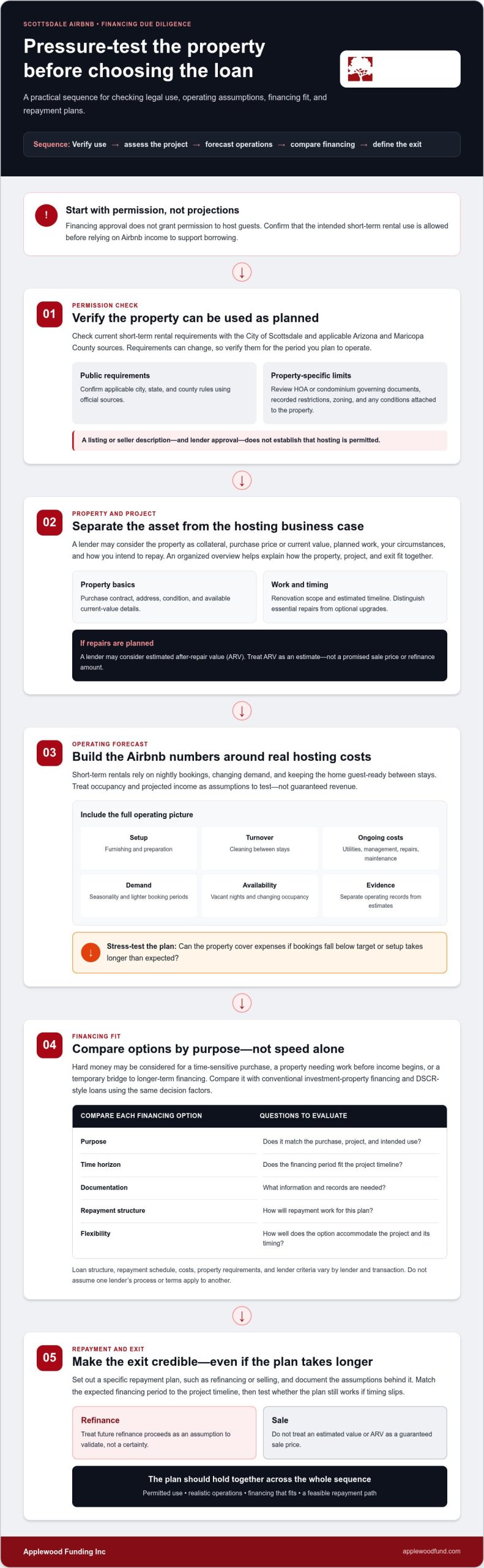
A Scottsdale Airbnb Due-Diligence Checklist Before You Borrow
Work through the decision in order. A strong revenue forecast can’t fix a property-use restriction, and favorable financing terms can’t make an unrealistic exit workable. Before pursuing a hard money loan for airbnb property scottsdale, document each step and pause if a key assumption is still unverified.
- Confirm lawful use. Review the City of Scottsdale’s current short-term rental requirements, along with applicable Arizona and Maricopa County rules. Check recorded documents, HOA or condominium restrictions, zoning information, and any property-specific conditions. Don’t rely on a listing description or a prior owner’s operating history as proof the use is allowed.
- Inspect the property and scope. Identify repairs, safety or maintenance needs, furnishing and setup work, and the time required before the home can host guests. Separate necessary work from upgrades that can wait. Use inspection findings and estimates where available, and account for delays that could push back opening or refinancing.
- Build conservative operating numbers. Forecast revenue using realistic nightly rates and bookings, then subtract vacancy, seasonality, platform charges, utilities, cleaning, maintenance, insurance, management, and taxes. Keep estimates distinct from documented results. Include recurring expenses even if they seem small individually; together, they can change the cash available for debt payments.
- Review financing terms. Map the payment structure, maturity date, extension provisions if any, and other applicable costs from the actual loan documents. Compare the expected loan timeline with the work and launch schedule. Don’t treat a general description of hard money as a substitute for the terms of a specific offer.
- Test the exit. Write down the planned repayment event, such as a refinance or sale, and the conditions it depends on. Model what happens if the property takes longer to prepare, bookings are weaker, or refinancing isn’t available on the expected timeline.
What local and property-specific checks belong on the list?
Use official sources for current requirements. Review Scottsdale’s city guidance, relevant Arizona Department of Revenue information, and Maricopa County guidance for obligations that apply to the address and rental plan. Then read applicable HOA, condominium, deed, and recorded-use documents. Keep notes on what you reviewed and when, since requirements and circumstances can change.
How can an investor stress-test the deal and exit?
Run a downside case with fewer bookings, lower nightly rates, and higher operating expenses. Compare the remaining cash flow with debt payments and the expected loan maturity. Then assess refinance and sale alternatives separately, without assuming future lender approval, property value, or market conditions. If the plan only works under peak-season assumptions, it needs more room.
Use the results to clarify the property, project, and repayment plan before discussing financing. Discuss your Arizona property financing goals with Applewood Funding.
Explore Airbnb Property Financing with Applewood Funding
Financing should fit the property and the plan, not just the purchase deadline. Applewood Funding offers rental property loans and hard money solutions in Arizona. For a Scottsdale Airbnb project, start with a clear picture of the property, intended rental use, work required, and how you expect to repay the loan.
A hard money loan for airbnb property scottsdale is not automatically the right fit for every home or investor. Discuss the project and how its details align with the financing approach. Approval, terms, and eligibility depend on the specific request. Financing does not establish permission to operate a short-term rental or guarantee investment results.
What should an investor bring to a financing conversation?
Prepare a concise project snapshot. Include the property address, whether you’re purchasing or already own it, the intended rental use, and the timeline for acquisition, renovations, or launch. Organize available records so the discussion can focus on the actual transaction rather than guesswork.
- Purchase contract or ownership details, plus property information and condition notes.
- Renovation scope, estimates, and an expected project schedule, if work is planned.
- Available rental history, income and expense records, and a forecast that clearly labels estimates.
- Existing financing details, the financing period you’re considering, and your primary repayment plan.
- A backup exit, such as a sale or alternative financing path, with the assumptions it depends on.
Keep the numbers grounded. If a property has no short-term rental history, say so and distinguish projected bookings from documented performance. This helps frame the request accurately and makes it easier to identify assumptions that need more support.
How should the reader decide on a next step?
First, revisit the legal-use review for the specific address before treating projected Airbnb income as an operating plan. Then compare the expected financing period with the time needed to complete work, prepare the property, and stabilize operations. If your timeline relies on a refinance or sale, consider what happens if that event takes longer or doesn’t proceed as expected.
Still weighing the trade-offs? The broader discussion in Hard Money Loan Pros and Cons: 2026 Strategic Guide can help you consider flexibility alongside repayment pressure and the need for a credible exit. Use that perspective to arrive with clear priorities, not a one-size-fits-all answer.
Bring your property details, intended use, project needs, and repayment plan into one focused discussion. Discuss your Scottsdale property financing options with Applewood Funding.
Make Your Next Move With a Clear Financing Plan
Before committing to a hard money loan for airbnb property scottsdale, turn your plan into clear decision points. Set the minimum operating cash flow you’d need, the longest delay your budget can absorb, and the conditions your refinance or sale would depend on. If the numbers miss those marks, adjust the plan before the loan clock starts.
A useful financing conversation isn’t just about how much you hope to borrow. Connect the property’s intended use and project timeline with a repayment strategy you can explain and support. Bring your assumptions forward, including the ones that could change. That clarity can help you compare options and decide whether to proceed, revise the project, or wait for a better fit.
Applewood Funding offers rental property loans and hard money financing in Arizona, including for investors in Scottsdale, Phoenix, Glendale, Peoria, Tempe, Mesa, Sedona, Flagstaff, and Tucson. The company is managed by Joel McDaniel, NMLS 175371. Discuss your Scottsdale property financing options and take the next step with a plan built around your property and goals.
Frequently Asked Questions
Can I use a hard money loan to buy an Airbnb property in Scottsdale?
Possibly, if the financing request fits the lender’s criteria and the intended use is viable for that specific property. A hard money loan for airbnb property scottsdale doesn’t authorize short-term rentals. Before making an offer, confirm the address-specific operating requirements and private restrictions, and make sure your purchase documents and financing request describe the planned use accurately. Keep any unresolved permission issue separate from your income forecast.
Is a hard money loan a good fit for an Airbnb investment?
It can fit a project with a defined short-term need, but it may be a poor match for a long hold if the repayment date arrives before the property is ready or stable. Compare the expected loan period with realistic setup and operating milestones. If an extension or refinance is central to your plan, treat it as uncertain, not automatic. A longer-term rental loan may better match a property you intend to hold.
Can projected Airbnb income help me qualify for a hard money loan?
Possibly, but lenders can assess projected income differently, and estimates aren’t the same as operating history. For a new Scottsdale rental, keep a record of how you built the forecast, including comparable booking data and the expenses deducted from gross revenue. Track actual results once the property operates. Gross bookings can look healthy while net cash after cleaning, utilities, maintenance, and management is much lower.
What happens if my Scottsdale property cannot operate as a short-term rental?
You may need to change the use or reconsider the purchase, depending on the property and applicable restrictions. Before closing, consider whether another lawful rental approach could work financially, and whether the financing terms still make sense under that scenario. Don’t assume a prior owner’s use settles the question. For address-specific legal or tax questions, consult a qualified local professional and relevant official sources.
How is a hard money loan different from a DSCR loan for an Airbnb?
Hard money generally refers to property-secured private financing, often considered for a project or temporary need. A DSCR loan relates the property’s income to its debt obligations, but lenders may define eligible income and calculate coverage differently. For an Airbnb, clarify whether the calculation uses documented short-term rental performance, another income basis, or a lender-specific method. Compare the full repayment timeline and exit needs, not just the loan label.
Can I refinance an Airbnb hard money loan into a long-term loan?
Refinancing may be possible, but future approval isn’t assured. A later lender may consider the property’s condition, legal rental use, documented income, value, and your borrower profile under its own standards. For example, a property that hasn’t established a consistent operating record may not support the refinance assumptions you made at purchase. Plan for a sale or other repayment alternative, and understand the current loan’s maturity obligations before borrowing.