


Private Mortgage for Business Owners: How to Find the Right Fit
October 19, 2026
Hard Money for Renovation: Understand Costs, Fees and Funding Gaps
October 21, 2026Fast funding real estate loans: Financing rehab properties
Fast funding real estate loans can help investors purchase and renovate a property when timing matters. With hard money financing, the property’s value and the investor’s plan may carry more weight in underwriting than credit score alone. Funds may be disbursed within a few days after final approval.
Real estate financing involves more than securing money for a purchase. Lenders may assess the property, planned repairs, and documents that explain how the project will work. A complete application can keep the process moving, while a lower-than-expected appraisal may affect the loan amount and renovation budget.
This guide explains how financing works for renovation properties, which income and property details lenders may review, and how hard money underwriting can support a faster closing. You’ll also learn to plan for a short-term loan, manage renovation cash flow, and prepare for repayment. These steps can help you approach your next Arizona property with a stronger plan.
Key Takeaways
- Prepare income records, credit information, and property details so a lender can review your application and project together.
- Expect a property assessment to examine its condition and the scope of planned repairs, which can shape the available renovation budget.
- For a fix-and-flip project, map out the purchase, rehab, sale, and repayment plan before choosing financing.
- Hard money underwriting may focus on the property’s value and your investment plan, helping support a faster closing after final approval.
- Build a realistic cash-flow and exit plan around the loan term, and discuss possible extensions before finalizing the agreement.
1. Loan application documents and property assessments
Start with a complete application file. Hard money lenders may ask for proof of income, credit reports, and property details. Prepare a project summary covering the purchase, planned repairs, and exit strategy, such as selling the renovated home or holding it as a rental. Organized records help connect your financial picture to the property and your plan.
Make the property easy to evaluate. A lender may require an inspection to assess its condition and the scope of repairs. Share access details, available property records, and a written repair plan so the assessment can address work that affects cost and timing. If the inspection identifies additional repairs, update the budget and schedule before relying on an expected profit.
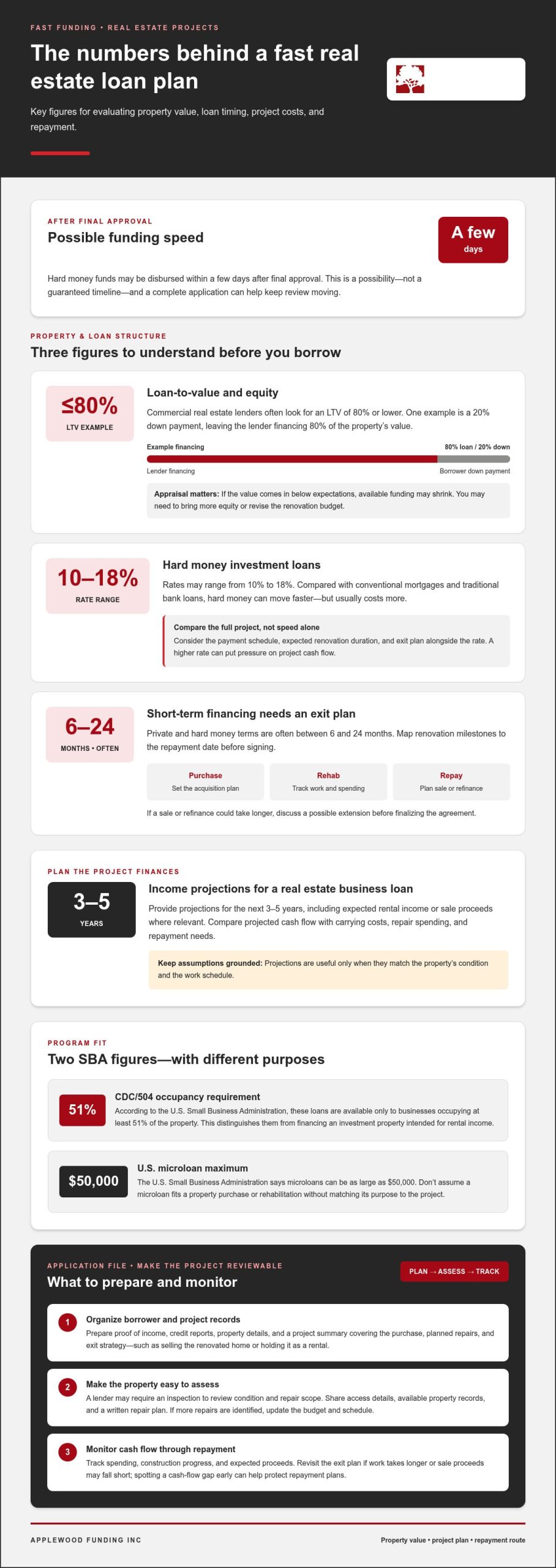
Use loan-to-value (LTV) to understand the equity question. Commercial real estate lenders often look for an LTV of 80% or lower. A 20% down payment is one example that leaves the lender financing 80% of the property’s value. The actual calculation and appraisal matter: if the appraisal comes in below expectations, the available funding may shrink, leaving you to bring more equity or revise the renovation budget.
Match the financing program to the property’s use. According to the U.S. Small Business Administration, SBA CDC/504 loans are available only to businesses occupying at least 51% of the property. That occupancy requirement makes the program distinct from financing an investment property intended for rental income. Separately, U.S. microloans can be as large as $50,000, according to the U.S. Small Business Administration; don’t assume a microloan fits a property purchase or rehabilitation without matching its purpose to your project.
Build costs and timing into the same plan. For a real estate business loan, provide income projections for the next 3–5 years, including expected rental income or sale proceeds where relevant. Compare projected cash flow with carrying costs, repair spending, and repayment needs. A projection is useful only when its assumptions match the property’s condition and the work schedule.
Finally, plan the exit before signing. Private and hard money terms are often short, commonly 6 and 24 months, so line up renovation milestones with the repayment date. If a sale or refinance could take longer, discuss a possible extension before finalizing the agreement. Track spending, construction progress, and expected proceeds throughout the project; that monitoring helps you spot a cash-flow gap before it threatens repayment.
2. What is Real Estate Financing?
In the United States, private lenders and hard money lenders offer fast funding for real estate loans. They can finance purchases and rehabilitation projects, with underwriting that may focus more on property value and the investor’s plan than on credit score alone.
Compared with conventional mortgages and traditional bank loans, hard money financing can move faster, but usually costs more and runs for less time. Hard money investment loan rates may range from 10% to 18%, and private or hard money terms are often between 6 and 24 months. Conventional financing may better suit a long-term hold, while a shorter loan may fit a defined renovation and resale plan.
Fix-and-flip financing is designed for a property an investor plans to improve and sell. Start with the purchase price, then map out repairs, expected resale proceeds, and the time each stage will take. For example, an investor buying a dated home should budget for visible repairs and work an inspection may uncover. Resale proceeds are not profit: subtract acquisition and renovation costs, loan payments, and other project expenses to estimate the result.
Match financing to the investment goal. A resale plan needs a practical route from purchase through renovation to sale. A rental plan depends on expected income and cash flow after expenses and loan payments. A commercial property may involve business use, tenant income, or both, so clarify the intended use and repayment plan before comparing terms.
Speed is only one factor. A shorter approval path can help an investor compete for a property, but a higher interest rate or shorter repayment period can strain cash flow. Compare the full loan term, payment schedule, expected project duration, and exit plan. If repayment depends on a sale, consider what happens if the work takes longer or proceeds fall short of expectations.
Do fast real estate loan options and regulations vary by state or property location? Yes. State and local rules differ, and a property’s location affects its value, market demand, and permitted use. These factors can shape a lender’s assessment and your project plan. Evaluate the specific address rather than relying on broad market assumptions, including for properties in Phoenix, Scottsdale, or elsewhere in Arizona.
For a project-specific discussion, talk through your real estate financing situation and the goals driving your purchase. A clear comparison of financing, project timeline, and repayment route helps reveal whether speed supports the investment or adds unnecessary pressure.
3. Hard money loans for property rehabilitation
A hard money loan can bridge the gap between buying a property and completing its renovation. The property is central to the lender’s review, while the borrower’s renovation plan explains how the asset may gain value. This structure may suit a property that needs substantial work before it qualifies for a conventional mortgage or attracts a long-term buyer.
For an acquisition, treat bridge financing as temporary capital, not the project’s final solution. Set out the purchase, repair sequence, expected completion, and exit route before committing. An investor might use a short-term loan to buy a vacant house, complete repairs, then sell it or refinance for a longer hold. Plan how to repay if a sale or refinance takes longer than expected.
An appraisal and an inspection answer different questions. An appraisal estimates value; an inspection examines condition and may reveal repairs that affect cost or timing. Provide relevant property details to the appraiser and access to areas inspectors need to review. Then compare the findings with the renovation scope. If an inspection uncovers roof damage beyond the budget, revise the work plan before assuming the original figures still support the project.
Valuation risk can change the entire deal. A lower-than-expected appraisal may reduce available funding and leave less for rehabilitation. It may also require the borrower to contribute more equity, reduce the work scope, or reconsider the purchase. Build a contingency into the plan, and don’t treat expected resale value as guaranteed profit. The purchase price, current condition, repair plan, and local demand all shape the potential exit.
Hard money rehabilitation loans are typically short-term, with repayment periods ranging from six months to a few years. Plan renovations and a sale or refinance to fit the loan term. Track contractor progress, spending, and cash flow against the schedule; delays can leave payments due before the property produces income. If the timeline depends on uncertain repairs or resale timing, discuss possible extensions before finalizing the agreement.
Rental property financing follows a different exit strategy. Rather than relying on a quick sale, the borrower plans to stabilize the property, attract tenants, and use rental income to support ongoing obligations. Estimate operating expenses alongside rent, including repairs and periods without a tenant. A rehabilitation loan may help prepare a property for rental, but the long-term financing plan should account for whether its income can support payments and future upkeep.
4. Application and underwriting requirements
Underwriting assesses whether the property, borrower, and repayment plan fit together. A lender reviews the requested amount alongside the project’s purpose, expected costs, and exit strategy. For a purchase and renovation, explain how the property will move from its current condition to sale or rental. Keep assumptions consistent across the application, project summary, and supporting records. Conflicting details can prompt follow-up questions and slow approval.
Prepare the core file before applying. Hard money applicants may be asked for proof of income, credit reports, and property details. Use current records, and explain unusual income changes or credit events plainly. Credit score can inform the review, but some hard money lenders focus more on property value and the investor’s plan. A clear project strategy matters even when credit profile is not the only factor.
Connect the requested loan amount to the work. Describe the property’s condition, renovation plan, and how each phase supports the expected resale or rental outcome. A lender may require an inspection to assess condition and repair scope. If it identifies work missing from the initial plan, update the budget and timeline together. This gives underwriting a more realistic picture than a low repair estimate paired with an ambitious schedule.
For commercial property, show how operating income relates to debt payments. The debt service coverage ratio, or DSCR, compares net operating income with debt service. Commercial real estate lenders are generally more inclined to approve a business loan when the DSCR is 1.25 or higher. A borrower can strengthen this analysis by organizing income and expense assumptions, explaining vacancies, and showing how planned improvements may affect property operations.
Review the proposed terms as part of underwriting, not after it. Compare the interest rate, payment structure, loan term, and any balloon repayment against the project’s expected cash flow. Hard money investment rates may range from 10% to 18%, so model payments using the actual proposed terms rather than a generic estimate. Test a slower renovation or delayed sale in the plan. If the project only works under the fastest timeline, returns may be vulnerable to ordinary setbacks.
Before accepting approval, reconcile the final loan terms with your original plan. Confirm the amount, repayment dates, required borrower equity, and conditions tied to the property review. Then set checkpoints for spending, construction progress, and expected income. Monitoring these milestones can reveal a funding gap early, while there is still time to adjust the work sequence or exit strategy.
5. Hard money loans and fast closings
Hard money loans can help real estate investors move quickly when a purchase has a tight closing window. After final approval, lenders often disburse investment funds within a few days. That timing applies after approval, not necessarily from the initial application. Allow for underwriting, property review, and closing coordination before setting a purchase date.
Speed up approval and closing by submitting a complete application, responding promptly to document requests, and arranging property access for an appraisal or inspection. Keep the purchase contract, project plan, financial records, and closing details consistent. Resolve title or property questions early, and coordinate the expected closing date with everyone involved.
Preparation matters because each open item can delay the next step. Before applying, confirm the purchase terms and outline the planned work. Organize requested borrower and property information in one place. If an inspection reveals a repair that changes the plan, provide an updated scope and budget promptly. Clear answers help underwriting assess the deal without avoidable back-and-forth.
Speed has a cost and a deadline. Hard money real estate investment rates may range from 10% to 18%, while private and hard money terms are typically between 6 and 24 months. Compare the proposed payments and total borrowing cost against expected project cash flow. A fast purchase can still become a poor investment if the renovation, resale, or refinance plan cannot support repayment within the term.
Use the closing timeline to protect the project, not just to secure the purchase. Set milestones for funding, contractor access, material orders, and major repairs. Track spending against the approved budget and progress against the planned exit. If you plan to sell, allow time for listing and closing. If the property will become a rental, plan for leasing and the transition to longer-term financing.
Some hard money lenders place more weight on property value and the investor’s plan than on credit score. This focus can help borrowers whose financing needs don’t fit a conventional process, but the deal still needs to be workable. Review the appraisal, loan amount, repayment date, and exit strategy together. A lower valuation or delayed work can reduce available capital or shorten the time remaining to repay.
Build your closing plan around the actual approval steps and property timeline. To discuss a hard money loan timeline for an investment purchase, connect with a financing specialist.
Applewood Funding: Owner Occupied Hard Money Loans
Applewood Funding Inc offers Owner Occupied Hard Money Loans for borrowers financing a home they plan to occupy. For investment property renovation or resale, Fix and Flip Loans may fit the project. Rental Property Loans suit rental investment plans, while Construction and Land Loans address building and land projects.
Choose based on how you’ll use the property and repay the loan. Before moving forward, organize the purchase details, property condition, planned work, and exit strategy. A clear project picture helps align the financing conversation with your needs and timeline.
Explore the financing options and contact Applewood Funding Inc to discuss your real estate project.
Turn Your Rehab Plan Into a Financing Conversation
Turn your project idea into a clear financing decision. Write down what you need the loan to accomplish, how you’ll use the property, and how you plan to repay. This helps you weigh trade-offs directly instead of choosing on speed alone. Fast funding real estate loans can support a time-sensitive purchase, but the financing still needs to fit the property and exit plan.
Applewood Funding Inc offers Owner Occupied Hard Money Loans, Fix and Flip Loans, and Rental Property Loans. If one fits your project, bring your property details and intended use into the conversation. These details help frame the right financing questions and next steps for your Arizona property.
Ready to talk through your project? Contact Applewood Funding Inc to discuss financing. Start with a clear plan, and take your next step with confidence.
Frequently Asked Questions
What is Real Estate Financing?
Real estate financing provides capital to purchase, improve, build, or hold property. The loan structure should match the property’s purpose: an investor renovating a home has different needs from a buyer financing a long-term rental. Map the purchase and improvement plan first, then match repayment to expected sale proceeds or rental income.
Can I Get Pre-Approved?
You can seek an early review of your borrower profile and proposed property before committing to a purchase. Prepare the property address, purchase terms, intended use, estimated repairs, and planned exit. These details frame the financing discussion and help identify information still needed for full underwriting. For an Arizona property, include its local market and condition in the project summary.
How Do Construction Draws Work With Your Loans?
Construction financing commonly releases funds in stages, called draws, as work progresses. The borrower submits a draw request for completed work, and the lender reviews it before releasing the next portion of capital. A project budget, for example, may separate foundation, framing, and finish work. Review the loan’s draw schedule and documentation requirements before setting a contractor’s payment calendar.
How Do I Choose the Right Strategy?
Start with the property’s intended use and your repayment plan. A resale strategy centers on renovation and sale; a rental strategy depends on income after operating expenses. For an Arizona investment, consider the specific property, local demand, repair scope, and time needed to reach your exit. Compare the financing term and payment structure with that timeline before making an offer.
How Fast Can I Get a Loan Decision?
A loan decision follows a review of the borrower, property, requested amount, and project plan. Keep these details aligned across your application and supporting records, and respond promptly when underwriting needs clarification. For example, an updated repair scope can resolve a mismatch between inspection findings and your original budget. Decision timing depends on the review steps required for the transaction.
How fast is funding?
After final approval, hard money lenders often disburse real estate investment funds within a few days. Approval and closing steps must be completed first. Keep purchase documents, property information, and closing details organized, and coordinate promptly with the transaction parties. This preparation can help prevent avoidable delays between approval and the release of funds.
What are fast-funding real estate loans, and how do they work?
Fast-funding real estate loans are financing options structured to support a time-sensitive property purchase or investment project. Hard money underwriting may emphasize the property’s value and the borrower’s plan, alongside other application details. The lender reviews the proposed transaction, approves terms, and completes closing before funding. Compare the repayment schedule and exit plan, not just the speed of the process.
How quickly can hard money, bridge, DSCR, and private real estate loans fund?
Hard money investment funds are often disbursed within a few days after final approval. Bridge, DSCR, and other private loan timelines depend on their underwriting and closing steps, including review of the property, borrower information, and repayment plan. To keep a purchase moving, prepare the transaction file early and coordinate appraisal, inspection, and closing requirements with the property’s schedule.