

Fast funding real estate loans: Financing rehab properties
October 20, 2026Hard Money for Renovation: Understand Costs, Fees and Funding Gaps

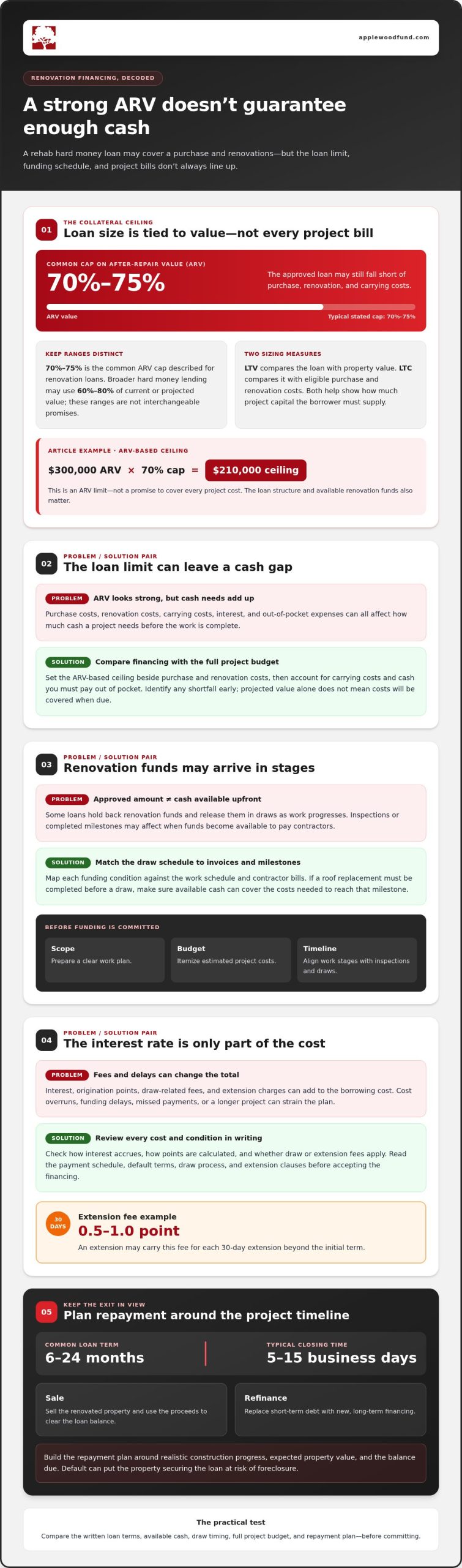
A renovation loan can still leave you short on cash. Hard money for renovation may cover both a property purchase and rehab, but lenders commonly cap the total loan at 70% to 75% of the property’s after-repair value (ARV). Some loans include renovation funds released in draws as work progresses, so the approved amount and the cash available upfront may differ.
That funding gap matters. Purchase costs, renovation draws, interest and out-of-pocket expenses all affect how much cash a project needs before work is complete. A strong projected after-repair value (ARV) does not mean every project cost will be covered when it comes due.
This guide explains how rehab hard money loans work, how to assess interest, origination points, and other fees, and why renovation funding may arrive in stages. You’ll also see how to estimate a cash gap and what can help address it, so you can judge the financing against the project’s full budget and repayment plan.
Key Takeaways
- Compare the loan amount with the project’s purchase, renovation, and carrying costs to spot a cash gap early.
- Understand how renovation holdbacks and draw schedules affect when funds are available to pay contractors.
- Look beyond the interest rate: origination points, extension charges, and draw-related fees can change the total borrowing cost.
- Assess a lender’s inspection and milestone requirements, and read the repayment terms closely before committing.
- Prepare a realistic project budget and exit plan, since property value, available equity, and renovation scope all shape financing.
What is a Rehab Hard Money Loan?
A rehab hard money loan can finance a property purchase, renovations or both, with the real estate serving as collateral. When comparing hard money for renovation, focus on the property’s current value, the project cost and its projected after-repair value (ARV).
Loan Terms and Financing Measures
Loan terms describe the amount, repayment period, and value measures used to size financing. Rehab hard money loans commonly run for 6-24 months, and closings typically take 5-15 business days. Loan-to-value (LTV) compares the loan with a property’s value; loan-to-cost (LTC) compares it with eligible purchase and renovation costs. These measures show how much project capital the borrower must supply.
Collateral-Based Approval and Limits
Collateral-based approval weighs the property and its potential value as security for the hard money loan. Lenders commonly cap loans at 70% to 75% of a property’s ARV, while broader hard money lending may use 60% to 80% of current or projected value. These are different ranges, not interchangeable promises. A lower cap or valuation can reduce financing even when the renovation plan looks profitable.
Renovation Budgets and After-Repair Value
Lenders evaluate renovation budgets against the work needed to reach the projected repair value. They assess the scope, estimated costs, and the completed property’s expected market value. To calculate an ARV-based ceiling, multiply the ARV by the lender’s applicable percentage, then compare the result with purchase and renovation costs. For example, a $300,000 ARV at a 70% cap produces a $210,000 ceiling. How do lenders evaluate renovation budgets and ARV? They weigh the documented work plan and projected value together, then size financing within the applicable collateral limit.
Repayment Through Refinancing or Sale
A rehab hard money loan is commonly repaid by selling the renovated property or refinancing into long-term financing. A sale uses proceeds to clear the loan balance; a refinance replaces short-term debt with new financing. The exit plan matters because many terms end within 6-24 months. Real estate investors should account for renovation timing, the property’s expected value, and the balance due when choosing an exit.
With a $300,000 ARV and a 70% cap, the calculated ceiling is $210,000. That figure is an ARV limit, not a promise to cover every cost. The actual loan structure, interest rate, and available renovation funds determine whether the financing matches the project budget.
Lender due diligence and predatory lending red flags
Due diligence means understanding how the property, renovation plan and repayment strategy are assessed. Compare the written loan terms with your work schedule and available cash before accepting financing.
Inspections and Renovation Milestones
Inspections and renovation milestones can tie construction progress to loan oversight and, in some programs, funding draws. When inspections or completed milestones are loan conditions, they can affect when funds become available. Map the schedule against contractor invoices and each stage of the work.
A lender may also arrange a third-party appraisal as part of reviewing the property and loan. Prepare a clear scope of work, itemized budget and timeline. For example, if a roof replacement must be completed before a draw, make sure your available cash can cover the costs required to reach that milestone.
Choosing a Lender
Assess a lender by examining its written terms, project process, and experience with similar properties. A hard money lender may request your real estate investment experience from the last 3 years and 2 months of personal and business bank statements. These materials help lenders evaluate the project and borrower. Ask how the lender assesses credit score, income, property value, and repayment capacity, then compare the answers with the loan documents.
Leverage matters too. A loan sized against projected value can leave the borrower responsible for part of the purchase or renovation costs. Compare the proposed loan amount with the total budget, and identify any conditions that could delay funding. Hard money loans differ from FHA 203(k) and Fannie Mae HomeStyle financing, which can combine renovation costs with mortgage financing. A HELOC instead draws against available equity in an existing home, while hard money commonly focuses on the investment property and project.
Review the payment schedule, draw process, default terms, and every extension clause in writing. A vague repayment explanation or pressure to sign before you understand the costs deserves careful attention. If you’re comparing a renovation project with an owner-occupied property, explore owner-occupied financing options as part of your assessment.
Loan Risks and Foreclosure
Loan risk includes funding delays, cost overruns, missed payments, and a project that takes longer than the loan term. An extension may carry a fee of 0.5-1.0 point per 30-day extension beyond the initial term. That added cost can strain the budget, especially if the property isn’t ready to sell or refinance.
Default can put the property securing the loan at risk of foreclosure. Build a repayment plan around realistic construction progress and the timing of a sale or refinance. Before signing, find the maturity date, payment requirements, extension conditions and default provisions in the agreement. Understand what happens if a renovation milestone is delayed, not just if the work stays on schedule.
Interest rates, origination points, and additional fees
The interest rate is only one part of a hard money loan’s borrowing cost. Review how interest accrues, how origination points are calculated and which closing charges apply to the investment property.
Interest Rates and Origination Points
An interest rate sets the borrowing charge, while origination points are upfront charges calculated against the loan amount. Together, they affect the project’s financing cost and available cash. One point equals 1% of the loan amount, so a borrower should translate points into a dollar amount using the proposed principal. Compare that charge alongside the interest rate, not in isolation.
Ask how interest is calculated during the loan term. With draw funding, interest may accrue on funds already advanced; with a pre-drawn loan, it may accrue on the full balance from the start. If renovation funds sit unused after closing but are included in the interest-bearing balance, carrying costs can rise before work begins.
Check whether payments are interest-only or reduce principal. Interest-only payments cover borrowing costs but do not lower the balance owed. This matters if you plan to sell, refinance or rent the property, because the full principal may still be due at maturity.
Closing Costs and Additional Fees
Closing costs are transaction charges beyond interest and origination points. A loan estimate or term sheet should identify applicable appraisal, document preparation, title, escrow and construction draw charges. These costs affect both the cash needed to close and the funds left for renovation. Note when each charge is due, such as at closing or when requesting a draw.
Review any extension charges, late-payment terms and conditions for releasing renovation funds. An extension can add expense if repairs or a sale run past the loan term. If draw fees apply, they may recur when funds are released in stages. Include potential charges in your project cash-flow plan instead of treating them as surprises.
Compare offers using the same assumptions: principal, funding schedule, repayment timing and expected project duration. A lower rate does not necessarily mean a lower total cost if points are higher, funds are pre-drawn or other charges apply. Ask for a written breakdown of what is due at closing, what accrues over time and what is due at payoff.
For a rental investment, calculate the cost through your planned exit, not just through renovation. Include the period before the property earns rental income, then account for the payoff balance under your refinance plan. This helps you assess whether the financing fits the project’s cash flow.
Can a rehab loan cover renovation costs?
Yes, some rehab loans finance both a property purchase and renovations, with repair funds released as work progresses. But advertised coverage of 100% of project costs remains subject to the lender’s after-repair value (ARV) cap, so it doesn’t automatically eliminate the borrower’s cash gap.
Financing Acquisition and Renovation
A combined loan covers acquisition and eligible renovation costs through one financing arrangement. This can help investors buy a real estate property that needs work, then fund improvements without arranging separate purchase and repair capital. Some programs may initially advance up to 90% of the purchase price, while renovation money is reserved for later draws.
The approved loan amount and the cash available at closing may differ. Renovation funds may be held back and released later. Compare the purchase amount, renovation reserve and draw schedule with contractor payment deadlines before treating the loan as full project financing.
Purchase Financing and Renovation Holdbacks
A renovation holdback is loan money set aside for repairs and released as work progresses. You may need to cover early expenses before receiving a draw. Inspections or completed milestones can be required before funds are released, linking cash availability to documented progress.
Build the draw schedule around the renovation plan. Identify each work stage, the evidence needed to show completion and the contractor payment due. A six-month renovation, for example, needs funding throughout the project, not only at closing. If a payment is due before a milestone-based draw, plan how you will cover it.
Rehab Cost Financing
Rehab cost financing can cover some or all of the approved renovation budget, depending on the program’s structure and property valuation. Some fix-and-flip lenders advertise 100% financing for purchase and renovation, but the combined loan still faces an ARV limit. The projected finished value therefore influences how much funding the lender can provide.
Separate the budget into purchase costs, approved repairs and expenses the loan may not cover. Compare the total with the loan amount and renovation reserve. A property needing substantial work may require financing structured to cover both the purchase and staged construction costs. Plan for the total capital required and when each portion will be available.
What are the credit score, down payment, and property requirements for a hard money renovation loan?
Hard money lenders assess the property, available equity, renovation plan and borrower’s financial profile. Requirements vary by program, so evaluate the financing against your project’s numbers rather than relying on a single qualification measure.
Credit score: There’s no universal minimum across hard money programs. Some programs have no minimum score, while other lenders commonly require a minimum FICO score of 660. A 500 score won’t automatically disqualify a borrower from some programs, but it can narrow choices or affect the other terms considered. Treat the score as one part of underwriting, alongside the property’s value and the borrower’s ability to make payments.
Down payment and equity: Hard money borrowers should generally expect a down payment of 20% to 40%; another common range is 25% to 40%, depending on the lender. If you already own the property, a lender may require you to retain 25% to 40% equity. These figures can vary with purchase price, loan-to-value, renovation budget, and projected after-repair value (ARV). Calculate your available cash after closing costs, then compare it with the purchase gap and any renovation expenses due before draws.
For example, a program financing 90% of the purchase price generally leaves the borrower bringing roughly 10% of that price to closing, plus fees. That doesn’t mean the remaining cash need is limited to the down payment. Renovation funds may be released in stages, and the total loan remains subject to its collateral limits. Include cash for early work, interest payments, and project costs that arrive before a lender-approved draw.
Property fit: Because the real estate secures the loan, its condition, market value, renovation scope and projected ARV all matter. A fix-and-flip property with a clear repair plan gives the lender a basis for assessing the collateral and proposed exit. Extensive work calls for a detailed budget and milestone plan. If you already own the property, available equity can also affect the financing considered.
Before applying, organize the purchase details, renovation scope, cost estimates, property information, and repayment strategy. Lenders may also review credit and financial records; some fix-and-flip applications request 2 months of personal and business bank statements. These records help explain available cash and the project’s funding plan. Compare the proposed loan with your down payment, draw timing, and expected sale or refinance proceeds.
Planning an owner-occupied renovation or using property equity? Discuss your hard money financing options in relation to your property and project needs.
Applewood Funding: Owner Occupied Hard Money Loans
Applewood Funding Inc offers Owner Occupied Hard Money Loans for borrowers financing a home they will live in. Owner Occupied Home OK. For investment renovations, Fix and Flip Loans and Rental Property Loans are designed for property investment plans. Applewood Funding Inc also offers Construction and Land Loans for development projects.
Choose financing that matches how you’ll use the property and repay the loan. Bring the property details, renovation scope, budget and intended exit strategy into the discussion. This helps focus on a structure that fits your project instead of options that do not.
Have a renovation project in mind? Contact Applewood Funding Inc to discuss the financing option that fits your property and plans.
Turn Your Renovation Plan Into a Clear Next Step
Before choosing financing for renovation work, define the project. Write down how you’ll use the property, the outcome you want and what needs to happen before the loan is repaid. This gives the conversation a practical starting point and keeps the property’s purpose at the center.
Applewood Funding offers Owner Occupied Hard Money Loans, Fix and Flip Loans and Rental Property Loans for different property plans. Consider whether you’ll live in the home, renovate and sell it, or hold it as a rental. The right fit starts with the intended use and your project goals.
Bring your property details and renovation plan to the conversation. Ask how the financing structure can align with your intended use and next move. A clear plan helps you make a more informed decision, and you don’t have to sort through the options alone.
Contact Applewood Funding to discuss your options, and take the next step with confidence.
Frequently Asked Questions
Do hard money loans require down payments?
Yes, borrowers generally contribute a down payment or existing equity. The amount depends on the lender’s purchase financing, property valuation, and renovation plan. For example, if a lender finances 90% of the purchase price, the borrower generally brings roughly 10% of that price to closing, plus fees. Budget separately for renovation costs that may be due before construction funds are released.
Is credit a factor for a rehab loan?
Yes, credit can be part of the review, but hard money lenders don’t all use one minimum score. Some programs have no minimum credit score, while other lenders commonly require a 660 FICO score. A lower score may affect which programs fit, but lenders also assess the property, available equity, renovation plan, and repayment approach. Prepare to explain the project clearly, not just your credit history.
What is after repair value (ARV)?
After-repair value is the estimated market value of a property once planned renovations are complete. It helps assess whether the finished property could support the loan and planned exit. For example, a lender may compare projected ARV with the purchase price and repair budget. Because ARV is an estimate, the quality of the renovation plan and property valuation matters.
What is loan-to-cost (LTC)?
Loan-to-cost compares the loan amount with eligible project costs, usually the purchase and renovation budget. This measure shows how much of the project the loan may cover and how much you may need to fund separately. It is different from LTV, which compares debt with property value.
What is loan-to-value (LTV)?
Loan-to-value is the loan amount divided by the property value used in underwriting, expressed as a percentage. Depending on the loan structure, lenders may use current value or projected after-repair value. This helps explain why a large renovation budget alone does not determine how much a lender will provide.
What types of properties qualify for a rehab loan?
Rehab hard money financing can support real estate investments involving the purchase and renovation of a property. A lender assesses the property’s condition, repair scope, value and intended use. A documented rental or resale plan helps explain how the renovated property fits the financing. Location and marketability also inform the property’s value as collateral.
Why Get a Fix and Flip Loan?
A fix-and-flip loan can combine purchase and renovation financing for an investor who plans to repair a property and sell it. It may suit a deal where conventional financing doesn’t match the property’s condition or project schedule. In Arizona, Applewood Funding offers Fix and Flip Loans, with no credit required, no up-front fees, and no cost to apply. Owner Occupied Home OK; flexible terms from 3 to 360 months. Call 602-497-4444. Lowest rates guaranteed.
What is a hard money loan for renovation?
Hard money for renovation is property-backed financing that can cover a purchase, renovation or both. The property serves as collateral, and the lender assesses its value alongside the planned work and repayment strategy. Separate purchase funds from any construction reserve, then map when repairs need funding. This helps identify cash needs before work begins and compare the loan structure with your plan.