

Hard Money Loans for Scottsdale Airbnbs: 2026 Guide
October 14, 2026What Is ARV? How to Estimate After-Repair Value in 2026
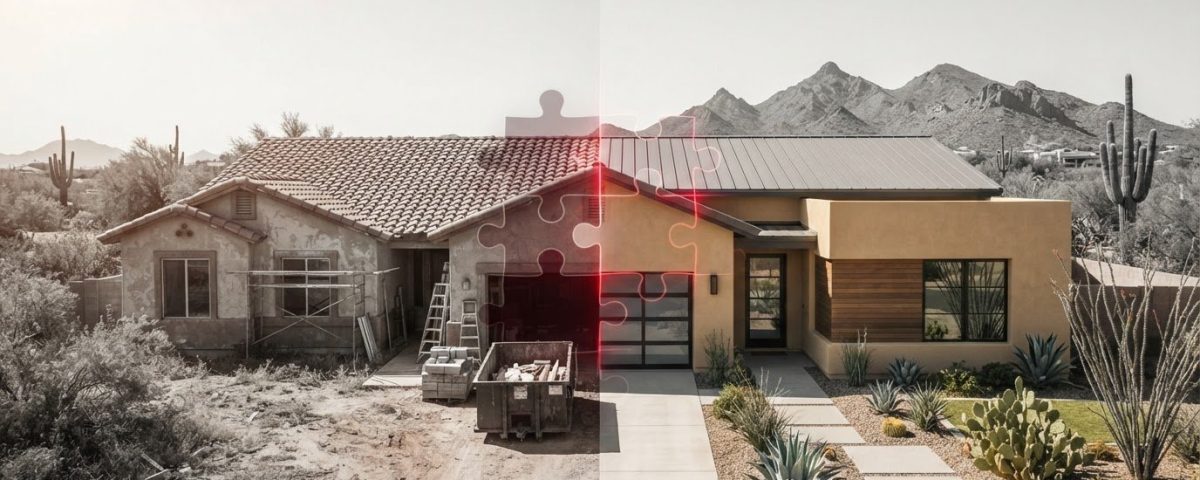
What if the resale value you’re counting on is based on the wrong homes? If you’re asking what is ARV, it’s an estimate of a property’s value after planned renovations are complete. It isn’t the purchase price plus the repair budget, and confusing those numbers can make a shaky project look profitable.
A polished home nearby may still be a poor comp if its size, layout, condition, or location differs from the property you’re evaluating. A defensible estimate starts with recent sales of renovated homes that closely match the finished property you plan to create. Before comparing prices, define the renovation scope and the condition you expect the home to be in when the work is done.
This guide explains the basic ARV calculation, how to choose relevant local comparable sales, and how to use those sales to build a cautious estimate. You’ll also see how ARV differs from repair costs and profit, and why a projected resale price is only one piece of a project decision. For a fix-and-flip, a well-supported estimate can help frame a financing conversation with Applewood Funding, which offers fix-and-flip loans. ARV alone doesn’t determine approval or loan amount.
Key Takeaways
- Understand what is arv: a projected value after planned repairs, not a guaranteed sale price, appraisal, or profit figure.
- Build a more defensible estimate by comparing recently sold renovated homes with similar property type, size, layout, condition, and location.
- Adjust for meaningful differences between the subject property and its comps instead of relying on a simple average of sale prices.
- Stress-test your estimate with conservative, base, and optimistic scenarios, and consider how market shifts or unfinished work could change the outcome.
- Use ARV as one part of a fix-and-flip financing discussion, alongside the property, project, borrower, and other relevant factors.
What Is ARV in Real Estate, and What Does It Tell You?
ARV is the estimated market value of a property after its planned repairs and improvements are complete. If you’re asking “what is arv,” the key is that the estimate describes a possible future condition, not the home as it stands today. ARV is a market-based estimate of what a property could be worth after a defined renovation scope is completed.
That distinction matters. ARV is a projection, not a guaranteed sale price, a formal appraisal, or a measure of profit. It helps a flipper assess whether a potential purchase and renovation plan appear workable before committing. Investors use it as one part of real estate investing, alongside the property’s current condition, planned work, and project expenses.
What does after-repair value include?
ARV assumes the property will be in a specified, finished condition. That might mean completed kitchen and bathroom updates, repaired systems, or other improvements included in the project scope. The estimate should reflect what buyers may value in that local market, not simply how much work or money goes into the renovation.
Keep the value estimate separate from the renovation budget. A larger spend doesn’t automatically create an equal increase in market value. The likely value depends on the completed property and evidence from comparable homes. Define the work clearly, including what will remain unchanged or unfinished, before estimating what the finished home could be worth.
ARV versus current value, resale price, and profit
Current-condition value describes the property as it exists now. ARV looks ahead to its assumed condition after the planned work. Resale price is different again: it’s the amount a buyer ultimately agrees to pay in a completed transaction. Until that sale happens, ARV remains an estimate rather than a known result.
Profit isn’t ARV minus renovation spending alone. A project’s expenses can also include the purchase, financing, taxes, insurance, utilities, transaction costs, and other holding costs. If those costs are left out, a projected resale value can look like a gain even when the full project economics are much tighter.
Consider a house that needs a kitchen update and other defined repairs. Its current value reflects its present condition; its ARV reflects the expected finished condition, judged against relevant market evidence. The renovation budget tracks the work itself. These are three different figures, and none should be substituted for another.
Use ARV to ask a practical question before you commit: does the estimated finished value still support the project after you account for the full scope and expenses? Treat it as a decision-making input, not a promise. A well-reasoned estimate gives you a clearer basis for evaluating a fix-and-flip plan and discussing the property with a lender, while leaving room for the market and final sale to differ from your projection.
How to Calculate ARV: Formula, Comparable Sales, and a Clear Example
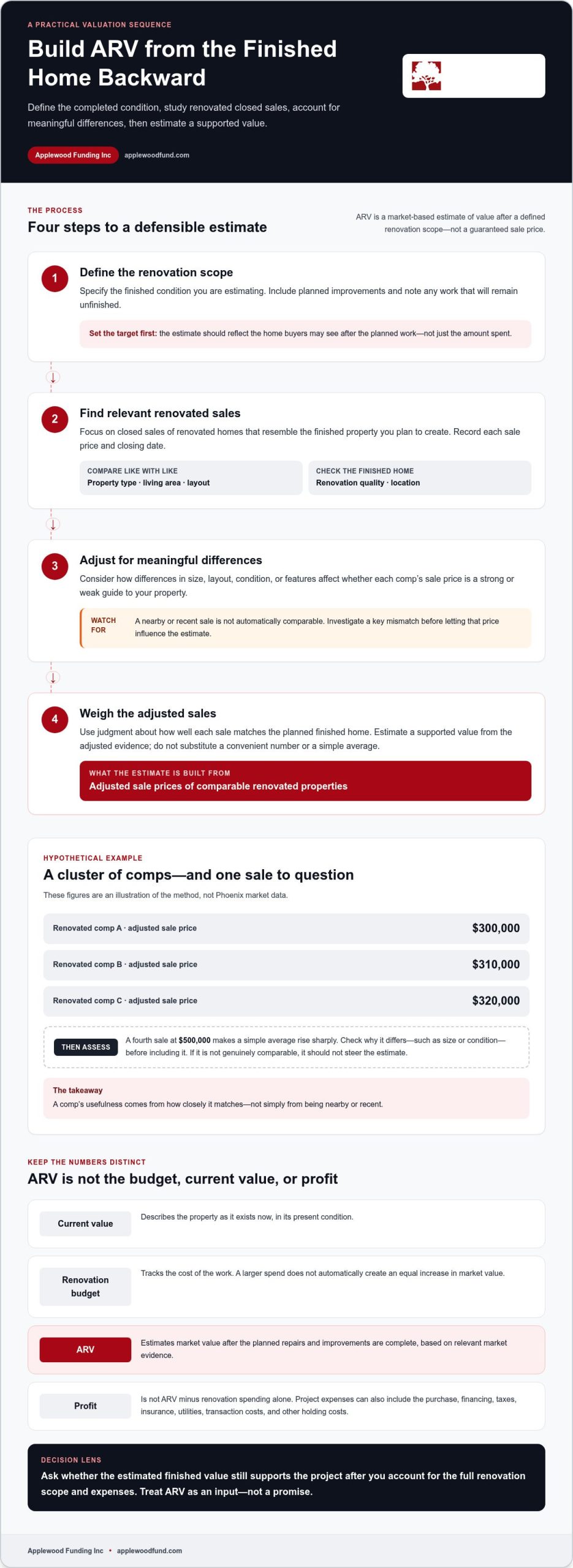
Build the estimate from the finished property outward, not from the renovation budget. Use this sequence: define the work, find relevant renovated homes that have sold, adjust their sale prices for meaningful differences, then estimate the subject property’s value. This keeps the analysis tied to market evidence rather than the assumption that every dollar spent adds a dollar of value.
ARV is an estimate derived from the adjusted sale prices of comparable renovated properties. “Adjusted sale prices” means closed-sale prices considered in light of differences between each comparable and the subject; “comparable renovated properties” means homes with similar features and completed condition; “estimate” is the reasoned value conclusion, not a promised sale result. For a broader overview of the concept, see After Repair Value (ARV) Explained.
- Define the renovation scope. Specify the completed condition you’re estimating, including the planned improvements and any work that will remain unfinished.
- Find relevant sold comps. Focus on renovated homes that resemble the property and record their closing dates and sale prices.
- Adjust for differences. Consider whether differences in size, layout, condition, or features make a comp’s price a stronger or weaker guide.
- Estimate a supported value. Weigh the adjusted sales together. Don’t let a convenient number replace judgment about how well each sale matches.
The basic ARV formula and a worked example
Here’s a clearly hypothetical example, not Phoenix market data. Suppose three renovated comps have adjusted sale prices of $300,000, $310,000, and $320,000. Together, they suggest an estimated value around their cluster, subject to how closely each matches the planned finished home. The example shows a method, not a guarantee that a property will sell at that level.
Now add a fourth sale at $500,000. A simple average of all four prices rises sharply, but that comp may differ in a key way, such as size or condition. Investigate why before including it. If it isn’t genuinely comparable, it shouldn’t steer the estimate just because it’s nearby or recent.
Build a useful comparable-sales set
Prioritize closed sales of the same property type, with similar living area, layout, renovation quality, and location. Note each sale date and the differences that could affect buyer appeal. Recent completed sales generally offer stronger evidence than asking prices because they show an agreed transaction, while a listing price shows only what a seller hopes to receive.
Nearby doesn’t always mean comparable. A renovated home across a major boundary or with a different layout may reflect a different buyer pool. Keep the strongest matches central, and note why a sale is included or excluded. That record makes the estimate easier to revisit as the project scope or available evidence changes.
Once your estimate is documented, use it as one piece of a project review and a potential fix-and-flip financing discussion. For an Arizona property, discussing your property and project estimate with Applewood Funding can help frame that conversation. The estimate alone doesn’t determine financing.
Which Renovated Comps Support ARV in Phoenix and Arizona Markets?
A useful comp isn’t simply the closest house or the highest recent sale. It’s a renovated property whose features and finished condition give you a meaningful comparison for the home you plan to create. For investors asking what is arv in a specific Arizona market, local details matter. Phoenix, Scottsdale, and Tucson aren’t interchangeable markets, and the same is true when comparing Glendale, Peoria, Tempe, Mesa, Sedona, and Flagstaff. Build your comp set around the subject property’s relevant local market rather than combining sales from across the state.
Start with closed sales, not asking prices or speculative online estimates. A listing shows what a seller hopes to receive; a completed sale shows what a buyer agreed to pay. Check the sale date, since older transactions may reflect different market conditions. Then compare the properties across the characteristics most likely to shape buyer appeal:
- Property type: Compare like with like, such as a detached house with another detached house, rather than assuming a condo sale is a useful match.
- Living area and layout: Look at usable space, bedroom and bathroom configuration, and how the home functions, not just its total size.
- Condition and renovation quality: A fully updated home may not represent a property with basic finishes or remaining work.
- Location: Consider neighborhood boundaries, access, and nearby surroundings. A short distance can still separate different buyer pools.
How to judge whether a renovated sale is a strong comp
Prioritize a similar property type, size, layout, and finished condition in the same local area. Don’t use a fixed distance alone as your test. A sale across a neighborhood boundary may be less relevant than one slightly farther away with a closer match in character and buyer appeal. If only a few strong comps are available, treat the estimate as more uncertain instead of stretching the criteria to fill the set.
Separate renovated closed sales from active listings, pending deals, and properties with unclear renovation status. Those sources may offer context, but they aren’t equivalent evidence. Verify the sale date and available details before relying on a price. A nearby home with a substantially different size, layout, or finish level can be a weaker comp than a better-matched sale farther away.
Adjust for condition, features, and local market context
Compare each sale with the home as it’s expected to look when the renovation is complete. Differences in finish quality, functional layout, or features buyers value locally may make a comp’s price more or less relevant. Don’t apply a standard dollar adjustment by habit. Explain the reason for each adjustment and use current local closed-sale evidence to support your judgment.
Keep a compact comparison record so your reasoning is visible. Include the property or comp identifier, sale date, sale price, key differences, and why those differences support an adjustment or exclusion. Label the source and date of market information, and verify it before relying on it. If a number can’t be tied to a reliable, current source, don’t present it as established local market data.
How to Stress-Test an ARV Estimate Before You Commit
A single ARV can make a deal look more certain than it is. Build three scenarios instead: conservative, base, and optimistic. The practical question behind “what is arv” isn’t just what the finished home might be worth. It’s how the project changes if your strongest assumptions don’t hold.
Anchor each scenario in evidence. The conservative case might rely on the lower end of relevant renovated sales or allow for softer market conditions. The base case should reflect the comps and renovation scope you consider most supportable. Use the optimistic case only when stronger evidence justifies it, not because a higher resale number makes the project more appealing.
Common ARV mistakes that inflate expectations
Asking prices are not completed sales, and one unusually high comp shouldn’t set the value for the whole project. Check whether it has features, finishes, or a location that make it a poor match. Also, don’t assume every upgrade adds equal market value. A renovation may improve buyer appeal without increasing value by the full amount spent.
Revisit your estimate when the property’s condition changes, the work scope expands, or newer sale evidence points in another direction. A delayed project can face a different market by the time it’s ready to sell. Keep the estimate tied to the expected completion date and clearly record which assumptions need another look.
Use sensitivity checks instead of a single confident number
Test how a lower ARV affects the deal before committing. If your base scenario assumes a finished value of V, model a conservative value below V using a reasoned change in comparable-sale evidence. Then review whether the expected resale proceeds still leave room for acquisition, rehabilitation, holding, and selling expenses. This is not a profit calculation by itself; it’s a way to see which assumptions put the project under pressure.
Focus your review on the least certain inputs. Are the best comps older or weaker matches? Is the renovation scope still changing? Could market movement or unfinished work affect the condition buyers see? These uncertainties deserve more attention than a precise-looking ARV unsupported by the evidence.
The 70% rule is sometimes used as a rough screening heuristic: multiply ARV by 70%, then subtract estimated repair costs to arrive at a possible purchase-price ceiling. It isn’t a guaranteed result, a universal standard, or a lender requirement. Its usefulness varies with the property, market, scope, and expenses, so don’t let the shortcut replace a full project review.
Before moving forward, lay out your scenarios and identify what would change your decision. For a fix-and-flip in Arizona, discuss your project and financing questions with Applewood Funding. ARV is one input in that conversation, not a promise of approval or a particular loan amount.
How ARV Can Inform a Fix-and-Flip Financing Conversation
A well-supported ARV can help explain why a fix-and-flip project is worth evaluating. It gives a lender a reasoned view of the property’s potential finished value, backed by comparable sales and a defined renovation plan. But what is arv in a financing discussion? It’s one part of the picture, not a shortcut to a decision. A lender may also consider the property itself, the project plan, the borrower, and other factors. ARV alone doesn’t determine approval, loan size, terms, or funding.
Make the estimate easy to follow. Organize the evidence behind it, and separate confirmed details from assumptions that may change. The same preparation helps you explain the project clearly and spot gaps before they become surprises. For broader context on the financing process, Applewood Funding’s fix-and-flip financing guide can be a useful next read.
What to organize before discussing a flip project
Start with a concise summary of the property’s current condition and the work you plan to complete. Describe the renovation scope in practical terms, including what will be repaired, updated, or left unchanged. Keep the scope aligned with the finished condition assumed in your ARV estimate; if those don’t match, the valuation story becomes harder to assess.
Next, present your comps in a compact table or document. For each sale, include its date, relevant similarities, meaningful differences, and your reason for any adjustment. Add a short note explaining why you included it. This lets someone reviewing the project see how you reached your estimate, rather than being asked to accept a single number without context.
- Verified information: Closed-sale details, observable property features, and the renovation work already defined.
- Working assumptions: Expected completed condition, estimates that still need review, or any uncertain market interpretation.
Label assumptions clearly. If the rehab scope is preliminary or a comp has limited information, note it in your analysis. That doesn’t make the analysis useless. It shows where further review could change the estimate or project plan.
Explore financing next steps with an Arizona-focused lender
Once your property summary, scope, and comp rationale are organized, you can have a more focused financing conversation. Applewood Funding offers fix-and-flip loans in Arizona, including Phoenix and surrounding markets. Bring the estimate as supporting context, not as a requested guarantee. A lender can review the project alongside other relevant information, and the eventual financing decision may differ from your own assumptions.
Use the discussion to understand how the property and project will be considered and what information is relevant to the next step. Keep your scenarios and supporting evidence close at hand, especially if your ARV depends on comps that are less similar or on work that has not been fully defined. A clear package makes it easier to discuss both the opportunity and its uncertainties.
If you’re evaluating a flip in Arizona, Discuss your real estate financing options with Applewood Funding.
Turn Your Estimate Into a Clear Next Step
Before moving ahead, decide what evidence would make you revise your plan. A new sale, a change in renovation scope, or a different view of the finished property could shift the numbers. Set those review points now, while you still have room to reassess. That discipline helps keep a promising projection from becoming an unquestioned assumption.
If you’re weighing a project, bring your assumptions and open questions into a financing conversation. Applewood Funding is managed by Joel McDaniel, NMLS 175371. A discussion can help you consider how the financing picture fits your next move, but it doesn’t guarantee approval or a particular loan amount.
Use what is arv as a starting point for a better-informed decision, not a reason to rush one. Discuss your real estate financing options with Applewood Funding, then move forward with a plan that reflects both the opportunity and the uncertainty.
Frequently Asked Questions
What does ARV stand for?
ARV stands for after-repair value: an estimate of a property’s market value once planned repairs or renovations are complete. For example, an investor evaluating a dated home can compare its expected finished condition with renovated sales before deciding whether to pursue the project. The estimate relies on assumptions and market evidence, so it isn’t a guaranteed sale price, appraisal, or profit figure. Investors use it to screen potential projects. That’s the practical answer to “what is arv.”
Is ARV the same as an appraisal?
No. ARV is an estimate of a property’s value in an assumed renovated condition. An appraisal is a formal valuation prepared by an appraiser for a defined purpose. The information considered and the scope of each analysis may differ. For instance, your estimate might assume specific improvements that haven’t been completed yet. Keep the terms distinct: an investor’s ARV worksheet can support project analysis, but it shouldn’t be represented as an appraisal.
Can ARV be higher than a property’s current value?
Yes. A finished property may be estimated to be worth more than it is in its current condition if relevant sales support that outlook. The difference isn’t automatic, though. A renovation’s quality, the property’s location, buyer demand, and how closely the comparable homes match all matter. Before treating the projected increase as support for a purchase, consider whether the comps reflect the finished home you actually plan to deliver. A higher estimate never guarantees a particular resale price.
Does ARV include renovation costs?
No. ARV estimates a property’s value after planned work; it doesn’t measure what the renovation will cost. Track the rehab budget separately, alongside acquisition expenses and other costs relevant to the project. For example, a larger renovation budget doesn’t necessarily mean the property’s estimated value rises by the same amount. Confusing these figures, or treating ARV as profit, can make a flip appear stronger than it is. Keep each number in its own place in your analysis.
How often should I update an ARV estimate?
Update it whenever an important assumption changes. A revised renovation plan, newly discovered property issue, different set of comparable sales, or shift in relevant market conditions can all affect the estimate. A preliminary figure may help you decide whether to investigate a deal, but it shouldn’t stay fixed simply because it was written down first. Date each version and record the comps and assumptions behind it, so you can see what changed and why.
Can two similar homes have different ARVs?
Yes. Similar size or appearance alone doesn’t make two homes equal in estimated value. Layout, specific location, condition, renovation quality, buyer-facing features, and available comparable sales can lead to different conclusions. In Arizona, a Phoenix comp shouldn’t automatically set the estimate for a property in Scottsdale, Glendale, Peoria, Tempe, Mesa, Sedona, Flagstaff, or Tucson. Keep comparisons grounded in the relevant local market and the home’s planned finished condition.
Is ARV used for rental properties as well as house flips?
Yes. Investors can use ARV to consider a rental property’s estimated value after planned improvements, but that figure answers only a value question. It doesn’t show whether projected rent will cover operating expenses, financing, maintenance, or periods without a tenant. For example, an upgraded unit may have a higher estimated value while still requiring a separate review of its rental economics. Assess income and expenses independently; ARV alone can’t establish cash flow or investment performance.