


Self-Employed Mortgage With No Tax Returns: Your 2026 Options
October 12, 2026Phoenix Multi-Family Private Lender: 2026 Buying Guide

A strong Phoenix multi-family financing request starts with the property plan, not a rate comparison. Searching “private lender for multi-family properties phoenix” is only the first step. The key question is whether the financing approach fits the building, its income, your project goals, and your timeline.
When conventional financing seems too slow or doesn’t fit a transaction, private financing may offer another route. The lender and loan structure still need to make sense for the project. A clear picture of the property’s value, current performance, and planned improvements helps focus the financing discussion.
This guide explains what to evaluate when comparing private financing, what to prepare for a project request, and how to discuss your plans with Applewood Funding Inc. You’ll learn how a rent roll and operating history can support your request, and how to outline your investment plan and financing needs. Applewood Funding Inc provides rental property loans and alternative real estate financing in Arizona, including Phoenix. Start with the project facts to make your next financing conversation more focused.
Key Takeaways
- Match financing to the property’s intended use, investment purpose, and project timeline.
- Understand how property details and financing goals can shape a project-focused lending discussion.
- Compare private and conventional financing by their typical evaluation focus, documentation, flexibility, and transaction fit.
- Prepare a clear snapshot of the property’s location, unit mix, condition, occupancy, and financing purpose.
- Learn how a private lender for multi-family properties phoenix may fit your plans, and how to discuss project-specific financing with Applewood Funding.
Why Phoenix investors consider a private lender for multi-family properties
Start with the property, purpose, and timeline. An investor buying an income-producing apartment building has a different financing request from someone seeking a home to live in. The distinction matters because an investment property is part of a business plan, while owner-occupied financing is centered on a borrower’s residence. State clearly how the property will be used and what the funds need to accomplish.
A private real estate lender is a non-bank lender that provides financing for a property-related purpose under terms assessed for the specific transaction. Investors may explore this route when a conventional process doesn’t align with the project, such as when the plan includes improvements, a transition between ownership stages, or a different financing approach. These circumstances are reasons to compare options, not promises of approval or proof that private financing is always faster or more suitable.
Which Phoenix multi-family projects may prompt a private-financing search?
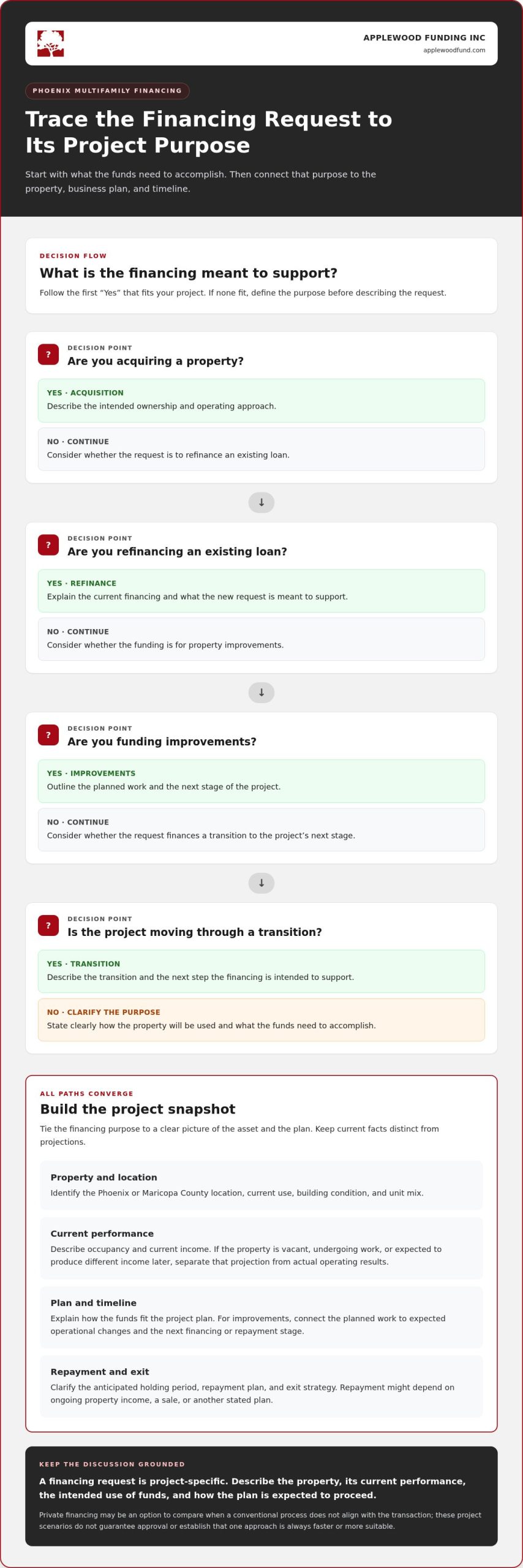
Possible goals include acquiring a property, refinancing an existing loan, funding improvements, or financing a transition while a project moves toward its next stage. For example, an investor might be evaluating a building that needs work before its long-term operating plan is in place. These are common project scenarios, not statements about eligibility. Fit depends on the request’s details and review.
Make the local context concrete: identify the property’s Phoenix or Maricopa County location, its current use, and your planned next step. Arizona investors may also be evaluating properties in Scottsdale, Glendale, Peoria, Tempe, Mesa, Sedona, Flagstaff, or Tucson. The broad category of multifamily residential properties includes different building types and ownership situations, so describe the actual asset rather than relying on a general label.
What does a private lender evaluate beyond the borrower?
The property is central to describing the request, but it isn’t the whole story. Explain its intended use, whether it’s occupied or undergoing work, why you’re seeking financing, and how the funding fits the project plan. The relevance of each detail varies by request, so there isn’t one universal checklist for every investment.
Connect the details to the plan. For an acquisition, describe the intended ownership and operating approach. For improvements, outline the work and the next stage. For a refinance, explain the current financing and what the new request is meant to support. Clear, consistent information helps frame a project-specific discussion without assuming that one feature alone determines a lending decision.
Applewood Funding offers rental property loans and alternative real estate financing in Arizona, including Phoenix. Bring the project facts into focus: where the property is, how it’s used, what you plan to do, and the financing purpose. That gives the conversation a practical basis for discussing your request and goals. A search for “private lender for multi-family properties phoenix” is a starting point; a well-defined project gives it direction.
How private financing for Phoenix multi-family property is assessed
Private financing discussions often consider the property as well as the borrower. This is sometimes described as asset-based lending: the real estate and its role in the project may help frame the request, alongside the borrower’s financial picture. It’s a general lending concept, not a statement that every private lender uses the same method or that one factor determines approval.
General private-lending principles can help explain what may matter, but loan terms and review depend on the specific property, borrower, and financing purpose. For investors looking for a private lender for multi-family properties phoenix, this distinction is useful: don’t assume a generic checklist or example applies to your request. Describe the deal clearly, then discuss how its details shape a project-specific review.
A focused discussion starts with the financing purpose, then considers the property and how you plan to use the funds. A business plan connects those pieces. It can explain what the financing supports, how the property is expected to perform, and where repayment is intended to come from. If the project includes improvements, lay out the sequence: planned work, expected operational changes, and the next financing or repayment stage. Keep projections separate from current facts.
The American Association of Private Lenders is an industry resource for learning more about private real estate lending. Use general information to prepare questions, not to assume a particular lender’s process or terms.
How property value and income inform the financing conversation
Describe the building’s condition, occupancy, and current income, and provide supporting details where available. If the property is vacant, undergoing work, or expected to produce different income later, distinguish that projection from actual operating results. Income analysis can vary with the property and financing purpose. A lender may also discuss debt-service coverage ratio, or DSCR, a comparison of a property’s income with its debt obligations. It’s a common concept, not a stated Applewood requirement.
What to clarify about the loan structure
Before discussing structure, be ready to explain the financing purpose, anticipated holding period, repayment plan, and exit strategy. Repayment might depend on ongoing property income, a sale, or a later financing step. Describe the plan without treating it as assured. Rates, fees, term, and other conditions vary by transaction, so compare the full structure against the project’s expected cash flow and timing.
Assess fit, not just the headline rate. Consider whether the planned repayment path aligns with the holding period and what could change if the project takes longer than expected. To discuss these trade-offs for your Phoenix property, bring a concise outline of the property and goals to Applewood Funding’s Phoenix financing team.
Private lender versus conventional financing for Phoenix multi-family properties
No single financing route fits every building or investment plan. Conventional mortgages may suit borrowers whose finances, property, and schedule align with that process. Private financing may be worth exploring when project circumstances call for a different approach. These are general tendencies, not fixed rules: documentation, terms, review, and timing depend on the transaction.
Use the comparison as a starting point, not a verdict. A search for a “private lender for multi-family properties phoenix” should lead to a closer look at how financing fits the property and repayment plan, not just a quick comparison of rates.
| Comparison area | Conventional financing, generally | Private financing, generally |
|---|---|---|
| Evaluation focus | May place substantial weight on borrower finances, property details, and fit with the lender’s program. | May give particular attention to the property, financing purpose, and project plan, alongside borrower information. |
| Documentation | Often involves detailed financial and property documentation, with requirements shaped by the lender and loan type. | Documentation varies by lender and request; property and project information can be central to the discussion. |
| Flexibility | Terms and processes may follow established program requirements. | Some private lenders may tailor financing details to the transaction, subject to review. |
| Transaction fit | May suit plans that align with conventional documentation, property, and timing expectations. | May be considered when project circumstances or goals call for an alternative lending approach. |
When a conventional mortgage may fit the investment plan
A conventional route may be worth considering if you can provide the requested financial records and property information, and the building and transaction fit the lender’s requirements. Fannie Mae and Freddie Mac are examples of entities in the conventional mortgage market, not Applewood Funding partners. Requirements vary by program and lender, so a specific multi-family property needs review before you assume it qualifies.
When to consider a private lending conversation
Consider discussing alternatives if the project’s timing, property circumstances, or financing purpose don’t line up neatly with a conventional process. That doesn’t make private financing automatically faster or a better fit. Review the full cost, repayment plan, holding period, and risks before deciding. For a multi-family ground-up project, explore construction loan options as part of evaluating the project’s financing approach.
Applewood Funding provides rental property loans and alternative real estate financing in Arizona, including Phoenix. Compare those approaches with your project goals and the financing options relevant to your request. Keep the focus on fit: what the property needs, what financing must accomplish, and how repayment is expected to work.
How to prepare a Phoenix multi-family financing request
A clear request turns a broad financing question into a focused project discussion. Organize the property facts, transaction details, and repayment plan before approaching a lender. Be accurate, flag estimates, and explain what the financing is meant to accomplish. You don’t need to make projections sound certain, but you should be able to show how you reached them.
Build a concise property and project snapshot
Start with a one-page overview, then gather records to support it. The snapshot should make the asset and transaction easy to understand without requiring the reader to piece together details from scattered files.
- Identify the property. Give its street address and Phoenix-area location, property type, unit count, and unit mix. Note whether it’s occupied, vacant, partially occupied, or undergoing work.
- State the transaction stage. Explain whether you’re considering an acquisition, refinance, improvement project, or another financing purpose. Include purchase details or current loan context when relevant.
- Summarize operations. Gather available rent rolls, trailing operating statements, income records, and expense information. Label the period each record covers, and distinguish actual income from projected income.
- Describe condition and planned work. Note known repairs, larger property concerns, and improvements under consideration. If you have estimates or a work plan, identify them as estimates or plans, not completed work.
- Assemble supporting borrower information. Organize relevant financial records and real estate experience details if they apply to the request. Documents can vary by transaction, so present what you have accurately and keep sensitive records organized.
Location, unit mix, condition, occupancy, operating records, financing purpose, and repayment plan give a lender a clearer starting point for assessing a request.
Set out the requested financing and repayment plan
Connect the amount you’re seeking to a defined purpose. Explain how funds would support the purchase, refinance, or planned work, and separate known costs from estimates. Then describe the expected holding period and proposed repayment or exit strategy, such as repayment from property operations, a sale, or a later financing step. These are plans, not guaranteed outcomes.
Before comparing proposals, look beyond one headline metric. Review the full structure, including rates, fees, term, repayment schedule, and other conditions. Then consider how those details fit the project’s cash flow and timeline. The terms that matter most depend on the transaction, so record open questions and compare proposals using the same assumptions.
For investors seeking a private lender for multi-family properties phoenix, an organized package can make the first conversation more productive. Share the property snapshot and project plan with Applewood Funding to discuss your Phoenix financing request. Applewood Funding offers rental-property and alternative real estate financing for a project-focused discussion centered on the property and your stated goals.
Discuss your Phoenix multi-family project with Applewood Funding
A productive financing conversation starts with a clear picture of the deal. Applewood Funding provides rental-property loans and alternative real estate financing in Arizona, including Phoenix. These services are relevant to investors weighing financing for a multi-family property, whether the goal is an acquisition, refinance, or planned project work. The focus is your specific request, not a one-size-fits-all loan structure.
Financing details are tailored to the property and your stated project goals. Be direct about what you need the funds to do, what stage the transaction has reached, and how you expect to repay the financing. Clear information keeps the discussion grounded in the actual property and plan. It doesn’t guarantee approval or any particular terms.
What to bring to an initial financing conversation
Bring a concise property snapshot and documents that explain its current condition and operation. If a record is unavailable, say so plainly rather than filling the gap with an unsupported estimate. Accurate context helps frame the project’s financing fit.
- Property details: Address, property type, unit count and mix, condition, occupancy, and current operating status.
- Transaction information: Purchase details for an acquisition, or current loan and property context for a refinance.
- Operating records: Available rent roll, income and expense history, and other records that help describe current performance.
- Project plan: Planned improvements, expected costs or estimates where available, and the stage of any work already underway.
- Timing and repayment: Your target timing, anticipated holding period, and proposed repayment or exit strategy.
Keep confirmed facts separate from projections. For example, label estimated post-improvement income as a projection, not current property income. If your timeline depends on a purchase date or planned renovation sequence, explain the connection so the financing purpose is clear.
Start a Phoenix financing conversation
Applewood Funding serves Arizona borrowers with alternative lending solutions, including rental-property financing. A conversation can focus on the property, the purpose of financing, and the goals you’ve set for the project. Rates, fees, repayment terms, timing, and other details depend on the individual transaction, so begin by explaining the request accurately.
If you’re searching for a private lender for multi-family properties phoenix, bring the key facts and your questions together. Be concise, but include details that could shape the project discussion. A clear explanation of the asset, transaction, and repayment plan gives the conversation a practical starting point.
Discuss your Phoenix multi-family financing needs with Applewood Funding and outline the goals behind your request.
Turn Your Phoenix Property Plans Into a Clear Next Step
Your next move doesn’t have to be a full financing decision. Start by defining what you want the property to accomplish, what needs to happen next, and which questions you need answered before moving forward. A focused conversation can help clarify those priorities and how a financing approach might fit your plans.
If “private lender for multi-family properties phoenix” is the search that brought you here, Applewood Funding’s rental-property and alternative financing experience offers a starting point for discussing your Phoenix project. Define your goals, gather the details you have, and be ready to explain what matters most. Project terms and fit depend on the individual request, but a clear first conversation can help identify next steps.
Discuss your Phoenix property financing needs with Applewood Funding. Bring your questions and plans to start the conversation.
Frequently Asked Questions
Can I use a private lender to buy a multi-family property in Phoenix?
Yes, private financing can be considered for a Phoenix multi-family purchase, but the property and transaction need an individual review. An investor buying a building with current tenants may present a different request from one buying a property that needs work before rental operations. Explain the purchase stage, intended use, and repayment plan clearly. A possible financing route isn’t a promise of eligibility or approval.
What does a private lender look at for a multi-family property loan?
A lender may consider the property, its condition and occupancy, available income information, the borrower’s financial picture, and the purpose of the request. Details like leases nearing expiration or repairs that could affect operations add useful context. Keep documents consistent: if the rent roll and operating statements show different figures, explain why. The factors considered and their importance vary by lender and transaction.
Is a private lender better than a bank for a Phoenix multi-family property?
Neither option is automatically better. A conventional mortgage may suit an investor whose property and financial profile fit its process and whose plan supports its requirements. Private financing may be worth discussing if the transaction calls for another approach. Compare the complete cost, repayment schedule, term, and risks against your expected ownership period, not just one quoted rate.
How do I prepare to apply for multi-family property financing?
Gather property and borrower records before submitting a request. Useful materials may include a rent roll, trailing 12-month operating statement, purchase agreement or current loan details, personal financial statement, tax returns, and schedule of real estate owned. Include a short explanation of the planned transaction and use of funds. Organize records by topic, label the reporting period, and identify estimates so actual results remain clear.
Can private financing cover repairs or construction on a multi-family property?
Financing for property work may be explored, but the appropriate approach depends on the project and transaction. A targeted repair plan for an operating rental building differs from a major renovation or ground-up construction project. Applewood Funding offers fix-and-flip, construction and land, and rental property financing. Describe the work, expected costs, project stage, and intended repayment path; financing details are assessed for the specific request.
What should I compare before choosing a private lender in Phoenix?
Compare the full proposed structure, not just the interest rate. Review fees, repayment schedule, term, payoff conditions, documentation needs, and how the plan handles a delayed sale or renovation. Ask for key terms in writing and compare each proposal using the same project assumptions. Also consider whether the expected holding period and property cash flow leave room for repayment if the project takes longer than planned.
Does Applewood Funding offer financing for multi-family investment properties in Phoenix?
Applewood Funding offers rental property loans and alternative real estate financing in Arizona, including Phoenix. These services are relevant to investors discussing financing for a multi-family rental property. The company also provides hard money solutions. A project conversation can focus on the property, transaction purpose, and your investment goals. Share the information you have to discuss the request and its financing details.