


Construction Loans: Fast Private Financing for Ground-Up Builds in 2026
September 23, 2026Hard Money Loans for Bad Credit: How Equity Secures Real Estate Funding in 2026

Can you qualify for real estate funding when your credit score sits below 600? Absolutely. If a conventional retail bank just rejected your application over rigid FICO requirements, your deal isn’t dead. In fast-moving markets where closing deadlines won’t wait, hard money loans for bad credit give you a powerful financing alternative centered on property value rather than past setbacks.
It’s frustrating to watch a prime investment slip away while traditional underwriters spend weeks dissecting an old bankruptcy or an imperfect score. You shouldn’t have to lose profitable opportunities to banking red tape. In this guide, you’ll discover how private, asset-based lending prioritizes physical collateral and clear exit strategies over credit history so you can secure rapid funding for acquisitions or stabilization. Here is how equity secures your immediate financing and builds a direct bridge toward long-term refinancing.
Key Takeaways
- Discover how hard money loans for bad credit rely on physical property equity and protective margins instead of rigid credit scores.
- Overcome past bankruptcies, foreclosures, or recent retail bank rejections without waiting through multi-year seasoning periods.
- Learn what private mortgage underwriters evaluate during collateral assessments and deal viability checks.
- Master the documentation needed to secure rapid asset-based financing across competitive Arizona markets.
- Build a solid exit strategy to safeguard your project equity and transition short-term debt into long-term wealth.
What Are Hard Money Loans for Bad Credit and How Do They Work?
Traditional retail banks operate like rigid gatekeepers. They demand pristine credit scores, extensive tax returns, and spotless debt-to-income ratios. One past blemish, and your file gets stamped with a rejection. Private lending plays by entirely different rules. A hard money loan for bad credit relies on property equity rather than FICO scores. While institutional banks obsess over past financial setbacks, private mortgage underwriters evaluate the tangible value of the physical real estate, its marketability, and your planned exit strategy. Simply put, asset-based lending is a financing structure where loan security rests on protective equity and collateral value rather than a personal balance sheet.
The Mechanics of Asset-Based Lending
Private capital sources look at the collateral first. When you purchase or refinance real estate with substantial equity, the physical property serves as primary security for the debt. Lenders use conservative loan-to-value ratios to establish a built-in safety cushion. This protective equity margin shields the lender against loss if a default occurs, which makes your FICO score a secondary concern.
Underwriting moves in days rather than months because private lenders inspect the real estate instead of auditing years of personal financial history. You bypass the bureaucratic verification layers that stall retail bank approvals, letting you secure hard money loans for bad credit before valuable deals slip away.
Commercial vs. Consumer Hard Money Lending
Many lending institutions treat asset-based loans as strictly commercial tools, completely ignoring property owners who need primary residence solutions. Private financing actually spans two distinct lanes:
- Commercial hard money: Finances non-owner-occupied investments, including fix-and-flip acquisitions, multifamily assets, and ground-up construction ventures.
- Consumer hard money: Provides residential financing for primary residences under strict federal and state consumer lending rules.
If conventional underwriters reject your mortgage application after a financial bump in the road, you still have options. Securing an owner occupied hard money loan delivers vital bridge funding when retail banks refuse approval, keeping your home purchase or refinance moving forward without delay.
Credit Score vs. Property Equity: What Private Lenders Actually Evaluate
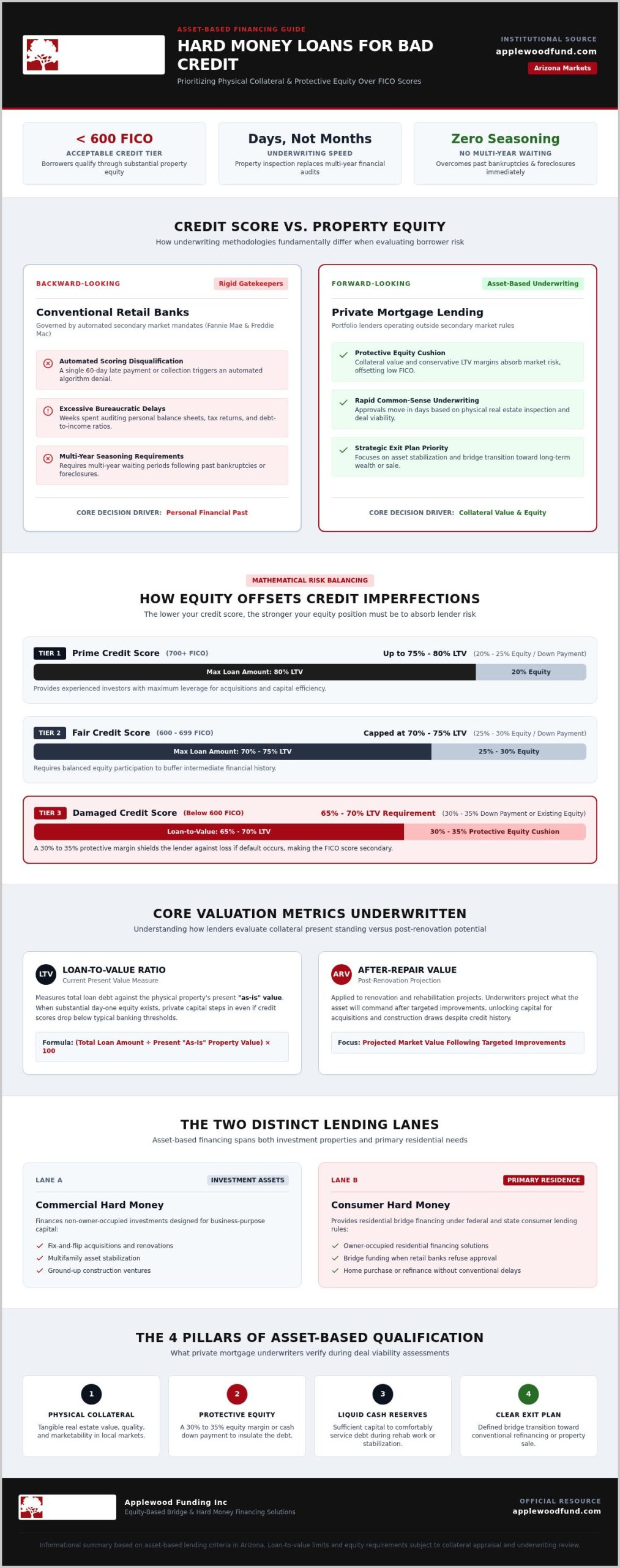
Your credit score looks backward. Property equity looks forward. Conventional retail banks judge your entire financial future based on past payment records, treating any historical misstep as an immediate roadblock. Private mortgage underwriters look at risk through a mathematical lens. They focus on protective equity margins designed to absorb market fluctuations and default risks. When evaluating hard money loans for bad credit, a substantial equity cushion directly offsets credit imperfections.
The trade-off is clear: the lower your credit score, the stronger your equity position must be. Lenders balance borrower risk by adjusting loan-to-value limits across different credit tiers:
- Prime credit (700+ FICO): Up to 75% to 80% LTV, giving experienced investors maximum leverage.
- Fair credit (600-699 FICO): Typically capped around 70% to 75% LTV, requiring balanced equity participation.
- Damaged credit (below 600 FICO): Generally requires 65% to 70% LTV, meaning you provide a 30% to 35% down payment or equivalent existing property equity.
Understanding Loan-to-Value (LTV) and After-Repair Value (ARV)
Loan-to-value measures total debt against the property’s present “as-is” value. For renovation projects, lenders evaluate the after-repair value, projecting what the asset will command after targeted improvements. When substantial equity exists on day one, private capital steps in even when credit scores drop below typical thresholds, ensuring that viable projects move forward smoothly.
Why Conventional Mortgages Reject Low-Credit Borrowers
Fannie Mae and Freddie Mac dictate automated scoring algorithms that retail banks cannot override. A single recent 60-day late payment or collection account triggers an automatic system rejection. Private mortgage capital operates outside these institutional secondary market mandates. Portfolio lenders review the complete deal structure, allowing common-sense approvals based on physical real estate value.
The Role of Down Payments and Cash Reserves
Equity alone doesn’t complete the picture. Underwriters also examine liquid reserves to verify that you can comfortably service debt during rehab work or stabilization. Putting cash into the transaction gives you real skin in the game, which aligns your financial interests with the private lender. This dynamic explains why asset-backed options excel whenever financing for a project is needed immediately and institutional processes move too slowly.
Weighing these structural requirements helps you determine whether fast-acting debt matches your financial strategy. Review our detailed hard money loan pros and cons guide to evaluate whether asset-based terms fit your timeline, or reach out to our team to discuss your property equity options today.
Common Credit Obstacles That Hard Money Overcomes
Conventional mortgage guidelines punish past financial hardship with mandatory multi-year waiting periods. If you went through a foreclosure or filed bankruptcy, institutional banks force you to sit on the sidelines for two to seven years before they will even glance at your loan file. Hard money loans for bad credit bridge temporary financial distress directly into property stability by prioritizing current asset collateral over past credit history.
Outstanding tax liens, judgment filings, and unpaid collection accounts will shut down a bank application on the spot. Private lenders take a proactive, real-world approach. They structure loan proceeds so that clouding title issues, recorded tax liens, or court judgments get paid off and cleared directly in escrow at closing.
Navigating Recent Bankruptcies and Foreclosures
A recent Chapter 7 or Chapter 13 discharge does not disqualify you from private mortgage capital. Many portfolio lenders require zero waiting periods once the court signs the final discharge papers, provided the collateral property carries sufficient protective equity. A foreclosure on a prior real estate investment also won’t halt a viable deal today. Underwriters look at the big picture: what triggered the past default, how you stabilized your business, and whether you possess sufficient cash reserves to carry the new project to completion.
Overcoming Collections, Charge-Offs, and Low FICO Scores
Algorithmic software at retail banks cannot distinguish between chronic non-payment and isolated life disruptions. Human underwriters at private lending firms do. They review collections, medical bills, and student loan disputes with realistic context instead of hitting an automated decline button.
- Medical debt and unexpected emergencies: Underwriters understand that health crises do not reflect your ability to execute a real estate deal.
- Billing disputes and charge-offs: Resolving the story behind the blemish matters far more than an arbitrary three-digit score.
- Pressing business or personal liabilities: Accessing trapped equity with a cash out hard money loan allows you to consolidate costly balances, wipe out lingering collection accounts, and reset your balance sheet immediately.
If your property holds strong tangible equity and you have a clear plan to execute, historical credit marks won’t stand in your way.
How to Qualify for a Bad Credit Hard Money Loan in Arizona
Qualifying for private financing in Arizona requires tangible proof of collateral strength rather than an automated credit checklist. Generic national platforms often sell borrower leads to out-of-state call centers that don’t understand regional real estate dynamics. In contrast, local asset-based underwriting hinges on specific property valuations across Phoenix, Scottsdale, Mesa, Glendale, and Tucson. Spotting title defects or unrecorded liens early eliminates standard closing delays at title companies, keeping your timeline intact.
Securing hard money loans for bad credit comes down to presenting a clean, practical loan package that validates protective equity. Here is how to prepare your request for rapid in-house underwriting.
Step 1: Document Your Property Collateral and Equity
Start with a realistic valuation. Obtain a broker price opinion or detailed comparable sales analysis establishing the property’s true market standing. Gather payoff statements for any existing liens to prove your net equity cushion, and take clear photos showing the asset’s current physical condition or recent interior improvements.
Step 2: Prepare a Feasible Renovation or Project Plan
If the deal involves construction or rehabilitation, create a detailed scope of work. Include firm contractor bids, material breakdowns, and realistic timelines tailored to municipal permitting speeds across Maricopa or Pima County. Review how specialized fix and flip financing structures construction draws so work proceeds without unexpected cash disruptions.
Step 3: Define a Realistic and Documented Exit Strategy
Lenders need to know how their capital gets returned. Spell out whether your repayment relies on an open-market retail sale or refinancing into permanent debt once the property stabilizes. Outlining a viable secondary backup plan demonstrates genuine borrower preparedness.
Ready to structure an equity-based solution for your next deal? Connect with licensed Arizona mortgage broker Joel McDaniel (NMLS 175371) to get your Arizona loan scenario reviewed today.
Strategic Exit Plans: Transitioning from Hard Money to Long-Term Wealth
Private funding is built for speed and flexibility, not permanence. Hard money loans are intentionally designed as short-term bridge financing tools rather than thirty-year mortgages. They provide the immediate liquidity needed to acquire, renovate, or stabilize a property when traditional banking gates remain closed. A bulletproof exit strategy protects your equity from maturity defaults and late penalty fees, ensuring that short-term debt transforms into lasting wealth.
Every successful borrower enters a bridge loan knowing exactly how they plan to exit. That clarity turns hard money loans for bad credit into strategic leverage instead of financial stress. You have two primary paths: refinancing into permanent debt or selling the stabilized asset on the open market.
Refinancing into Long-Term Debt After Credit Repair
Use your loan term as an active rebuilding window. While your hard money loan funds the asset, take decisive steps to settle delinquent balances, pay down revolving lines of credit, and dispute inaccurate marks on your credit profile. Once the property stabilizes and your score improves, several long-term financing options open up:
- DSCR rental loans: For income-producing rental properties, debt-service coverage ratio loans qualify the asset based on rental cash flow rather than personal employment history.
- Bank statement programs: Self-employed investors can bypass traditional tax return underwriting by using verified bank statements to prove ongoing revenue.
- Conventional takeouts: Once seasoning requirements pass and credit benchmarks are restored, conventional retail refinancing delivers low long-term amortized payments.
Selling the Renovated Property for Maximum Capital Return
For fix-and-flip investors, an outright sale represents the cleanest exit. Pricing property accurately within competitive Arizona submarkets like Phoenix, Tempe, and Scottsdale ensures fast turnover before monthly debt service erodes your margins. Calculate all transaction costs into your net returns early, including title fees, escrow costs, holding expenses, and brokerage commissions.
Maintaining a disciplined project calendar keeps renovations on track, protects your capital, and positions your portfolio for steady growth. If you need a direct lending partner who evaluates deals based on collateral rather than credit algorithms, take the next step by contacting our Arizona hard money team today.
Unlock Your Property Equity and Fund Your Next Deal
Past credit hurdles do not have to sideline your investment goals. Tangible property equity and a viable exit strategy carry far more weight with private lenders than an automated FICO score. By utilizing hard money loans for bad credit, you bypass multi-year bank waiting periods, protect urgent transaction timelines, and secure the flexible bridge funding needed to stabilize or improve your real estate.
Don’t let institutional red tape stall your financial momentum. Backed by decades of trusted Arizona mortgage experience, Applewood Funding Inc delivers direct portfolio underwriting across Phoenix, Scottsdale, and surrounding metro areas. Whether you need capital for a quick fix-and-flip acquisition or a specialized owner-occupied residential scenario, we evaluate your deal based on collateral value, not credit algorithms. Take control of your equity. Connect with Joel McDaniel and the Applewood Funding Inc team for fast financing, and move your project forward with total confidence.
Frequently Asked Questions
Can I get a hard money loan with a credit score under 550?
Yes, you can qualify with a credit score under 550 because private capital focuses on collateral value rather than automated credit benchmarks. When underwriting hard money loans for bad credit, portfolio lenders prioritize protective property equity and a clear repayment exit strategy. If the property carries strong loan-to-value numbers and you possess enough cash reserves to handle holding expenses, a low FICO score won’t automatically stop your financing.
What is the minimum down payment required for bad credit hard money loans?
Borrowers with credit challenges generally need a down payment between 25% and 35% of the purchase price. While prime borrowers might access higher leverage, private lenders manage credit risk by capping loan-to-value ratios between 65% and 75% for damaged credit profiles. Supplying adequate cash upfront provides the protective equity cushion private underwriters require, aligning your financial interests directly with the lender throughout the project.
How fast can a private hard money loan close in Arizona?
A private hard money loan in Arizona can close in as little as 3 to 7 business days once title work is clear. Because private lenders like Applewood Funding handle underwriting in-house without conventional bureaucratic committee delays, loan decisions happen quickly. Providing property photos, purchase contracts, and existing payoff statements immediately helps speed up the closing process across Phoenix, Scottsdale, and surrounding regional markets.
Will a private lender approve financing after a recent foreclosure or bankruptcy?
Yes, private portfolio lenders regularly approve funding immediately following a bankruptcy discharge or foreclosure event. Unlike retail banks that enforce rigid multi-year seasoning requirements, asset-based underwriters focus on the transaction at hand. As long as your prospective property has sufficient equity, clear title documentation, and you can demonstrate a viable plan to service and exit the debt, past credit distress won’t disqualify your application.
Can I obtain a hard money loan on my primary residence if I have poor credit?
Yes, you can secure financing for a primary residence through dedicated owner-occupied hard money programs. While many private lenders avoid primary homes due to complex consumer compliance statutes, specialized Arizona lenders like Applewood Funding structure bridge solutions for homeowners facing bank denials. Approval depends on substantial home equity, verified ability to make monthly payments, and a defined timeline to stabilize your credit before refinancing.
What happens if my credit does not improve before the hard money loan matures?
If your credit score doesn’t recover before maturity, you must execute an alternative exit strategy to avoid default. Many borrowers sell the property to capture accrued equity, while others negotiate a short-term extension with their private lender. Maintaining constant communication with your lender is essential. Alternatively, you can look into non-QM refinancing or portfolio loan options that evaluate property cash flow rather than personal credit.
Do hard money lenders verify personal income and tax returns?
Private lenders typically bypass the exhaustive two-year tax return audits demanded by traditional retail banks. For commercial investment projects, underwriting focuses on property value, cash reserves, and anticipated rental revenue. For owner-occupied consumer loans, federal regulations require lenders to confirm reasonable ability to repay, but options like bank statement programs allow self-employed borrowers to qualify using cash deposits rather than net income reported on tax filings.